Unions, students seek youth jobs action
THE IRISH Congress of Trade Unions has joined student organisations in a call for immediate Government action to address the youth jobs crisis. Together with the Union of Students in Ireland (USI) and the IMPACT-supported Irish Second Level Students’ Union (ISSU), Congress has proposed a national jobs strategy for young people. A joint publication, Locked out? Investing in a Future for Youth, calls for an end to the ‘lock-out’ of young people from the jobs market.
THE IRISH Congress of Trade Unions has joined student organisations in a call for immediate Government action to address the youth jobs crisis. Together with the Union of Students in Ireland (USI) and the IMPACT-supported Irish Second Level Students’ Union (ISSU), Congress has proposed a national jobs strategy for young people.
A joint publication, Locked out? Investing in a Future for Youth, calls for an end to the ‘lock-out’ of young people from the jobs market. It proposes a range of measures to improve access to the workplace and enhance employment skills including:
- A national jobs strategy for young people
- A jobs stimulus
- Major investment in the EU Youth Guarantee
- A legal framework for work placements
- The creation of a new career information service
- The creation of a national skills map.
The three organisations are seeking joint meetings with Government ministers and departments to discuss the proposals.
Speaking on behalf of the Congress Youth Committee, Lorraine Mulligan said: “We cannot afford to lose a generation to precarious work, joblessness or emigration. We need a clear strategy to tackle the problems facing young people, including investment in a Youth Guarantee, offering employment or training opportunities and ensuring decent pay and working conditions for those in the labour force.”
The trade union-backed Nevin Economic Research Institute (NERI) has also outlined job stimulus proposals, which it says should be included in the forthcoming Budget package (see below).
 |
|
| |
Larkin Hedge School remembers September 1913
|
Union members, their families and friends are invited to Liberty Hall, this Sunday night (22nd) for a unique theatrical commemoration of the centenary of the 1913 Lockout.
Actress Sabina Higgins, a life long trade unionist and member of Siptu, will join relatives of James Larkin and James Connolly in the Liberty Hall Theatre, Dublin for the concert, which begins at 7.30pm.
“September 1913” is hosted by the Larkin Hedge School, and is inspired by the WB Yeats poem of the same name. The evening will feature poems, music, readings and songs. Ms Higgins will read from the writings of Maud Gonne and Countess Markievicz.
Artist Brian Maguire has designed a specially commissioned set, inspired by the poem's lines “What need you, being come to sense, But fumble in a greasy till”.
Directed by Des Geraghty the concert will feature musicians Steve Cooney, Liam O‘Connor and Peter Browne. They will be joined by acclaimed singers Len Graham, Tommy Sands and Mary McPartlan.
Poet Theo Dorgan will also be joined by Stella Larkin, granddaughter of Jim Larkin, and James Connolly Heron, great grandson of James Connolly in performing poems and readings.
Tickets for the concert are €15 and are available from the Box office, Liberty Hall Theatre:
Telephone: 0818 205 205 / 01 872 1122
For more click HERE
| |
1
............................................................
Seán Redmond remembered
IMPACT’s Municipal Employees’ division unveiled a commemorative plaque in honour of former national secretary Seán Redmond in Dublin earlier this month. Seán, who died last year, was general secretary of the Irish Municipal Employees’ Trade Union (IMETU), which he led into a merger with IMPACT in the early 1990s. The event was attended by activists and staff from the Muno, IMPACT and other unions, as well as members of Seán’s family including his son Seán who travelled from Australia to be at the event. Seán junior is pictured here with Seán’s wife Susan at the commemorative event, which took place in Drumcondra, Dublin.
You can read an appreciation of Seán HERE
2
............................................................
Ronanstown youth drama gets IMPACT support
|
IMPACT’s Boards & Voluntary Agencies Branch made a donation to Ronanstown Youth Service to help repair lighting and electrical equipment needed to keep their local drama group in operation. Local IMPACT representative John O’Hara is a youth worker in Ronanstown in North Dublin, and works with young people in development drama. The group was able to stage the play “Our Day Out” from the junior cert curriculum, helping local young people to study the play at first hand for their summer exams.
Branch organiser Siobhan Curran explained: “John’s drama group is a great example of an invaluable resource for young people, where they can engage positively within their communities as well as gain confidence and self esteem. IMPACT represents many workers across the youth sector and we’re actively organising workers in the sector to build their strength as a group."
Siobhan is developing a campaign to highlight the vital role of youth work in the community. “This life changing work is too often undervalued. As the recession continues, these great services are suffering disproportionate cutbacks, at a time when they’re needed more than ever.
“Youth services are continuing to provide a safe environment, a ‘home from home’ for many young people in some of the most disadvantaged areas of the city, but they do so with increasingly limited resources. By organising workers in the sector, we have a real opportunity to develop the potential of the sector to resist this decline,” she said.
| |
3
............................................................
ICTU seminar: Organising for Decent Work
The Irish Congress of Trade Unions is hosting a seminar, Organising for Decent Work, in October. The seminar is designed for those who work as union organisers or who have considerable responsibility for organising within their union.
Organising for Decent Work takes place on Friday 18 October at 10.30am. The venue is the Communication Workers Union Conference Centre, North Circular Road, Dublin 1. The seminar has a limited number of places, so early booking is advisable. Nominations should be sent by email to this address no later than 4pm on Friday 11 October.
More details are available HERE.
|
| |
HSE and hospital change plans explained
IMPACT has published an information bulletin, which describes new health service changes including hospital clusters, trust structures, and how HSE corporate functions are being transferred to new divisions within a new HSE directorate.
The document also explains health minister James Reilly’s plans to make “money follow the patient,” and highlights the unions’ continuing doubts over whether the reforms will work. The union says experience of the roll-out of new structures has so far been mixed. And it warns that outsourcing will continue to be a threat as the plans are implemented.
IMPACT has published an information bulletin, which describes new health service changes including hospital clusters, trust structures, and how HSE corporate functions are being transferred to new divisions within a new HSE directorate.
The document also explains health minister James Reilly’s plans to make “money follow the patient,” and highlights the unions’ continuing doubts over whether the reforms will work. The union says experience of the roll-out of new structures has so far been mixed. And it warns that outsourcing will continue to be a threat as the plans are implemented.
The “money follows the patient” system is meant to ensure that funding for each hospital is directly linked to the number and type of procedures it delivers to patients. The HSE aims to put a standard value on medical procedures and, in theory, hospitals will only be funded for procedures that they actually perform.
The IMPACT bulletin says it remains to be seen whether, and how, this will operate in practice. “There are no international examples of how the ‘money follows the patient’ system envisaged by the HSE would work in a public hospital,” it says. The union says there are a number of potential flaws in the approach adopted by the HSE, including:
- While it is possible to see how a system like this would work for straightforward procedures, it will be much more difficult to place a standard ‘price’ on treatment for patients who present with complex or multiple conditions.
- The system will not take account of complications that arise, even from simple procedures. If complications leave hospitals spending more than the ‘price’ placed on a procedure they will have to chase the HSE for additional funding after the event.
- It has been suggested that the HSE may underestimate the cost of procedures in order to ‘promote competition’. If it does, it is virtually inevitable that funding crises will emerge.
- All hospitals will get the same sum for a given procedure regardless of the age and condition of its facilities. This may mean significant underestimation of the real costs of providing services in some hospitals or result in a bias towards better-equipped hospitals, leaving patients with longer distances to travel for treatment.
- It is not yet clear how the necessary data about procedures will be collected. However, it’s clear that a significant additional administrative burden will be placed on already short-staffed hospitals, which do not currently have systems in place to track procedures and costs to the level of detail required to make “money follows the patient” work. It is by no means certain that all hospitals will be able to put the required systems in place.
The IMPACT bulletin also describes plans for a new Child and Family Agency.
Further information
New Health Service Structures
The future of healthcare in Ireland
Red card for health reforms
| |
Budget can avoid spending cuts and still meet targets
Further spending cuts in health, education and social welfare could be avoided if the Government introduces “small increases” in effective tax rates for higher income households in the forthcoming budget. That’s according to the trade union-backed Nevin Economic Research Institute (NERI), which has set out an alternative to austerity that can still meet deficit targets by the 2015 troika deadline.
Further spending cuts in health, education and social welfare could be avoided if the Government introduces “small increases” in effective tax rates for higher income households in the forthcoming budget. That’s according to the trade union-backed Nevin Economic Research Institute (NERI), which has set out an alternative to austerity that can still meet deficit targets by the 2015 troika deadline.
NERI defines “higher income” households as those that collectively earn over €109,000 a year, including employers' PRSI and pension contributions – the top 10% of households by earnings.
Even within this group, it identifies scope for progressive tax changes so that the very highest income households bear the biggest tax increases. NERI’s latest Quarterly Economic Observer, published on 18th September, quotes Revenue figures that show 22,000 individuals or couples earn over €200,000 a year and 3,300 earn over €500,000.
Senior NERI researcher Dr Micheál Collins said: “There are choices open to Government and it is possible to pursue a jobs-friendly, growth-friendly and equality-friendly fiscal adjustment.”
NERI says tax breaks and allowances see the highest earning households pay about 27% of their income in tax on average. An average 1.5% increase in this could raise an additional €400 million in 2014, plus €200 million in 2015, without changing tax rates or bands. This could be done by:
- Increasing the minimum effective tax rates currently allowed under the ‘high earners restriction’
- Increasing the 30% target effective tax rate for higher earners, and
- Reforming the structure and availability of tax breaks that are “predominantly availed of by high earners.”
The alternative Budget strategy also calls for:
- No further cuts in day-to-day public spending
- The proceeds of the promissory note deal to be used to reduce the budgetary adjustment by €1 billion in 2014 and 2015, and
- A jobs-boosting stimulus of €4.5 billion over the next two years, which NERI says can be done without additional exchequer spending.
Research by the Institute informed the Irish Congress of Trade Unions’ pre-Budget submission which was launched last month.
See also:
| |
1913 remembered
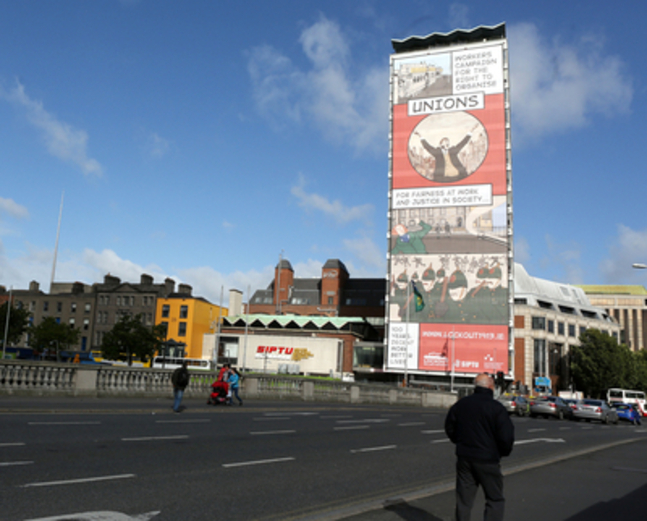
The first of three dramatic banners recalling the 1913 Dublin Lockout was draped on the south-facing side of Liberty Hall last Saturday (14th September) as part of a special installation, The Story of the Lockout. The banner features Jim Larkin and the events of the first Bloody Sunday on August 31st 1913. The three-sided wrap will be installed around Liberty Hall to provide a unique focal point for the commemorative year by depicting the story of the Lockout. The Lockout ‘graphic novel’ will build on and complement the programme for the commemoration as well as drawing attention and making links to the programme of 1913 commemoration events.
The first of three dramatic banners recalling the 1913 Lockout in Dublin was draped on the south-facing side of Liberty Hall last Saturday (14th September) as part of a special installation, The Story of the Lockout. The banner (pictured) features Jim Larkin and the events of the first Bloody Sunday on August 31st 1913.
The three-sided wrap will be installed around Liberty Hall to provide a unique focal point for the commemorative year by depicting the story of the Lockout. The Lockout ‘graphic novel’ will build on and complement the programme for the commemoration as well as drawing attention and making links to the full programme of 1913 commemoration events.
Tapestry
On Wednesday (18th) President Michael D Higgins launched a tapestry depicting scenes and imagery from the 1913 Lockout at a special event in Liberty Hall. The tapestry, which consists of 30 panels designed by artists Cathy Henderson and Robert Ballagh, was created by over 200 volunteers from trade unions, communities, schools and prisons across the country.
Before formally launching the tapestry, President Higgins met a number of the volunteers who worked on the panels. Addressing a capacity crowd in the Liberty Hall Theatre, the President paid tribute to the work of the volunteers in bringing the events of the 1913 Lockout to life for a new generation.
He said the tapestry and the communal manner in which it was produced was “the embodiment of the civic spirit” that had also inspired workers of 1913. He welcomed the co-operation of the SIPTU and the National College of Art and Design whose director, Professor Declan McGonagle, who also addressed the audience of tapestry volunteers as well as community workers and trade unionists.
1913 Events
A series of events marking the centenary of the Dublin Lockout continue into October including:
- ITUC Digital Archive, Trinity College Dublin
- September 1913: A solidarity gathering (Sunday 22nd September - see 'Related Articles' below)
- Dublin Festival of History: Duel personalities (29th September)
- Dublin Divided art exhibition, Hugh Lane Municipal Gallery, Parnell Square (26 September 2013-02 February 2014)
- The Food Ship Re-enactment, Dublin Port (5-6 October 2013)
- Banners Unfurled: Lockout 1913, National Museum (09 October to 14 November 2013)
More details of these events, and a full list of other special events, is available HERE.
| |
IMPACT organiser's Cork run for carers
IMPACT organiser Linda Kelly ran the Cork Evening Echo Womens' mini marathon last Sunday (15th), raising just over €2,100 for the Carers' Association. Linda was supported by IMPACT members and staff, as well as the SNA South Dublin South Leinster branch.
IMPACT organiser Linda Kelly ran the Cork Evening Echo Womens' Mini Marathon last Sunday (15th), raising just over €2,100 for the Carers' Association. Linda was supported by IMPACT members and staff, as well as the SNA South Dublin South Leinster branch.
Linda dressed up as one of her all time favourite cartoon characters 'Smurfette,' donning blue body paint, gold hairspray and a smurf hat for the gruelling four-mile road race, which Linda completed in a time of 36 minutes and 30 seconds (a record for the IMPACT union/Smurf community).
Linda explained why she chose to run in aid of the Carers' Association. "The Carers' Association were there for my family when my nan was sick last year. They need support for the amazing work they do, and I wanted to say thanks for the help they gave us at a difficult time. I'm overwhelmed by the support I've received," she said.
Make a donation to Linda's fundraising campaign HERE.
|
|
|