|
Calling retired members
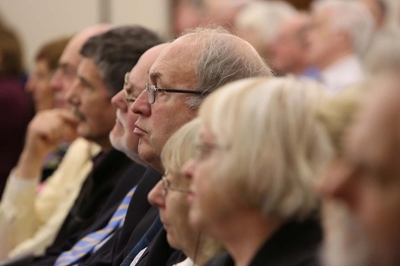
IMPACT’s Retired Members’ Vocational Group hosts its second retired members’ seminar in Dublin’s Gresham Hotel on 6th November. ‘Your Rights After Work’ will explore how IMPACT can work with other retired public servants groups, and top speakers will outline retired members’ rights on pensions, the law, social welfare, health and other services.
IMPACT’s Retired Members’ Vocational Group hosts its second retired members’ seminar in Dublin’s Gresham Hotel on 6th November. ‘Your Rights After Work’ will explore how IMPACT can work with other retired public servants groups, and top speakers will outline retired members’ rights on pensions, the law, social welfare, health and other services. To register click HERE to down load registration form.
|
 | |
Taxpayers subsidising low pay and casual hours
|
Almost 90,000 employees are currently receiving jobseekers benefits because their pay is too low or their working hours are too few. And over 40,000 working families are receiving family income supplement, according to new figures.
In a recent answer to a Dáil question, social protection minister Joan Burton said “a changing labour market” had caused an “increase in the number of persons employed for less than a full week.” The minister has asked the Advisory Group on Tax and Social Welfare to explore the issue of atypical work and make recommendations.
The figures emerged as unions voiced increasing concerns about casual work and ‘zero hours’ contracts, where staff must be available for work but employers don’t provide set hours. It was recently reported that a majority of staff in Irish outlets of McDonalds and Dominos Pizzas are on zero hours contracts.
A membership survey by retail union Mandate recently found that, while 70% had worked in retail for over five years, less than a third had full-time contracts. Half said their hours were changed at least once a month and only a third had stable hours. The recent Dáil answer listed retail giants like Dunnes Stores, Tesco, Lidl and Pennys as having large numbers of staff who also claim FIS or jobseekers benefits.
A separate Dáil answer recently revealed that the number of public servants who receive family income supplement (FIS) has increased by 32% since 2008, up from 2,720 to 3,595 in 2013.
| |
Burton to open union history conference
The Irish Labour History Society holds its annual conference in Beggar’s Bush, Haddington Road, Dublin 4 on Saturday 2nd November between 9.30am and 4.pm. The Lockout-themed event will be opened by social protection minister Joan Burton. Speakers include Gary Granville, Emmet O’Connor, Mary Muldowney and Ann Mathews. Get more information here or contact 01-668-1071 or info@irishlabourhistorysociety.com.
Dun Laoghaire trade unionist commemorated
A wreath-laying ceremony in memory of trade unionist James Byrne, who died 100 years ago from complications arising from a hunger strike, takes place in Dún Laoghaire at 2pm on Saturday 2nd November. Byrne was secretary of the Dún Laoghaire branch of the Irish Transport and General Workers’ Union during the 1913 Lockout and was on hunger strike in protest at his imprisonment for an alleged assault.
A wreath-laying ceremony in memory of trade unionist James Byrne, who died 100 years ago from complications arising from a hunger strike, takes place in Dún Laoghaire at 2pm on Saturday 2nd November. Byrne was secretary of the Dún Laoghaire branch of the Irish Transport and General Workers’ Union during the 1913 Lockout and was on hunger strike in protest at his imprisonment for an alleged assault.
ICTU president John Douglas will speak at the event, which has been organised by the LBS Men’s Shed Group and the Dún Laoghaire and Bray 1913 Commemorative Committee. The meeting point is the main gate of Dean’s Grange cemetery, Dean’s Grange Road, Blackrock, County Dublin. There will be speeches, song, a plaque and a wreath-laying ceremony.
The commemorative committee has also organised an exhibition on Dún Laoghaire and the 1913 Lockout, which is open at the National Maritime Museum, Moran Park, Dún Laoghaire until 18th January 2014.
For more details of the James Byrne commemoration contact dunlaoghaire1913@gmail.com or phone 086-074-5402.
For more details about the exhibition contact 01-214-3964 or administration@mariner.ie.
| |
ICTU global solidarity training
ICTU is again seeking nominations for its global solidarity champions training course, which starts in Dublin on Thursday 31st October and finishes on the afternoon of Saturday 2nd November. The aim of the programme is to equip participants to become global solidarity champions and help strengthen development education and international solidarity work within their union.
The programme will address issues facing workers around the world including trade union rights and the role of international trade union bodies and institutions like the International Labour Organisation.
If you want to attend the course you must book through IMPACT. Contact Roisin Nolan at rnolan@impact.ie. You can get more details on the course content from Louisa Gavin (louisa.gavin@ictu.ie).
ICTU youth conference now booking
IMPACT is now taking bookings from young members interested in attending the Irish Congress of Trade Union’s (ICTU) youth conference, which takes place in Dublin on 16th and 17th November. ‘Our future, our fight,’ which is for workers aged under 35, will discuss issues affecting young workers and ways of organising them into trade unions. It’s free for participants, but you must book through IMPACT. Nominations and expressions of interest should be made through Elaine Elliott at eelliott@impact.ie.
|
| |
More public servants claim family income supplement
The number of public servants who receive family income supplement (FIS) has increased by 32% since 2008, up from 2,720 to 3,595 in 2013. The figures, revealed in an answer to a recent Dáil question, also show that 300 more FIS applications from public servants are awaiting a decision.
The number of public servants who receive family income supplement (FIS) has increased by 32% since 2008, up from 2,720 to 3,595 in 2013. The figures, revealed in an answer to a recent Dáil question, also show that 300 more FIS applications from public servants are awaiting a decision.
Meanwhile, new figures show that the proportion of public servants earning over €100,000 continues to decline. Just 5,000 (1.7%) of public servants are now in that pay bracket compared to 6,791 (2.2%) in February last year. Around half of them are hospital consultants.
The figures, which were set out in a separate Dáil answer, show that 15% of public servants now earn less than €30,000 a year, 41% earn less than €40,000, and 67% earn less than €50,000.
IMPACT says the data exposes the myth of a high-paid public service. All public servants have experienced at least two pay cuts since 2009, totalling 14% of earnings on average, while those earning over €65,000 have been subject to an additional temporary cut in pay since July 2013. Public servants have also experienced the same increased taxes and charges as everyone else over the last five years.
| |
IMPACT rejects criticism of driving licence service
IMPACT has rejected claims that the local authority driver licence service was characterised by long delays. The claim was made by a Road Safety Authority (RSA) spokesperson in a radio interview, in which he tried to deflect criticism from the RSA after it took over the service this week.
IMPACT has rejected claims that the local authority driver licence service was characterised by long delays. The claim was made by a Road Safety Authority (RSA) spokesperson in a radio interview, in which he tried to deflect criticism from the RSA after it took over the service this week.
IMPACT national secretary Peter Nolan said local authorities had provided an excellent service prior to the transfer. He said the RSA had greatly exaggerated the length of any delays which, in any case, were mainly caused by additional work associated with the transfer.
In information leaflets produced for IMPACT members to distribute to the public, the union explained that the service was likely to be worse after the transfer. The union says the centralisation of driving licence renewals and applications will mean a worse service with more inconvenience for people trying to apply for, or renew, a driving licence.
Since the changeover, it is no longer possible to make a written application for a licence. Members of the public have to go in person to a National Driver Licence Centre (NDLS) to apply for or renew a licence. This is because the new system requires a digital photograph to be taken at the centre. The RSA admits that drivers will now have to travel up to 50 kilometres – sometimes further – to get a licence.
Despite opposing the move, staff fully cooperated with the establishment of the new system because they wanted to minimise any inconvenience to the public. But, from the outset, IMPACT members have been concerned that centralising a local and efficient service is bad news for motorists.
| |
Red Cross warns of European humanitarian crisis
Europe is sinking into a protracted period of deepening poverty, mass unemployment, social exclusion, inequality and collective despair, according to the International Federation of Red Cross and Red Crescent Societies (IFRC).
“The effects of the crisis will be felt for decades even if there is an economic upturn.”
Europe is sinking into a protracted period of deepening poverty, mass unemployment, social exclusion, inequality and collective despair, according to the International Federation of Red Cross and Red Crescent Societies (IFRC).
In a stark new analysis, the IFRC says Europe’s response to the debt and currency crisis is creating the continent’s worst humanitarian crisis in six decades.Think differently: Humanitarian impacts of the economic crisis in Europe says millions of people are still falling into poverty five years after the start of the economic crisis.
The study reveals a decline into sustained poverty throughout the continent, not just in Ireland and other countries typically associated with the economic crisis. It gives the example of France, where 350,000 people have fallen below the poverty line since 2009. It says this trend is mirrored in many other countries, including relatively wealthy states like Germany, Luxembourg and parts of Scandinavia.
The IFRC distributed food aid to 3.5 million Europeans in 22 countries last year, an increase of 75% compared to 2009. Hundreds of thousands more are being assisted with advice, financial and material help. "Whilst other continents successfully reduce poverty, Europe adds to it. The long-term consequences of this crisis have yet to surface. The problems caused will be felt for decades even if the economy turns for the better in the near future," it says.
Turmoil
IFRC secretary general Bekele Geleta said people’s lives had been thrown into turmoil. “There seems to be a gradual degradation, with millions existing on a day-to-day basis, with no savings and no buffer to withstand any unforeseen expenses,” he said.
The study finds that, in Greece and Spain, adult children with families are moving back in with their parents with several generations living in single households with one breadwinner. The study says it is now a common sight to find formerly prosperous middle class people sleeping rough in Milan, Italy's financial capital.
It charts a gradual economic degradation throughout Europe, with increasing numbers of working poor, who have some income but struggle to make ends meet. It says many middle class Europeans have spiralled downward into poverty with more people becoming poor and the poor getting poorer.
It says unemployment is the most debilitating issue facing the EU. The number out of work for longer than a year stands at 11 million out of a total EU unemployment figure of more than 26 million. In a quarter of the countries surveyed, youth unemployment ranged from 33% to over 60%. Meanwhile, unemployment among workers aged 50-64 has risen from 2.8 million to 4.6 million between 2008 and 2012.
"The rate at which unemployment figures have risen in the past 24 months alone is an indication that the crisis is deepening, with severe personal costs as a consequence, and possible unrest and extremism as a risk. Combined with increasing living costs, this is a dangerous combination," it says.
| |
TUC leader wants Europe for citizens and workers
The general secretary of Britain’s Trade Union Congress (TUC) has called for Europe to be run for citizens and workers, not bankers and bond markets. Speaking at the Dublin-based Institute of International and European Affairs (IIEA) last week, Frances O’Grady said the European social model must be reshaped for a new age and a new Europe.
The general secretary of Britain’s Trade Union Congress (TUC) has called for Europe to be run for citizens and workers, not bankers and bond markets. Speaking at the Dublin-based Institute of International and European Affairs (IIEA) last week, Frances O’Grady said the European social model must be reshaped for a new age and a new Europe.
She said the European project was fraying around the edges because of the way EU-sponsored austerity, privatisation and liberalisation programmes had been foisted onto member states. Five years after the collapse of Lehmann Brothers bank, Europe was characterised by “soup kitchens, young couples moving back in with their parents, the poor going without medicine, and horrific murders committed by fascist thugs,” she said.
Ms O’Grady said Europe could not afford to turn its back on social democracy. “From the trade union movement’s perspective, Europe needs to rediscover the values that served it so well not just during the long post-war boom, but also through challenges posed by the oil crisis and the economic counter-revolution of the 1980s. Now is not the time to reject European social democracy, but to reinvent it for a new age,” she said.
She said Europe had been tested before in the aftermath of the Second World War, the fall of the Berlin Wall and EU enlargement to the east. “Each time our continent succeeded in rising to these challenges because we had the courage to take the high road. Because collectively we refused to walk away from the social solidarity that has brought the diverse peoples of Europe together,” she said.
Related
Europe must be rebuilt for citizens and workers says TUC’s Frances O’Grady (includes full text of speech).
|
|
|
|