|
Important website updates
Important parts of the IMPACT website have just been updated. On the Haddington Road agreement, a new and comprehensive 'frequently-asked questions' document now deals with the most common queries we hear on the deal. There's also a facility to put your specific question. And another new section guides you through the financial and other benefits available to IMPACT members.
Important parts of the IMPACT website have just been updated. On the Haddington Road agreement, a new and comprehensive 'frequently-asked questions' document now deals with the most common queries we hear on the deal. There's also a facility to put your specific question. And another new section guides you through the financial and other benefits available to IMPACT members.
|
 | |
Union proposals address SNA JobBridge fears
|
IMPACT has outlined proposals for tighter monitoring of JobBridge placements in classrooms after the union identified a “worrying and growing trend” of supplementing or replacing special needs assistant (SNA) posts with work experience placements.
In evidence submitted to the Oireachtas Joint Committee on Education and Social Protection last week, the union said it was aware of at least 100 cases of potential displacement of SNA posts through the JobBridge work experience scheme
.
The union submission says only experienced SNAs can deliver maximum educational and social benefits to children with special needs. “IMPACT supports quality work experience programmes as a means of enhancing skills and providing a valuable first step into the world of work. However, some employers in the education sector are misusing JobBridge. Much greater care is needed in vetting the places on offer and ensuring that JobBridge is not used as a substitute for employment,” it said.
IMPACT has also called for a review of the educational and training requirements of new and existing SNAs, along with an exploration of the benefits of developing FETAC-level qualification requirements or an appropriate apprenticeship approach to improving and maintaining training standards in the role. The union wants a programme of continuous SNA professional development.
The Oireachtas submission also criticised the casualisation of the role of classroom-based SNAs and the practice of allocating portions of SNA posts to schools, rather than full-time SNAs.
| |
Merger plans put Coillte at risk
|
A merger of Bord na Mona and Coillte would leave the state forestry company as a small and relatively weak voice within a much larger company focused heavily on energy production, IMPACT has said.
The union fears that a rebalancing of company priorities following a merger would likely divert wood to energy usage rather than maintaining its most economically-advantageous use. This would seriously weaken Coillte’s economic base with consequences for its ability to sustain its social and environmental functions, including access to state forests for recreation and tourism.
In a paper called Coillte: The way forward, IMPACT’s Coillte Branch outlines fears that a merged company would divert substantial amounts of high-grade timber to energy generation, with significant adverse effects on Coillte’s forestry, environmental and social operations.
IMPACT national secretary Matt Staunton said: “If Coillte activity is rebalanced in this way, the economic return from the public forest will be weakened. The social and environmental benefits will then diminish because they are sustained by the economic return from forestry operations. Irish forest output should generate the highest possible value economically, environmentally and socially.”
IMPACT’s Coillte Branch has successfully campaigned against the sale of Coillte forest harvesting rights. It’s publication Save Our Forests set out the economic, environmental and social benefits provided by the company. It also commissioned an economic assessment of the proposal by economist Peter Bacon, which concluded that a sale of Coillte harvesting rights was not justifiable on economic grounds and would cost the State €1.3 billion.
| |
Boost for union schools' programme
IMPACT and the Public Service Executive Union (PSEU) made a €10,000 donation to the ICTU schools programme this month. The money, presented by IMPACT treasurer Tara Robertson and PSEU president Brendan Lawless, will help ICTU to expand its extensive programme of schools visits by trade unions, and the development of associated teaching and project aids for teachers.
The revamped schools programme was initiated after the former IMPACT Tax Officials’ branch made a substantial donation to ensure that school children could learn about workers’ rights and the role of trade unions in the workplace and beyond.
The programme provides invaluable information to students about the reality of working life and the role trade unions play in promoting fair pay and decent working conditions. This year, the programme has been developed to cover the centenary of the 1913 Dublin Lockout and its relevance today.
Wexford county library is best
Wexford library services have won the best library accolade at this year’s Chambers Ireland ‘excellence in local government’ awards. The award was for the new county library in Wexford town.
John Ryan, library assistant and a member of IMPACT's Wexford branch, said staff should take great pride in the award. “The new library forms part of the town's new cultural spine, and the building is a stunning piece of architecture nestled in the historic heart of Wexford. It’s a great place to spend time, whether you’re researching your family history or using our internet access. With more than 100,000 books in our collection, there’s something for everyone of all ages. There’s lots of activity here and it’s all free” he said.
Wexford Library on Facebook.
Limerick remembers the Lockout
An event in Limerick to mark the centenary of the Dublin Lockout takes place this Sunday, 1st December. Hard Times: A Commemoration in Song and Spoken Word takes place in Flannery’s Bar, Catherine Street in Limerick at 4pm. The event will be opened by Matthew Potter of Limerick City archives, who will give a short talk on Labour in Ireland during the decade of revolution, 1913-1923.
What in the World (RTE)
The RTÉ What in the World series returns to our screens next week. Along with many other funders, IMPACT’s developing world fund made a modest contribution to help ensure the programme’s important human rights and development stories continue to be aired in Ireland. Here’s a taste of what to expect.
|
| |
Public service pay down nearly €50 a week
Average public service pay has fallen by nearly €50 a week since 2009 according to official data. The figures, from the Central Statistics Office (CSO), do not include the so-called pension levy, which has further reduced public service pay by 7% on average.
Average public service pay has fallen by nearly €50 a week since 2009 according to official data. The figures, from the Central Statistics Office (CSO), do not include the so-called pension levy, which has further reduced public service pay by 7% on average.
Public servants have also been hit by the same increased taxes and charges as everyone else over the last six austerity budgets.
The CSO calculates that average weekly wages in the public sector are down by €47.88 - or 5% - since 2009. This compares to a much smaller average decline of €2.41 - or 0.4% - in the private sector.
Hourly wages have decreased by even more in both the public service (-5.8%) and private sector (-1.4%). The average number of weekly hours decreased from 32 to 31.4 in the private sector and increased from 31.9 to 32.2 in the public service.
A sectoral breakdown of the earnings figures shows a highly mixed picture with a huge 10.3% decrease in hourly earnings in education, compared to a 12.4% increase in the information and communications sector.
The wide disparity demonstrates that the average income figures mask very different fortunes for workers in different sectors and pay bands. The figures do not measure the impact of compulsory redundancy - the biggest determinant of income decline during the recession - which has not been a feature in the public service.
The CSO figures also reveal an 8.3% decline in public service employment between 2009 and 2013.
The national unemployment rate decreased from 13.6 % to 12.8 % in the year to September 2013. Unemployment is now at its lowest level since 2009 after the fifth successive quarterly decline.
| |
Arbitration likely over sick leave changes
The final shape of new certified sick leave arrangements, due to come into force for most public servants on 1st January, is likely to be determined by binding arbitration in the Labour Court.
The final shape of new certified sick leave arrangements, due to come into force for most public servants on 1st January, is likely to be determined by binding arbitration in the Labour Court.
Discussions about a protocol on how critical illnesses will be handled under the new arrangements, which have been underway for some months, are now heading towards a conclusion. But management has taken a robust position on some key issues, making agreement impossible.
Outstanding issues are likely to be referred back to the Labour Court, whose original binding recommendation set up the talks.
From 1st January, paid certified sick leave for non-critical illnesses will be halved to three months on full pay, followed by three months on half pay in any four-year period. But IMPACT and other unions have ensured that current arrangements – six months paid sick leave, followed by six months on half pay – will remain in cases of critical illness. The current talks focus on how this will be applied.
In a letter to union branches this week, IMPACT general secretary Shay Cody outlined how the distinction between critical and non-critical illnesses was likely to be handled. IMPACT is trying to ensure that the criteria take account of the particular circumstances of mental health, disability and pregnancy-related illness. No agreement has yet been reached on these matters, which will likely be referred to the Labour Court.
Under the arrangements, sick leave taken over the last four years will be taken into account when calculating eligibility for paid leave. But a one year ‘look back’ mechanism will also remain in place. There are more details about this in Shay Cody’s recent letter to branches.
Unions have already ensured that existing schemes for occupational illnesses or injuries will remain unchanged.
| |
Public spending claims challenged
The union-backed Nevin Economic Research Institute has challenged claims that Irish public spending is too high. Its director Tom Healy has questioned the international comparisons cited in a recent article by the Independent group’s economics editor Brendan Keenan, who had argued that Irish public spending was still too high despite the cuts.
The union-backed Nevin Economic Research Institute has challenged claims that Irish public spending is too high. Its director Tom Healy has questioned the international comparisons cited in a recent article by the Independent group’s economics editor Brendan Keenan, who had argued that Irish public spending was still too high despite the cuts.
Keenan argued that Irish per capita public spending was higher than in France, Germany and Britain in 2011. “Most of the cuts just prevented large increases in public spending, rather than achieving actual reductions,” he wrote.
Responding in a blog called Are we overspending?, Healy said all international comparisons should to be treated with caution. “The particular year in which OECD reports is 2011, when Irish public spending was boosted by the amount of money injected into private banks,” he wrote.
Healy points out that Irish public spending is consistently lower than the EU average “except for 2010 when a huge amount of money was injected as capital transfers into the banks.” He also said the high cost of unemployment, which is much worse here than most other EU countries, boosts Irish public spending on benefits, medical cards and other services.
He concludes that Irish per capita public spending is comparable to countries of similar size and economic development.
The figures come from the Organisation for Economic Cooperation and Development’s Government at a Glance, which looks at comparative data on a range of economic and social areas.
| |
Workplace reps skills recognised
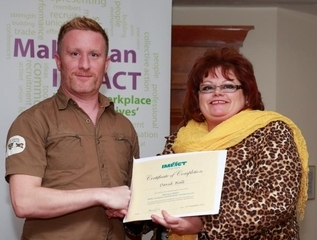 |
| David Hall of IMPACT’s Dublin North HSE branch receives his training certificate. |
|
The achievements of over 60 IMPACT workplace representatives were honoured at a training graduation ceremony in Dublin this month. All of them had completed new IMPACT workplace representatives’ training over the last two years.
The achievements of over 60 IMPACT workplace representatives were honoured at a training graduation ceremony in Dublin this month. All of them had completed new IMPACT workplace representatives’ training over the last two years.
Almost 200 reps have so far completed the training, which was designed to help them deliver better services to members and develop more effective branches across the country. The graduates were drawn from a wide range of IMPACT branches in all parts of the country and every division of the union.
The course is currently in its third year. The awards were presented by the union’s honourary training officer Margaret Coughlan. The event was addressed by IMPACT deputy general secretary Kevin Callinan and ICTU deputy general secretary Sally-Ann Kinahan.
Contact Margaret Gorman (mgorman@impact.ie) to find out more about the training courses.
A short video about the trainees experience is available HERE.
|
|
|