Recent feminist labour organising efforts in India have created ripple effects throughout the country’s broader community health workers’ workforce, demonstrating how strategic organising can amplify impact beyond direct participants.
A historic 45-day strike in Mumbai and sustained organising across India has secured maternity rights and new benefits for Community Health Workers (CHWs), following a Public Services International (PSI) led program in the region.
Increased organising among five unions since the pandemic has resulted in higher pay for members, regular payment of wages which were previously often delayed by months, and 6 months maternity leave for many more workers.
It has also led to a formalised work status and career path for workers that were often misclassified as ‘volunteers’ and significant growth in union membership.
Sumedha, a young Community Health Worker from the Mumbai union Mahanagar Karmachari Mahasangh (MMKM), said: "Earlier I thought unions were just for making demands. Now I understand we are building power for ourselves."
With an estimated 1 million Accredited Social Health Activists (ASHA workers) in India alone, and hundreds of thousands more CHWs across South Asia, these workers deliver healthcare to over 500 million people in disadvantaged communities.
Community Health Workers across South Asia have been campaigning for recognition as public health workers, entitled to fair and dignified working conditions. You can find out more about their campaign and support their efforts for recognition, rights, respect, care and for a well-funded public health system here.
CHWs hold a pivotal role in enhancing public health throughout South Asia, a region grappling with myriad health challenges, from infectious diseases to limited healthcare access. They bridge these gaps by delivering vital healthcare services to communities, imparting education, raising awareness, and advocating preventive health measures. Their significance is amplified in remote areas with scant formal healthcare infrastructure.
They are known as Accredited Social Health Activists (ASHAs) in India, Lady Health Workers in Pakistan, and Female Community Health Volunteers in Nepal. They serve as the initial point of contact during health emergencies.
Regrettably, this workforce, primarily composed of women from rural, socio-economically disadvantaged backgrounds, suffers due to gendered assumptions about their work. Their contributions are often undervalued, and they are poorly compensated. They perform their indispensable tasks without proper recognition as public health workers. In India, CHWs are denied the basic right to a minimum wage and lack essential social security benefits like pensions, medical coverage, and maternity leave.
The unions representing CHWs and PSI launched the campaign “Community Health Work is Work” in 2020 during the peak of COVID-19 pandemic. Even though CHWs were at the highest risk of contracting COVID-19 owing to their work, they were still denied health and life insurance and pensions.
The most powerful demonstration of the results of the campaign and the resulting organising capacity came in 2024, when CHWs from MMKM led a meticulously planned 45-day strike in Mumbai. It successfully transformed working conditions for thousands of health workers. Drawing on their organising training, CHWs developed and implemented a sophisticated two-phase approach. In the first phase, the workers ran a complete work stoppage across the whole city putting immediate pressure on the Brihanmumbai Municipal Corporation (BMC).
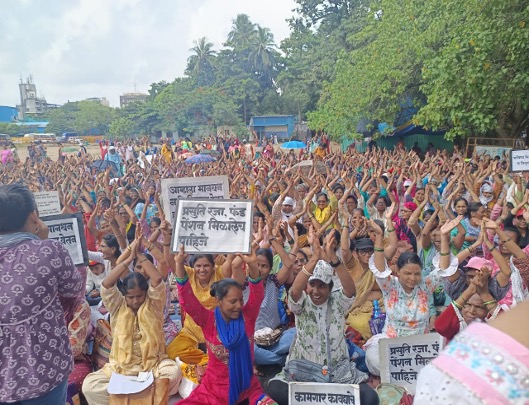
"Kaam Bandh" Movement (Work Stoppage): From 11-17 June 2024. Image from Public Services International
That was followed by a rotating protest system, from 18 June - 28 July 2024, to maintain essential services while keeping pressure on authorities. Each day, CHWs from different areas would participate in protests while their colleagues in other areas continued to provide critical healthcare services. This approach prevented authorities from dismissing the action as irresponsible or endangering public health, while ensuring that protest momentum could be sustained over the remarkable 45-day period.
What made this campaign particularly effective was its multi-pronged approach. The women CHWs leaders maintained detailed records of participation, with careful tracking of attendance from 24 different wards, held strategic meetings with various state ministers, municipal representatives and government officials, distributed demand letters to officials at multiple levels of government and engaged media to publicise their cause and the impact of the work stoppage.
After 45 days of sustained action, the CHWs secured significant victories and demonstrated the power of women-led organising, with planning, execution, and documentation led by the CHWs themselves.
Mumbai's success is part of a broader pattern of organising happening across India, with similar approaches being implemented by other unions across the country.
In each case, small groups of committed CHWs have built powerful movements and secured significant improvements through consistent organising, leadership development, and strategic action. As a result, women now also actively participate in union planning and leadership as well as hold visible positions in union leadership.
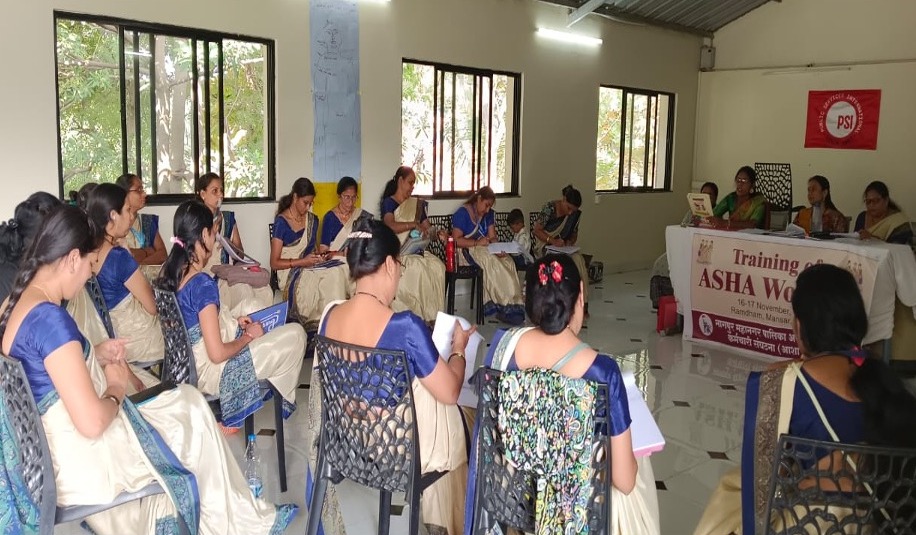
Public Services International stated that the most transformative aspect of this effort has been the shift to a "training the trainers" model, where CHWs themselves become educators and organisers. One health worker leader from Tamil Nadu said: "We are not just fighting for better wages. We are fighting for recognition that what we do is real work, skilled work, essential work. When we win, our communities win too."
Read more about this inspiring campaign here.
Join a union that wins. Join Fórsa.





 Like
Like

