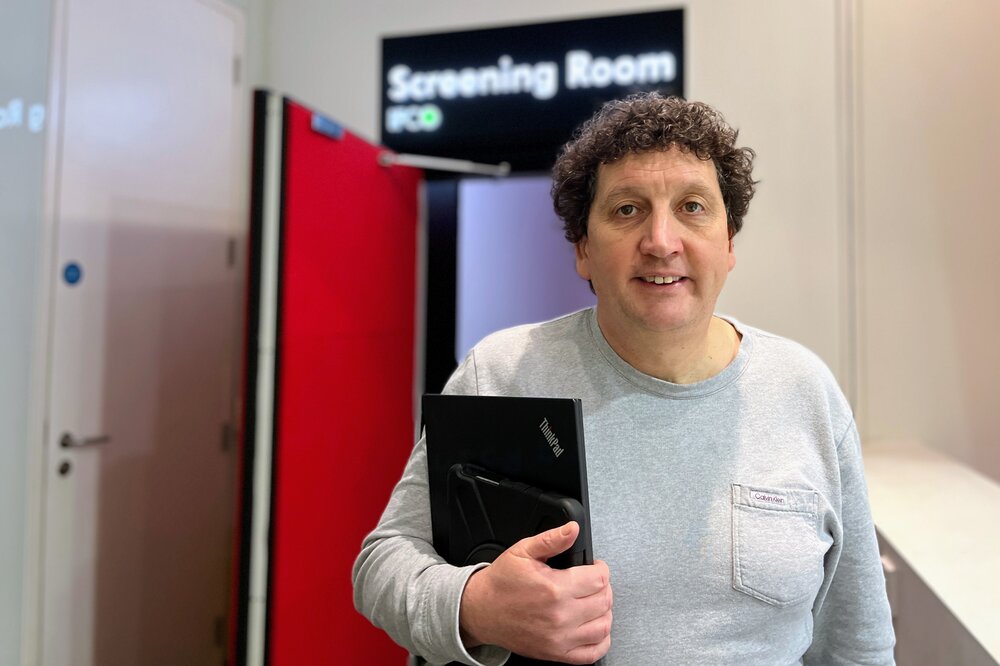
You’ve probably seen Ciarán Kissane’s name on the silver screen more times than any Hollywood A-lister, but the bells might not be ringing. James Redmond catches up with Ireland’s Director of Film Classification (and Fórsa activist) as he gives members of the Service and Enterprises Divisional Executive Committee a behind-the-scenes look at his work.
It’s a gloomy Thursday morning in Smithfield as more than a dozen members of the Service and Enterprise Divisional Executive Council (DEC) wait in the lobby of the IFCO building. It’s handily tucked away in a new build beside the Light House cinema. Tea and coffee are provided, and we’re handed red clipboards with a breakdown of the Irish classification system as it ranges through G, PG, 12A, 15A, 16 and 18. There’s a matrix of concern that veers across thematic content, violence, sex, language and drugs.
We’re ushered upstairs to the small cinema where Ciarán has lined up three recent trailers for Bridget Jones: Mad About The Boy. Each trailer is edited to be played before a different feature film audience and we’re asked to give our thoughts on how we’d grade them. 1,365 theatrical works were classified in 2024 and trailers take up a surprising amount of his time.
Last year alone, IFCO reviewed 700 trailers, a process that begins early each morning. “You can get a15A-rated one first, and then the 12A, or a PG as the trailers tend to target particular films being released each week. Therefore these trailers for Bridget Jones were submitted weeks apart,” Ciarán explains.
Members of Fórsa DEC debate the Bridget Jones trailers, dissecting the subtle nuances between different versions—ranging from standard rom-com laughs to darker takes on bereavement, before culminating in an over-the-top raunchiness that would make a hen party blush.
Next up we’re diving into a recent Irish short film called The Golden West. It’s a gloomy gothic western set on the harsh Snowdonian coastlands of Wales. Two sisters, filled to the brim with mutual loathing and bitterness have fled the Irish famine and are spending their days prospecting for gold. It’s a beautifully filmed psychological horror with bursts of dark comedy, put together as a passion project by Oscar and BAFTA-winning directing duo Tom Berkeley and Ross White. The film weaves a tale of survival, greed, and fractured sisterhood.
85 short certificates were issued in 2024 mainly for Irish productions - it’s a remarkable jump up from 17 the year before. The film includes off-screen violence and a suicide pact between the two women, complicating the rating as members of the DEC struggle to guess its age appropriateness. It’s a perfect film for Kissane to use to talk us through the more complex aspects of classification work.
“Suicide thematically, that's one of the things that has become much more of an issue than it would have been maybe 20 years ago—representations of harmful behaviour, suicide, things like that, are triggering for people. Whereas, you know, 20 or 25 years ago, that really wasn't something that was taken into account,” he says.
The use of humour as a mitigating factor becomes a contentious point in the discussion, with some on the DEC seeing the film as funny while others perceive it as incredibly dark. The room is divided on whether the film should be rated 12A or 15A.
He explains that understanding "mitigation"—factors that lessen the impact of a potentially harmful scene—is crucial. “And that often comes in in horror films, where you have a lot of humour, and that can reduce the impact because you're laughing with it, rather than necessarily being terrified by it," Ciarán explains pointing to the black humour of writers like the MacDonagh brothers, who often weave dark humour mirth films like The Guard and In Bruges.
As the world of content continues to shift, new technologies like AI are beginning to play a role in the classification process elsewhere. The British Board of Film Classification (BBFC) launched an AI content classification project with Amazon Web Services in 2023, and Kissane is keenly aware of the implications of AI and how streaming technology is reshaping how we consume media. Can machines really read cinematic complexities?
He reminds me that Safer Internet Day took place earlier that week and points to fresh research. “There was research only published two days ago by Cyber Safe Kids, it’s a short document and one of the frightening stats in it is that over 80% of children between eight and 12 have an internet connected device in their bedroom, which is generally a smartphone.”
Ciarán believes his role is still vital despite all the AI hype.
"While audiences recognise the different contexts in which they view audiovisual content, they have an expectation that some basic standards and protections will apply,” he explains."
This is particularly the case in cinema, which is a communal experience where the theatrical nature of the presentation remains more immersive and impactful than home entertainment."
Kissane maintains that film classifiers still have an essential role, citing research published by IFCO in 2023, which found that 80% of parents trust the office to provide reliable age ratings. "88% of parents believed the advice provided through the website is useful," he concludes, emphasising the continued significance of his role, and that of the film classification office.
Join a union that wins. Join Fórsa.





 Like
Like

