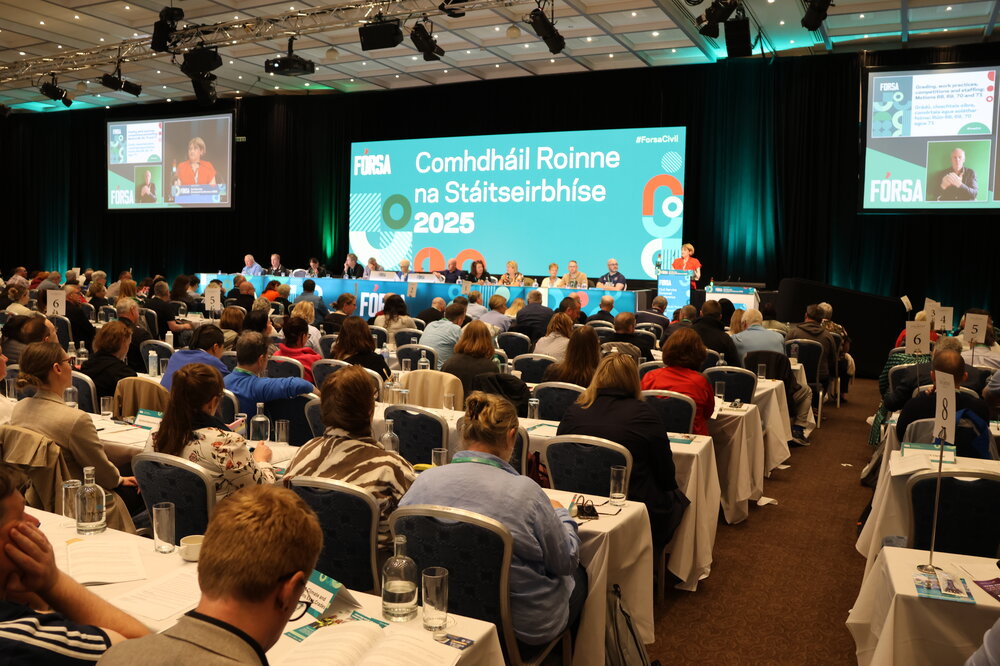
Close to 100 motions were on the agenda at the Civil Service divisional conference in Galway last week. Delegates spoke passionately about the challenges they face at work and the solutions they want to pursue with their union.
From pay and working conditions, to blended work, political activity, and inclusion, the diversity of issues raised demonstrated the diversity of members in the division.
Blended working dominated debate on the first day of conference. Delegates spoke at length about how blended work has impacted their lives for the better, and how morale is drastically impacted when requests to work from home are unfairly refused. Delegates also emphasised the contribution of blended working to society and the State.
Gary Fagan of the DSP Executive branch told delegates that blended working had become an essential part of how many in the Civil Service operate. He said: “It's our responsibility to ensure that these arrangements are secured in the long term. It's working for members, it's working for services and it's working for the State. We must stand for evidence-based policies, not a rushed return to outdated ways.”
Olasubomi Oyenuga, from the Longford clerical general branch, said blended work was about respect, fairness, and the kind of civil service we want to build. She talked about the punitive and unfair manner in which blended working requests are sometimes responded to, and urged delegates to support the motion saying "We must protect the progress we’ve made—and go further."
The sheer diversity of issues faced by civil servants and, the diversity of workers in the civil service was highlighted throughout the day on Thursday.
Deirdre Morgan, chair of the Legal Professionals branch, brought forward motion 65 calling for mobility to include professional and technical grades, underlining that when those working at general services grades have access to mobility but those who are on professional grades cannot avail of it, it becomes a discriminatory practice and limits career progression.
Hazel Menton of the Archivists branch brought forward a motion on the protection of grading structures for professional and technical grades. Hazel is a member of the National Professional and Technical Committee (NPTC) which is an Equivalent Grades Committee, working to represent professional and technical grades in the civil service.
A poignant moment came during the debate on Motion 33, which called for the establishment of disability, neurodiversity and chronic illness policies within civil service organisations.
Delegates gave a standing ovation to a member who movingly told of how her recent ADHD diagnosis had helped her, she said : “I’m intelligent, I’m strong, and I’m resilient -and I’ve known this since I was diagnosed with ADHD two years ago. I support this motion, but I also believe it’s important to work with the union to explain what ADHD is and raise awareness.”
Two motions calling on the CSDEC to work to reform the blanket ban on political activity by civil servants also passed.
Speaking to both motions, Cathal Kelly of the Finance, PER and Associated Organisations branch said: “There is nothing sacred about the work that civil servants do that means we should be banned from all forms of political activity.”
He continued: “Our blanket ban is excessive, and it is a denial of our rights to be full and active citizens. It bans us from participating in activism on human rights, climate change, in activism on policy on sport to the arts.”
Speakers from the FGE branch spoke passionately about the need to protect their jobs from outsourcing. Ellie Brennan told conference that there are some departments that aren’t recruiting FGE grades anymore and cited the reduction of service officers in Dublin Castle which has reduced from 22 to 7 as an example. Supporting their calls for solidarity, conference sent a strong message that outsourcing service officers’ work will not be supported by the union.
On Friday members passed motions on annual leave and on Gaeltacht Irish language courses.
A number of motions on AI were debated. Delegates emphasised the need to protect jobs, the importance of the ethical and transparent implementation of AI and called for training on AI literacy.
Motions on health and safety covered the full range of health risks at work and demonstrated the very real safety issues members face, from antisocial behaviour to bullying and psychosocial hazards, speaker after speaker sent a clear message that everyone has the right to feel safe at work.
Commending members for their commitment to debating motions, deputy general secretary and head of division Éamonn Donnelly said: “The motions passed by conference will shape our work over the next two years and I would like to thank delegates for their hard work drafting and speaking on motions.”
Join a union that wins. Join Fórsa.





 Like
Like

