Don't miss: One size does not fit all
by Róisín McKane
ICTU seminar on 4th March will look at occupational hazards affecting women.
The Irish Congress of Trade Unions (ICTU) is set to host an important seminar examining the often-overlooked issue of gender in occupational health and safety. “One Size Does Not Fit All: Focusing on Gender in Occupational Health and Safety” will take place on Tuesday, 4th March 2025, from 10:30 am to 1:30 pm at the CWU Office in Dublin.
The seminar will be chaired by Katie Morgan, Vice President of ICTU, and will feature discussions by a range of experts on the challenges and gaps in workplace health and safety policies concerning women.
The event aims to highlight the fact that health and safety research, policy development, and workplace protections have traditionally been designed with men in mind, often failing to account for the distinct risks and needs of women in the workforce.
ICTU reports that many occupational hazards affecting women are either overlooked or insufficiently addressed in workplace policies. This seminar will explore the implications of this oversight and discuss ways to develop more inclusive and effective safety measures that cater to the needs of all workers.
The seminar will feature a panel discussion, which will explore the issue of gender in workplace health and safety from a range of perspectives. Tara Horigan, Fórsa Vice President, will be sharing her expertise as part of the panel, along with speakers from the Association of Secondary Teachers in Ireland (ASTI) and the Irish Nurses and Midwives Organisation (INMO).
With gender equality and workplace safety gaining increasing attention, this seminar is expected to generate meaningful dialogue and actionable insights towards safer and more inclusive working conditions across all sectors.
Fórsa is encouraging members to attend. Interested members should register their interest by contacting Natalie Higgins at natalie.higgins@ictu.ie.
Join a union that wins. Join Fórsa.
Fórsa Youth table quiz on 20th March
by Fórsa Youth
Raise funds for the grassroots Palestinian Stop the Wall campaign organising resistance against the apartheid wall since its construction in 2002.
After two successful events to kick off 2025, Fórsa Youth is planning a table quiz on Thursday, 20th March to raise funds for Stop the Wall. Stop the Wall is a grassroots Palestinian campaign that has been organising resistance against the apartheid wall since its construction in 2002.
Fórsa Youth held a highly successful information night titled "What the Fórsa" on Thursday, 30th January. Held at Fórsa HQ, the event brought together members from across the civil and public service, offering them a unique opportunity to learn more about unions, their role, and the various ways to get involved with the union’s activities.
The evening featured an insightful panel consisting of Fiona Dunne, director of training, Michael Kerrigan, assistant general secretary and Fórsa Youth’s own recruitment officer, Aine Bullock.
The panel shared their expertise on what a union is, how unions help workers, and the importance of attracting more members to strengthen the movement. The event was chaired by Fórsa Youth chair, Hugh McInerney, who guided the discussions and facilitated questions from the audience.
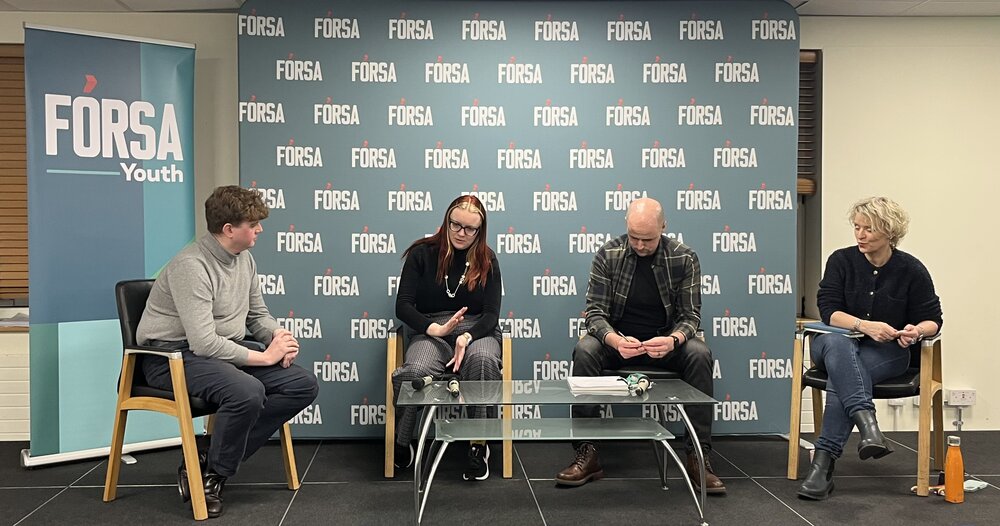
What the Fórsa event, L-R Hugh McInerney (Fórsa Youth chair), Aine Bullock (Fórsa Youth recruitment officer), Michael Kerrigan, (Fórsa Youth assistant general secretary), and Fiona Dunne ( Fórsa director membership, training and development)
The following day, Friday 31st January, saw Fórsa Youth’s first network meeting of 2025. The committee outlined its plans for the year and were delighted with the ideas and engagement of all those who attended.
The meeting concluded with a vote on the campaigns to prioritise, with members selecting political issues such as the housing crisis, outsourcing, underfunding of public services, and a low-pay campaign. These campaigns are set to guide Fórsa Youth’s advocacy efforts throughout 2025, with a strong focus on improving the lives of workers across Ireland.
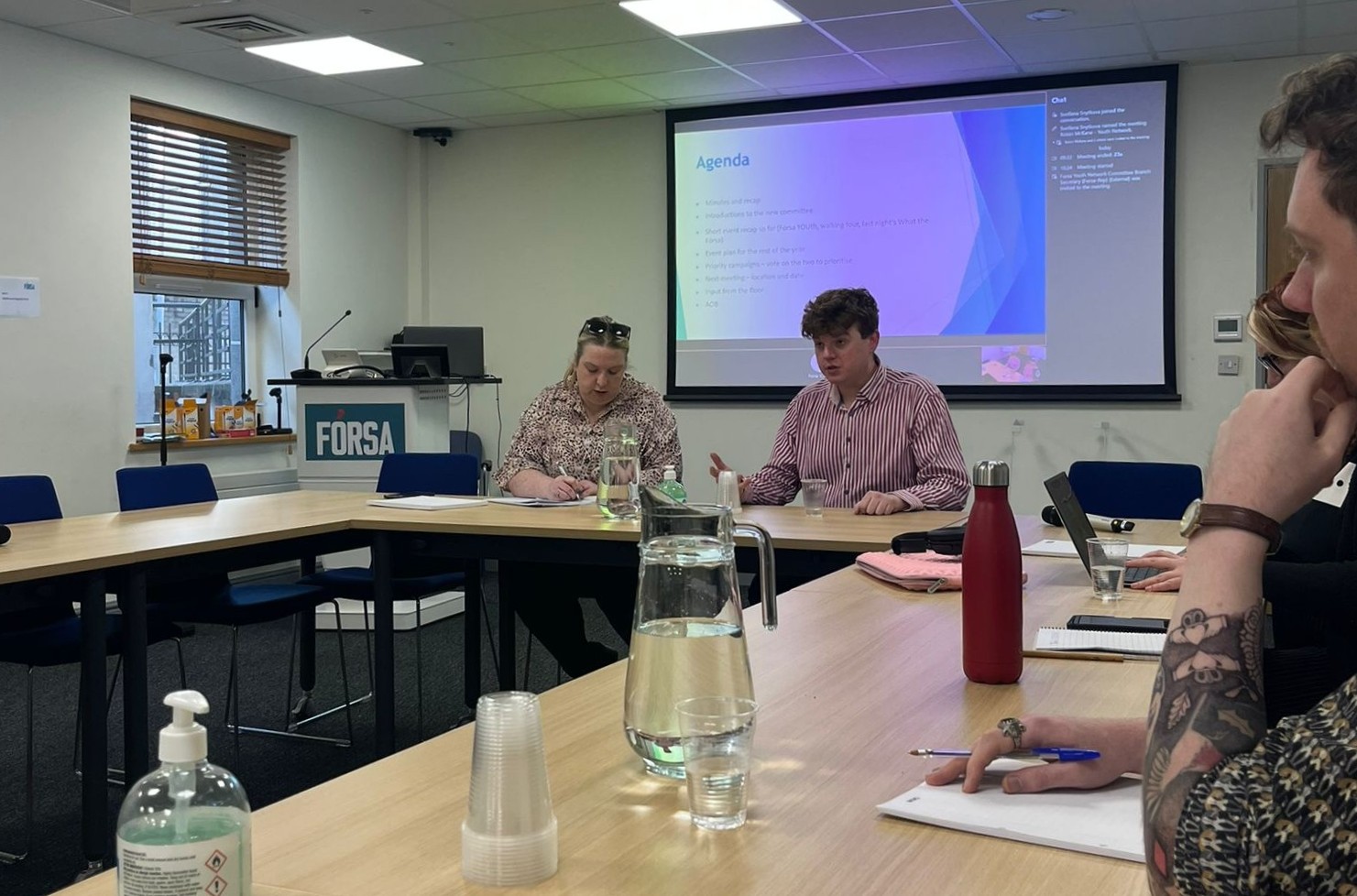
Fórsa Youth’s network meeting, L-R Rachel Fennelly (Fórsa Youth secretary) and Hugh McInerney (Fórsa Youth chair).
As 2025 progresses, Fórsa Youth will continue to provide opportunities for members to become more active and engaged with the union’s mission. If you are interested in getting involved, email forsayncsecretary@forsa-rep.ie.
The next Fórsa Youth event is a table quiz in aid of Stop the Wall on Thursday, 20th March in Fórsa HQ, with more details to follow. Stop the Wall is a grassroots organisation campaigning against the separation barrier built by Israel along the Green Line and inside parts of the West Bank. The next meeting is planned for Friday, 11th April in Galway.
Join a union that wins. Join Fórsa.
AGM Alert: Retired Members Association
by Hannah Deasy
Stay active and engaged long after retirement with the Fórsa Retired Members Association!
The Annual General Meeting of the Fórsa Retired Members Association (RMA) will take place on Thursday 6th March 2025 at Fórsa’s offices in Nerney’s Court at 11am.
Over the past year, our retired members have been more active than ever, as the group takes on a greater role within the union. In recent months, chair of the RMA, Martin Bridgeman, has been travelling across the country, speaking at AGMs to promote retired membership.
Discussing the benefits of staying involved in the union after retirement, Martin said: “Just because you’re leaving work doesn’t mean you have to leave the union. Many members don’t know that they can continue to be a member of Fórsa after they retire. In fact, not only can you stay a member, but you also continue to benefit from a wide range of benefits and stay connected to your wider union community.”
The Retired Members Association was established to support retired members of Fórsa by providing practical, relevant advice on issues like pension rights as well as developing a vibrant community of retired individuals to socially engage and support each other in retirement. Membership is open to all retired members. You can find out more here.
The RMA focuses on protecting pension terms and conditions, advocating for timely pension payments, and addressing issues, such as occupational pensions, state pensions, social welfare benefits, health matters, personal security, retirement planning, and public transport.
Join the upcoming AGM to have your say, stay connected, and help shape the future of retired membership!
Agenda, minutes and link for people attending online will be issued through branches. Motions and nominations will be accepted on the day.
For more information email: RMA_Chair@forsa-rep.ie
Join a union that wins. Join Fórsa.
Spring into action with Fórsa’s Skills Academy
by Mehak Dugal
Upgrade your skills with our spring training programmes for members.
Fiona Dunne, Fórsa’s director of membership, training and development, encouraged members to sign up before places run out. Fiona explained that the training programmes are designed to equip members with the skills and knowledge needed to perform their roles to the best of their abilities.
She also highlighted the broader impact of these courses, stating, “The skills members take away from these training courses not only benefit them in their union role but also greatly contribute to their professional and personal goals outside of their work with Fórsa.” She emphasised that by building confidence and capabilities across different issues, members can strengthen their expertise and expand their opportunities.
With a variety of training programmes available this spring, there is something for everyone—whether you are new to Fórsa or looking to build on your existing skills. Below are some key upcoming courses designed to support you in your union role and beyond.
Fórsa Induction, 12th March - Online
If you want to learn more about what Fórsa does and how you can be more involved with the union, this induction is a great chance to get started! An awareness raising session built to welcome new Fórsa members, this programme is specifically targeted to those who have never received any training previously or are not currently active within Fórsa but want to be more involved. You can sign up for it here.
Level 1 Workplace Rep Training, 25th-27th March – Wexford
The only programme of its kind in the south-east region, the Level 1 workplace representative training runs over three days and is an intensely rewarding exercise for newly elected workplace representatives, or those with less than 2 years representative experience (who have attended Fórsa Induction or Fórsa 101 in the past).
Over the three days, you will cover all the basic skills and information required to confidently carry out your role, and to survive your first year as a workplace rep!
The course is offered in seven locations throughout the country. The dates are Tuesday 25th March, Wednesday 26th March and Thursday 27th March 2025. You can register here.
The course covers all the necessary skills and information that new representatives require to give them confidence in this role and get them through their first year. Topics include:
- Branch structure and roles of the Executive Committee
- The role and responsibilities of the workplace representative
- Organising and recruiting members
- An introduction to health and safety
- An overview of equality in the trade union agenda
- Industrial relations, handling members' problems and local representation
Level 2 Workplace Rep Training Part 3 – Health & Safety, 18th March - Galway
The second level of our Workplace Rep training is on health and safety. This programme comprises of three parts, all of which must be completed, is aimed at those who have already completed the Level 1 Workplace Representative training.
Members who have applied to do Level 2 will be required to complete all its modules to be eligible to receive their certificates.
Applications will close as soon as the course capacity is reached, so if you are interested in this course, we recommend you confirm your place as soon as possible.
Live: Lunch & Learn: Member Communication, 28th February - Online
The next lunch and learn session will be held on Friday 28th February on the topic of communicating with members. Our speaker will be Hannah Deasy, Fórsa’s director of member communications. Come join us on this brief online meeting to hear about communication tips and ask questions on effective ways to reach out to your colleagues.
Hannah will speak about ways to improve how you communicate with members whether you are a branch officer or a workplace rep. She will also talk about how Fórsa’s bi-monthly bulletin is produced, and what communications resources are available to members.
You can register for it here.
If you have any questions about these programmes or would like to know more, please contact skillsacademy@forsa.ie.
Join a union that wins. Join Fórsa.
 |
|
Remote work stays in the spotlight
by Niall Shanahan
Fórsa’s fight for hybrid work in the face of push back from the Department of Social Protection is again making splashes in the media. Last year a Fórsa survey revealed how remote work is reshaping the lives of Irish civil servants with less time spent commuting and more time spent being productive.
Last week The Irish Times reported again on the recent clash between Fórsa and the Department of Social Protection, following recent attempts by management to unilaterally change blended work arrangements.
The front-page story reported Fórsa’s intentions to engage with civil service management centrally on the issue of hybrid work arrangements, with a view to preventing any further “solo runs” by individual departments.
Remote and hybrid work arrangements continue to receive significant media attention, as a number of global tech companies, and the new US administration, take a punitive approach to getting tech workers and federal employees back into the office on a full-time basis.
Fórsa members have been reflecting on their own experiences about remote and hybrid working. See the item linked below for their take on the benefits that hybrid work has made possible for them, and their concerns on the environmental impact of a full return to the office, including at least one voice expressing the view that remote work is only appropriate in exceptional circumstances, such as a pandemic.
Survey data
In a 2024 survey of its members, Fórsa gathered data from 20,000 respondents on a wide range of issues, including the number of days they work remote, and what form of transport they used to get to the office.
More than half of respondents (51%) said they attend for office-based work on a fulltime (five days) basis. Just 12% reported working four ‘office days’ per week, while working remote just one day per week.
Those working only one ‘office day’ per week (four days remote), accounted for just 6% of responses. A very high proportion of all respondents (around 80%) relied on driving their own car to get to work, while half of those respondents said they had no other transport option.
Only 12% of all respondents reported using public transport for the longest part of their journey to work.
Younger workers (<35 yrs) and workers based in Dublin and Leinster had the longest average commute time, suggesting the effect of higher housing costs on younger workers. A much higher proportion of older workers (32%) commute for 15 minutes or less.
The survey data provides insights into how members are utilising remote work options when it’s available. The data shows that younger workers generally need to spend more time travelling travel further for work, as they’re so often pushed further away from their office locations by the housing crisis.
Any imposed increase on the number of days workers are required to spend in the office, is likely to make the availability of housing - within a reasonable commuting distance - a much bigger problem for both workers and employers.
The data also shows that the Irish workforce still has a very high dependence on private cars to get them to work.
Until the housing crisis abates, and more sustainable transport options expand, blended work arrangements are helping to reduce the burden of congestion on our road networks. The global research continues to show higher levels of productivity by remote workers, illustrating a high probability that time spent commuting is a drain on productivity.
Related stories - No going back: Your views on remote work - Lives changed for the better: what you told us
Join a union that wins. Join Fórsa.
|
|
No going back: access to remote work matters to members
by Brendan Kinsella
Fórsa members share their thoughts on remote work, highlighting its benefits for the environment, reduced commutes, caregiving support, and key advantages for workers with disabilities.
In our last issue, we asked you, our members, for your feelings on remote working. Many of you took the opportunity to share your thoughts. While responses were overwhelmingly in favour of maintaining blended working arrangements, there was considerable variety in the reasons members want to retain access to flexible work options.
Sick of the commute
The most often cited issue for members was that a full time return to the office would increase the amount of time they spend commuting to and from work.
A member from the Services and Enterprises division crunched the numbers and found that his commute adds roughly an additional 500 hours (70 days) per year, at a cost of €5K.
A member from the Civil Service division was concerned about the environmental impact of thousands of public service workers commuting into the office an extra day or two a week. He said, “The carbon footprint for needlessly dragging staff into offices should be calculated and laid at the doorstep of that department.”
For some members working in Dublin, living in the city is simply not viable. One Civil Service member who is currently working remotely, shared that she “was finally able to afford to purchase my first home” though this means commuting from Laois to Dublin on office days.
Another member tells of a cross-country commute from Donegal to Dublin three days a week. Explaining why she does it, this member said: “it would not be financially viable to stay in Dublin full time and, as a parent, not viable from a caring point of view either.”
Caring
Family and care responsibilities were the next most common issue for members. Remote working is allowing members to spend more time with their children. A Civil Service member commented: "Working from home changed my life” and meant she has “much more time with my children and for myself.” Another, father of two young children, said: “We can properly share the dropping and collecting of our kids.”
A member from the Local Government and Local Services division said remote working gives them the option to stay in the job despite having “no consistent childcare” and describing local childcare options as “practically non-existent.”
Care responsibilities kept one member out of the workforce for decades. After raising her children and caring for a sick parent she was finally able to return to work: “I could have re-started my career at least 10 years earlier had work from home existed pre-Covid.”
Accommodating all workers
The benefit of remote working for those living with a disability is also reflected by members’ experiences. One member who lives with a visual impairment said, “working from home allows people with disabilities to fully engage with the workplace.”
Another member was concerned about people with what she described as ‘invisible’ disabilities: for workers with autism, like herself, working in a moderately busy office can be “unreasonably stressful.” This is because, for autistic people who are sensitive to sensory overload, even an average office can make it “impossible to concentrate.”
Despite its overall popularity, remote working still had its detractors. One civil service member said: “Blended working was only for Covid, and I think going forward all staff should come into the office five days a week.”
Some feel a better balance is needed. Another member expressed a preference to have one or two days a week in the office. She said: “working from home 90% of the time, as is our case, can be quite isolating, not good for your mental health and wellbeing and your confidence.”
The picture painted in members’ responses is that maintaining access to remote working options is crucial. It is allowing them to work productively while, at the same time, saving money and giving them more time with family.
Overall, it is clear that members highly value remote working, as echoed by one Civil Service member: “There is no going back.”
Join a union that wins. Join Fórsa.
You are not alone: Fórsa’s new LGBTQIA+ network meets
by Mehak Dugal
Fórsa’s newly established LGBTQIA+ network was born from an overwhelming vote at the union’s 2024 conference. The network is already making an impact—amplifying voices, confronting discrimination, and aiming to ensure LGBTQIA+ members have support in the union.
The union’s newly established LGBTQIA+ network met at Nerney’s Court in Dublin yesterday, Thursday 20th February. While the network was formally launched in November, yesterday’s meeting was the first working meeting.
The creation of the network resulted from a motion passed at Fórsa’s biennial conference in May 2024. Delegates voted overwhelmingly in favour of a motion proposed by the Galway Health and Local Government branch to establish a network to support all members and staff who are a member of the LGBTQ+ community.
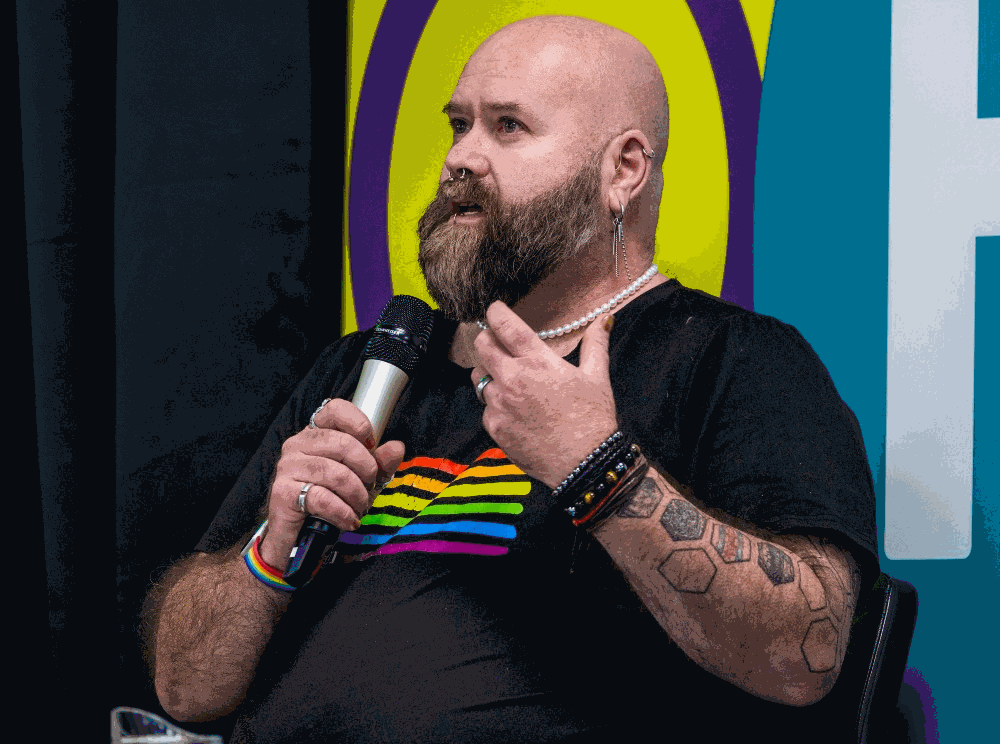
Rob Partridge (Galway Health and Local Government branch) was elected Chair of the LGBTQIA+ Network
Rob Partridge, who presented the motion at conference, was elected Chair of Fórsa’s LGBTQIA+ network. Rob said that LGBTQIA+ rights are workers’ rights, and trade unions have always been at the heart of fighting for better conditions and protections for all workers. “What this network aims to do is to make sure our voices are heard. And to build on the power of our union with its 89,000 members, to make sure our employers hear us too,” he emphasised.
Rob added “Our community is very publicly under attack in the western world as we speak; it is a dark time for us. To see such solidarity is a much-needed reminder that our strength has always come from each other. Societies target us at different times in different ways, but we always come through it as a community. They are not going to win this time either. We are.”
A recent survey of Fórsa members pointed to the ongoing and ever-increasing need for a network like this. 53% said they had experienced direct harassment as a result of their LGBTQIA+ identity, including: Verbal (52%), Physical (18%), Sexual (6%), Online trolling (18%), and Doxing (2%).
79% have also experienced discrimination in the workplace because of their LGBTQIA+ identity.
Ryan McKinney, the national secretary supporting the network, said the establishment of this crucial network in Fórsa displays the sheer power that a simple conference motion can have.
Ryan said: “If you are going through something or feel strongly about an issue, just know you are not alone. Make sure you use the democratic tools available to you and voice your concern. It can truly be surprising just how much support you can get once you do that – and the changes that can stem from your one act of courage.”
Spanning back decades, the trade union movement has been central in the fight to secure LGBTQIA+ rights in Ireland. You can read more about that history in a recently published book by Kieran Rose Trade Union and LGBT Rights: A Personal History.
Join a union that wins. Join Fórsa.
Lives changed for the better: what you told us
by James Redmond
In the last issue, we asked you for your thoughts on remote working. It is clearly an issue members care about dearly. Read a small selection of the responses we received.
We crowdsourced over 60 detailed responses on the issue of remote working and are presenting a varied small selection of responses from civil service members here. It's clear that remote work is a key concern for Fórsa members, and we will be featuring it in the next issue of the Civil Service Quarterly. Names have been changed to protect members.
“The introduction of remote working has massively benefited me, my family and friends. It reduces carbon emissions, reduces congestion, reduces the stress and burden of unnecessary commutes, and improves social wellbeing and work life balances by increasing time for family care, cooking, and exercise!” - Deborah
“Being able to work remotely meant I was finally able to afford to purchase my first home. I re-located outside of Dublin. I know of many colleagues who were able to afford housing further afield thanks to remote working. During the pandemic, when most workers were fully remote, the reduction in traffic on the roads was notable so environmentally, it's a no-brainer. Remote working has changed my life for the better in so many ways.” - Carol
“We must demonstrate to management that we're prepared to fight, otherwise, compliance will be interpreted as acceptance, and they'll feel emboldened to implement detrimental changes. Waiting until after the decision is made weakens our position. This isn't about being militant, but about ensuring our voices are heard. A passive approach guarantees an unfavourable outcome.” - Jabari
"Working from home changed my life. Not only was I getting more work done but now that I wasn’t commuting, I had much more time with my children and for myself. I understand there are challenges to overcome when it comes to training and engaging with new staff members, but I believe these challenges can be met without bringing everyone back into the office and returning to old routines.” - Susan
“Remote working has given me the opportunity to balance work and caring for my elderly mother and my brother with special needs who live nearby. I can do my work and be nearby in the event of an emergency or just be able to check in during my lunch break and after work. This kind of reassurance that someone is available is invaluable to my elderly mother.” - Roisin
“The office environment can be useful for collaboration and social contact, but it can also be a messy place with extra jobs being thrown your way when you're trying to finish your own work, or other colleagues' work issues affecting your productivity, or personality clashes affecting things. The double-edged sword of the office environment makes it even more imperative to continue blended working as, in my opinion, it benefits the employee and the employer in terms of the well-being of the employee and the resultant improvement in productivity." - Eoin
“I have a vision impairment. Working from home allows people with disabilities to fully engage with the workplace. If remote work is removed, this would make my life more difficult.” - Sharon
Join a union that wins. Join Fórsa.
New mortgage service for Fórsa members
Fórsa members can now consult a personal mortgage advisor from Symmetry Financial Management. This expert advice can help you understand your borrowing capacity, find tailored mortgage recommendations, and handle applications.
We are delighted to announce a brand-new mortgage service for Fórsa members offered by Symmetry Financial Management. This mortgage service includes tailored advice and dedicated support designed around your needs.
This exclusive service is designed to support you in your journey to homeownership and property investment by providing bespoke advice and personalised support.
What does this service offer?
- Expert mortgage guidance: Enjoy an expert service at no cost.
- Free valuation: Reimbursement of your valuation costs.
- Fixed rate legal fees: Benefit from our partner conveyancing panel.
- Discounted mortgage protection: Secure your home with reduced-rate insurance.
- Complimentary Will service: Provided by partner legal firms (T&Cs apply).
- Webinars and workplace visits: Gain insights through accessible informational sessions.
You can meet with a personal mortgage advisor who will evaluate your financial standing, determine your borrowing capacity, recommend suitable mortgage products for your long-term goals, handle your application process to save you time and effort, and provide tailored insurance and protection guidance.
Symmetry Financial's award-winning end-to-end mortgage service has assisted thousands in purchasing their dream homes. By working with a wide network of lenders, they can provide extensive options during a single meeting. With years of experience supporting public sector employees, their team is committed to streamlining the mortgage process and offering tailored solutions to meet your housing aspirations.
How to Access This Service?
There is more information here and you can schedule a consultation here.
Alternatively, call (01) 683 1673 to speak directly with an expert.
Join a union that wins. Join Fórsa.
Dublin event to mark three years of ‘Russian shame’
by Niall Shanahan
As the invasion of Ukraine enters its third bloody year, a group of activists—who have maintained a daily peaceful protest outside the Russian Embassy in Dublin—will gather once more to mark this somber anniversary on Monday, 24th February.
An event to mark three years since Russia’s invasion of Ukraine will take place on Monday 24th February at the Russian Embassy in Dublin. The event, which takes place from 3pm, has been organised by a group of activists, including a retired member of Fórsa, who have continued to hold a peaceful protest at the embassy since the February 2022 invasion.
John Farrelly, retired from the City of Dublin Education and Training Board (CDETB) a few of years ago and was an active member of the union. He is one of a number of regular protesters that have, since the invasion of Ukraine on 24th February 2022, gathered daily outside the Russian Embassy in Dublin.
He explained: “As part of our ongoing protest we are organising this event to mark three years of Russian invasion and full-scale war. The situation remains critical, so we have stayed on this peaceful protest at the embassy on Orwell Road for three years,” he said.
As global concern mounts in response to the US administration’s approach to peace talks with Russia, that has so far excluded Ukraine and EU representation, Monday’s protest welcomes friends, family and supporters to gather and remember those who have been killed in Ukraine, including Pierre Zakrewski, Rory Mason, Finbar Cafferkey and Graham Dale.
“As the illegal invasion of Ukraine continues, we wanted to give people the opportunity to reflect, to remember the thousands of innocent civilians killed, injured and displaced by this war, in a spirit of solidarity with the people of Ukraine,” he remarked.
John says the group of protesters who gather at the Russian embassy is a very diverse group of individuals: “The unifying force for us as a group is a fierce determination to oppose the criminal invasion of Ukraine by Putin and his regime.”
Join a union that wins. Join Fórsa.
ICTU Anti-racism project: upcoming training
by Brendan Kinsella
Coming up this month ICTU’s anti-racism project is offering training free of charge for trade union members, which will cover migrant worker leadership, how trade unions and civil society can work together to combat racism, and a focus on training the trainers.
The Irish Congress of Trade Unions’ Stronger Together Anti Racist Trade Unions & Workplaces project is now in its second year. The project’s mission is to make unions and the workplace more welcoming for people of an ethnic minority background and migrant workers. As part of that mission, the project is offering several training sessions to union members, free of charge.
This February, we are bringing back the ethnic minority/migrant worker leadership training. This half-day workshop will take place in Dublin and is open to migrant workers and those from an ethnic minority background.
Over the course of a morning, participants will learn how to enhance their leadership skills and familiarise themselves with effective workplace advocacy. This course hopes to increase participation of people of an ethnic minority background and migrant workers within union structures.
For anyone unable to make the February date or living in the North, a second date is available in Belfast in April.
On Thursday 27th February a workshop on Trade Unions & Civil Society: Working Together to Combat Racism will take place. This half day training will take place in Wexford and will show participants the importance of collaborative action between trade unions and civil society organisations when tackling social justice issues. It will also work on developing strategies to tackle far-right narratives and actions.
Also, the Training the Trainers workshop will take place the next day at the Wexford Trade Union Centre. This is a full-day workshop open to all trade union representatives and members. It will be especially beneficial for members working in a training or education setting.
This workshop covers a range of topics, including effective responses to racism in training settings and interactive activities designed to promote anti-racism.
If you are interested in attending a course, please email antiracism@ictu.ie with your name, title, union affiliation, and the course title and location.
If you can’t attend these dates, don’t worry, additional sessions will be announced soon.
Ethnic Minority/Migrant Worker Leadership Training
- Tuesday, 25th February, ICTU Offices, 31/32 Parnell Square, Dublin. (10am to 1pm).
OR
- Tuesday, 1st April, ICTU Offices NI, 45-47 Donegall Street Belfast BT1 2FG. (11am to 2pm).
Trade Unions & Civil Society: Working Together to Combat Racism
- Thursday, 27th February, Wexford Trade Union Centre
Training the Trainers
- Friday, February 28th, Wexford Trade Union Centre
Join a union that wins. Join Fórsa.
|
|
|
|