In July 2026 Ireland will assume the rotating Presidency of the European Council for the eighth time since joining the EU in 1972.
In a speech earlier this year Minister for EU Affairs Thomas Byrne TD underlined the political significance of the Presidency and the scale of the work involved for Ministers, and for public servants. There will be over 230 events in Ireland during the six month period, while Irish officials will chair over 170 preparatory bodies, committees and working groups in Brussels.
Between July and December 2026 Irish Ministers will chair formal meetings of the Council, in Brussels and in Luxembourg, and host informal meetings of EU Ministers in Ireland.
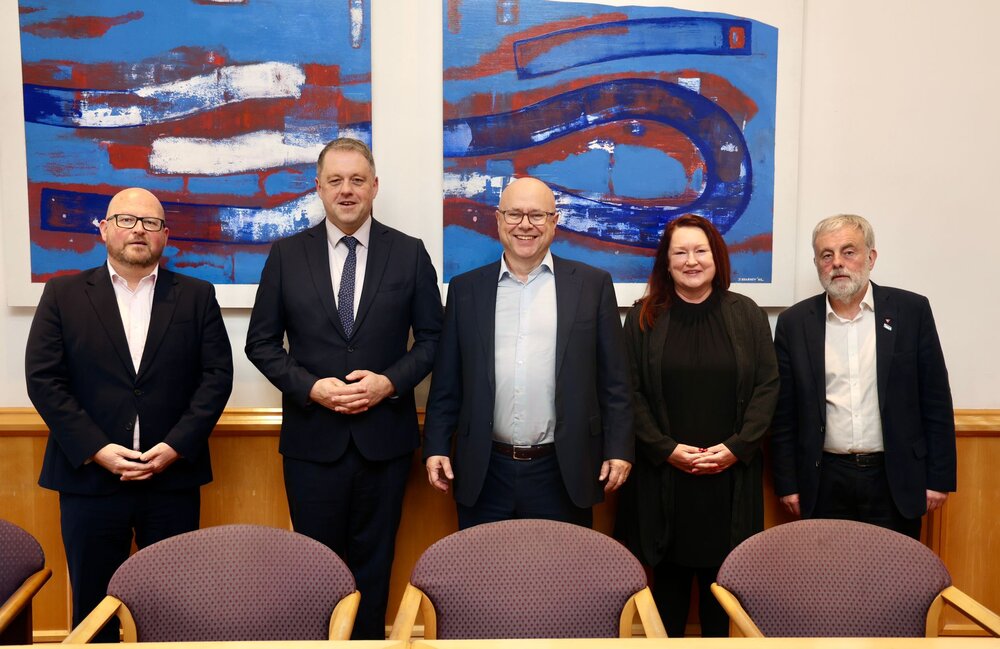
Stakeholder engagement to prepare this large-scale undertaking is already underway, and as part of that engagement, Minister Byrne met with ICTU representatives last week.
ICTU general secretary Owen Reidy was joined by Fórsa general secretary Kevin Callinan, as well as Ethel Buckley from SIPTU, and Jack O’Connor, former SIPTU general secretary and one of Ireland’s representatives at the European Economic and Social Committee (EESC).
The agenda of the meeting focused on issues the trade union movement in Ireland and Europe want to see prioritised by the Irish EU Presidency. These include further initiatives to promote and support collective bargaining, an EU directive on a just transition, reform of public procurement rules to guarantee that public money goes to organisations that respect workers’ rights and trade union, a new directive on remote work and the right to disconnect, and the protection of funding for social objectives, which should not be redirected to increase defence spending.
At the meeting Fórsa general secretary Kevin Callinan stressed how important it is that this Presidency helps to rebuild confidence in the EU, saying that in the midst of global turmoil, rapid technological change, the rising cost of living crisis and the acute housing crisis, Europe risks becoming increasingly removed from people’s lives.
He said: “Record number of people are at work in Ireland and Europe, but it is harder and harder for people to make ends meet. Without meaningful action on the issues that impact daily life the EU risks becoming dangerously disconnected from citizens.”
“During our next EU Presidency Ireland has the opportunity to tackle these major challenges and have a real impact. Right now, the European Commission is developing Europe’s first ever Affordable Housing Plan, with a public consultation ongoing, and Ireland’s EU Presidency will have a key role in follow up discussions and implementation.
“We need to do everything we can to ensure that the plan is a transformational document, not just a list of empty promises. We are calling for full involvement of social partners in the development of the plan to ensure that we move away from an approach that prioritises private profit over public investment, at a time when so many people in Ireland and across Europe are struggling to put a roof over their heads.”
Join a union that wins. Join Fórsa.





 Like
Like

