Last week at Biennial Conference Fórsa launched the results of major research on remote and hybrid working.
Over half a decade since it became part of modern working life, research now shows remote and hybrid working is having an impact far beyond the workplace.
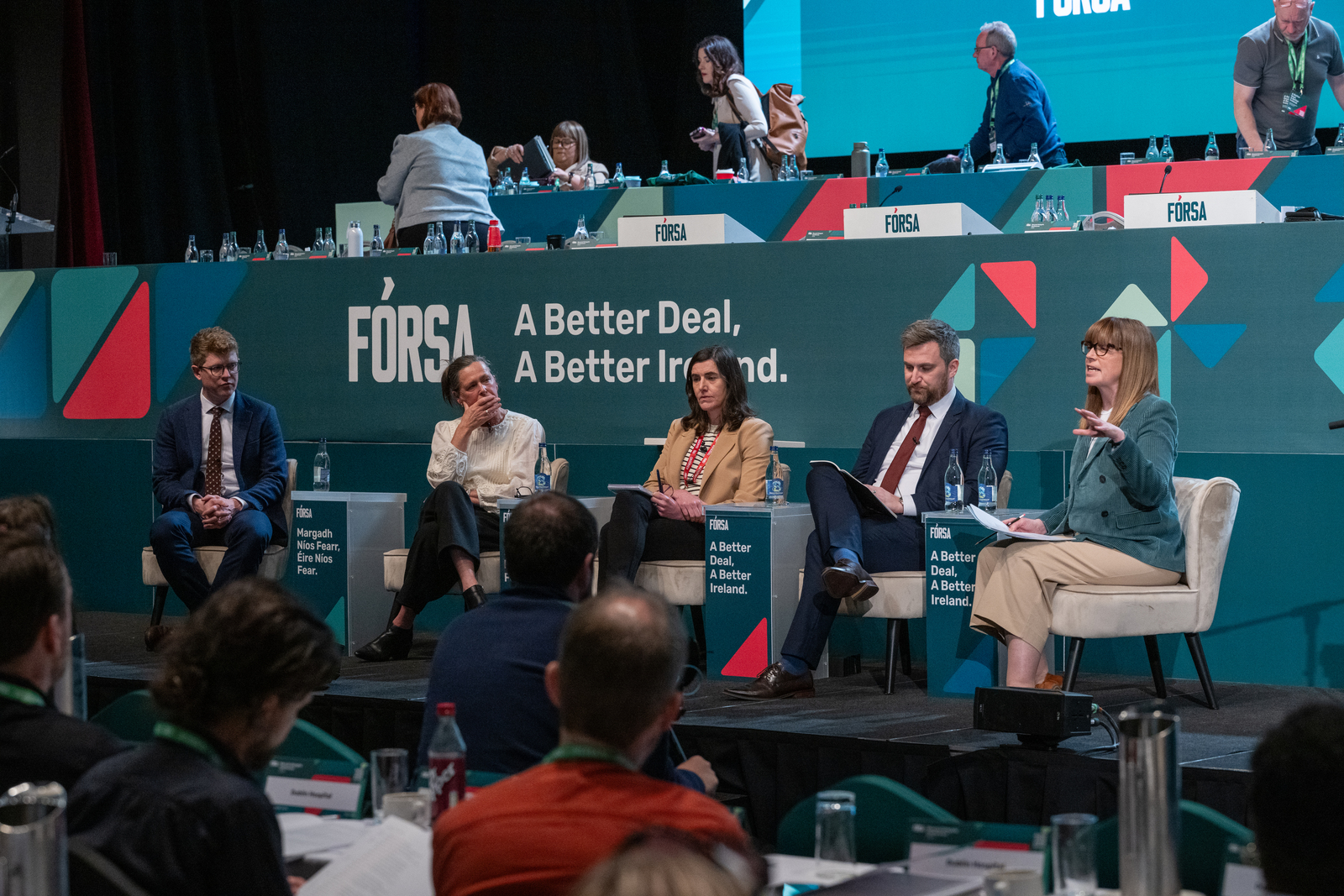
Two new pieces of research commissioned by Fórsa, The Social Impacts of Remote and Hybrid Working Arrangements in Ireland (Ireland Thinks) and Remote & Hybrid Working (Amárach), were presented to delegates at Biennial Conference. The presentation was followed by a panel discussion on the findings, moderated by Dr. Laura Bambrick (ICTU) and featuring contributions from Dr. Margaret Heffernan (DCU), Sinead O’Sullivan (Amárach) Kevin Cunniningham (Ireland Thinks) and Kevin Donoghue (Fórsa).
Over 19,000 members took part in the survey which informed the research, making it one of the largest ever studies of workers on this topic.
The research shows that not only has remote and hybrid working become a standard expectation of modern employment, but it is also having positive impacts on productivity, transport, infrastructure, regional development, local economies, family life and staff retention.
Despite the recent increase in return-to-office mandates, the research shows little divide between workers and managers, with managers also reporting positively on productivity and deadlines in remote working arrangements.
Attitudes were overwhelmingly positive towards remote and hybrid working, with managers and workers alike reporting that remote and hybrid working arrangements performed as well as, or better than, fully on-site working arrangements.
Retention risk
Reduction in access to remote and hybrid working arrangements emerged as a significant risk factor for retention of staff. While 28% of workers said they would accept a reduction in access to remote working, four in ten said they would look for another job to retain or improve their current level of flexibility. This rises to seven in ten for members who currently work in remote or hybrid arrangements.
Commenting on the findings, Fórsa campaigns director Kevin Donoghue said: “For many workers, hybrid working is no longer viewed as a perk or temporary pandemic arrangement. It has become part of the new normal of working life.”
While much of the drive to bring workers back to the office relies on claims of issues with productivity and team cohesion, these issues are not born out in the experience of the managers who responded to the survey.
Managers reported experiencing fewer problems among staff working in remote or hybrid arrangements than among fully on-site teams. Similarly, managers overseeing remote working staff were less likely to report problems relating to deadlines, communication with external clients, or collaboration with colleagues.
This is reflected by 86% of managers supervising remote-working staff having said employees seldom or never missed work-related deadlines, compared with 73% among fully on-site teams.
Benefits beyond the workplace
Kevin said the findings pointed towards a need for better workplace adaptation rather than a simple return to pre-pandemic working models: “The research suggests that where challenges exist, there are practical ways to address them through better management supports, clearer expectations and more effective workplace policies, rather than simply assuming the solution is a blanket return to the office.”
“But this research also shows that the future of work debate now extends far beyond office walls. Hybrid working affects commuting patterns, congestion, childcare, family life, local economies, climate policy, regional development and participation in communities.” He continued.
Seven out of ten reported experiencing increased congestion and crowding at peak times over the past twelve months. Despite the increase in travel times, nearly half of commuters who work remotely reported gaining more than three hours each week by not travelling to or from the office.
“In that context, hybrid working arrangements clearly have a role in any serious policy discussion about infrastructure and climate measures,” Mr Donoghue said.
Workers avoiding long commutes emerged as a possible boon for local economies, as 77% of remote and hybrid workers reported spending more money in their local area because of remote work, with almost half saying it is money that was previously spent near workplaces.
Mr Donoghue added: “Working from home is changing where Ireland spends its money. The daily coffee purchase, in some cases, had moved to Clonee, Longford, Ballinasloe or Ennistymon. This kind of economic redistribution could play an important role in supporting rural and suburban towns which, at one time, risked becoming dormitory communities for people working in larger towns and cities,” he said.
Worryingly, research indicates the emergence of a divide in access to flexible work, with 64% agreeing that remote work opportunities are unfairly concentrated among higher-paid or higher-skilled jobs.
Mr Donoghue added: “Remote work cannot become a class divide in the workplace. The challenge now is ensuring that flexibility, where possible, is implemented fairly, transparently and sustainably across the workforce.
“This research emphasises the ordinary, practical value of remote work. The benefit is not only fewer hours in the office. It is also a calmer morning, the ability to do a school run, time to exercise, the chance to start dinner earlier, or the ability to recover from work without a long commute,” he emphasised.
Join a union that wins. Join Fórsa.





 Like
Like


