"An early diagnosis can completely change treatment outcome."
by Hannah Deasy
For Breast Cancer Awareness month we spoke to Cathy Hannigan and Prof.Arnie Hill on early detection and breast health.
Every family in Ireland knows what it feels like to get a phone call sharing a cancer diagnosis. Each year in Ireland over 3,400 women and approximately 30 men are diagnosed with breast cancer. Treatments range from surgery, radiotherapy, chemotherapy, hormone therapy and targeted therapies.
Fundraising for further research into new treatments remains vital.
Cathy Hannigan was diagnosed with breast cancer at age 23. This summer she raised over €8,000 for Breast Cancer Ireland, supported by many Fórsa members. This fundraiser is now closed, however, any members still willing to support the cause can do so by donating here.
Speaking about why fundraising remains vital Cathy said: “These funds go towards research to find new treatments for breast cancer. Throughout my treatments, I have been told by my doctors how much breast cancer treatments have advanced in recent years. With further research, even more new treatments can be trialled so that everyone diagnosed has a fighting chance.”
Cathy also urged people to remember the importance of self-checks, saying “Getting an early diagnosis can completely change treatment outcome.”
Early diagnosis is crucial so this month we’re sharing a Breast Health Q&A for our members, with Breast Cancer Ireland Chair Prof. Arnold Hill.
Breast Health Q & A with Prof. Arnold Hill, Consultant Breast Surgeon & Chair, Breast Cancer Ireland.
1. How often should I do a self-check?
You should check your breasts once a month to know what is normal for you. This will help you recognise an abnormality if one occurs. For women who are pre-menopausal, generally a week to 10 days after your period is the best time. If you are post-menopausal, just pick the same day each month. It is important for all women to check their breasts monthly from teenage years throughout adulthood, whatever your family history, age or risk status, make sure you make time for a monthly check.
2. What should I look out for?
Knowing what is normal for you is the first step to recognising an abnormality. Stand in front of the mirror and look at the skin of your breasts with your hands on your hips, and then raising your hands above your head. This will help you recognise any skin changes or puckering that a lump in the breast may cause. Look for any changes to your nipples, any discharge or new inversion of a nipple. This visual inspection of your breasts is just as important as palpation your breasts and any changes should be checked by your GP. When examining your breasts, feel for any new lumps, thickened areas or swelling that is unusual for you and follow the breast self-examination video and breast cancer Ireland’s breast aware to help you with your technique of self-examination. Download the Breast Cancer Ireland App to schedule discrete monthly reminders along with a useful step-by-step simulated video.
3. If I notice something unusual, what should I do next?
Firstly, do not panic. There are a large number of benign lumps that can occur in the breast. 9 out of 10 women I see in my practice do not have a cancer diagnosis and although breast cancer is one of the more common cancers in women, if you notice a change, this does not mean you have breast cancer. The first step is to visit your GP who will examine your breasts and decide what steps to take in next.
4. If the GP deems further investigation is required, what happens next?
If your GP feels it is necessary they will refer you to one of the 8 breast cancer centres in Ireland for further evaluation. It is important to attend one of the 8 centres as there are breast surgeons, radiologists, pathologists and nursing staff who specialise in breast care and can provide the best evidence-based care.
5. What can I expect if I’m referred for further tests?
If you are referred for further tests by your GP, you will most likely attend a triple assessment clinic in one of the 8 breast centres. In this clinic, you will be seen first by a doctor who will take a focused medical history from you and do a clinical examination. If you have a family history of breast cancer it is useful to have this information to hand, usually the type of relative and the age they were diagnosed. Where appropriate your doctor will then send you for some breast imaging, which would be a mammogram and ultrasound of the abnormal area. The radiologist may take a biopsy of this on the same day.
6. Will tests differ depending on my age?
In general, mammograms are performed on women over the age of 35. Due to the nature of younger breast tissue, abnormalities are not as easily visualised on a mammogram in younger women so an ultrasound may be performed. If you do have an abnormality your doctor may decide to do both as they complement each other when diagnosing breast disease, both benign and cancerous.
7. What kind of a “wait time” could I expect for tests?
For some patients these tests are done on the same day where possible and when deemed clinically appropriate by your breast surgeon. If you don’t have your tests done on the same day, your doctor will be able to reassure you and you will be called for your mammogram in the coming weeks.
8. I’m very anxious at medical appointments and sometimes forget to ask questions. Am I allowed have a friend or family member attend appointments for support?
Absolutely! It is always very useful to have somebody with you to ask questions, take in the information from your doctor or nurse and to be a support at this stressful time.
9. Do you have any tips for coping while waiting for medical results or going through cancer treatment?
Waiting for results and not knowing what lies ahead in the future can be very difficult. It is important to try and continue to do the things that you like, whether it be exercise, meeting with friends or even working! Be good to yourself and use the support of family and friends around you. Your breast care nurse can also give you some information on local support groups that can help you during this difficult time.
Join a union that wins. Join Fórsa.
Boost your skills this autumn
by James Redmond
The Fórsa Skills Academy has several exciting events lined up for October and November.
The Fórsa Skills Academy has several exciting events lined up this October and November, starting with a Lunch and Learn session on Friday 25th October.
The topic, Building Effective Industrial Relations Locally, will be led by guest speaker Brendan Cunningham, a former Regional Manager with the Workplace Relations Commission. This session is essential for workplace representatives and branch officers, so all branches are strongly encouraged to register for this valuable talk.
In addition, the monthly induction for new members is scheduled for Wednesday 13th November. This session will introduce members to how the union operates, the role of local workplace representatives, and how members can get involved in union activities directly in their workplace.
For those with experience, there are still a few spots available for the Level 2 Workplace Representatives Training on Wednesday 6th and Thursday 7th November in Galway. If you have completed Level 1 training or have more than two years of experience as a workplace representative, we encourage you to register soon, as places are limited.
Lastly, due to high demand, a second workshop with Brendan Cunningham on Industrial Relations (IR) in the Civil Service has been added for October. This opens up spaces in the original November 6th workshop, now available exclusively to representatives from non-Civil Service branches. Don’t sit around - secure your spot now!
Details of all Skills Academy trainings can be found on the dedicated training hub on forsa.ie.
Join a union that wins. Join Fórsa.
 |
|
Healthcare protests intensify nationwide as ballot opens
by James Redmond
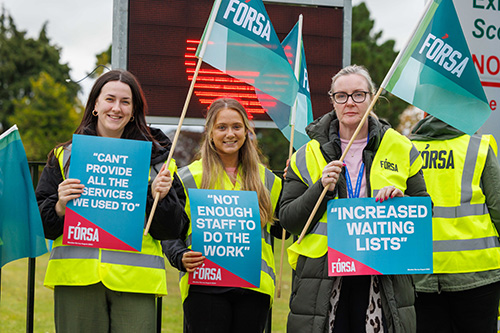
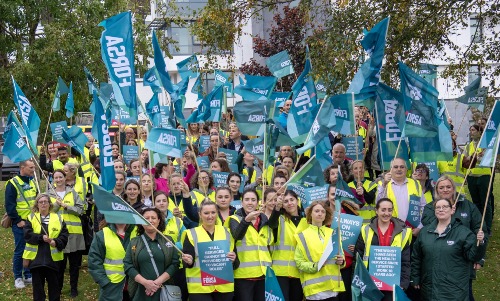
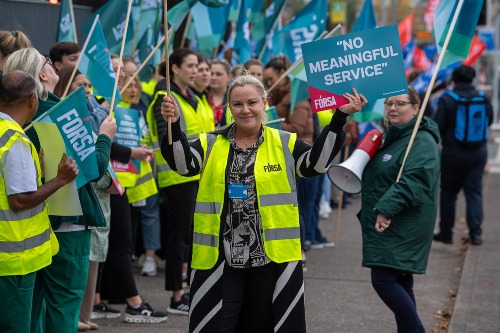
Lunchtime protests by healthcare workers in the ICTU group of unions are intensifying nationwide, as members voice increasing concerns over the Health Service Executive’s capacity to adequately staff its services.
Lunchtime protests by healthcare workers in the ICTU group of healthcare unions are growing across the country as members continue to express serious concerns over the Health Service Executive’s ability to adequately staff its services.
This week Fórsa members protested at Cavan General Hospital, Tuam Primary Care Centre, Sligo University Hospital, Mayo University Hospital, and Naas General Hospital.
Cork University Hospital
This dispute centres on the impact of the HSE’s Pay and Number Strategy. Since October 2023, unions have highlighted the persistent issue of unfilled vacancies. Despite the removal of the recruitment ban, many sanctioned posts from 2023 remain vacant, with unions questioning how funding for these positions was allocated.
In July 2024, the HSE's Pay and Numbers Strategy effectively "decommissioned" thousands of vital positions, a move that has severely impacted frontline services. Despite repeated requests for engagement, the HSE rejected all efforts to address these concerns.
Cork University Hospital
In response, Fórsa surveyed its members in August, receiving nearly 4,000 submissions detailing the growing inability to deliver essential services, worsening waiting lists, and the significant toll on both workers and the public.
Union members across the board are arguing that the failure to fill critical posts is exacerbating pressure on frontline workers, leading to rolling protests across the country. Following Cork University Hospital and Dr. Steevens Hospital two weeks ago, last week it was the turn of union members at Our Lady Of Lourdes Hospital in Drogheda and Connolly Hospital Blanchardstown, as well as Tullamore Regional Hospital and St.Lukes in Kilkenny.
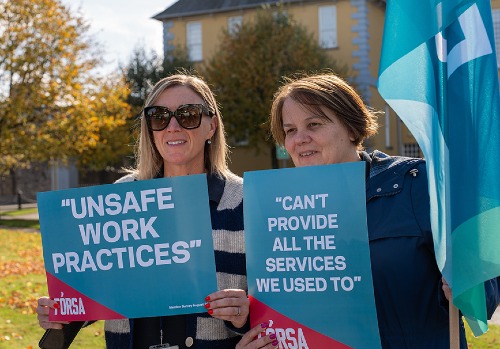
Dr. Steeven's Hospital Dublin
Ashley McGowan is a respiratory physiologist at Connolly Hospital, where she has been working for over 18 years, she explained her frustration with the hiring freeze, saying: “We had two posts frozen. We're only a small department, and the impact was significant.”
McGowan said they proceeded with interviews, expecting the embargo to be lifted, but were later told the positions were lost. “Two people who were on a panel for those posts that were immediately paused, which I feel is extremely unfair. It’s terribly unfair on patients that they’re lounging on waiting lists. And because of staffing, we’re just really not able to cope with this,” she said.
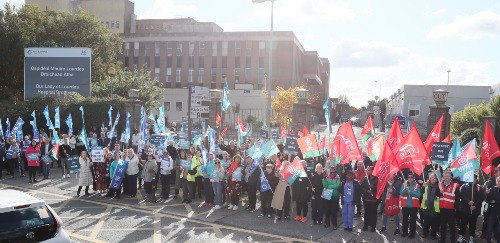
Our Lady of Lourdes Hospital, Drogheda
Niamh, an administrative worker at Our Lady of Lourdes Hospital in Drogheda, highlighted how the shortage of admin staff has slowed down the hiring of other essential roles. “We understand in admin roles that the priority posts are the posts within the hospital, but if the admin roles aren’t filled, for example in HR, we can’t then fill the other roles in a speedy time because we’re short-staffed too. So, it’s important all around for a functioning hospital for us all to be fully staffed,” she explained.
Standing alongside the Drogheda protest, Fórsa’s president Martin Walsh warned that the reductions will severely impact patient care. "We’re here today at Our Lady of Lourdes Hospital to let the HSE know that staff cuts equal service cuts."
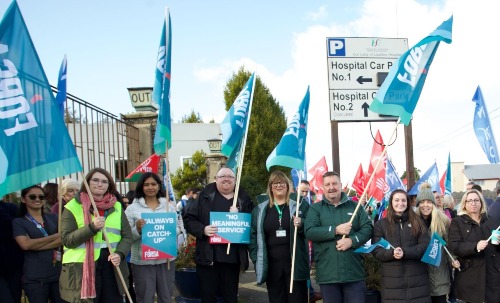
Our Lady of Lourdes Hospital, Drogheda
He pointed out that the decision made by the HSE to cut over 2,000 jobs would have far-reaching effects: "We need the government to realise that if you cut jobs, you are cutting services. If you are cutting services, you are impacting lives.”
“While the HSE claims its workforce is at an all-time high, the reality is that increased demand from an ageing population has left the system critically under-resourced," explained the head of Fórsa’s health division Ashley Connolly.
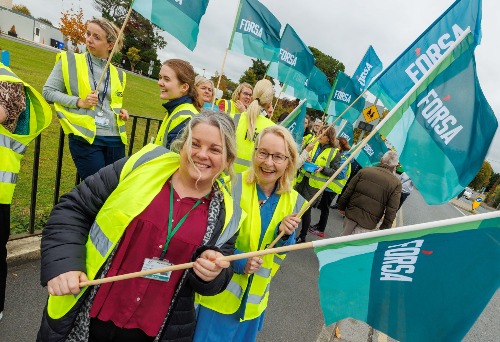
St. Luke's Hospital, Kilkenny
Ashley emphasised that arbitrary decisions to leave key positions unfilled have resulted in chaotic downsizing.
"This has severely compromised members' ability to provide safe care. In September, after reviewing the survey results and consulting with representatives, Fórsa's Health & Welfare Divisional Executive Council (DEC) voted to ballot for industrial action, up to and including strike action. The anger on the ground is growing. Staff cuts lead to service cuts, and everyone across the board is suffering—from staff to patients.”
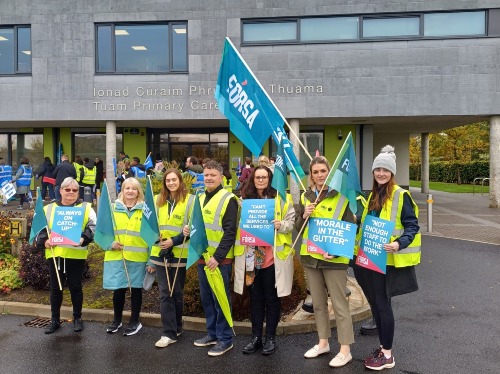
Tuam Primary Care Centre
Linda Kelly, national secretary urged members from all divisions across the union to support members in the Health & Welfare division. She said:
“Our members' ability to deliver safe services has been severely compromised. Everybody needs a hospital appointment some time and the letter you get in the post confirming an appointment, or the OT that helps your child or parent, might well be a Fórsa member. They need your support now.”
The ballot for industrial action among Fórsa members of the HSE opened on Monday 14th October and will run until Tuesday 26th November. Additionally, the INMO has opened its own ballot. Further protests are scheduled for next week at Kerry University Hospital on Wednesday 23rd October and at University Hospital Clonmel, Tipperary, on Thursday 24th October.
Join a union that wins. Join Fórsa.
|
|
Ballot opens in HSE Pay and Numbers Strategy dispute
Members working in HSE and Section 38 hospitals are being asked to vote in a ballot on industrial action, up to and including, full strike action. The ballot will run to Tuesday 26th November.
Fórsa members working in HSE and Section 38 hospitals are being asked to vote in a ballot on industrial action, up to and including, full strike action. The ballot opened on Monday 14th October and will close on Tuesday 26th November.
This ballot is being held in response to the impact of the HSE Pay and Numbers Strategy, which imposes a fixed employment ceiling on all areas, as well suppressing all posts that were vacant on the 31st December 2023.
Head of the Health and Welfare division Ashley Connolly said: “For many months now we have sought to engage with the HSE on staffing levels. Last year we called for the recruitment embargo to be lifted and negotiated in good faith. Then, earlier this summer the HSE announced that they would lift the embargo to great fanfare, but what they didn’t say quite so loudly was that any job which has been vacant up to the 31st of December would cease to exist. In reality this is the embargo by another name.”
Ashley continued: “Members are under immense pressure and stress. In the survey we carried out this summer over 4,000 of you told us of low morale, severe stress, and that services are suffering due to lack of staff.”
“We are at a point now where members feel their ability to provide services has been severely compromised.”
At the end of September, Fórsa’s Health & Welfare Divisional Executive Council (DEC) met to consider the options available to them, in line with Fórsa rules.
Following careful consideration of the survey results, including engagement with our branch representatives, they took the decision to conduct a ballot for industrial action up to and including strike action, and to recommend approval. This week the DEC decided to extend the length of the ballot, which will now run until Tuesday 26th November, and to extend the eligible voters to include members working in Section 38 hospitals.
National secretary Linda Kelly said: “You and your colleagues have turned out in huge numbers in the recent lunchtime protests, and you have made it very clear that you will not take any more of this. The stress and anger have been palpable. Now, we need you to take the time to vote in the ballot. High turnout will send a clear message to the HSE that our members stand united.”
The ballot is an electronic ballot, and members should have received their Unique Voter Code (UVC) to (UVC) by now, which is needed to access a ballot paper. If you haven’t received your code please contact hwhelp@forsa.ie.
Director of membership Seán McElhinney urged members to cast their votes as soon as possible. He said: “It takes just seconds to have your say. While the ballot is on for a month, we’re keen to ensure as many members vote as possible, so the sooner you take part in the ballot the better.”
Seán also reminded members that talking to colleagues who aren’t in the union about the ballot can be an effective way to convince them to join. He said: “If your colleagues aren’t in the union yet talk to them now about how the outcome of this ballot could impact their working life for the better. It’s easy to join online, you can send them this link.”
A ballot hub is available with all the information you need, including a frequently asked questions document (FAQ) which you can read here.
Join a union that wins. Join Fórsa.
HSE re-considers HSCP exclusion after 10,000 strong petition
by Hannah Deasy
After an overwhelming response to our petition, the HSE has now committed to reconsidering the exclusion of Health and Social Care Professionals (HSCPs) in regional executive management teams. This significant win follows members' fierce opposition to the HSE’s initial decision to exclude HSCPs from the management of the new Health Regions.
In a significant turnaround, this week the HSE has written to Fórsa, confirming that there will now be consideration given to the Health and Social Care Professions (HSCP) leadership role within regional executive management teams.
Over 10,000 HSCPs signed our petition calling on Minister Stephen Donnelly to stop the HSE’s decision to exclude Health and Social Care Professionals from the management of the new HSE Health Regions.
Fórsa national secretary Linda Kelly said: “Without your participation in the campaign to stop the exclusion of HSCPs this would never have happened.”
Linda continued: “HSCPs are the second largest clinical group in the HSE. They provide vital patient care, from occupational therapy to psychology, audiology, physiotherapy, and so much more. Patients rely on their expertise and no service should be developed without their input.”
In the letter the HSE noted that following concerns raised by Fórsa and HSCPs, further consideration will be given to HSCP leadership in regional executive management teams, when REOs deliberate on “future state Integrated Service Delivery (ISD) arrangements”.
Linda welcomed the development but noted that the issue is not yet resolved, saying: “While this is a step in the right direction, we have not received an explicit commitment yet to a post for a Regional Director of HSCPs. That is what Health and Social Care Professionals believe is essential to the success of integrated care in the new regional structure. We will keep working towards that until we get it.”
Join a union that wins. Join Fórsa.
Fórsa slams Barnardos for withholding staff pay
by Niall Shanahan
Fórsa has condemned Barnardos for retaining State funds meant to honour last year's Workplace Relations Commission (WRC) pay agreement for community and voluntary sector workers. Despite negotiating an eight percent pay increase, Barnardos has only sanctioned a portion of the agreed raise, leaving staff facing financial hardship.
Fórsa has criticised the children’s charity Barnardos, as it has emerged the organisation has retained funds paid by the State to honour last year’s WRC pay agreement for workers in the community and voluntary sector.
Fórsa represents staff at Barnardos and was one of the unions that negotiated a pay agreement for workers providing health and welfare services in the community and voluntary sector last October.
The October 2023 agreement helped to avert an indefinite work stoppage by thousands of workers in the sector, which continues to experience significant staff turnover as workers secure better paid employment in other sectors.
Fórsa official Louise O’Hara explained that Barnardos management has withheld the State funds and refused to honour an agreed eight per cent increase, in three phases, and backdated to 1st April 2023.
Louise added: “Barnardos has, so far, only sanctioned one increase of four percent, which was delivered in March, followed by a once-off payment for lower-paid staff (under €35,000). That still leaves another four percent, and the required retrospection, to be paid, and is now long overdue.
“Barnardos management has argued that the funds provided by the State was to compensate the organisation for a 6.5 percent pay increase made in 2022. It’s an outrageous and disingenuous claim, and is an attempt to sidestep Barnardos’ obligations under the terms of the 2023 agreement,
“The State funds were provided solely in respect of this agreement, not for any other pay arrangements. There is no provision in the agreement for an employer to retain the funding for pay as a re-imbursement, especially not for decisions on pay uplifts prior to the 2023 agreement being reached,” she said.
Louise said Barnardos management has so far ignored efforts by Fórsa to engage constructively: “The employer, a trusted children’s charity, has declined an invitation from the WRC to attend conciliation."
“Barnardos has more than €15m in unrestricted reserves and has been provided with the necessary funds – taxpayer’s money - to deliver on the 2023 WRC pay terms. Why isn’t it using those funds as intended? By withholding these funds Barnardos is imposing further financial hardship on their staff,” she said.
Join a union that wins. Join Fórsa.
Time is running out! Fórsa’s third level grant scheme closes soon!
by Brendan Kinsella
Time is running out! Fórsa’s Third Level Grant Support Scheme for the 2024/25 academic year closes next week.
Fórsa’s Third Level Grant Support Scheme for union representatives for the 2024/25 academic year will close next week. The deadline for applications is 5.30pm Thursday 24th October, 2024.
The scheme is intended to assist union representatives in acquiring knowledge and skills that will help them to better carry out the role of a union representative. Financial assistance will be provided to successful applicants so that they can undertake a certified educational course at third level.
Courses should provide qualifications and skills which will benefit a member in their work and union activities. Post graduate qualifications are not covered.
A union representative role includes performing any role on behalf of their union colleagues at workplace, branch, vocational group or other level.
Grants are based on the overall cost of undertaking the course up to a maximum of €3,000 per year. The amount awarded to successful applicants will be decided by the Membership Services Committee.
Applications must be submitted via email to bursaries@forsa.ie by 5.30pm Thursday 24th October, 2024.
Further details are available here. Application form is available here.
Join a union that wins. Join Fórsa.
|
|
|
|