May Day 2025
by Hannah Deasy
ICTU seminar, DCTU march and collective bargaining seminar.
May Day 2025: Pay, collective bargaining, and marching
There is no shortage of events for union members this May Day. In addition to branch-led local activity being held as part of Trade Union Week, members are invited to three national events.
Members are invited to attend an Irish Congress of Trade Unions (ICTU) seminar taking place in Nerney’s Court, a Fórsa online meeting on collective bargaining, and the Dublin Council of Trade Unions annual march.
ICTU symposium: The minimum wage: 25 years on - 9.30am - 12.30pm
As part of their Trade Union Week celebrations, the private sector committee of ICTU is hosting a symposium to mark the 25th anniversary of Ireland's minimum wage in Nerney’s Court on Thursday 1st May. The event begins at 9.30am and runs until 12.30pm.
For more information on the event read this flyer. To register to attend the event email unionweek@ictu.ie
Fórsa briefing on collective bargaining public consultation - 1.00pm - 2.00pm
A public consultation on collective bargaining opened this week. The purpose of the public consultation is to inform the Government’s action plan to promote collective bargaining, required under the terms of the EU Adequate Minimum Wages (AMW). It will be open for four weeks.
Fórsa will make a submission on behalf of our members to the consultation, and we are encouraging members to also put forward submissions.
This online meeting will discuss the importance of making a submission, hear from ICTU general secretary Owen Reidy and Fórsa general secretary Kevin Callinan, and cover key points to include in submissions.
Your input will play a key role in shaping the future of collective bargaining in Ireland, so come to the briefing and take part! You can register for our webinar here.
Dublin Council of Trade Unions march and rally – 6.30pm
Each year the Dublin Council of Trade Unions holds a march for May Day. It’s an opportunity for trade unionists from all unions to come together and stand in solidarity with workers everywhere.
Assembly will take place from 6.30pm at the Garden of Remembrance. At 7pm the march will begin and proceed to Beresford Place (Liberty Hall) for a rally with speakers and music. A social will follow in Cois Life bar in Liberty Hall. The rally will be addressed by the following speakers: Paul Gavan (ICTU), Aisling Hedderman (CATU), Roh Perera (Le Cheile – Diversity not Division), and Mags O’Brien (Trade Union Friends of Palestine).

Join a union that wins. Join Fórsa.
You're Better in a Trade Union!
by Mehak Dugal
Fórsa branches are gearing up for this year's Trade Union Week.
Fórsa branches are gearing up across the country to take part in the second annual ‘Trade Union Week’.
Better in a Trade Union is a joint union campaign that aims to build union membership. Trade Union Week is a celebration of unions and their members, with events throughout the week designed to empower union members across Ireland, ensure that all workers are aware of the benefits of being in a trade union, and the strength people have as part of a collective.
Fórsa had high levels of participation among branches last year during the first ever Trade Union Week and we are all set to exceed that this year.
Featuring events organised by public and private sector workers from across the island of Ireland, the Better in a Trade Union campaign highlights key benefits such as enhanced job security, advice and support and improved terms and conditions of employment.
Fórsa national secretary and Irish Congress of Trade Unions (ICTU) Vice President Katie Morgan said: “We now find ourselves in a deeply unpredictable and precarious landscape. This economic climate necessitates the protection and unrelenting promotion of collective bargaining, so be part of the fight and call on your colleagues to join a union too.”
Now entering its second year, a key part of the campaign is Union Week, which will run from Monday 28th April to Friday 2nd May.
As part of Trade Union Week, numerous Fórsa branches are hosting events in their workplace. If you would like to host an event too here are some ideas of what you can do to get involved!
The purpose of these events is to talk to your colleagues about why you’re in the union and why they should join one too.
For example, the University Hospital Limerick branch will host an ice cream van onsite to ‘break the ice’ with colleagues, while events will take place in schools, hospitals, offices and libraries around the country. We’ll be sharing photos of events on our social media channels all through the exciting week.
Hosting a Trade Union Week event presents an exciting opportunity to engage with your colleagues about Fórsa in a relaxed and informal environment. While we have provided some guidance on how to approach hosting an event, you can be as creative and imaginative as you like in developing your own event. And you can let us know about it here, so we don’t miss it!
We want to fully capture the scope of planned events so we can better tailor our support for participating branches.
If you have any questions about hosting a Trade Union Week event, please contact campaigns@forsa.ie
Fórsa’s director of campaigns, Kevin Donoghue, encouraged branches to get involved and said: “Trade Union Week events present a great opportunity to celebrate union membership and underline why unions matter. Recent international events show that union membership is as important as ever.”
“Here in Ireland some workers still face opposition from their employers even if they just want to join a trade union, and we need to do everything in our power to change that”.
“Fórsa branches are gearing up across the country for their events, and we’re calling on every workplace to get involved. Host an event, talk to your coworkers, and build this movement to demand a future where workers hold the real power. Given the current political climate, there is no better time to organise — Trade Union Week is a great opportunity to start.”
Bespoke branded merchandise with the ‘Better in a Trade Union’ and Fórsa logos are also on the way for branches who pre-ordered them through the union and will be reaching them soon.
As part of Trade Union Week celebrations, ICTU is also hosting a symposium on 1st May to mark the 25th anniversary of Ireland's minimum wage. Speakers from Fórsa, Connect, SIPTU and the Communication Workers Union will all take part. You can find out more about that event here and register for it by emailing unionweek@ictu.ie
Join a union that wins. Join Fórsa.
Skills Academy trainings in May
by Brendan Kinsella
An exciting end of semester promised for members.
As we approach the end of the academic year, Fórsa’s Skills Academy is set to head into the summer break on a high.
In response to exceptional interest from members, an additional date has been announced for Branch Treasurers training. Fórsa Induction also returns, ready as ever to provide members with a solid understanding of our union, along with an unmissable Lunch & Learn session for those looking to take their first step onto the property ladder.
Fórsa Induction for new members – Online - Wednesday 14th May
The first stop for any new member as it unravels the mysteries of Fórsa. Fórsa Induction is a short, informative session designed to welcome new members to the union and raise awareness about how they can become more involved at a local level.
Learn the basics of what exactly a trade union is, the structure of Fórsa and how we do our business, and how members can become more engaged, have their voice heard locally, and raise their issues at divisional and national levels.
Register here.
Branch Treasurers training – Thursday 22nd May – Nerney’s Court
A second date has been announced for the Branch Treasurers training for those who missed the chance to register for the first session.
If you are a treasurer or vice-treasurer who has not availed of this training before, this course is a great opportunity to be guided through your role and responsibilities.
This is one of our most popular trainings – make sure to register early to secure your place! Register here.
Lunch & Learn - Mortgage essentials: first time buyer’s guides to mortgages - 25th April – Online
Thinking of buying a house for the first time? Or perhaps you’re not quite there yet but want to know what to expect down the line. Join Mark Solon, Managing Director of Symmetry Financial Management, as he guides you through everything you need to know to get mortgage ready.
Mark will present a step-by-step guide on how the mortgage process works, as well as provide detailed insight into what lenders are currently offering and the criteria they use to assess applications. By the end of the session, you will have an in-depth understanding of the mortgage and home buying journey and will be able to navigate it with confidence.
Don't miss out on this valuable opportunity to gain the knowledge you need to embark on your property purchase journey. Register here.
Watch back: previous Lunch & Learn sessions
Members have been treated to two fascinating Lunch & Learn sessions in the past month. Both are now available online.
In the March Lunch and Learn ‘Making learning easier: assistive technology in education’ Deirdre Madden, assistive technology outreach co-ordinator at Access UCC, explained the various types of assistive technologies and how they can be useful to both abled and disabled people.
You can watch the session here.
In the Friday 11th April session ‘Introduction to Artificial Intelligence (AI) in your workplace’ the Skills Academy asked is ‘AI the fifth industrial revolution or the great destroyer of jobs?’
Lisen to experts from Fórsa and the European Trade Union Institute (ETUI) explain what generative AI is, what effects it may have on workers, and what unions are doing to ensure AI improves jobs rather than replacing them.
You can watch the session here.
Missed a training?
The training calendar for the 2025/2026 academic year will be released in early May. If you were sad to miss out on any trainings this year, you will soon have your next chance, so watch this space!
Join a union that wins. Join Fórsa.
Fórsa’s summer series returns in 2025
by Mehak Dugal
Want to build your campaigning and advocacy skills? Then join us in Athlone this June.
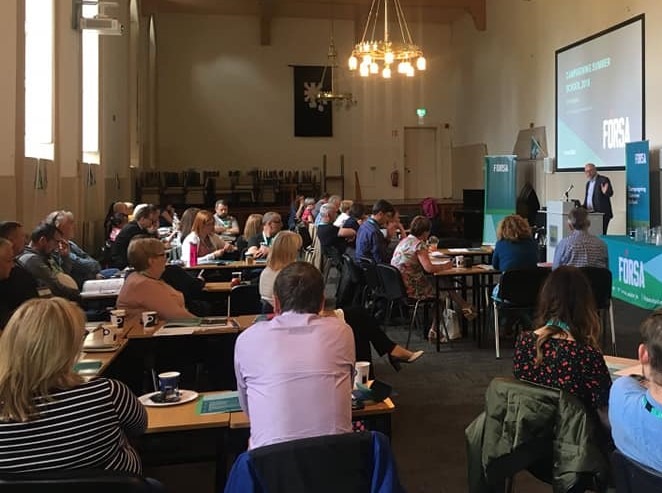
Fórsa is very excited to announce the return of our Summer Series, a two-day event focused on providing our members with the skills, knowledge, and tools to get involved with key union campaigning activity.
This tailored programme is built to enhance activists’ campaigning skills and to build the strength and profile of Fórsa campaigns through meaningful branch participation and activity. This annual event aims to boost the skillsets of Fórsa activists and those interested in further developing their campaigning skills by providing the necessary tools and training.
This year’s summer series will be taking place on Tuesday 10th and Wednesday 11th June in the Radisson Hotel, Athlone. This is an in-person event only.
Our summer school is open to all Fórsa members, but branch campaigns officers are highly encouraged to apply as this programme will be of particular value to them and their work.
The summer series delivers a comprehensive training programme for new and returning activists and specifically provides Fórsa members an opportunity to expand their advocacy skills and networks.
While this event is open to all Fórsa members you should discuss your attendance with your branch before applying.
You can register for the Fórsa summer series here. The deadline to register is Wednesday 30th April.
More information on the event, including a full programme will be published in the coming weeks.
If you have any further questions at this time, please do not hesitate to contact us at summerseries@forsa.ie.
Join a union that wins. Join Fórsa.
 |
|
Calls for greater urgency on overhaul of C&A scheme
by Hannah Deasy
Discussions on a new conciliation and arbitration scheme have been ongoing in earnest since October 2023. Since then, significant progress has been made and broad agreement has been reached on four key elements of a newly re-modelled scheme. However Fórsa is now calling for a renewed sense of urgency.
Discussions on a new conciliation and arbitration scheme have been ongoing in earnest since October 2023. Since then, significant progress has been made and broad agreement has been reached on four key elements of a newly re-modelled scheme. However, the staff side, which represents union members, feels strongly that a renewed sense of urgency is now needed.
In late 2024 it was agreed that an officer of the WRC would be invited to independently chair the General Council, a move which Fórsa felt represented significant progress at the time. However, no invitation has yet been issued. Describing the need to move ahead with this, head of Fórsa’s civil service division Éamonn Donnelly said: “For the staff side it’s clear that the independent chair should be appointed now, rather than waiting any longer. This would demonstrate that the official side are committed to the new scheme.”
While agreement has also been reached between the staff side and the official side on the need to re-design the civil service grievance procedure, a number of key elements remain under discussion. The staff side have argued that the current system of statements and counter statements should be abolished, as they result in inordinate delays. Clear timelines for hearings are needed, and any dispute resolution process should mirror the same principles which govern the state’s industrial relations processes. There must be a route for unresolved grievances to be adjudicated on independently.
Underlining the need for urgency, Éamonn said: “We need to speed things up now on this long running issue. We would like the new scheme to launch in the autumn 2025. Civil servants have been dealing with an antiquated industrial relations system for long enough. We have broad agreement on the principles so it’s time to get a move on and finalise agreement."
Join a union that wins. Join Fórsa.
|
|
Weekend pay for chaplains remains unresolved
by Brendan Kinsella
Irish Prison Service to consider their position following lack of agreement emerging from conciliation meeting.
On Wednesday 9th April, Fórsa official Paul Moyer engaged the Irish Prison Service (IPS) in conciliation facilitated by the Workplace Relations Commission (WRC).
While no agreement emerged from the meeting, the IPS has been given time to reflect on their position.
The dispute centres on remuneration for chaplains in the prison service. Those on seven-day contracts are not receiving compensation for weekend work and bank holidays.
Paul Moyer said: “We hope the Irish Prison Service takes this time to consider their position and comes around on this.”
He continued: “We will take this to the Labour Court if we have to. Our position is supported by the Organisation of the Working Time Act, 1997, and there is precedent.”
The precedent Paul refers to is a previous Fórsa win in June 2024. A chaplain working in the HSE was similarly denied a Sunday premium and sought back pay on wages owed. Back pay was awarded and Fórsa’s legal argument upheld.
The IPS alleges the chaplains' claim is a cost increasing claim. Paul dismisses this argument, stating: “Our members are working Saturdays, working Sundays, working bank holidays, and they are due payment in line with the legislation.”
The IPS has previously claimed that working weekends is now optional for chaplains. They contended that they do not need to provide religious services and therefore have no need of seven-day cover. This would mean chaplains do not need to work weekends or bank holidays if they do not wish to do so.
Paul said: “Sundays are not optional for a chaplain, and by calling weekends “optional” the IPS has ignored the right of people to congregate and worship, especially on religious days. Sundays are seen as a day that mass is held right across this country, so of course that applies to prisons too. They have also issued no instruction to chaplains telling them not to work on weekends or bank holidays. So, the current situation lacks clarity and must be resolved.”
Join a union that wins. Join Fórsa.
“It’s not a coincidence when they go after working people, it’s policy”
by Niall Shanahan
ICTU accuse government of “cowing to business lobbyists” as delays to pension auto-enrolment and living wage announced.
The Irish Congress of Trade Unions (ICTU) has criticised the Government’s decision to delay key measures already agreed that would make life better for working people. These include the delay of pension auto enrolment and a delay to the implementation of a national living wage for three years.
New measures to address business costs, announced by Enterprise Minister Peter Burke this week and welcomed by the employer body, Ibec, include “adjusting” the implementation timeline for the living wage to 2029.
A national living wage, set at 60% of the median wage, was due to be introduced in 2026. Other measures include delays to improve the minimum wage, delays to improve statutory sick leave and another delay to pension auto-enrolment. Congress described the plan as a “shopping list of anti-worker measures.”
ICTU’s social policy officer, Dr Laura Bambrick, said that Ireland is the most competitive economy in the eurozone and that, while Government is right to focus “on maintaining our position,” she said “the decisions they have taken are not about competitiveness. This is government cowing to business lobbyists,” she said.
Fórsa general secretary Kevin Callinan said the new measures showed the Government’s willingness to give in to employer demands without consideration to the impact on working people: “The business lobby had actively pursued these measures throughout the last year, citing high costs.
“However, these measures have now been framed as a response to uncertainty caused by the threat of US tariffs, providing cover for the Government’s capitulation on progressive wage measures.
“Delaying the living wage means the cost saving to business is being underwritten by people who currently earn the National Minimum Wage, which was the first item to be cut by the Government in 2008, following the onset of the financial crisis. It’s not a coincidence when they go after working people, it’s policy,” he said.
Earlier in the week, ICTU’s general secretary Owen Reidy said the new measures were “shameful and unacceptable” revealed that government policy seems to favour employers over low-paid workers, and called for supports for workers who may face short-time working breaks or layoffs due to anticipated economic challenges.
Mr Reidy said competitiveness issues are not caused by low-paid workers, but rather by the Government’s infrastructural failures, such as housing, energy, water and transport.
Speaking on RTE’s Morning Ireland, Mr Reidy added: “You're going to see hospitality workers hit whilst their employers are getting gilt-edged VAT reduction of €650 million. This is the type of stuff you'd expect from the current inhabitant in the White House. It's incoherent. It's chaotic,” he said.
Join a union that wins. Join Fórsa.
If you stay silent, others will decide for you – collective bargaining consultation opens
by Mehak Dugal
A new public consultation on collective bargaining is now open, and your voice matters. Have your say by making a submission.
Fórsa members are being encouraged to share their views on the new public consultation on collective bargaining launched by the Department of Enterprise, Trade and Employment, earlier this week.
The consultation is set to gather views from all relevant stakeholders in relation to Ireland’s national action plan on collective bargaining which should outline how Ireland can progressively increase and promote collective bargaining.
Fórsa will make a submission on behalf of our members to the consultation, and we are encouraging members to also put forward submissions.
Your input will play a key role in shaping the Government’s action plan to promote collective bargaining under the terms of the EU Adequate Minimum Wages (AMW) directive.
To guide members as they navigate the submission process, Fórsa will host an online event on this public consultation on Thursday 1st May. This lunchtime session and will feature contributions from Irish Congress of Trade Unions (ICTU) general secretary Owen Reidy and Fórsa general secretary Kevin Callinan.
You can register for our webinar here.
The Department has already received proposals for possible inclusion in Ireland’s action plan through the recommendations arising from the Final Report of the LEEF High Level Group on Collective Bargaining. The High-Level Working Group was formed in March 2021, and Fórsa general secretary Kevin Callinan was one of the three union representatives to participate in the group. It was established to review the collective bargaining landscape in Ireland and to make recommendations for improvement.
Reflecting on its importance, Kevin stated: “The report was the result of significant work, and it should be implemented in full, not left to gather dust”.
This consultation presents an important opportunity for workers to shape the future of working life in Ireland.
The EU AMW Directive instructs member states with less than 80% collective bargaining coverage to set out a plan to progressively increase and promote collective bargaining, and this consultation is a great opportunity to get involved and make your views heard.
Fórsa national secretary Katie Morgan said: “The EU Adequate Minimum Wages directive is one of the most significant pieces of legislation in recent history. Ireland is an outlier in Europe with weak legislation and a broken industrial relations structure that needs to be fixed as part of this process.
“Fórsa members know all too well the impact of the voluntarist system on the fight for recognition and collective bargaining. We only have to look back to the recognition disputes with Ryanair and Emerald Airlines for examples of when workers were forced to take industrial action to show their power and gain recognition.”
“Today, we are still fighting with employers who refuse to recognise the union. This is unacceptable in the 21st century and can no longer continue. This consultation provides us with a chance to tell government what needs to change. It is incumbent on all of us to create an action plan that fixes our broken industrial relations system.”
Fórsa's director of campaigns, Kevin Donoghue, stressed the importance of member participation in the consultation. “We have a real chance to push for change together and ensure trade union members have a seat at the table now and in the future,” he said.
“This is not only an opportunity to strengthen collective bargaining rights for Irish workers but to demand better protections and greater levels of coverage across the economy. This is your chance to influence that change so don’t miss it. If you stay silent, others will decide for you.”
You can make your submission using the following form: Public consultation on Ireland's Action Plan to Promote Collective Bargaining.
Please ensure your submission is sent by close of business on Monday 12th May 2025.
Join a union that wins. Join Fórsa.
LEEF discussions focus on rising economic uncertainty and remote work
by Hannah Deasy
At the first plenary meeting of the Labour Employer Economic Forum (LEEF) since the formation of the new government, unions call for remote work to be protected, and for discussions to have more concrete outcomes.
The first plenary meeting of the Labour Employer Economic Forum (LEEF) since the formation of the new government, took place on Friday 4th April, chaired by An Taoiseach Micheál Martin.
The LEEF is made up of representatives from the government, employers and trade unions and provides for dialogue on economic and employment issues.
Fórsa national secretary and Irish Congress of Trade Unions (ICTU) Vice President Katie Morgan took part. Speaking after the meeting, Katie underlined the importance of the discussions at the LEEF whilst also emphasising the need for agreed outcomes from these meetings.
“While it’s important that a forum like the LEEF exists to bring unions, government, and stakeholders together, it must become more than a consultative space. Given the scale of the challenges we face collectively, it is imperative that we strive to reach agreed outcomes, and that government takes action to achieve these.”
“There was an update on how the government intends to meet its obligations to implement the EU Adequate Minimum Wages Directive, as well as discussion on a national approach to remote and blended working, and how best to develop a ‘whole of society’ analysis of the benefits of remote working.”
She continued: “We feel strongly that this approach is necessary given the positive impact blended work has had on reducing carbon emissions, increasing rural development, assisting higher participation of women in the workplace and providing a better work-life balance for people with caring responsibilities, to name just a few. The programme for government commits to promoting and supporting remote working, an objective which unions share.”
In advance of the meeting, Fórsa general secretary Kevin Callinan wrote to the Taoiseach underlining the union’s view that remote work has benefitted all of society and urging the Taoiseach to ensure a “robust evidence base” underpins any review of remote work.
He said: “Our members have consistently expressed their strong support for remote and hybrid working arrangements, highlighting the hugely positive impact the arrangements have had on both their working and personal lives. It has boosted wellbeing, supported carers to better manage their care responsibilities outside of work, and has enabled people to participate in their local communities.”
He continued by outlining the ways in which remote work has enabled government to mitigate societal challenges, citing the impact it has had on: “accommodation shortages in our cities and surrounding areas, reducing transport-related carbon emissions, and in enabling balanced regional development through the revitalisation of our rural towns and villages. These benefits, alongside the many other economic, social and environmental benefits must be thoroughly explored in any review of remote and hybrid work.”
In the Taoiseach’s response he stated he is “confident” that the principles of constructive engagement with stakeholders, and effective public service delivery will be part of any review, which will also “be informed by any relevant and available evidence.”
Research released this week by employers’ federation Ibec adds to the mounting body of evidence indicating that blended and hybrid working arrangements bring great benefits. 68% of respondents said that flexible work was “key to their well-being” and 35% said they would leave a job that wouldn’t accommodate hybrid working.
International economic turmoil occupied much of the meeting, which took place before the US decided to pause the tariffs announced earlier in the month.
A government statement after the meeting said: “All sides acknowledged the challenging global and geopolitical landscape and the associated risks to the economy and labour market.”
“Perspectives were shared by the employer and trade union representatives on how best Ireland can collectively respond, as a member of the European Union, to these developments.”
Join a union that wins. Join Fórsa.
Ireland’s “shameful” disability employment gap
by Brendan Kinsella
Following reporting in the Financial Times, general secretary Kevin Callinan calls on Government to address shameful gap in employment between disabled people and general population.
The gap in employment rates between disabled people and the general population has been thrust into the spotlight by coverage in the Financial Times. According to the article, Ireland finds itself in the unenviable position of having the largest gap in the Organisation for Economic Co-operation and Development (OECD), surpassing perennial laggards such as the United States.
Fórsa general secretary Kevin Callinan took to social media to call the gap “shameful.” He excoriated the Government saying they have “choices to make.”
The Financial Times compared Ireland to Chile. Despite being a smaller economy with lower overall employment, Chile has a significantly smaller gap between disabled and general employment rates. The gap was largely credited to government policy, with Chile’s 2018 Labour Inclusion Act receiving the lion’s share of plaudits. The Act places a quota on large organisations requiring one percent of staff to be registered disabled workers.
The issue of quotas was raised at Biennial Conference last year. Presenting a motion to increase the public sector’s minimum statutory employment target, Fórsa Youth member Brian Dooley said: “The public sector is a leader in employment issues. If we start by requiring public sector organisations to hire disabled staff members, proportional to our existence in the Irish population, we can show inclusive workplaces work.”
Echoing Brian, Kevin said “Government have the ability to shape the labour market, through their own employment practices and through legislation. This needs to be a wake-up call to look at their policies and make the changes needed, because where we are right now shames us all.”
Quoted in the article, Emer Begley, director of advocacy and inclusion at the Disability Federation of Ireland, pointed to the issue of the lacklustre uptake of existing government programmes such as the Work and Access programme.
She cited a reluctance amongst disabled people “to even name the reasonable accommodation they need” as being among the reasons for low uptake. She explained that disabled people often have to fight hard for accommodations when they do name them.
This experience was reflected at Biennial Conference by Grace Doyle of the Meath health and local government branch when she described the experience of seeking accommodations as “hitting a brick wall”.
Begley also took aim at the social welfare system, which does not take into account how disabled people engage with work. Depending on a person’s disability, they may drop in and out of work or prefer to work part-time. This requires giving up Disability Allowance (DA), which is subject to a means test and one of the more difficult payments to successfully apply for. Giving up the disability allowance also means losing access to benefits such as free travel or their medical card. She said: “They may be able to work, but it’s actually that barrier of losing benefits that keeps them out of the labour market.”
Echoing these points, organisations such as the Irish National Organisation for the Unemployed (INOU) have for some time claimed rigidity in disability allowance further discourages disabled people from entering the workforce.
According to the INOU, if a disabled person is unsure whether they are able to work but wishes to trial working part-time, they can switch from DA to a part-time unemployment payment. If they then find part-time work is beyond their capabilities, they will have to reapply for DA and risk the period of part-time employment counting against their claim.
In January of this year, Fórsa’s Disability Matters Working Group delivered its recommendations to the union’s National Executive Committee. These recommendations form the outline of Fórsa’s campaign to improve the conditions of disabled workers going forward.
Details of the Disability Matters Working Group’s recommendations were previously covered in the members’ bulletin; you can read them here.
Kevin concluded by saying: “Supporting disabled workers has from day one been part of our mission at Fórsa. We are proud that our disabled members have led on this, telling us what they need.”
He emphasised, “Disability is not inability. Our members show this in their work every day. As a country, we can and must do better.”
Join a union that wins. Join Fórsa.
|
|
|
|