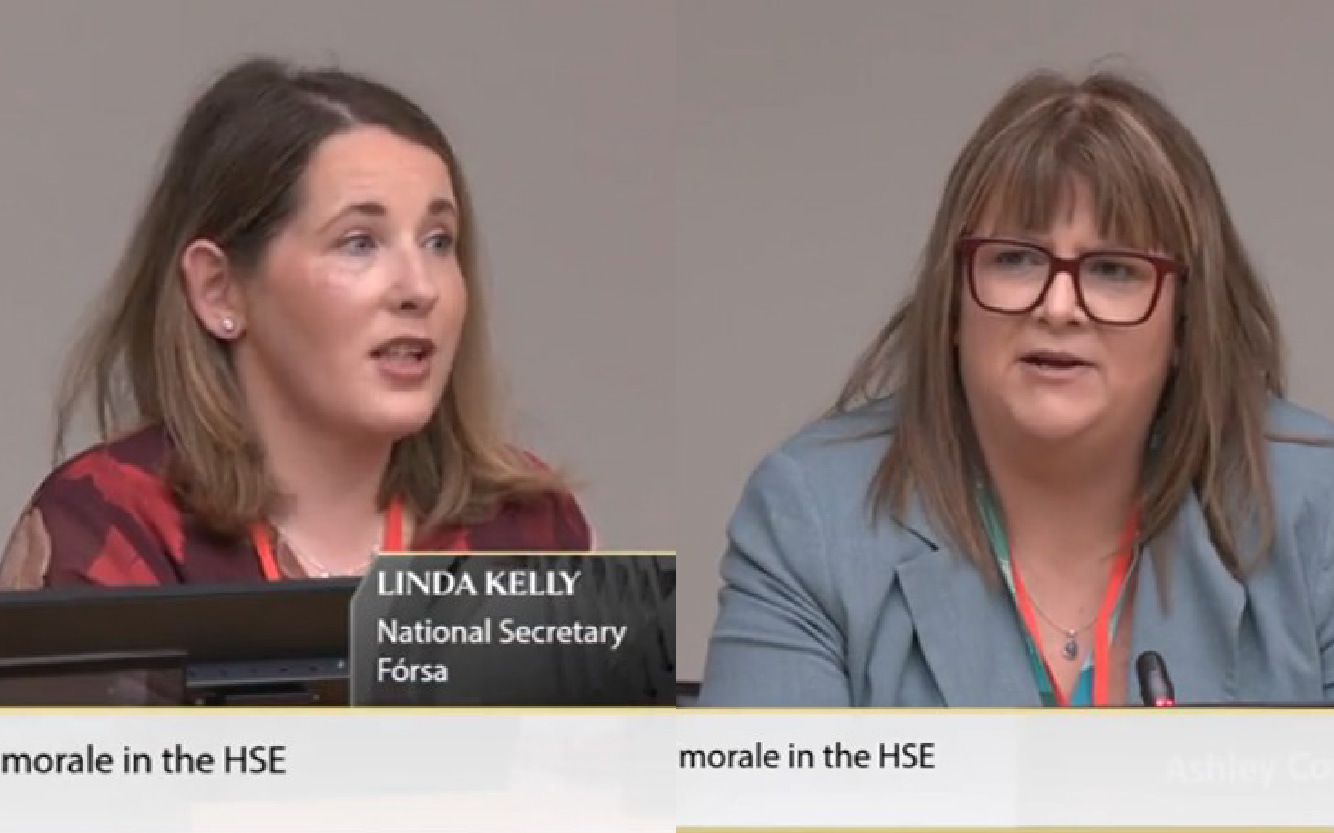
On Wednesday national secretaries Ashley Connolly and Linda Kelly addressed the Joint Oireachtas Committee on Health on morale among the health and social care professional workforce. They were joined by Clodagh Kavanagh, Chair of the health and welfare division and members of the Divisional Executive Committee (DEC).
The research was carried out by TASC and is based on a substantial body of evidence: 3,775 workers responded to a national survey and 24 workers took part in focus groups.
You can read the full report here.
Speaking ahead of the Committee meeting, head of the health and welfare division Ashley Connolly, said: “We are raising the alarm about the very serious challenges affecting morale across the health and social care workforce.”
National secretary Linda Kelly told the committee that the central message from the research is clear, saying: “Low morale is not a marginal staffing issue; it is affecting retention, service capacity, patient care, and confidence in the delivery of Sláintecare.”
During their contribution Ashley and Linda also called for clarification regarding what constitutes “non-critical, non-front line” posts.
Ashley said: “Two weeks ago, we learned, without warning, that the HSE was to reimpose recruitment restrictions yet again. To do so during a morale crisis as serious as this is nothing short of irresponsible, given the knock-on impact the non-filling of posts has for those who remain in their roles, doing their best to provide services to patients as the pressure continues to grow.”
She continued: “We can’t stand over any attempt to pit worker against worker. Every day in hospitals around the country staff from all teams work together to provide patient care. Further undermining staff resources in clerical and administrative roles will have a detrimental impact on patients. The HSE must urgently clarify why it feels that pausing recruitment will solve any of the very serious problems facing the health service.”
To address the persistent issues of appropriate funding for adequate staffing, Ashley and Linda said there was an urgent need to move to a multi-annual funding system based on the needs of the population, rather than “an arbitrary number decided by the Department of Public Expenditure”, warning that it would be impossible to deliver on the promise of Sláintecare without such a move.
The union is calling for a series of practical measures to be implemented to address the morale crisis.
Linda outlined the measures, saying: “First, staffing levels should be assessed based on local need, with routine cover for maternity leave and faster recruitment to cover long-term absences.
“Second, retention strategies should be focused on sustainable workloads so experienced staff stay in post. Third, pay equity must be improved, particularly for workers in the community and voluntary sector, and finally consultation with workers must be increased to improve decision-making.”
Ashley added: “This report tells us what we already know - that understaffing, poor retention, weak consultation, and pay inequities are creating a vicious cycle. Experienced staff leave, pressure grows on the workers that remain, morale worsens and services become even harder to sustain.”
Watch back the Oireachtas Committee meeting here.
Join a union that wins. Join Fórsa.





 Like
Like


