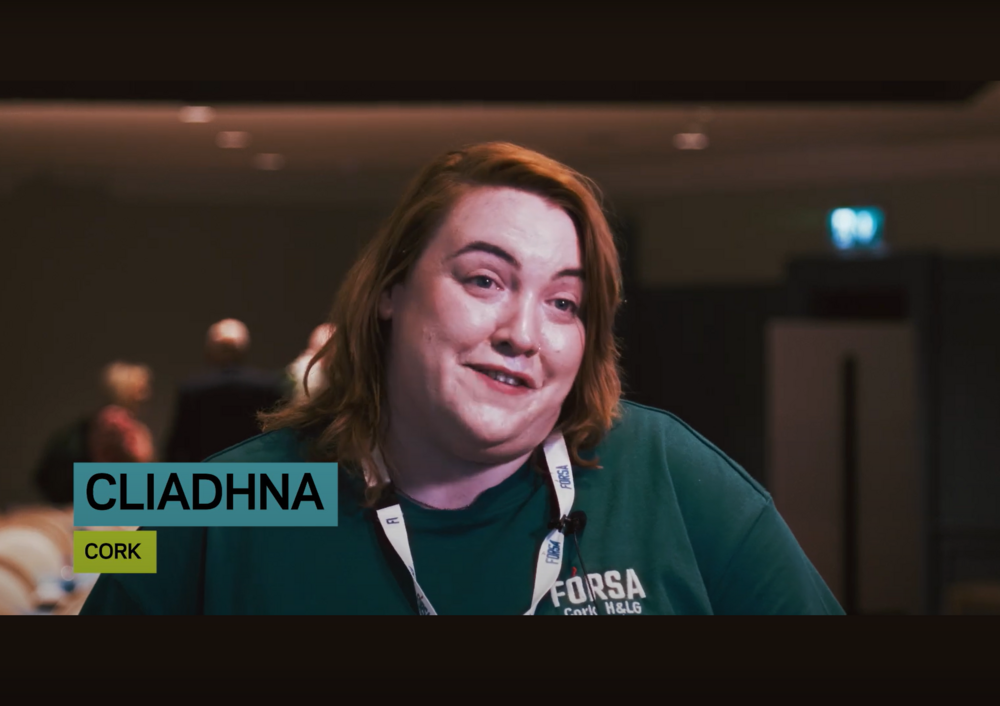
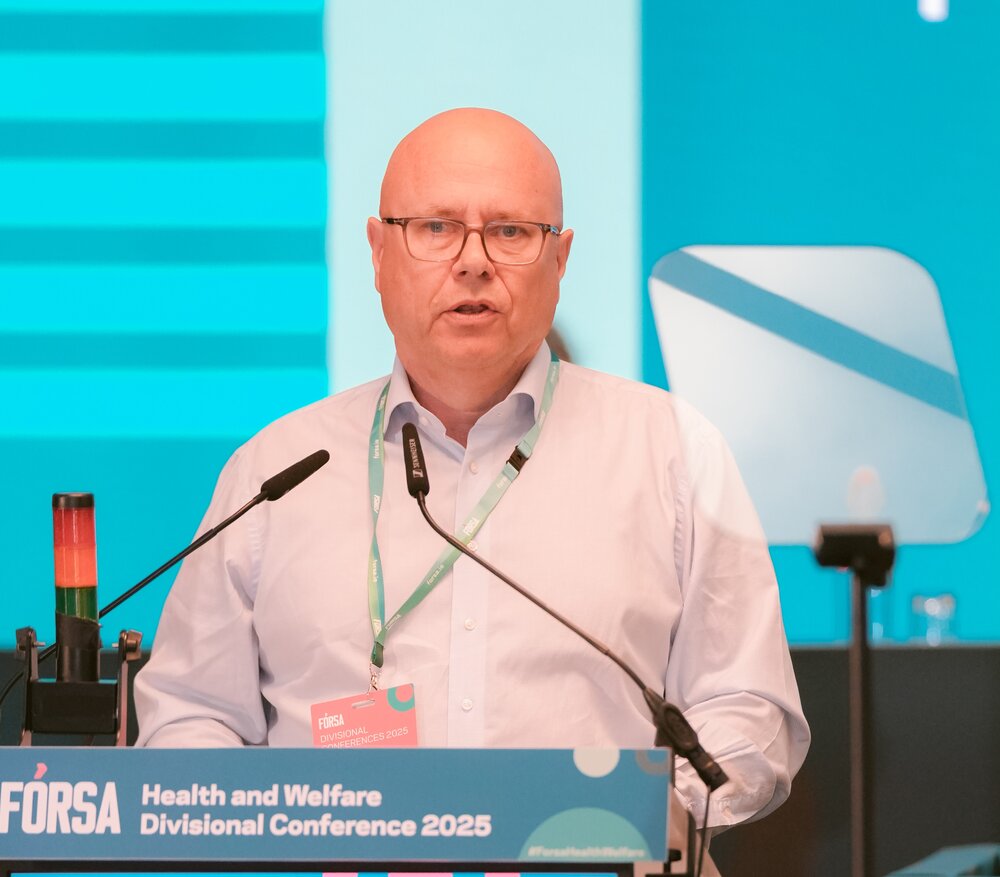
Watch our video recaps of the recent Health & Welfare and Local Government conferences
The Local Government and Local Services and Health and Welfare divisional conferences took place in Letterkenny last week, running from Wednesday 14th May to Friday 16th May.
Energy ran high as delegates converged to shape policy and strategy for the coming years.
Members in Fórsa's health and welfare division shared frontline realities. Delegates told stories of poor morale, terrible conditions, and being forced to work in cars or kitchens. But it wasn’t all complaint, as motions were moved, solidarity flowed, and a huge camaraderie swept the room.
Cathaoirleach Clodagh Kavanagh opened the conference by reaffirming union values of justice and solidarity. Head of division Ashley Connolly issued a rallying call to press on for pay justice in the community and voluntary sector.
The findings of a Fórsa-commissioned TASC report showed 68 percent of health workers rate staff morale as low or terrible. Members spoke passionately about the impact of outsourcing and fragmentation on patient care. Real union strength comes from deep conversations, local fights, and national solidarity. We are not waiting. Our members are building power, one member, one workplace at a time.
At the Local Government and Local Services conference there was a clear buzz around core issues including job evaluation, fair pay, housing, staffing levels, and resisting outsourcing. The atmosphere was charged with purpose as debates unfolded and motions passed. Head of division Richy Carrothers made a surprise announcement of major progress on job evaluation.
Members shared frustrations, hopes, and a deep determination to drive change. Many remarked how attending conference replaced isolation with solidarity, giving them a renewed sense of empowerment and momentum.
Speakers condemned the harmful impact of privatisation and the rise of far-right rhetoric, calling instead for investment in public services and a strong, secure public sector. They championed local government as the bedrock of daily life and a space where progressive values can thrive.
A key takeaway from the closing message from general secretary Kevin Callinan was the power of collective action and the simple idea that when working people organise together in solidarity, they become a beacon of hope and a powerful force for lasting change.
Due to a technical issue with an external service provider, emails sent through the Fórsa website contact form were not delivered between 12th May 2025 and 19th May 2025. This issue has now been fully resolved.
If you did not receive a response to a query submitted through the website contact form during that period, please do send it again. Any other emails to Fórsa were not impacted.
We apologise for the inconvenience and have put measures in place to ensure it does not happen again. Many thanks for your understanding.
Explore the full 2025–2026 calendar and see what’s coming up.
The Fórsa Skills Academy has launched its brand-new training calendar, running from September 2025 to August 2026, and it's filled with a wide range of opportunities for professional growth, union empowerment, and personal development.
Designed in response to the interests and priorities of Fórsa members, this year’s programme is built to equip activists, representatives, and members with practical tools to thrive both in the union and beyond.
Fiona Dunne Director of Membership Training and Development said: “We’re delighted to share this calendar with our members. We’ve shaped this programme by listening to what people need — in their union roles, and in their everyday lives. Our aim is to create a learning space that’s relevant, engaging and empowering.”
Courses range from workplace essentials to leadership development and include both in-person and online options. Here’s a snapshot of what’s on offer:
Branch Chairs and Secretaries training – learn everything you need to know about running effective meetings and organising your branch.
Time Management – This course delivers practical strategies with immediate impact, including effective planning, task prioritisation and smart goal setting.
Resilience Building Workshop – a course that provides tools and templates to build personal resilience and reduce stress.
Public Speaking, Communications and Digital skills training – we now have three exciting courses that cover all aspects of communication!
Regular favourites Fórsa Induction and our monthly Lunch and Learn will return and run throughout the next training year.
Details of upcoming courses, along with application forms, are emailed directly to each branch chairperson, secretary, and training officer 4–6 weeks in advance of the training dates. Courses are also promoted in Fórsa’s fortnightly member bulletins. Registration links for the new calendar will be issued from mid-June.
We know life gets busy, that’s why we’re sharing the full calendar now, so you can plan ahead and make space for your upskilling and development throughout the year.
Live this month: Lunch & Learn - Fórsa Mentoring Programme - Friday 30th May – Online
The Fórsa mentoring programme, launched at the union’s biennial conference in 2024, is an initiative to supplement training provided by the Skills Academy and provide support and encouragement to our trained representatives who might require some additional guidance to build confidence whilst implementing their learning.
For our May Lunch & Learn session scheduled for Friday 30th, we’ll hear directly from past participants of Fórsa’s mentoring programme about what worked well and how it benefited them and their workplaces. Our external programme facilitator will also speak on how mentoring strengthens union capacity and creates long-term value for Fórsa.
Take this opportunity to be inspired, build your confidence, and see how mentoring can support your journey — register now and get involved!
The recent Australian elections showed that working from home is now an election issue around the world. In this opinion piece, published in the Irish Examiner on Tuesday 13th May, Fórsa general secretary Kevin Callinan calls on the government to initiate a major study looking at the benefits of remote work.
The recent Australian elections showed that working from home is now an election issue around the world. In this opinion piece, published in the Irish Examiner on Tuesday 13th May, Fórsa general secretary Kevin Callinan argues that we need real data to inform future policy. Fórsa is calling on the government to initiate a major study looking at the benefits of remote work, and how to embed sustainable hybrid policies.
The Australian Liberal Party's opposition to working from home, a policy that proved so unpopular that it was reversed mid-campaign, is widely believed to have contributed to its defeat in the recent general election.
Speaking as the scale of the outgoing government's victory was becoming apparent, Labor Senator Deborah O'Neill expressed disbelief that the Liberals had sought to cut back working from home.
"Do they have no idea what it's like to be a modern family?" she said. Referring to the expectations of many young people to have the option to work from home, she went on to say: "There's a productivity agenda here for families and society as well as for the economy".
There's an important message in this for other governments. In Ireland, the current Programme for Government is noticeably silent on the subject when compared to the commitment in the previous programme to a 20% target and to the Make Remote Work policy.
It's difficult not to conclude that some politicians are more concerned with mimicking the DOGE agenda in the United States and having a go at what is often mistakenly perceived as an almost exclusively public service phenomenon.
At April’s Labour Employer Economic Forum (LEEF), understanding the importance of the availability of flexible working arrangements to attract and retain the best talent, employer representatives supported the trade union call for an in-depth examination of all the issues involved in working from home.
There are concerns expressed about the health, safety, and welfare of staff operating in isolation, and about the ability of organisations to harness the energy that can come with physical team gatherings. There’s also concern about the negative career trajectories for women that could be a consequence of home working.
These are challenges that call for good management, and they are all issues that can be addressed. It would be a mistake to throw the baby out with the bathwater.
The Covid experience has shown conclusively that remote working can be successful, and productivity can be improved, not just maintained. As recent statistics show, younger workers are voting with their application letters and CVs, favouring opportunities that provide for remote, hybrid, or blended work.
Decisions should be based on evidence, not on whether it's inconvenient for those in charge to manage. This appeared to be at play earlier this year, in moves to reduce working from home in parts of the civil service. These changes should be suspended to allow a comprehensive review to be conducted. We need real data to inform future policy.
Any assessment must also extend to the broader societal and ecological issues. For those of us who cannot work from home, it's not in our interest to have additional traffic on the road adding to our already lengthy commutes and to atmospheric pollution and the carbon footprint.
We all benefit, however, from the growing evidence that, by avoiding wasted travelling hours each day, people who work from home have time to give to their local schools, sports clubs, and communities, not to mention to their families.
It is ironic that the loudest voices railing against working from home have been from some regional independents. Perhaps this is driven by frustration with service delivery. If so, this should be dealt with on the merits of the case, whether it's due to a failure of management, inadequate resources, or something else.
There can be little doubt that working from home is making a real difference in rural Ireland and that, with proper planning, it has the potential to be transformational. The people using regional remote working hubs, now based in many towns and villages, and those working in home offices, represent a market for local shops and businesses that would otherwise be elsewhere.
There is too much at stake for working from home to be seen as just a Covid phenomenon. If we get it right, this can be central to our economic and social prosperity. We need to recognise that and resist the trendy opposition to it that we see in parts of the political and corporate world.
The government should seize the initiative, arising from the Labour Employer Economic Forum, to propose terms of reference for a major study. To fail to do so would be an enormous own goal. Like in Australia, there could be a political price to be paid too.
To date Fórsa has submitted three cross-sectoral claims, and has now called on DPENDR to set a date for formal discussions to begin.
On Monday 19th May, deputy general secretary and head of the civil service division Éamonn Donnelly wrote to the Department of Public Expenditure, NDP Delivery and Reform urging them to set a date for formal discussions on local bargaining to begin.
In the letter, Éamonn refers to the timelines outlined in the Public Service Agreement 2024-2026, which state that pay increases achieved through local bargaining should start to be implemented by 1st September 2025.
Fórsa has now submitted three core claims related to civil service grades, which cover Clerical Officers, Executive Officers, Higher Executive Officers, Administrative Officers, and Engineer Grades 1, 2 and 3. These claims are also cross-sectoral, given they encompass a range of equivalent and related grades across the public sector. This will be reflected in representation in formal discussions.
Speaking about the letter, Éamonn said: “It’s been quite some time now since we submitted these claims and it’s essential that we begin formal discussion soon. Thousands of our members are impacted by these claims, and it isn’t fair to leave them in the dark. This process was part of the Public Service Agreement negotiated last year, and it must be honoured.”
The Association of Higher Civil and Public Servants (AHCPS) has now also submitted two claims on behalf of its members at assistant principal and principal officer grades.
Some Fórsa members in management grades within the non-commercial state agencies (NCSAs) are connected to the civil service assistant principal and principal officer grades.
Head of the services and enterprises division, which is the division for members working in NCSAs, Katie Morgan said: “We will monitor developments surrounding the AHCPS claim and the impact it could have on Fórsa members linked with these grades.”
Underlining the need to move the process forwards, Fórsa general secretary Kevin Callinan said: “This new form of national bargaining has the ability to address specific challenges and pay issues related to grades, groups and categories. We got it included in the agreement because we knew members needed a mechanism to address issues that have built up over time.”
“Time is now moving on, and even though we submitted our first claim over six months ago we still haven’t heard anything tangible back from the Department.”
Read more about the claims submitted to date in these articles:
Delegates will gather to debate motions, set policy and elect a new DEC. The union's services and enterprises division represents more than 7,000 workers in commercial and non-commercial semi-state organisations, in addition to private companies in aviation and communications.
Fórsa trade union will host two divisional conferences next week at the Galmont Hotel, Galway, between Monday 26th May and Friday 30th May.
Fórsa’s services and enterprises division conference takes place from 3pm on Monday 26th May and concludes at 12 noon on Wednesday 28th May.
The services and enterprises division represents more than 7,000 workers in commercial and non-commercial semi-state organisations, in addition to private companies in aviation and communications.
Policy motions up for debate at conference include outsourcing of work by non-commercial state agencies, the planned restructuring of the Road Safety Authority (RSA), the employment of driver testers and waiting times for driving tests, and the protection of remote and hybrid working arrangements.
Fórsa has launched a survey for Land Development Agency (LDA) staff, aimed at strengthening the union’s understanding of workplace issues and promoting the benefits of union membership.
Fórsa has launched a survey for Land Development Agency (LDA) staff, aimed at strengthening the union’s understanding of workplace issues and promoting the benefits of union membership. Take part in the survey and share it with your colleagues.
Fórsa has been engaging with the employer to formally establish an agreement that would allow the union to represent members on collective matters such as pay, terms and conditions. Although the union recently had a positive meeting with the CEO, the employer is currently refusing to agree to this, and Fórsa has sought the assistance of the Workplace Relations Commission (WRC).
Fórsa official David Field said, “It’s been a frustrating number of months trying to engage with LDA management to establish normal industrial relations within the company. Management has been avoiding a meeting and refusing to allow us to enter the workplace to meet with our members and potential members.”
“We have been engaging with members remotely and off-site to ensure we can answer any questions they may have, and we want to deepen our understanding of workplace issues with the launch of this union survey for all LDA staff.”
David continued: “Fórsa has a broad membership across local authorities, state agencies and private sector employments, and represents a diverse range of professions, including planners, architects, engineers, management, inspectors and administrative staff. We assist our members and activists in negotiating improvements to their pay, terms and conditions and delivering real wins for workers. We want to help our members in the LDA achieve similar improvements in their workplace, something that management are unfortunately trying to obstruct.”
Fórsa national secretary, Katie Morgan said, “It is disgraceful that a state funded body is refusing to recognise the union for collective bargaining. The employer may think that stopping officials from entering the premises or refusing to meet the union will stop the workforce from organising, but we will continue our efforts to support members and LDA staff.”
“We’re asking all Fórsa members who liaise with LDA staff, or know them personally, to share the survey with them and share messages of support or solidarity.”
Please feel free to share this survey with other LDA colleagues.
A ballot of Fórsa members working as Community Employment (CE) supervisors closed at midday on Wednesday 21st May. 90% voted to accept the pay offer.
A ballot of Fórsa members working as Community Employment (CE) supervisors closed at midday on Wednesday 21st May. 90% voted to accept the pay offer.
The ballot of SIPTU members working in the same sector is ongoing. When it closes, the votes will be aggregated, and results will issue from the Irish Congress of Trade Unions (ICTU) to the Department of Social Protection.
This pay deal resulted from negotiations between the Department of Social Protection (DSP) and an ICTU led group of unions representing workers in the Community Employment sector.
An interim pay deal which was approved by members in a ballot late last year, included an agreement that unions and the department would re-enter talks at an early date this year.
This new agreement is a result of those talks. The pay increases on the table amount to 5.25% to be paid across 2025, with an initial 3.25% increase backdated to February, and a further 2% increase, which would be effective from the 1st of November.
The terms of the agreement apply to all CE Supervisor members, and members working at the Tús initiative, the Rural Social Scheme, and the Job Initiative scheme.
The European Transport Workers’ Federation (ETF) has launched a new survey to gather real stories from women on the front lines of transport work.
Are you a transport worker who has faced violence or intimidation at work? Are you a woman? Then this survey is for you.
The European Transport Workers’ Federation (ETF) has launched a new survey to gather real stories from women on the front lines of transport work. The aim is to collect testimonies directly from women working in all areas of the transport sector.
This survey is more than just data collection, it’s about building strong evidence to push employers, governments and institutions to take concrete action, informed by the reality of women transport workers.
Take the survey here and help build a safer transport industry for all.
If this doesn’t affect you directly, but you know a woman working in transport who has been affected, please ask them to fill out this important survey.
Fórsa national secretary and head of the union’s services and enterprises division, Katie Morgan, said: “Every single woman in the transport industry deserves to work without fear. This ETF survey is your chance to contribute to the collective demand to stop violence and harassment against women transport workers. Violence and harassment are sadly part of daily life for far too many women in the transport sector. Women continue to face abuse, intimidation and harassment for simply doing their jobs. And yet, too often, their voices go unheard, their experiences are dismissed, and this problem is ignored. Together, we can demand safer workplaces for every woman in transport.”
The ETF said: “As we all know, violence against transport workers has been on the rise since the recent pandemic. This must end. Together we can make a change. For this reason, the women's committee of the European Transport Workers' Federation has decided to conduct the survey ‘Violence and harassment against women transport workers’. Although we know that all transport workers suffer from violence, this survey is specifically for women transport workers, and we kindly ask you to support it. Your voices and real experiences are essential in helping the ETF expose the extent of the problem and fight for safer, fairer workplaces.”
If you would like to fill in the survey in a different language, you can choose from several options available here.