Fuel crisis demands problem-solving approach as unions meet Government
by Niall Shanahan
Discussions on remote work, and other options to address the fuel crisis, are taking place today between Fórsa and the Department of Public Expenditure, as unions push for relief measures.
Trade unions stepped up engagement with Government in response to the escalating fuel crisis, with last week’s meeting of the Labour Employer Economic Forum (LEEF) marking a renewed focus on coordinated action across unions, employers and the State. The LEEF is currently Ireland’s principal national forum for dialogue between government, employers, and trade unions.
The Irish Congress of Trade Unions (ICTU) used the meeting to press for both immediate relief measures and longer-term policy responses to address rising fuel and living costs. Fórsa deputy general secretary Katie Morgan was part of the delegation, which proposed targeted supports for workers, in addition to greater flexibility in remote and hybrid working to offset commuting pressures.
The strong message from unions was that consultation must translate into practical measures that ease the burden on working households. There was also a clear warning that if engagement through the LEEF does not deliver practical outcomes, unions will be forced to consider next steps to protect members’ interests.
This has been reinforced by a strong media and public response to Fórsa’s call for “urgent remedial action” on workplace attendance during the crisis. Following coverage in the Irish Independent, the issue gained further traction across national outlets, including The Journal and a series of radio discussions on RTÉ and regional stations.
Deputy general secretary Éamonn Donnelly spoke on RTÉ radio about the need to adopt practical solutions to the continuing uncertainty over fuel supplies and cost. He made the case for expanded remote working, where operationally feasible, as a practical and immediate tool to reduce fuel demand, ease congestion, and protect service continuity. He highlighted that this could be achieved with no loss of productivity and no additional costs to the employer.
Discussions on remote work, and other options to address the fuel crisis, are taking place today (Friday) between Fórsa and the Department of Public Expenditure. Fórsa has continued to position hybrid working as a common-sense response to current conditions, as well as proposing emergency suspension of the provisions in the travel and subsistence circulars which move travelling officers into lower band rates, and exploration of relief measures to offset the unsustainable cost of getting to work when 'in-office' attendance is required.
The wider implications of the crisis are also emerging across the education sector. Dr Paul Davis, writing in The Irish Times on Wednesday, warned that sustained fuel disruption could see a return to remote learning later this year, and called for urgent “energy-resilient planning” across schools and colleges to safeguard continuity.
In aviation, uncertainty around global fuel supply continues to affect operations. Fórsa learned this week that Aer Lingus has paused the airline's intake of trainee cabin crew, alongside schedule adjustments linked to operational pressures. The developments highlight the broader economic risks associated with fuel volatility, reinforcing the need for coordinated policy responses that protect both workers and essential services.
Join a union that wins. Join Fórsa.
 |
|
Share your Trade Union Week stories with us
by Brendan Kinsella
Biggest and best Trade Union Week takes place next week!
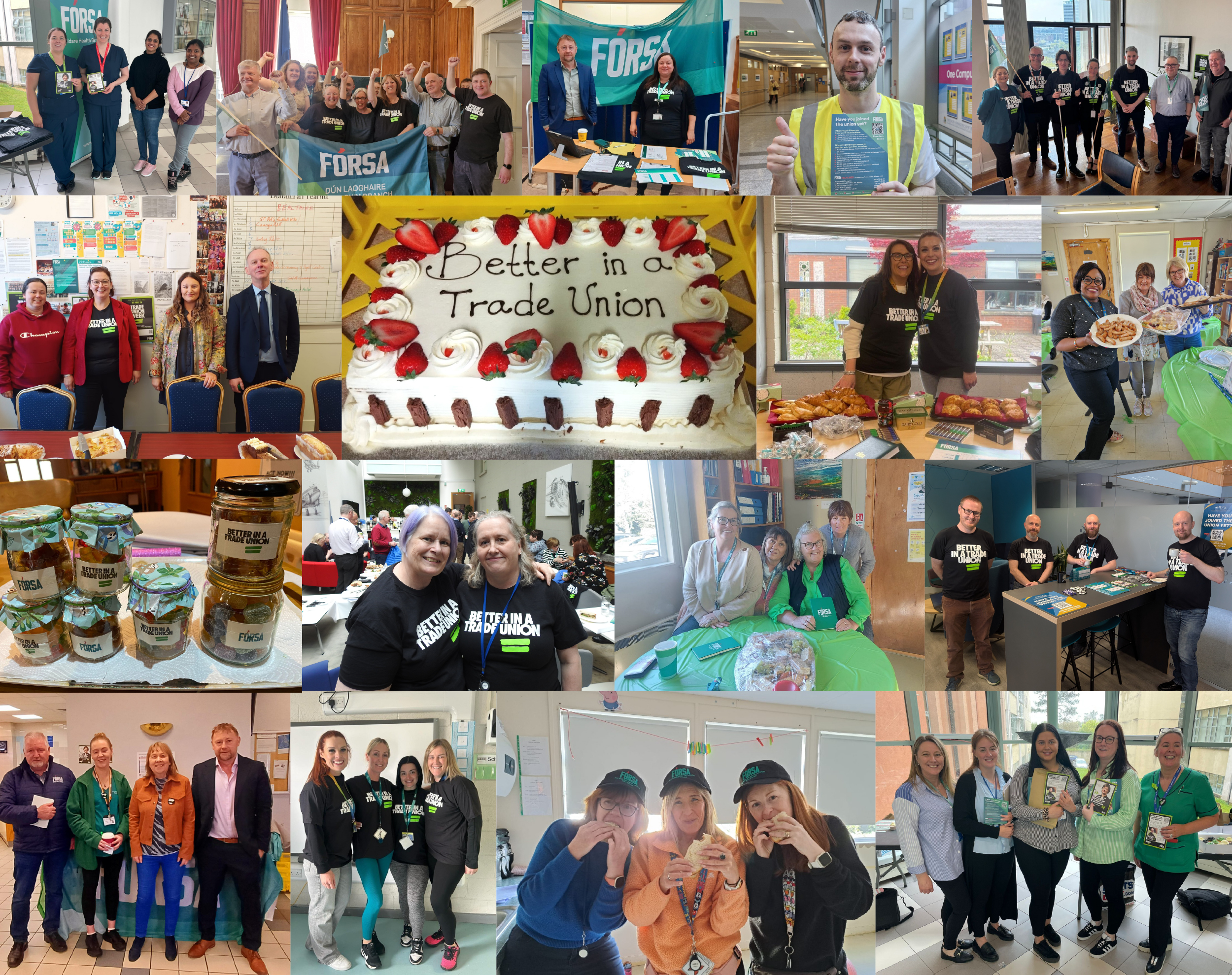
As Trade Union Week is almost upon us, Fórsa is calling on all members to share photos of their workplace events next week.
You can send us your photos via email at photos@forsa.ie or on WhatsApp at 087 188 2589 and we will share as many as we can on our social media. You can also share on your own social media using the hashtag #TradeUnionWeek.
This year’s Trade Union Week promises to be the biggest yet. Branches have confirmed over 130 events planned in workplaces across the country, a new record for participation.
The week begins this coming Monday 27th April, and will come to a close on May Day, Friday 1st May, when we have a big day planned, including a screening of a new documentary on James Connolly, followed by the Dublin Council of Trade Unions annual May Day march and a gig afterwards.
Encouraging members to send in photos Kate O’Sullivan, Fórsa’s director of digital, said: “Every year we get photos in from our members, and it’s great to see and share how everyone comes together to celebrate Trade Union Week.”
“I can’t wait to see what members get up to this year. Send in your photos and let’s show how active our members are in their workplaces.”
Email your photos to photos@forsa.ie or on whatsapp us at 087 188 2589
Join a union that wins. Join Fórsa.
One fine May
by Brendan Kinsella
Registration open for upcoming courses.
Registration has now opened for the Skills Academy's May courses.
Branch Treasurers training - Thursday 7th May - Nerney’s Court, Dublin
Becoming Branch Treasurer can be an overwhelming experience. It is a role that comes with a very important set of duties and responsibilities that can be difficult to pick up on the job. This training is open to Treasurers and Vice-Treasurers so they can hit the ground running, know what to do and when to do it.
Due to the popularity of the course, a second Nerney’s Court date is available later in May, on Thursday 21st of the month.
Keep your branch’s finances healthy and save yourself time and stress.
Fórsa Induction - Wednesday 13th May - Online - Open to all new members
A short welcome session for new members. Fórsa induction will peel back some of the mystery of how we work as a union and how you can become more engaged, have your voice heard locally, and raise issues at divisional and national levels.
There are morning and evening sessions available to fit your schedule. So, if you’re a new member, wondering what you’ve become part of, or looking to become a union activist make sure to join this session.
You can register for Fórsa Induction here.
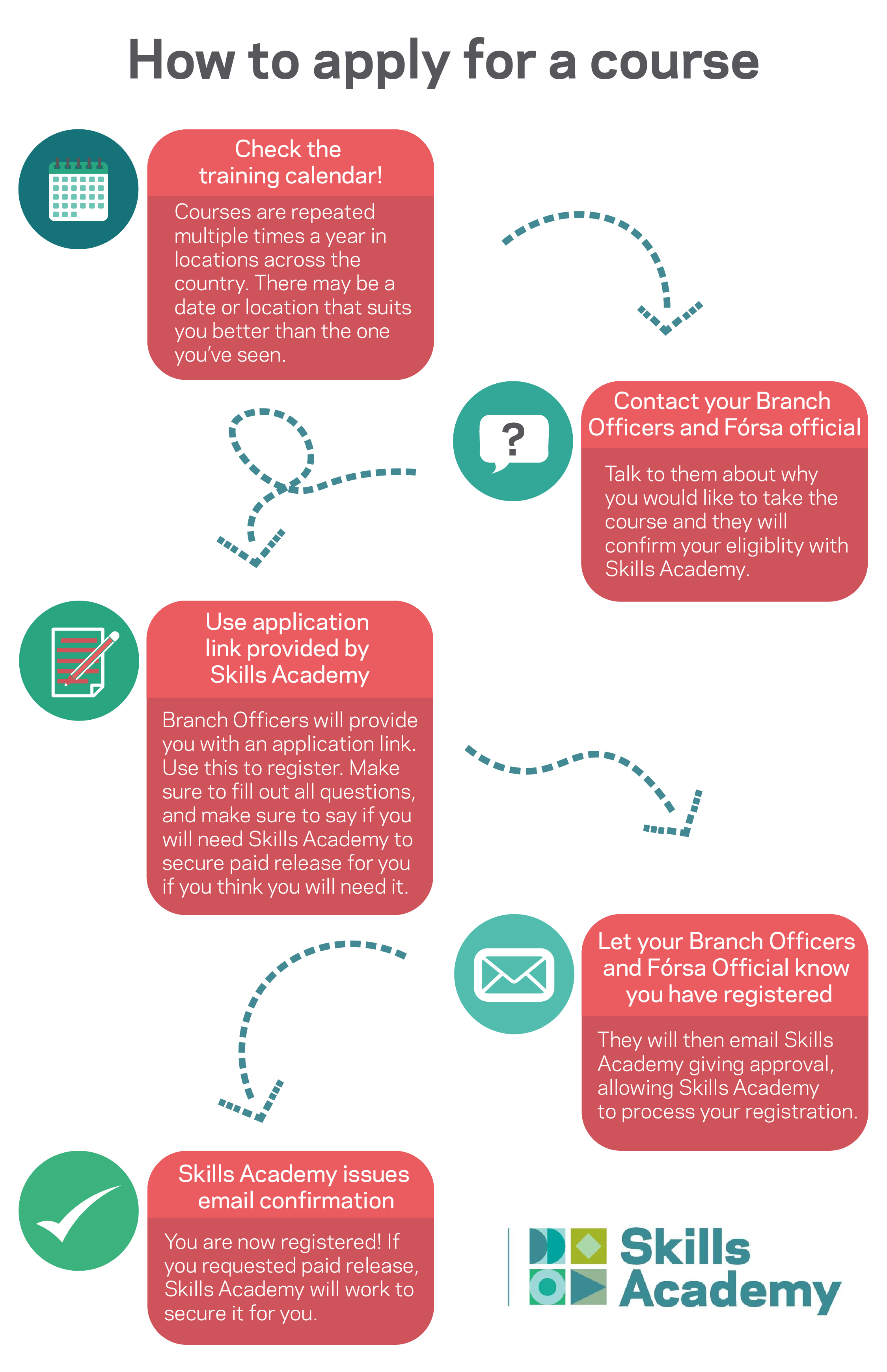
To register for a course:
Aside from Live: Lunch & Learn and Fórsa inductions, participation on all courses requires sign off from your branch and official. To apply, contact your branch training officer or secretary if your branch does not yet have a training officer.
Join a union that wins. Join Fórsa.
Summer Series 2026: Limited places remaining!
by Mehak Dugal
Don't miss your final chance to register.
This is your final chance to register for Summer Series 2026, a practical, skills-based training where you’ll learn skills you can bring straight back to your branch and workplace.
This year’s event is shaping up to be a focused, practical two days built around the skills Fórsa activists need to organise, communicate, and win. Places are limited, and they are filling up fast.
On day one we’ll kick off with a shared session on Political Economy, grounding our work in the bigger picture of how power and resources are organised.
From there, you can choose from hands-on sessions designed to strengthen your branch campaigns. On day one you can pick from:
- Member activation
- Branch newsletter development
- Using research effectively in campaigning
Day two is all about building core activist skills, with two rounds of small-group training. You’ll have the chance to take part in sessions on:
- Media engagement
- Lobbying
- Public speaking
- Power mapping
If you’re serious about building stronger campaigns and a more active union, this is where that work starts. Talk to your branch, make the arrangements, and secure your place.
Register here – Summer Series 2026
Join a union that wins. Join Fórsa.
|
|
Unions call for swift payment of agreed increases for C&V workers
by Hannah Deasy
Fórsa representatives express frustration with late payment of a 2% pay increase due from April 1st 2026.
Workers in the community and voluntary sector are soon due to receive the latest round of pay increases outlined in a pay agreement reached last year.
Fórsa members working in the community and voluntary sector (in Section 10, 39, 40 and 56 funded organisations) approved the terms of the pay agreement in a ballot, which followed lengthy negotiations at the Workplace Relations Commission (WRC).
The agreement also established a joint implementation group (JIG) to monitor application of the agreement and resolve any issues should they arise, and a coordinate a sector‑wide data gathering exercise on pay.
Over the past year, Fórsa representatives have been attending regular meetings of the group, which brings together unions, employers and government departments. At the most recent JIG meeting, it became clear that several of the funding departments had not made arrangements in order to pay staff the place the 2% pay increase due from 1 April 2026.
Fórsa representatives expressed strong frustration that workers could face delays receiving this increase, particularly given the escalating cost of living crisis.
Thanks to this intervention by unions, the funding departments confirmed that the necessary arrangements are now being made. While arrangements vary across departments, the 2% increase should be paid no later than June and will be fully backdated to 1 April 2026.
Fórsa official Louise O’Hara said: “The JIG has proven to be an effective forum for addressing cases where the agreement has been misapplied, as well as for improving transparency around funding timelines and delays. Any delay in getting workers the pay raises they are entitled to is unacceptable, so we were pleased to be able to intervene in timely manner and minimise the delay in this instance.”
The sector wide data gathering exercise is now underway. All organisations in the Community & Voluntary sector have been asked by funding departments to submit information on staffing levels and pay rates by Friday 1st May.
Louise said: “This data is critical to informing future pay improvements across the sector. While the 2025 agreement was significant and delivered cumulative increases of 17.25 % there is still significant work to be done to ensure that pay in the sector is fair. We’re encouraging members to check with their HR departments to confirm that this information has been submitted before the deadline.”
The 2025 pay agreement reached provides for the following increases:
- 2.25% backdated to 1 October 2024
- 1% from 1 April 2025
- 2% from 1 November 2025
- 2% from 1 April 2026
- 2% from 1 October 2026
Any member encountering delays related to pay increases should contact their branch in the first instance, or email healthandwelfareinfo@forsa.ie.
Join a union that wins. Join Fórsa.
Non - acute pharmacist claim referred to JIC
Fórsa proposal would see the Hospital Pharmacy Agreement, finalised in 2024, extended to cover pharmacists working outside of acute hospitals, on a cost neutral basis.
A claim on behalf of pharmacists working in non-acute services, such as community services, mental health services, hospices, and addiction services amongst others, has been referred to the Joint Implementation Committee (JIC) of the Public Service Agreement.
Fórsa had proposed that the Hospital Pharmacy Agreement, finalised in 2024, should be extended to cover pharmacists working outside of acute hospitals, on a cost neutral basis, however the HSE has responded that this would be a cost increasing claim.
National secretary Linda Kelly said: “We cannot allow a two-tier pharmacy workforce to develop. The value and importance of pharmacists’ work is no different based on the location of their work. In the Hospital Pharmacy Agreement, the HSE conceded that a career structure could be put in place in a cost-neutral manner, and we believe this is replicable for pharmacists working in non-acute settings. That’s why we requested referral to the Joint Implementation Committee.”
She continued: “Unless you and your colleagues come together on this issue, it will be hard to get the traction we need for a successful outcome. So please talk to your colleagues about this issue. While it might seem abstract it directly impacts your pay, and career progression prospects.”
Join a union that wins. Join Fórsa.
We only want the Earth: May Day event
by Mehak Dugal
Join Fórsa members, activists and staff for a special screening of a new documentary on James Connolly on Friday, 1st May, followed by the annual May Day march.
Join Fórsa members, activists and staff for a special screening of We Only Want the Earth: The Life & Ideas of James Connolly on Friday, 1st May.
Sign-up here.
Our May Day event will serve as the central gathering for the week bringing everyone together to celebrate and close out Trade Union Week 2026.
We’ll gather at the Fórsa office (Nerney’s Court, Dublin 1) on Friday, 1st May from 4.30pm for food catered by Shaku Maku, followed by a screening of We Only Want the Earth, a documentary on James Connolly which will run from 5pm-6.30pm.
At a time when democratic values feel increasingly fragile, this powerful documentary reclaims Connolly’s legacy and reasserts the relevance of his bold social vision for the world we inhabit today. In the film, Alan Gilsenan positions Connolly’s radical ideas and political achievements within the contemporary political landscape, as well as documenting his prominent role in the 1916 Rising.
Following the screening, Fórsa activists are invited to head together to the national May Day march, which this year takes place under the banner 'Can You Afford to Live?'.
This is our moment to stand visible and united in the face of issues most affecting workers today. Fórsa activists will march together, raising our voices against the crushing realities of the cost-of-living and housing crises.
This year’s march begins at the Garden of Remembrance at 6.30pm and will kick off at 7.00pm, moving to a rally at Beresford Place, outside Liberty Hall and beside the James Connolly statue.
After the rally, there’s also an after-party in the backroom of Cleary’s Pub (opposite Connolly Station) on Amiens Street, with the band Fizzy Orange kicking-off music from 8.30pm onwards. All are welcome to attend.
Sign-up here to let us know if you would like to attend Fórsa's May Day Screening and gathering.
Join a union that wins. Join Fórsa.
Big Tech is writing a New Deal, so where is our government?
by Kevin Callinan
In an opinion piece originally published in the Business Post, Kevin Callinan asks if government is asleep at the wheel in regards to deciding how AI will shape the future of work in Ireland.
Last week, OpenAI, the company behind ChatGPT, released something remarkable. Not a product launch, but a policy paper.
‘Industrial Policy for the Intelligence Age’ is, in effect, Silicon Valley's attempt to write a new social contract for the age of artificial intelligence (AI).
It calls for a four-day working week. A public wealth fund giving every citizen a stake in AI-driven growth. New taxes on automated labour to replace shrinking payroll revenues. An expanded social safety net that triggers automatically when displacement reaches critical levels.
Read that list again. A four-day week. Public wealth funds. Robot taxes. Automatic safety nets. These are not proposals from a union manifesto.
They come from Sam Altman, the chief executive of the world's most valuable AI company, a man whose firm is valued at over $300 billion (€254 billion) and whose technology is already reshaping how millions of people work.
Proper engagement
I want to be clear about two things. First, many of these proposals are worth engaging with seriously. The recognition that AI's productivity gains require a fundamentally new approach to how we share prosperity is correct. The acknowledgement that existing safety nets were designed for a different economy and will not hold is overdue. The call for an intervention of New Deal scale and ambition, evoking Roosevelt's transformation of American society in the 1930s, reflects the reality of what is coming.
But the second thing is just as important: the messenger matters. OpenAI is proposing that society reorganise itself to absorb the speed at which OpenAI plans to develop and deploy AI. It is asking governments to build the infrastructure, fund the safety nets, and manage the social disruption that its own products will cause, while simultaneously lobbying against the regulation that might slow that disruption down.
A public wealth fund is a far heavier political lift than sensible safety standards. And that is no coincidence: the harder the ask, the longer the delay, and the longer companies like OpenAI operate without constraint.
There is something else missing from OpenAI's vision: workers themselves. In a 13-page document proposing a new social contract for the age of AI, the word "union" appears exactly once in a passing reference to "incentivising companies and unions to run pilots of 32-hour work weeks." That single mention, thin as it is, is still more than appears in our own government's National Digital and AI Strategy.
Collective bargaining, the mechanism through which Roosevelt's New Deal gave workers power, through which weekends and paid leave and safe workplaces were secured, is barely a footnote.
The original New Deal was not designed in a boardroom and handed down. It was forged under pressure from organised labour, from millions of workers who understood that economic transformation without democratic power is just a new form of control. OpenAI's version skips that part entirely. It is a social contract written by and for capital, with benefits distributed to citizens as recipients rather than earned by workers as agents of change.
This intervention does, however, expose a gap that should alarm us in Ireland. When the most powerful technology company on the planet is acknowledging that AI requires a wholesale reinvention of industrial policy, including shorter working weeks and new mechanisms for sharing prosperity, what does it say about a government whose own strategy contains 90 actions but not a single meaningful framework for worker voice?
When Big Tech is calling for a New Deal and our government appears to be asleep at the wheel, something has gone badly wrong.
Consultation
The current public service pay agreement, expiring in June, acknowledges a "leading role for the public service in embracing and adapting to developments in digitalisation." It commits unions and the employer to consultation. But we have already seen what that commitment looks like in practice.
The HSE published its AI for Care strategy, covering imaging, clinical decision support, clinical documentation, and contact centre automation, with a stakeholder working group of over 30 organisations. Not a single one represented workers or their unions. Patients were consulted through a ‘Citizens' Jury’. Workers weren't consulted at all. As AI reshapes our economy at pace, the Irish labour movement has no intention of letting that institutional habit continue.
Fórsa's position is straightforward. If AI delivers genuine productivity gains in our public services, workers must share in those gains. Not as a favour from employers or a concession from government, but as a right negotiated through collective bargaining.
Reduced working time. Protected time for learning and adaptation. A genuine say in how roles evolve. Reinvestment to improve the quality of services, not just the efficiency of delivering them. And a commitment that the benefits of this transition are shared equitably, not concentrated among those who already hold the most power, while those in the most exposed and lowest-paid roles are left to absorb the disruption.
We do not need Silicon Valley's permission to demand a new deal for Irish workers. But we do need a government that recognises the scale of what is coming, and the urgency of putting workers rather than algorithms and AI companies at the centre of the response.
The choice is not between technological progress and fairness. It is whether we have the political foresight and courage to pursue both.
OpenAI, of all organisations, seems to understand this. The question is whether our government does.
This opinion piece was originally published in the Business Post on Thursday 16th April.
Join a union that wins. Join Fórsa.
New exhibition traces Waterford volunteers in the Spanish Civil War
by Brendan Kinsella
Experience the journey made by eleven members of the 15th International Brigade who hailed from Waterford, as they fought for democracy in the Spanish Civil War.
Fórsa members who find themselves in Waterford over the next two weeks may want to stop by The Index Gallery of the Waterford Central Library where ‘The War in Spain - travels in the steps of the Waterford International Brigadistas, 1936 - 1938’ photo exhibition will be taking place.
Sponsored by Fórsa’s Waterford Health and Local Government branch, the exhibition marks 90 years since a military coup deposed the democratically elected government of Spain, launching the country into two years of bloody civil war. It opens today, Friday 24th April and runs until Wednesday 6th May.
Through a series of black and white photos you will walk in the footsteps of the eleven brave men who left Waterford to stand up for democracy. Follow their journey as they leave the safety of Ireland to join the 15th International Brigade and take to the frontlines in the fight against fascism.
The photos tell a story of hope, heartbreak, heroism, and the price paid for standing against a brutal regime.
The exhibition consists of a series of landscape photographs accompanied by descriptions telling the stories of the eleven men.
The photographs were taken by former Fórsa deputy general secretary, Eoin Ronayne, as he followed the path of the 15th International Brigade. He said: “Each location has its own story where the men came face to face with hope and loss, elation and despair”
Eoin hopes the photographs will create a bridge between then and now. He invites you to consider what took place at each location. Almost a century later the signs of war may have faded, but in each place these men fought to defend democracy, and visitors are asked to think about how that struggle relates to the reemergence of the far-right as a global force in recent years.
In an earlier existence as a reporter for RTE, Eoin was fortunate enough to talk to Peter O’Connor, one of the eleven. That conversation with Peter stuck with him through the years, later becoming the inspiration for the exhibition.
Eoin said: "He set me thinking about the link between those men’s foresight of what was happening to the world in the 1930s and the world of Regan and Thatcher in the 1980s, but now it seems to me their story is even more relevant today”.
A little over three decades later Eoin began the five years of research that would go into this project. He said: “The Spanish civil war might be the most well documented war in history. The two books I had when I started have now grown to four shelves, and that’s barely a fraction of what’s out there.”
This wealth of research has allowed Eoin to tell the story of the Waterford members of the 15th International Brigade, and to bring their fight against fascism back to prominence at a time of increasing relevance.
The exhibition runs from Friday 24th April to Wednesday 6th May 2026 in The Index Gallery, Waterford Central Library.
The opening will take place at 2.30pm today, Friday 24th April, with contributions from Mayor of Waterford City & County, Cllr Seamus Ryan and Dr. Emmet O’Connor, University of Ulster.
The photo exhibition is supported by the Waterford Health and Local Government Branch of Fórsa and is a sister event to ‘Adelante – The Waterford men who fought Franco 1936 -1938,’ The Mall, Friday 1st May, 5pm - 8pm.
Join a union that wins. Join Fórsa.
|
|
|
|