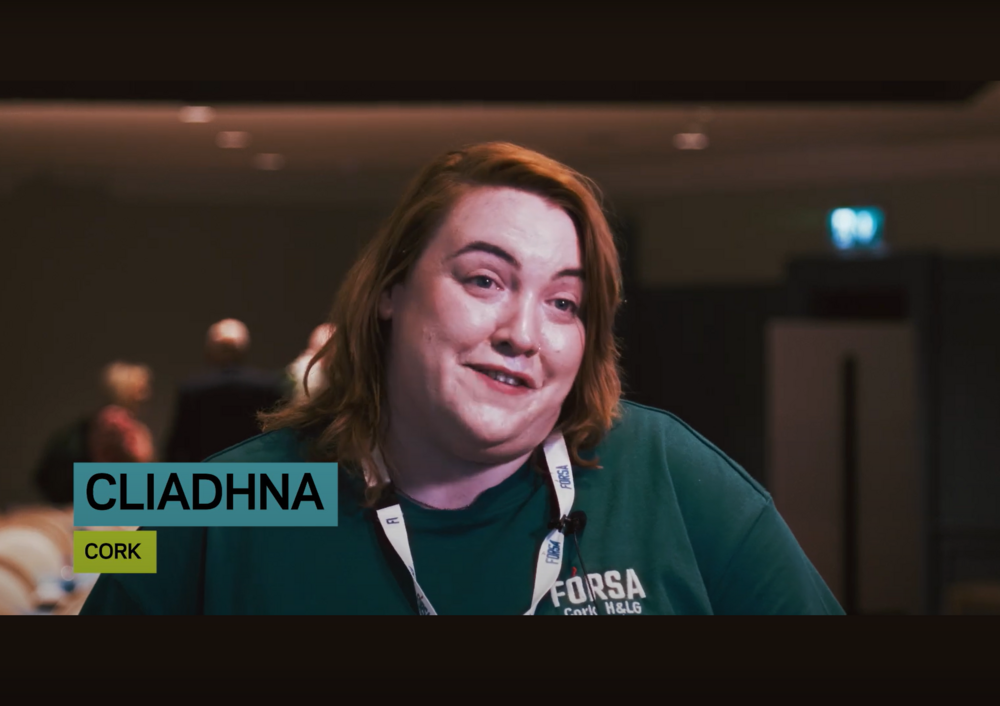
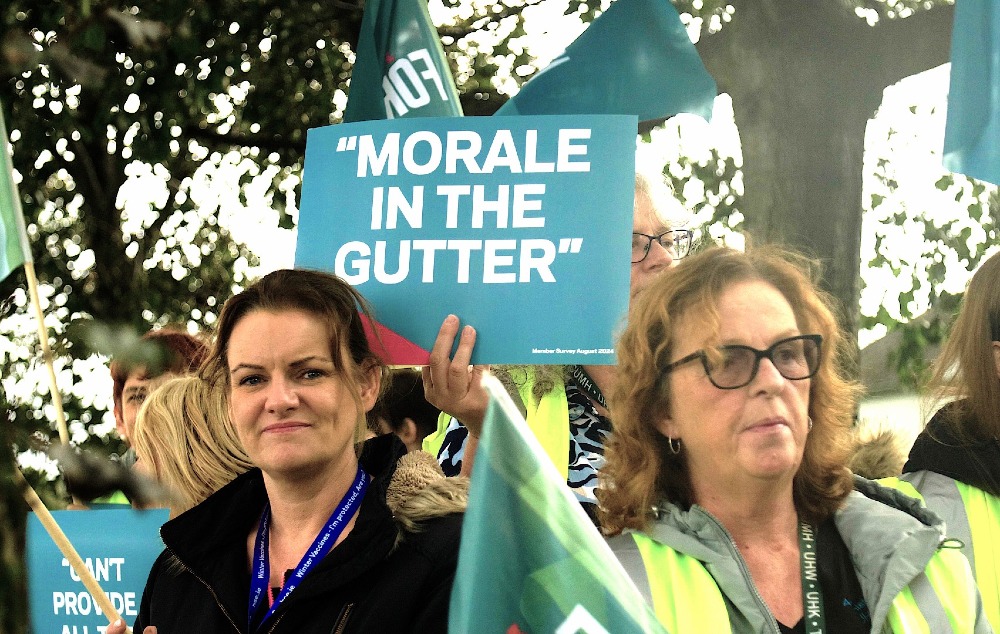
Members at the Health & Welfare and Local Government conferences talk about their experiences.
The Local Government and Local Services and Health and Welfare divisional conferences took place in Letterkenny last week, running from Wednesday 14th May to Friday 16th May.
Energy ran high as delegates converged to shape policy and strategy for the coming years.
Members in Fórsa's health and welfare division shared frontline realities. Delegates told stories of poor morale, terrible conditions, and being forced to work in cars or kitchens. But it wasn’t all complaint, as motions were moved, solidarity flowed, and a huge camaraderie swept the room.
Cathaoirleach Clodagh Kavanagh opened the conference by reaffirming union values of justice and solidarity. Head of division Ashley Connolly issued a rallying call to press on for pay justice in the community and voluntary sector.
The findings of a Fórsa-commissioned TASC report showed 68 percent of health workers rate staff morale as low or terrible. Members spoke passionately about the impact of outsourcing and fragmentation on patient care. Real union strength comes from deep conversations, local fights, and national solidarity. We are not waiting. Our members are building power, one member, one workplace at a time.
At the Local Government and Local Services conference there was a clear buzz around core issues including job evaluation, fair pay, housing, staffing levels, and resisting outsourcing. The atmosphere was charged with purpose as debates unfolded and motions passed. Head of division Richy Carrothers made a surprise announcement of major progress on job evaluation.
Members shared frustrations, hopes, and a deep determination to drive change. Many remarked how attending conference replaced isolation with solidarity, giving them a renewed sense of empowerment and momentum.
Speakers condemned the harmful impact of privatisation and the rise of far-right rhetoric, calling instead for investment in public services and a strong, secure public sector. They championed local government as the bedrock of daily life and a space where progressive values can thrive.
A key takeaway from the closing message from general secretary Kevin Callinan was the power of collective action and the simple idea that when working people organise together in solidarity, they become a beacon of hope and a powerful force for lasting change.
Due to a technical issue with an external service provider, emails sent through the Fórsa website contact form were not delivered between 12th May 2025 and 19th May 2025. This issue has now been fully resolved.
If you did not receive a response to a query submitted through the website contact form during that period, please do send it again. Any other emails to Fórsa were not impacted.
We apologise for the inconvenience and have put measures in place to ensure it does not happen again. Many thanks for your understanding.
Explore the full 2025–2026 calendar and see what’s coming up.
The Fórsa Skills Academy has launched its brand-new training calendar, running from September 2025 to August 2026, and it's filled with a wide range of opportunities for professional growth, union empowerment, and personal development.
Designed in response to the interests and priorities of Fórsa members, this year’s programme is built to equip activists, representatives, and members with practical tools to thrive both in the union and beyond.
Fiona Dunne Director of Membership Training and Development said: “We’re delighted to share this calendar with our members. We’ve shaped this programme by listening to what people need — in their union roles, and in their everyday lives. Our aim is to create a learning space that’s relevant, engaging and empowering.”
Courses range from workplace essentials to leadership development and include both in-person and online options. Here’s a snapshot of what’s on offer:
Branch Chairs and Secretaries training – learn everything you need to know about running effective meetings and organising your branch.
Time Management – This course delivers practical strategies with immediate impact, including effective planning, task prioritisation and smart goal setting.
Resilience Building Workshop – a course that provides tools and templates to build personal resilience and reduce stress.
Public Speaking, Communications and Digital skills training – we now have three exciting courses that cover all aspects of communication!
Regular favourites Fórsa Induction and our monthly Lunch and Learn will return and run throughout the next training year.
Details of upcoming courses, along with application forms, are emailed directly to each branch chairperson, secretary, and training officer 4–6 weeks in advance of the training dates. Courses are also promoted in Fórsa’s fortnightly member bulletins. Registration links for the new calendar will be issued from mid-June.
We know life gets busy, that’s why we’re sharing the full calendar now, so you can plan ahead and make space for your upskilling and development throughout the year.
Live this month: Lunch & Learn - Fórsa Mentoring Programme - Friday 30th May – Online
The Fórsa mentoring programme, launched at the union’s biennial conference in 2024, is an initiative to supplement training provided by the Skills Academy and provide support and encouragement to our trained representatives who might require some additional guidance to build confidence whilst implementing their learning.
For our May Lunch & Learn session scheduled for Friday 30th, we’ll hear directly from past participants of Fórsa’s mentoring programme about what worked well and how it benefited them and their workplaces. Our external programme facilitator will also speak on how mentoring strengthens union capacity and creates long-term value for Fórsa.
Take this opportunity to be inspired, build your confidence, and see how mentoring can support your journey — register now and get involved!
TASC research for Fórsa identifies understaffing, and ‘disconnect’ between management and staff, affecting morale.
New research, developed with the participation of almost 3,800 health staff, has revealed that staff morale in Irish health services is at a critically low level.
Fórsa commissioned the research by independent think-tank TASC, in which 68% of respondents described staff morale as either ‘low’ (43%) or ‘terrible’ (25%). Almost half of respondents (48%) said the situation had worsened over the last two years, while just over half (53%) said low morale is negatively affecting the quality of care.
The research findings were presented last week to delegates at Fórsa’s Health and Welfare divisional conference in Donegal.
The research shows high levels of dissatisfaction with opportunities for career development (63%), and a significant number of staff continuing to work despite feeling unwell. Some 74% of respondents reported coming to work, despite feeling unwell, during the previous three months, while 68% of respondents reported feeling unwell, due to work-related stress, over the previous two years.
On the factors responsible for the continuing decline in morale, the research identifies understaffing, a sense of ‘disconnect’ between management and staff, a ‘lack of recognition and underappreciation’ of staff, alongside increasingly negative public perceptions of health and care systems.
Commenting on the research findings, Fórsa national secretary Linda Kelly said: “Unfortunately, the research confirms what our members have been talking about over the last couple years with increasing frequency.
“Staff shortages, in a wide range of acute health areas, has really increased the pressure on health and social care staff, and that has placed a heavy toll on staff morale,” she said.
Linda said that the most concerning aspect of the research is the extent to which staff are actively considering leaving their jobs to work elsewhere: “The staffing pressures are having a negative impact on staff retention.
“Diminishing morale among existing staff is leading to burnout, and we can see this especially among those with longer service and experience, while a very high proportion of respondents - 76% - said they often think about leaving their current role,” she said.
Linda added that staff shortages in some areas has led to cuts in services in some network areas, while the lack of referral options means that key services are sourced from private providers, at much higher cost: “Added to long wait times, which undermines preventative care, this is causing the public - our service users - to lose faith in our health system. This is a source of very serious concern for our members,” she said.
The TASC research combines an online survey of close to 3,800 participants, focus group research and a literature review, drawing responses from HSE, Tusla, and ‘Section 38’ and voluntary health organisations. Respondents include clerical and administrative staff and health and social care professionals (HSCPs).
Linda said Fórsa members identified the lack of recognition of issues faced by frontline staff, and the failure of management to address systemic issues, as factors that indicate “a lack of respect for workers.”
Proposing a motion to conference in response to the research, Donegal Fórsa member Angela McGinley said her department is at the loss of two people, both on stress sick leave: “These colleagues are not being replaced, and this has a knock-on effect of the rest of us, creating additional work, people eating lunch at their desk, while trying to maintain a service that responds to our patients,” she said.
Angela said while low morale jeopardises workforce retention, it also compromises service delivery.
See also: RTÉ’s coverage of Fórsa’s Health & Welfare divisional conference is available here.
Responding to a video message from Minister of Health Jennifer Carroll MacNeill, head of division Ashley Connolly said health workers remain ready to hear proposals from the HSE and the Department of Health on the provision of health services over a seven-day week.
Health workers remain ‘ready and waiting’ to hear proposals from the HSE and the Department of Health on the provision of health services over a seven-day week, and Fórsa is ready to engage and explore on how it can be achieved.
That was the message delivered by Fórsa’s head of Health & Welfare, Ashley Connolly, in her response to a video address by the Minister for Health, Jennifer Carroll MacNeill TD, at last week’s Health & Welfare conference in Donegal.
Ashley said Fórsa members, including clerical, admin, management and a range of clinical staff, believe in improving service delivery where and whenever possible: “It’s been two years since we assembled as a division in Galway where the HSE chief executive announced his plans for a seven-day service.
“Our message then was to affirm our willingness to engage in the discussion, and we expressed our readiness to discuss ideas. But nothing happened. No proposals were tabled. No ideas exchanged. Time passed, and we are still ready to talk, and to exchange ideas on how to action this ambitious plan for health service delivery, within the scope of existing resources,” she said.
In her message to delegates, the minister said: “The government vision for health is to provide a seven-day, very balanced public service to the public, regardless of the day of the week that they get sick,” adding the HSE is planning for the delivery of all services “relevant to improving patient flow in emergency departments and outpatient services over seven days,” she said.
In her response Ashley welcomed a planned engagement with the department this week: “There are lots of our members keen to explore the opportunities. They have ideas, they know how and where it will work, and it’s a conversation we’ve been ready to have for two years.
“We also need to be clear-eyed about the implications for managing the HSE’s human resources. Employment has increased, but we continue to be concerned about employment gaps in areas that will be key to the delivery of seven-day services.
“An arbitrary application of ‘5 over 7’ rosters, or mandates for weekend work, are not going to be sufficient, and risk exposing serious resource gaps. Having said that, I know we have members with positive ideas about how to organise resources to extend the current 5-day delivery model, and we’ll approach this process with a positive approach, with the aim of exploring how to make health services more accessible, more of the time, to the people who need it,” she said.
The Health and Welfare divisional conference took place in Letterkenny last week, running from Wednesday 14th May to Friday 16th may. Delegates from branches around the country gathered to debate motions, elect a new divisional executive committee (DEC) and set the direction for the division for the next two years.
The Health and Welfare divisional conference took place in Letterkenny last week, running from Wednesday 14th May to Friday 16th may. Delegates from branches around the country gathered to debate motions, elect a new divisional executive committee (DEC) and set the direction for the division for the next two years.
Media coverage of the conference featured on RTE, in the Irish Independent and in The Irish Time here and here. Donegal News was also on site, their report is here.
A selection of photos taken over the course of conference is available on our website, linked here.
In her opening address Cathaoirleach Clodagh Kavanagh underlined the importance of divisional conference saying: “This is more than just a gathering; it is a re-affirmation of our values of solidarity and justice. The motions you pass will give direction to your division for the next two years.”
She thanked members for their dedication, strength and unity during recent disputes, which she said showed members’ commitment to fairness, dignity and respect for working people.
On Wednesday head of division Ashley Connolly addressed conference on the long running campaign for pay parity in the community and voluntary sector, recalling the many twists and turns on the path.
She said: “It has taken a long time to secure these pay recovery measures. The next step in the process is the data gathering exercise and this must take place immediately. We must keep applying pressure, otherwise we will be left waiting again to achieve pay justice. That can’t be allowed to happen,” she said.
Ashley also said the current pay deal, endorsed in a ballot of Fórsa members at the start of May, was a major milestone for a large group of workers whose pay had not been properly restored after austerity-era cuts to pay in 2009.
In a rallying cry and tribute to members Ashley said: "Let us honour the lessons of the past, so we may stand strong against the challenges of the future. We will continue to organise, campaign and stand strong to champion and defend this sector, until such a time as all issues are brought to resolution."
Debate on motions then began in earnest, with issues ranging from Tusla reform, to reports on motions, pay in the community and voluntary sector and outsourcing all on the agenda.
The debate on privatisation and outsourcing heard from many members who spoke eloquently about the impact this practice is having.
Una Burke from the Tipperary South Health and Community branch, spoke on privatisation and the outsourcing of core HSE work. She said: “The practice of outsourcing core work is undermining and diluting some of the HSE’s core services. It has caused fragmentation of services and has negatively impacted the provision of care. It is a strategy that devalues workers and undermines patient care.
Speaking on behalf of the DEC motion on this topic national secretary Linda Kelly sent a strong message saying: “It is never benign, it is always about saving money, it is never in the interest of the public, but only ever in the financial interest of a very small group of private individuals. We need a whole of division approach to this issue, and we will consult with members and branches on our approach."
There were two panel discussions at conference, the first was on morale among healthcare workers, which examined the results of a study released by Fórsa, conducted by TASC; while the second was on artificial intelligence (AI) in health care.
Fórsa commissioned the research by the independent think-tank, given the persistent feelings of low morale being expressed by members. In the research 68% of respondents described staff morale as either ‘low’ (43%) or ‘terrible’ (25%).
For the panel discussion TASC researcher Tiarnán McDonough was joined by Dr. Laura Bambrick, head of social policy at the Irish Congress of Trade Unions, and Niki Gallagher, head of public affairs at Ibec.
Laura Bambrick spoke about the vital need to expand our understanding of the right to disconnect, that it should be understood to cover not just a digital disconnect, but also the right to take breaks, to have lunch undisturbed, or take annual leave without feeling like you’re putting your already understaffed colleagues under further pressure. She underlined that when faced with persistent short staffing workers cannot disconnect, which in turn, exacerbates low morale.
Niki Gallagher emphasised the importance of stakeholder engagement and the value Ibec places on its engagement with unions. She noted that Ibec supports calls for a larger state with better investment in public services.
In the panel on the use of AI in health care, Molly Newell of TASC noted that while diagnostic algorithms can reduce waiting lists times, Irelands e-health landscape is particularly underdeveloped, while Gareth Murphy of the FSU noted that unions should not make the mistake of assuming they know what workers want, instead they should use research and make data informed decisions.
On Thursday Minister for Health Jennifer Carroll MacNeill TD addressed delegates at Fórsa’s Health and Welfare divisional conference via video message, as she was not able to attend conference in person, however she has committed to meeting the Health and Welfare DEC later this year.
In her message she commended Fórsa members for the vital role they play in delivering health services across the country. She then went on to outline investment in health infrastructure around the country, referencing four new hospitals which will enhance patient care around the country.
Also on Thursday general secretary, Kevin Callinan, rallied delegates with an address that put unions and union activists at the heart of the fight to overcome the “dark times” we live in. He said, “we stand in the vanguard, against division, against hate, against war. For community, for justice, for peace.”
Kevin extolled the need for reform and modernisation within the union movement citing work already done within Fórsa to invigorate the organising power of our activist base. He called on delegates to use Local Bargaining to have conversations with coworkers and bring them into the Fórsa community.
A new Divisional Executive was elected by conference delegates. Clodagh Kavanagh (Cork Health and Local Government) returns as Chair, and Andy Meaney (Waterford Health and Local Government) will be vice chair. The members of the Health & Welfare DEC are:
Trish Ahern (Limerick Health) Helen Canning (Boards and Voluntary Agencies) Orla Carroll (Kilkenny Health and Local Government) Gillian Cawley (Dublin Hospitals) Paula Cregg (Clare Health and Local Government) Pat Fallon (Sligo Health and Local Government) Henry Hennessy (Laois Health and Welfare) Barry Herridge (Dublin north Health and Welfare) Keivan Jackson (Kildare Health and Welfare) Patricia Mellsop (Offaly Health and Local Government) Bernadette Mooney (Dublin South Health and Welfare) Colette O'Connell (Tipperary South Health and Community) Corinne Phelan (Galway Health and Local Government)
The recent Australian elections showed that working from home is now an election issue around the world. In this opinion piece, published in the Irish Examiner on Tuesday 13th May, Fórsa general secretary Kevin Callinan calls on the government to initiate a major study looking at the benefits of remote work.
The recent Australian elections showed that working from home is now an election issue around the world. In this opinion piece, published in the Irish Examiner on Tuesday 13th May, Fórsa general secretary Kevin Callinan argues that we need real data to inform future policy. Fórsa is calling on the government to initiate a major study looking at the benefits of remote work, and how to embed sustainable hybrid policies.
The Australian Liberal Party's opposition to working from home, a policy that proved so unpopular that it was reversed mid-campaign, is widely believed to have contributed to its defeat in the recent general election.
Speaking as the scale of the outgoing government's victory was becoming apparent, Labor Senator Deborah O'Neill expressed disbelief that the Liberals had sought to cut back working from home.
"Do they have no idea what it's like to be a modern family?" she said. Referring to the expectations of many young people to have the option to work from home, she went on to say: "There's a productivity agenda here for families and society as well as for the economy".
There's an important message in this for other governments. In Ireland, the current Programme for Government is noticeably silent on the subject when compared to the commitment in the previous programme to a 20% target and to the Make Remote Work policy.
It's difficult not to conclude that some politicians are more concerned with mimicking the DOGE agenda in the United States and having a go at what is often mistakenly perceived as an almost exclusively public service phenomenon.
At April’s Labour Employer Economic Forum (LEEF), understanding the importance of the availability of flexible working arrangements to attract and retain the best talent, employer representatives supported the trade union call for an in-depth examination of all the issues involved in working from home.
There are concerns expressed about the health, safety, and welfare of staff operating in isolation, and about the ability of organisations to harness the energy that can come with physical team gatherings. There’s also concern about the negative career trajectories for women that could be a consequence of home working.
These are challenges that call for good management, and they are all issues that can be addressed. It would be a mistake to throw the baby out with the bathwater.
The Covid experience has shown conclusively that remote working can be successful, and productivity can be improved, not just maintained. As recent statistics show, younger workers are voting with their application letters and CVs, favouring opportunities that provide for remote, hybrid, or blended work.
Decisions should be based on evidence, not on whether it's inconvenient for those in charge to manage. This appeared to be at play earlier this year, in moves to reduce working from home in parts of the civil service. These changes should be suspended to allow a comprehensive review to be conducted. We need real data to inform future policy.
Any assessment must also extend to the broader societal and ecological issues. For those of us who cannot work from home, it's not in our interest to have additional traffic on the road adding to our already lengthy commutes and to atmospheric pollution and the carbon footprint.
We all benefit, however, from the growing evidence that, by avoiding wasted travelling hours each day, people who work from home have time to give to their local schools, sports clubs, and communities, not to mention to their families.
It is ironic that the loudest voices railing against working from home have been from some regional independents. Perhaps this is driven by frustration with service delivery. If so, this should be dealt with on the merits of the case, whether it's due to a failure of management, inadequate resources, or something else.
There can be little doubt that working from home is making a real difference in rural Ireland and that, with proper planning, it has the potential to be transformational. The people using regional remote working hubs, now based in many towns and villages, and those working in home offices, represent a market for local shops and businesses that would otherwise be elsewhere.
There is too much at stake for working from home to be seen as just a Covid phenomenon. If we get it right, this can be central to our economic and social prosperity. We need to recognise that and resist the trendy opposition to it that we see in parts of the political and corporate world.
The government should seize the initiative, arising from the Labour Employer Economic Forum, to propose terms of reference for a major study. To fail to do so would be an enormous own goal. Like in Australia, there could be a political price to be paid too.
The European Transport Workers’ Federation (ETF) has launched a new survey to gather real stories from women on the front lines of transport work.
Are you a transport worker who has faced violence or intimidation at work? Are you a woman? Then this survey is for you.
The European Transport Workers’ Federation (ETF) has launched a new survey to gather real stories from women on the front lines of transport work. The aim is to collect testimonies directly from women working in all areas of the transport sector.
This survey is more than just data collection, it’s about building strong evidence to push employers, governments and institutions to take concrete action, informed by the reality of women transport workers.
Take the survey here and help build a safer transport industry for all.
If this doesn’t affect you directly, but you know a woman working in transport who has been affected, please ask them to fill out this important survey.
Fórsa national secretary and head of the union’s services and enterprises division, Katie Morgan, said: “Every single woman in the transport industry deserves to work without fear. This ETF survey is your chance to contribute to the collective demand to stop violence and harassment against women transport workers. Violence and harassment are sadly part of daily life for far too many women in the transport sector. Women continue to face abuse, intimidation and harassment for simply doing their jobs. And yet, too often, their voices go unheard, their experiences are dismissed, and this problem is ignored. Together, we can demand safer workplaces for every woman in transport.”
The ETF said: “As we all know, violence against transport workers has been on the rise since the recent pandemic. This must end. Together we can make a change. For this reason, the women's committee of the European Transport Workers' Federation has decided to conduct the survey ‘Violence and harassment against women transport workers’. Although we know that all transport workers suffer from violence, this survey is specifically for women transport workers, and we kindly ask you to support it. Your voices and real experiences are essential in helping the ETF expose the extent of the problem and fight for safer, fairer workplaces.”
If you would like to fill in the survey in a different language, you can choose from several options available here.