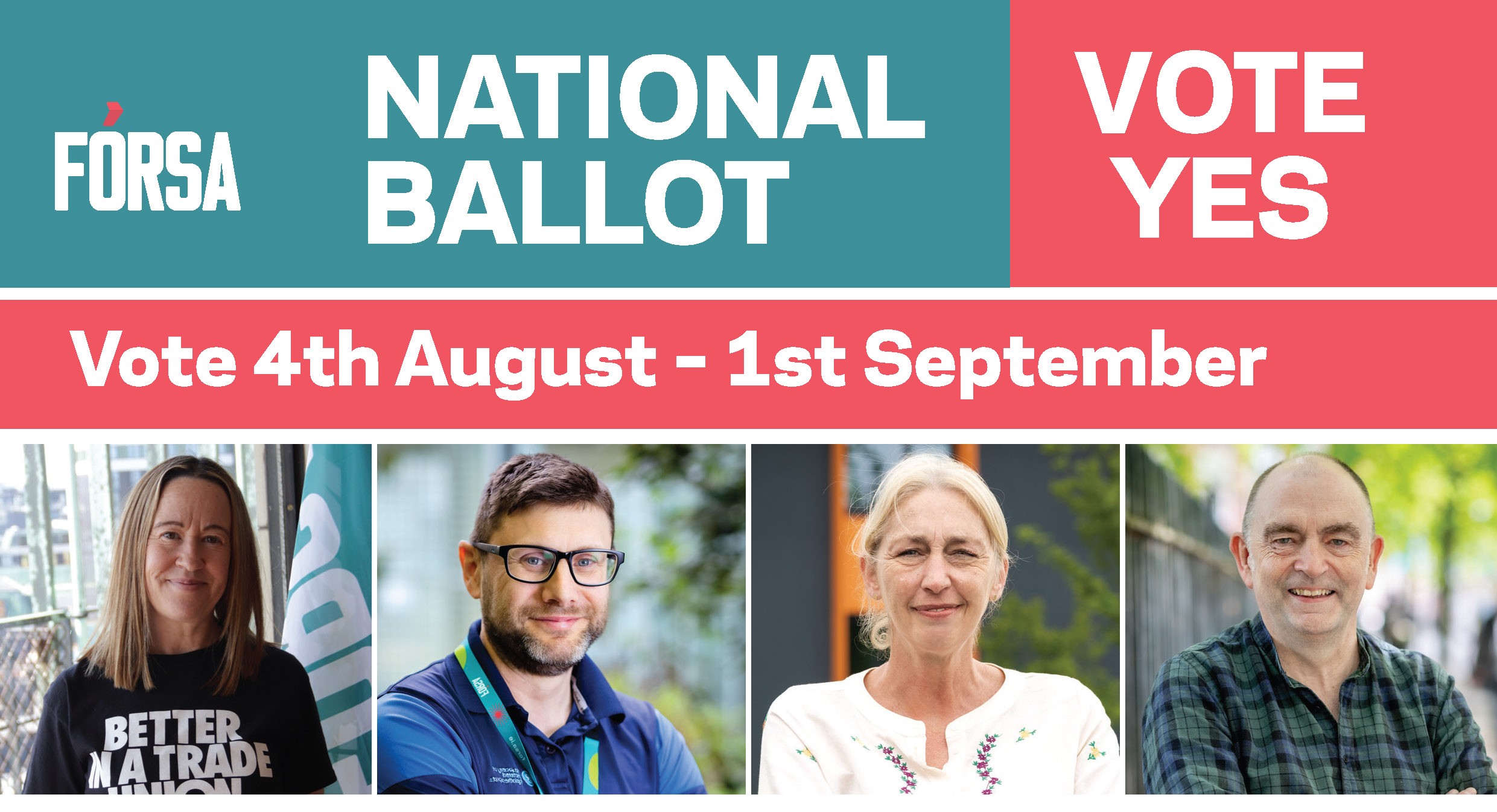
A ballot of close to 90,000 Fórsa members working across the civil and public service will open next week, on Tuesday 4th August, running until Tuesday 1st September.
A ballot of close to 90,000 Fórsa members working across the civil and public service will open next week, on Tuesday 4th August, running until Tuesday 1st September.
The ballot is taking place as there is currently no public service pay agreement in place, yet the cost of living keeps on going up while living standards fall.
In the secret ballot members will be asked if they are willing to take industrial action to:
secure an acceptable pay increase to cover July to December 2026, as well as increases to cover 2027 and/or the duration of any proposed agreement.
for the resolution and implementation of Local Bargaining claims.
to resist changes to work practices, organisation of work, or organisational structures without the agreement of the union.
Emphasising the importance of high turnout, general secretary Kevin Callinan said: “This ballot is a critical opportunity to send government a message.”
“By voting yes in this ballot, you can show the government how much this matters to you and that you won’t be taken for granted.”
The secret ballot will take place online. Members will get an email from Mi-Voice, a secure, third-party ballot provider, on Tuesday 4th August containing a Unique Voting Code (UVC), which will allow you to vote.
Director of membership Seán McElhinney explained that the electronic ballot allows members to vote wherever they are, which will make it easier for members working remotely or on leave to vote, while being fully secure.
He said: “We use an independent third-party ballot provider called Mi-Voice, who are fully GDPR compliant. Throughout the ballot period we’ll be reaching out to reps, branches and members, to help increase turnout.”
Seán concluded: “The question to ask everyone you meet in the weeks ahead is – have you voted yet? Get involved, talk to your colleagues, and let’s make sure our collective voice can’t be ignored.”
Union training is all about building confident activists who can organise and strengthen the union from the ground up. Fiona Dunne tells us all about what's in store at the Skills Academy in the months ahead.
More often than not, the real work of a trade union is done far away from the headlines. It begins with the little moments, such as a conversation with a workplace rep at the lunch table. A member seeking advice or volunteering to have that difficult chat with management. It’s the moment when someone steps up for the first time.
That is the thinking behind the Fórsa Skills Academy, which has launched its new 2026–2027 Skills Academy calendar, offering more than a year's worth of learning opportunities designed to help members develop as workplace representatives, branch officers and workplace activists.
From industrial relations and negotiations to leadership, communications, public speaking and resilience, the programme is about much more than training courses. It is about building confident activists who can organise and strengthen the union from the ground up.
"The highlight of the year really has been the number of new workplace representatives we have trained. One hundred and sixty-five have come through the doors from August 2025 to May 2026, which is fantastic," says Fiona.
That demand has been reflected in the need to schedule additional courses beyond the published calendar.
"We have received a lot of additional requests for the Level 1 course which are off calendar because it really sets the groundwork for being an effective and confident representative."
But Fiona says the course gives participants far more than technical knowledge.
"Reps can build a network with other reps on the course and understand that the sector, division and context might be different, but many of the issues are similar that reps deal with."
That shared learning creates something that extends well beyond a lunchtime Zoom call.
"Many leave the three-day course full of enthusiasm and new ideas to create greater visibility and engagement in their work locations. They also have the skills to begin their representative role for colleagues, although there are more skills-building courses at other levels."
One of the biggest developments for the new academic year is the introduction of a clearer learning pathway, allowing representatives to continue building their knowledge as they gain experience. Rather than viewing training as a series of standalone courses, the Skills Academy has designed a progression that reflects the different stages of a representative's journey.
New activists begin with Level 1 Workplace Representatives Training, before progressing to Level 2 once they have gained practical workplace experience. From there, representatives can continue to develop through specialist skills courses and branch leadership training.
Fiona says the pathway is designed to help members grow naturally into new responsibilities.
"Given that we are developing a learning pathway, there are many different skills reps can take, depending on the level they are at, so we have popular courses at Level 1 and our skills courses such as public speaking or resilience building."
The pathway also reflects how the union believes activists should develop.
"New reps should take Level 1 Workplace Representatives Training first and then progress to Level 2 with about nine to twelve months' experience and support from their branch committee. We also recommend that when deciding to become active, a member should first become a local workplace representative, get the training, and then become active on the branch committee once they have gained some local experience."
For experienced activists, the learning doesn’t need to stop, with the academy continuing to expand its industrial relations training.
"Branch officers can avail of any of the skills training such as public speaking, negotiations or conflict resolution," says Fiona.
"We run a two-level Industrial Conflict Resolution which is all about using procedures correctly and how to get the most out of them. We are currently developing a Level 3 Industrial Resolution for the new term which will be a practical team roleplay, and more information will be released on this over the coming months."
The Skills Academy is built around adult education principles, recognising that representatives already bring valuable knowledge with them before they ever enter a training room.
"First and foremost, they will get a very big welcome onto the course before we get down to the topic. All our trainers are highly experienced in their subject matter, and have all been practitioners, many still are, in their chosen area."
Fiona is insistent that rather than relying on lectures, the emphasis is on practical learning.
"Courses are based on the principles of adult education and trade union education which means they are focused on the student, providing practical knowledge, developing key skills and outlining the application of learning to embed their learning and gain experience."
Just as importantly, participants learn from each other.
"It also focuses on peer-to-peer learning, is group oriented, recognises prior learning and experience and encourages the sharing of knowledge gained."
Those connections often continue long after the course finishes.
For Fiona, the real success of the Skills Academy isn't measured by attendance figures. It's measured by what representatives do when they return to their workplaces.
"The essence of training is empowerment, and we are trying to ensure that workplace representatives feel that they can take on challenges within their experience and skills level, and then to keep progressing."
Branch communications, digital skills and rep training all on offer.
September will mark the beginning of a busy semester for the Skills Academy, with more on offer than ever. In addition to launching a new calendar the Skills Academy has a new monthly Q&A session for branch training officers to make it even easier for branches to understand what training will best suit members, and a simplified registration process will streamline applications.
Fórsa Induction - Wednesday 12th August - Online - Open to all new members
Are you a new member or a long-standing member looking to be more active? Join our little welcome session for new members. Learn about Fórsa and how you can get involved in your trade union. Morning and evening sessions available.
Monthly online Q&A session for Branch Training Officers – 1pm – 1.30pm Thursday 20th August – Online
This new monthly session is open to branch training officers. If you are a branch training officer with questions about anything to do with training, this session is to give you the opportunity to find answers and clear up any confusion.
An online invitation will issue to registered branch training officers in early August.
Effective IR Practices (Level 1) - Thursday 17th September - Nerney’s Court, Dublin 1 - Civil Service members only
If you are a branch rep in the civil service who participates in local industrial relations, along with your branch and union official, this is a session you do not want to miss. Learn how to stay calm under pressure, be prepared and get the best outcome for your members.
A second session will be held in November for members from other divisions.
Communications Training – Tuesday 22nd September - Nerney’s Court, Dublin 1
Having solid lines of communication with members is crucial to the success of any branch. If you feel your branch could do with some help reaching your members this is the course for you. Learn the most effective tools for reaching your members and when to use them. Build your branch’s relationship with its members and craft compelling messages that will drive member participation.
This session is available to members based in Dublin and surrounding counties. Cork and Galway sessions will take place later this year.
Digital and Social Media (Level 1) – Tuesday 22nd September - Nerney’s Court, Dublin 1
Or Tuesday 29th September - Limerick regional office
Is your branch thinking of wading into the waters of social media? This course will give you a firm foundation in how to use social media to reach your membership. Make sure you’re using the correct tool for the job and give yourself and your branch the best opportunity to make a splash online.
Ideal for novice and casual social media users. This course will give you a firm grasp of the basics, then you can take on the level 2 and learn how to use social media intentionally as an activist.
These will be the only dates available for the Level 1 training this year. Register early to secure your place!
Level 1, Workplace Representative Training – Tuesday 22nd to Thursday 24th September – Galway regional office
If you are new to the role of workplace rep and want to hit the ground running, this session will give you a firm foundation in the skills you will need. Over three days, you will learn all the basic skills that you will need in your first year as a rep: the role and function of the workplace rep, improving interpersonal skills and building good working relations, organising your union work, recruiting members and handling problems, an introduction to equality and diversity, and health and safety.
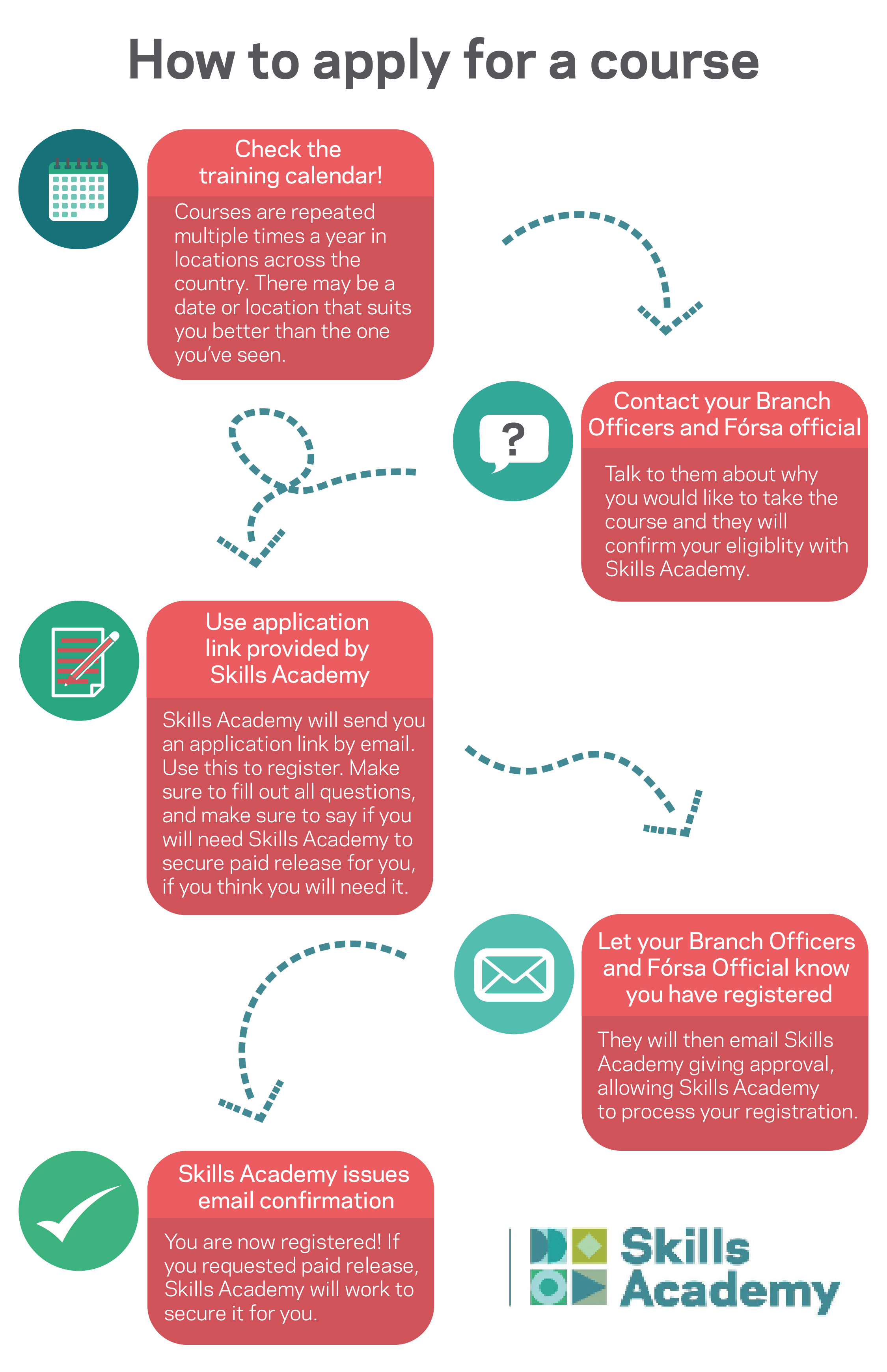
To register for a course:
Aside from Live: Lunch & Learn and Fórsa inductions, participation in all courses requires sign-off from your branch and official. To apply, contact your branch training officer or secretary if your branch does not yet have a training officer.
Branch officers with responsibility for training will be aware that there has been a change to the process for members receiving their training registration link. Registration links will no longer be sent to branches. Links will be issued directly to members following their branch’s nomination and confirmation of their eligibility with Skills Academy.
Fórsa members are to escalate ongoing industrial action at Oberstown Children Detention Campus, arising from the continuing dispute over resourcing and the provision of safe staffing at the campus.
Fórsa members are to escalate ongoing industrial action at Oberstown Children Detention Campus, arising from the continuing dispute over resourcing and the provision of safe staffing at the campus.
Management at Oberstown was formally notified this week (Monday 27th) that Fórsa members will begin a series of work stoppages next week. The first stoppage will take place on Tuesday 4th August, from 12 noon to 6pm.
The action follows a ballot of Fórsa members, concluded in May, which supported industrial action up to and including a full withdrawal of labour in pursuit of a resolution to the dispute. Oberstown staff have been engaged in a work-to-rule action since 25th June.
The notified work stoppages are as follows:
Tuesday 4th August 2026, 12 noon to 6pm
Tuesday 11th August 2026, 12 noon to 8pm
Tuesday 18th August 2026, 12 noon to 10pm
Tuesday 25th August 2026, 12 noon to midnight
Fórsa assistant general secretary Deirdre O’Connell Hopkins explained: “All Fórsa members across Oberstown campus will participate in these stoppages, while industrial action will continue indefinitely.
“The action became unavoidable in the context of ongoing capacity challenges at Oberstown. Safe staffing is the goal here. Until that’s achieved, the health and safety of residents and staff continue to be compromised.
“Fórsa has reserved the right to review, amend and further escalate the action, up to and including additional work stoppages or a further withdrawal of labour,” she said.
Fórsa has advised Oberstown that representatives remain available to meet management in an effort to resolve the dispute and secure safe staffing at the campus.
Union representatives met Aer Lingus management this week, on Wednesday 29th July, in the first engagement since the airline announced job cuts earlier in the month.
The meetings focused on the company’s stated rationale for the proposed cuts, the protections available to members, and the union position on any redundancy process.
Representatives of Fórsa’s Cabin Crew and IAESA branches met airline management alongside representatives of the ICTU group of unions. IALPA representatives met the airline separately.
The ICTU group of unions told the company that the recent announcement appears to be driven at group level within IAG and raises concerns about the company’s failure to meet its legal obligations to inform and consult with the IAG European Works Council.
The union reiterated its firm opposition to compulsory redundancies. Further meetings are expected in the coming weeks.
IALPA members at Emerald Airlines have voted overwhelmingly to back a new collective labour agreement (CLA), delivering significant improvements in pay, career progression and conditions of employment. Cabin crew are also organising at the airline, leading to a recent surge in membership.
IALPA members at Emerald Airlines have voted overwhelmingly to back a new collective labour agreement (CLA), delivering significant improvements in pay, career progression and conditions of employment.
The agreement, which covers pilots employed by Emerald Airlines, the operator of Aer Lingus Regional services, was endorsed by 92% of IALPA members in a ballot, comfortably exceeding the threshold required for ratification. A total of 97% of members participated in the ballot.
The new deal provides for improved pay scales across the pilot group, including increases of up to 20% for captains and enhanced salary progression for first officers throughout the scale. Captain base salaries will rise by €5,000 from 1st August 2026, in addition to annual 3% increases in March 2027, March 2028 and March 2029.
The agreement will run from 1st August 2026 until 28th February 2030, with discussions on a successor agreement due to begin no later than 1st September 2029. The new CLA also provides for further pay discussions during the lifetime of the agreement if the company reaches accumulated profitability, taking account of the company’s outlook and wider economic conditions.
IALPA’s Emerald Airlines chair, Aidan Rothwell, described the agreement as significant and said it would deliver meaningful improvements for members.
He said: “The scale of the ballot result demonstrates strong member support for the agreement and provides a solid foundation for continued engagement with the company over the lifetime of the deal.”
Fórsa is also working with cabin crew members at Emerald Airlines. A recent organising drive has increased membership, boding well for the future.
Assistant general secretary Nicola Coleman said: "The growth in membership shows that cabin crew also want a genuine voice at work, fair pay secured through collective bargaining, and union recognition."
She continued: "At a smaller airline, every voice counts. We are on the way to securing a stronger voice at work, but we need to keep building momentum. If every Fórsa member at Emerald encourages just one colleague to join this week, we can take a significant step towards winning union recognition, collective bargaining, and greater fairness in the workplace."
Fórsa’s cabin crew branch has stepped up their ongoing campaign for restoration of credit value and an overhaul of the credit system for Aer Lingus cabin crew, despite the company’s recent announcements regarding restructuring.
Fórsa’s cabin crew branch has stepped up their ongoing campaign for restoration of credit value and an overhaul of the credit system for Aer Lingus cabin crew, despite the company’s recent announcements regarding restructuring.
Speaking on behalf of Aer Lingus cabin crew members, Ángel Garcia said: “We do not accept that redundancies are needed in a profitable company. Management have their agenda and we have ours, which is to protect jobs and enhance conditions of employment. We’ve been pushing for an overhaul of the credit system for a long time and we’re not going to stop now.”
At a meeting with the employer, cabin crew branch representatives put forward the key demands of the ‘Credit Where Credit is Due’ campaign. These include:
Restored Valuation: Increase credit value to €7.69 (currently €5.83).
Future Proofing: Link all future credit increases directly to basic pay increases.
Sector Credits: Increase Sector Credits (TA) by 5.
Delay Protection: Increase the delay credit model to 4 credits per hour (or part thereof).
Agreement Alignment: Implement time of day and longstop away from base provisions in line with the black book agreement.
Fair Calculations: Remove "report" and "release" when determining if a payment is due, ensuring time brackets entered are respected.
Fórsa assistant general secretary Nicola Coleman said: “These demands are fair. Restoring credits that were cut as “temporary” cost-saving measures in 2008 is long overdue.”
She continued: “Unsurprisingly, management attempted to dismiss our claims as ‘unrealistic and unreasonable,’ which we reject. A fair day's work deserves a fair day's pay.”
A written submission detailing the demands was submitted after the meeting.
Nicola went on to urge members to get involved in the campaign. Any member who is ready to assist with the campaign or wants to share ideas with the branch committee is invited to email the branch at cabincrewofficers@forsa-rep.ie with the subject line: "FIGHT FOR FAIR PAY".
Officers of the Public Services Committee (PSC) of the Irish Congress of Trade Unions (ICTU) met officials from the Department of Public Expenditure yesterday in a bid to address outstanding local bargaining issues under the now-expired public service agreement.
Officers of the Public Services Committee (PSC) of the Irish Congress of Trade Unions (ICTU) met officials from the Department of Public Expenditure yesterday in a bid to address outstanding local bargaining issues under the now-expired public service agreement.
Fórsa general secretary Kevin Callinan led the union delegation, describing the engagement as limited in scope and relating only to the first phase of local bargaining measures that remain unresolved.
Kevin said all parties understood the meeting did not represent a resumption of talks on a successor agreement, nor did it indicate any change in the current position regarding pay negotiations: “Yesterday’s meeting arises from ongoing efforts to address unfinished business carried over from the previous agreement. Members will be aware that, following exploratory discussions in June, unions concluded there was no viable basis for formal talks on a new agreement. That position remains unchanged.”
Local bargaining in the last public service pay agreement provided for claims or proposals of up to 3% of the payroll cost of a grade, group or category of workers. A number of claims for the first 1%, which were due to be finalised before the deal expired, remain unresolved.
Kevin added: “The objective remains to address outstanding commitments from the last pay deal. However, the effort to resolve those commitments is separate from establishing a credible basis for future negotiations.
“While unions have consistently pressed for the implementation of agreed local bargaining provisions, the wider context has not shifted. There is still no agreed framework for negotiations on pay or living standards, and no process currently in place that could support meaningful engagement on a new deal.
“Costs keep going up and rising inflation is wiping out pay increases. Consequently, our preparations for ballots for industrial action continue. We need to demonstrate how much this matters to workers. By voting for industrial action, Fórsa members can show Government that public service workers won’t be taken for granted,” he said.
The unresolved local bargaining claims are therefore being dealt with separately from the wider dispute over a successor agreement, while preparations for industrial action continue. The ballot of Fórsa members opens next Tuesday (4th August).
Members can learn more about the ballot by visiting our ballot hub here.
Library workers who faced intimidation, harassment and abuse during a coordinated campaign targeting public libraries have been nominated for the Emilio Gabaglio Award, an international trade union prize recognising outstanding solidarity-based action across Europe.
Library workers who faced intimidation, harassment and abuse during a coordinated campaign targeting public libraries have had their response recognised with a nomination for the Emilio Gabaglio Award, a major international trade union prize recognising outstanding solidarity-based action across Europe.
The award was launched at a conference in Belgrade in 2025. It takes its name from Emilio Gabaglio, a founding figure and former general secretary of the European Trade Union Confederation (ETUC), born to working class Italian roots in 1937. He dedicated his life to building a Europe based on solidarity.
Fórsa’s nomination was submitted by the European Federation of Public Service Unions (EPSU) and highlights Fórsa's campaign in defence of library staff following a wave of far-right organised protests targeting LGBTQ+ books and programmes in public libraries across Ireland.
Speaking about the decision to nominate the campaign, EPSU Officer Pablo Sánchez Centellas said: "This campaign is a model for those of us working at European level, as it combines different elements of the best practices we are trying to promote for trade union renewal and to increase trade union density."
"It empowers municipal employees, it makes a clear link with the model of inclusive and progressive society we want to build, with taking to the streets and building power in the workplace, as well as alliances between workers and broader society. For the EPSU the fight against the far right and authoritarian politics is part of the fight back for a different future."
“They were screaming, shouting, hurling abuse at our members”
Across 2024 and 2025, libraries in several counties became the focus of protests importing far-right tactics from the States. Workers reported abuse, unauthorised filming, live-streaming, threatening phone calls and sustained online harassment. In some cases, libraries were forced to close temporarily due to safety concerns, and one incident escalated into physical assault.
Recalling the genesis of the campaign, national secretary Richy Carrothers described how Cork City Library became the focal point of the early protests and what workers faced on the frontline.
“Cork was at the epicentre of this. Far-right agitators entered Cork City Library demanding the removal of LGBTQ+ books. There was a coordinated campaign targeting the trans community and, by extension, the wider LGBTQ+ community. They were screaming, shouting, hurling abuse at our members, and live-streaming these incidents on social media for clickbait.”
He said the impact on staff was immediate and deeply unsettling.
“It wasn't just a Cork phenomenon, but Fórsa took the matter very seriously. At the time, we were the only ones speaking out. Employers and many people within the political system essentially went into hiding, and it was left to us to stand up and speak on behalf of library workers across the country.”
“The library is the hub of the community”
For library workers, the response was not just about defending their own safety, but about protecting the role of libraries in public life. Cliadhna Dinneen, a member of the Cork Local Government branch said the strength of feeling among staff and communities quickly became clear.
“The library is the hub of the community. We were fortunate to have some strong library representatives here in Cork who raised the issue very early on. Working alongside our union officials, we decided to organise a counter-rally in support of library workers.”
What followed, she said, was a powerful show of solidarity.
“We received fantastic support from Fórsa members across the country, but just as importantly, many other groups came out on the day to stand with library workers, who do an awful lot for their communities.”
“It was a great show of solidarity. Our library workers appreciated it enormously, and I think library workers across the country did too, because this didn't just happen in Cork - it started in Cork.”
“A pervasive undercurrent of anxiety and unease”
The experiences described by workers have since been reflected in independent research.
In 2024, a University College Dublin report, Resisting Hate and Navigating Agitation, funded by the Irish Research Council (now Research Ireland) and commissioned by Fórsa and LGBT Ireland, documented the impact of coordinated agitation on library staff.
It found workers were operating in what researchers described as a “pervasive undercurrent of anxiety and unease”, driven by repeated disruption, online abuse and the expectation of further incidents.
The report found staff were routinely required to implement additional security measures, manage organised harassment and respond to individuals using social media and pseudo-legal tactics to intimidate them.
Workers described books being removed from shelves, pages torn from materials, confrontations being filmed and broadcast online, and in some cases, staff being labelled as paedophiles or groomers.
The report recommended stronger security procedures, improved incident reporting and closer cooperation with An Garda Síochána and local authorities.
“We will not allow hate, division or discrimination”
For many library workers, however, the experience also strengthened their sense of purpose.
Speaking at a hastily organised rally in late November 2024 just days after horrendous racist rioting in Dublin, Fórsa member and librarian Edel Scally said the campaign brought together workers and communities determined to resist division.
“As a librarian, our message is simple: hands off our libraries. We stand for the LGBTQ+ community, for the migrant community, and for those who feel ostracised from society, because that's what libraries do. It's that simple.”
The October event will create a space for participants to share experiences and best practices on mitigating psychosocial risks at work.
Fórsa’s Health and Safety Committee will host an event for safety representatives, workplace representatives and members this autumn dedicated to ‘Managing psychosocial risks in the workplace’.
The event will provide valuable opportunities to connect with peers, learn from expert speakers, and contribute to discussions on prioritising workers' mental health.
Keynote speaker Dr. Patricia Murray will deliver a session on the importance of psychosocial risk assessments in the workplace, the questions reps should ask, and how to ensure they are conducted appropriately.
Dr. Murray spent over two decades as a senior psychologist and inspector with the Health and Safety Authority (HSA), leading national strategies on psychosocial risk, workplace bullying, and organisational wellbeing. Today she works directly with unions, employers, regulators, and government bodies across Ireland and Europe.
Deputy general secretary Katie Morgan said: “Members’ input will be invaluable to this event, and the forum will enable participants to share experiences and best practices on mitigating psychosocial risks.”
“Our members’ safety in the workplace is paramount, and employers regularly tend to focus on physical safety such as slips, trips and falls, and fail to protect members from psychosocial risks. This event is focused on equipping reps and members with information, strategies and tools to help protect themselves and their colleagues from psychosocial risks in the workplace.”
“Just last year, the HSA reported that 59% of all work-related ill-health cases in Ireland were linked to stress, depression or anxiety, which comes at an annual cost of €926 million to the economy. Yet the cost to the worker’s health is often something that they can’t recover from.”
This event will take place on Thursday, 22nd October 2026, from 11am to 3pm at Fórsa's head office, Nerney's Court, Dublin 1, coinciding with the European Week for Safety and Health at Work (19th–23rd October) and this year's focus on 'Healthy Workplaces: Together for Mental Health at Work 2026–2028'.