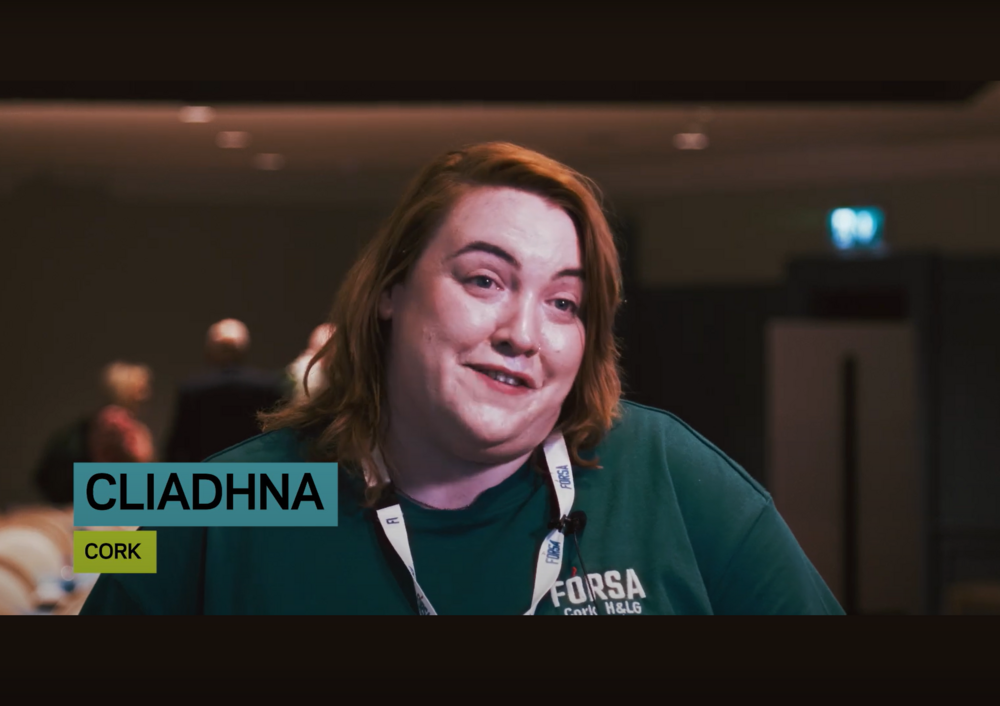
Watch our video recaps of the recent Health & Welfare and Local Government conferences.
The Local Government and Local Services and Health and Welfare divisional conferences took place in Letterkenny last week, running from Wednesday 14th May to Friday 16th May.
Energy ran high as delegates converged to shape policy and strategy for the coming years.
Members in Fórsa's health and welfare division shared frontline realities. Delegates told stories of poor morale, terrible conditions, and being forced to work in cars or kitchens. But it wasn’t all complaint, as motions were moved, solidarity flowed, and a huge camaraderie swept the room.
Cathaoirleach Clodagh Kavanagh opened the conference by reaffirming union values of justice and solidarity. Head of division Ashley Connolly issued a rallying call to press on for pay justice in the community and voluntary sector.
The findings of a Fórsa-commissioned TASC report showed 68 percent of health workers rate staff morale as low or terrible. Members spoke passionately about the impact of outsourcing and fragmentation on patient care. Real union strength comes from deep conversations, local fights, and national solidarity. We are not waiting. Our members are building power, one member, one workplace at a time.
At the Local Government and Local Services conference there was a clear buzz around core issues including job evaluation, fair pay, housing, staffing levels, and resisting outsourcing. The atmosphere was charged with purpose as debates unfolded and motions passed. Head of division Richy Carrothers made a surprise announcement of major progress on job evaluation.
Members shared frustrations, hopes, and a deep determination to drive change. Many remarked how attending conference replaced isolation with solidarity, giving them a renewed sense of empowerment and momentum.
Speakers condemned the harmful impact of privatisation and the rise of far-right rhetoric, calling instead for investment in public services and a strong, secure public sector. They championed local government as the bedrock of daily life and a space where progressive values can thrive.
A key takeaway from the closing message from general secretary Kevin Callinan was the power of collective action and the simple idea that when working people organise together in solidarity, they become a beacon of hope and a powerful force for lasting change.
Due to a technical issue with an external service provider, emails sent through the Fórsa website contact form were not delivered between 12th May 2025 and 19th May 2025. This issue has now been fully resolved.
If you did not receive a response to a query submitted through the website contact form during that period, please do send it again. Any other emails to Fórsa were not impacted.
We apologise for the inconvenience and have put measures in place to ensure it does not happen again. Many thanks for your understanding.
Explore the full 2025–2026 calendar and see what’s coming up.
The Fórsa Skills Academy has launched its brand-new training calendar, running from September 2025 to August 2026, and it's filled with a wide range of opportunities for professional growth, union empowerment, and personal development.
Designed in response to the interests and priorities of Fórsa members, this year’s programme is built to equip activists, representatives, and members with practical tools to thrive both in the union and beyond.
Fiona Dunne Director of Membership Training and Development said: “We’re delighted to share this calendar with our members. We’ve shaped this programme by listening to what people need — in their union roles, and in their everyday lives. Our aim is to create a learning space that’s relevant, engaging and empowering.”
Courses range from workplace essentials to leadership development and include both in-person and online options. Here’s a snapshot of what’s on offer:
Branch Chairs and Secretaries training – learn everything you need to know about running effective meetings and organising your branch.
Time Management – This course delivers practical strategies with immediate impact, including effective planning, task prioritisation and smart goal setting.
Resilience Building Workshop – a course that provides tools and templates to build personal resilience and reduce stress.
Public Speaking, Communications and Digital skills training – we now have three exciting courses that cover all aspects of communication!
Regular favourites Fórsa Induction and our monthly Lunch and Learn will return and run throughout the next training year.
Details of upcoming courses, along with application forms, are emailed directly to each branch chairperson, secretary, and training officer 4–6 weeks in advance of the training dates. Courses are also promoted in Fórsa’s fortnightly member bulletins. Registration links for the new calendar will be issued from mid-June.
We know life gets busy, that’s why we’re sharing the full calendar now, so you can plan ahead and make space for your upskilling and development throughout the year.
Live this month: Lunch & Learn - Fórsa Mentoring Programme - Friday 30th May – Online
The Fórsa mentoring programme, launched at the union’s biennial conference in 2024, is an initiative to supplement training provided by the Skills Academy and provide support and encouragement to our trained representatives who might require some additional guidance to build confidence whilst implementing their learning.
For our May Lunch & Learn session scheduled for Friday 30th, we’ll hear directly from past participants of Fórsa’s mentoring programme about what worked well and how it benefited them and their workplaces. Our external programme facilitator will also speak on how mentoring strengthens union capacity and creates long-term value for Fórsa.
Take this opportunity to be inspired, build your confidence, and see how mentoring can support your journey — register now and get involved!
School secretaries and caretakers are voting on whether to undertake industrial action at the beginning of the next school year in their campaign for pensions and public sector status.
Fórsa’s 2,300 school secretaries in primary and secondary schools have this week commenced a ballot of school secretaries for indefinite strike action. School caretakers are also balloting members.
The ballot is part of the union’s ongoing campaign to secure access to the Single Public Service Pension scheme for school secretaries and caretakers across the country.
The union said the move to ballot for indefinite strike action reflects the level of frustration with the continued exclusion of school secretaries and caretakers from the public service pension scheme, despite the regularisation of employment and centralised payroll arrangements for secretaries since 2023.
Fórsa’s head of education Andy Pike said the union’s 2023 agreement with the Department of Education successfully standardised pay and conditions for school secretaries, ending years of disparity in pay, contracts, and job security: “It was a landmark agreement, marking a major step forward in recognising the critical role of school secretaries in our education system.
“However, the agreement did not include pension provision under the Single Public Service Pension scheme, and this has left a significant gap in the effort to achieve full equality.
“Fórsa has consistently argued that pension justice is an essential and inseparable part of the process of regularising school secretaries into Department of Education employment. Like every other grade overseen by the department, they must now be afforded the same pension entitlements as other public service workers. Caretakers are also locked out of pension arrangements and have yet to see any progress on regularising their pay and conditions."
“School secretaries and caretakers are highly skilled and dedicated professionals. They play a central role in the daily operations of every school and provide crucial leadership in every school community. That school secretaries and caretakers remain excluded from the public service pension scheme undermines the progress already made. This ballot reflects our members’ determination to see the process through to its conclusion, and that includes pension equality.”
“Schools rely on school caretakers to do all of the unseen things that allow the school to function, from opening in the morning, to locking up, and fixing everything and anything. Their work deserves respect and recognition too. They too should have access to department payroll, pensions, critical illness leave and bereavement leave.”
Andy added that Fórsa continues to urge the Department of Education and the Department of Public Expenditure, NDP Delivery and Reform to re-engage meaningfully on the matter: “A fair and equitable resolution must be reached. School secretaries and caretakers deserve to be treated in the same way as other public service workers under the Department’s remit.”
The ballot will conclude on Tuesday 11th June.
All eligible members should now have received their unique voting code (UVC) from Mi-Voice. If you are entitled to vote but have not received your UVC, please contact your branch or official immediately. An FAQ for members is available here.
Special Needs Assistant (SNA) contract review discussions, which are part of the workforce development plan, are now in the final stages. The union continues to call for clarity in the redeployment scheme announced in April.
The Special Needs Assistant (SNA) contract review discussions which are part of the workforce development plan are now in the final stages, with some of the working groups now finishing up. These discussions are being conducted based on a package approach, which means that nothing is agreed until everything is agreed. This has limited the ability to report on progress on specific items.
The discussions have covered many items which have been issues for SNAs over the years including redeployment, job security, 72-hours & June working, training and development, recruitment and retention, among another issues. It is now expected that as the working groups cease a series of reports and recommendations will issue, at which point there will be tangible updates and the member engagement on this.
One of the key items discussed in the working groups was the need for a robust redeployment mechanism for SNAs to ensure that no SNA would be compelled to take redundancy in the event there was no longer a need in their school. Instead, the union has argued SNAs should be able to transfer seamlessly to another school within a reasonable distance should they wish, providing with certainty and job security.
Motions were discussed and passed unanimously at divisional conference this April which clearly stated that should a redeployment mechanism not be in place to protect against job losses by September coming, the union would immediately cease co-operation with the SNA Workforce Development Plan and “all bets would be off”.
At the education divisional conference last month, a new SNA redeployment scheme was announced by Minister for Education Helen McEntee.
Speaking on the issue Fórsa assistant general secretary Shane Lambert underlined that these commitments must now be delivered.
He said “At our recent Education conference in Galway, both Minister for Education, Helen McEntee, and Minister of State at the Department of Education with responsibility for Special Education, Michael Moynihan spoke, and both confirmed that a redeployment scheme will be in place this September. "
He said: “Whilst we know there should be increase in overall SNA numbers as provided for in the budget, and that a redeployment scheme is due to commence, we don’t know where those posts are or how the SNA redeployment scheme will operate.”
“We appreciate the patience and commitment our members have shown as we have gone through this long engagement process, but we know that patience is not infinite, and members need to see some benefits start to materialise now.”
“Too many issues remain, and emotions are high given we are in May again, awaiting confirmation of allocations to be announced.”
We are prepared to work with the Department and the NCSE on this, but we have heard the frustrations of our members as articulated in the motions that were passed unanimously at conference. That is now the mandated union position, and we must act on behalf of members as those motions compel us to.
Shane concluded by saying: “We appreciate that this time of year is a very delicate and sensitive time for members. We are in a position where once again we are awaiting allocations to be announced, however we do know that work has been going on in the background between the Department of Education, the NCSE and other stakeholders such as the Department of Public Expenditure, NDP Delivery and Reform."
“The union has continued to make representations to the Department seeking that the allocations are announced as soon as possible. We will continue to update members on the allocations once we have some concrete information.”
If you're interested in the SNA training programme don't miss this online info session on Monday 26th May.
The Atlantic Technological University (ATU), St. Angela’s, is running a scheduled information session for Special Needs Assistants (SNAs) on Monday 26th May 2025 at 4pm. The aim of this session is to provide information to SNAs about the national training programme, which is now being provided by the Atlantic Technological University (ATU), St. Angela’s, following its previous delivery by UCD.
More details are available in the posters which can be found here in English– or here as Gaeilge.
Fórsa strongly encourages members interested in undertaking the national training programme to register for and attend the online information session which will assist them in making an informed decision about whether to sign up.
Speaking about the programme, Fórsa assistant general secretary for schools, Shane Lambert said: “We campaigned long and hard to ensure that there was a national training programme put in place for SNAs that was run and paid for centrally by the department.”
“The huge numbers that have taken the course in recent years, clearly demonstrate the level of appetite that exists amongst SNAs to upskill or refresh their existing skills and a clear desire to continue to train and develop in their role. We see this course as a cornerstone to our work to professionalise the SNA role, and to give it full and proper recognition for the complexity it holds.”
The recent Australian elections showed that working from home is now an election issue around the world. In this opinion piece, published in the Irish Examiner on Tuesday 13th May, Fórsa general secretary Kevin Callinan calls on the government to initiate a major study looking at the benefits of remote work.
The recent Australian elections showed that working from home is now an election issue around the world. In this opinion piece, published in the Irish Examiner on Tuesday 13th May, Fórsa general secretary Kevin Callinan argues that we need real data to inform future policy. Fórsa is calling on the government to initiate a major study looking at the benefits of remote work, and how to embed sustainable hybrid policies.
The Australian Liberal Party's opposition to working from home, a policy that proved so unpopular that it was reversed mid-campaign, is widely believed to have contributed to its defeat in the recent general election.
Speaking as the scale of the outgoing government's victory was becoming apparent, Labor Senator Deborah O'Neill expressed disbelief that the Liberals had sought to cut back working from home.
"Do they have no idea what it's like to be a modern family?" she said. Referring to the expectations of many young people to have the option to work from home, she went on to say: "There's a productivity agenda here for families and society as well as for the economy".
There's an important message in this for other governments. In Ireland, the current Programme for Government is noticeably silent on the subject when compared to the commitment in the previous programme to a 20% target and to the Make Remote Work policy.
It's difficult not to conclude that some politicians are more concerned with mimicking the DOGE agenda in the United States and having a go at what is often mistakenly perceived as an almost exclusively public service phenomenon.
At April’s Labour Employer Economic Forum (LEEF), understanding the importance of the availability of flexible working arrangements to attract and retain the best talent, employer representatives supported the trade union call for an in-depth examination of all the issues involved in working from home.
There are concerns expressed about the health, safety, and welfare of staff operating in isolation, and about the ability of organisations to harness the energy that can come with physical team gatherings. There’s also concern about the negative career trajectories for women that could be a consequence of home working.
These are challenges that call for good management, and they are all issues that can be addressed. It would be a mistake to throw the baby out with the bathwater.
The Covid experience has shown conclusively that remote working can be successful, and productivity can be improved, not just maintained. As recent statistics show, younger workers are voting with their application letters and CVs, favouring opportunities that provide for remote, hybrid, or blended work.
Decisions should be based on evidence, not on whether it's inconvenient for those in charge to manage. This appeared to be at play earlier this year, in moves to reduce working from home in parts of the civil service. These changes should be suspended to allow a comprehensive review to be conducted. We need real data to inform future policy.
Any assessment must also extend to the broader societal and ecological issues. For those of us who cannot work from home, it's not in our interest to have additional traffic on the road adding to our already lengthy commutes and to atmospheric pollution and the carbon footprint.
We all benefit, however, from the growing evidence that, by avoiding wasted travelling hours each day, people who work from home have time to give to their local schools, sports clubs, and communities, not to mention to their families.
It is ironic that the loudest voices railing against working from home have been from some regional independents. Perhaps this is driven by frustration with service delivery. If so, this should be dealt with on the merits of the case, whether it's due to a failure of management, inadequate resources, or something else.
There can be little doubt that working from home is making a real difference in rural Ireland and that, with proper planning, it has the potential to be transformational. The people using regional remote working hubs, now based in many towns and villages, and those working in home offices, represent a market for local shops and businesses that would otherwise be elsewhere.
There is too much at stake for working from home to be seen as just a Covid phenomenon. If we get it right, this can be central to our economic and social prosperity. We need to recognise that and resist the trendy opposition to it that we see in parts of the political and corporate world.
The government should seize the initiative, arising from the Labour Employer Economic Forum, to propose terms of reference for a major study. To fail to do so would be an enormous own goal. Like in Australia, there could be a political price to be paid too.
The European Transport Workers’ Federation (ETF) has launched a new survey to gather real stories from women on the front lines of transport work.
Are you a transport worker who has faced violence or intimidation at work? Are you a woman? Then this survey is for you.
The European Transport Workers’ Federation (ETF) has launched a new survey to gather real stories from women on the front lines of transport work. The aim is to collect testimonies directly from women working in all areas of the transport sector.
This survey is more than just data collection, it’s about building strong evidence to push employers, governments and institutions to take concrete action, informed by the reality of women transport workers.
Take the survey here and help build a safer transport industry for all.
If this doesn’t affect you directly, but you know a woman working in transport who has been affected, please ask them to fill out this important survey.
Fórsa national secretary and head of the union’s services and enterprises division, Katie Morgan, said: “Every single woman in the transport industry deserves to work without fear. This ETF survey is your chance to contribute to the collective demand to stop violence and harassment against women transport workers. Violence and harassment are sadly part of daily life for far too many women in the transport sector. Women continue to face abuse, intimidation and harassment for simply doing their jobs. And yet, too often, their voices go unheard, their experiences are dismissed, and this problem is ignored. Together, we can demand safer workplaces for every woman in transport.”
The ETF said: “As we all know, violence against transport workers has been on the rise since the recent pandemic. This must end. Together we can make a change. For this reason, the women's committee of the European Transport Workers' Federation has decided to conduct the survey ‘Violence and harassment against women transport workers’. Although we know that all transport workers suffer from violence, this survey is specifically for women transport workers, and we kindly ask you to support it. Your voices and real experiences are essential in helping the ETF expose the extent of the problem and fight for safer, fairer workplaces.”
If you would like to fill in the survey in a different language, you can choose from several options available here.