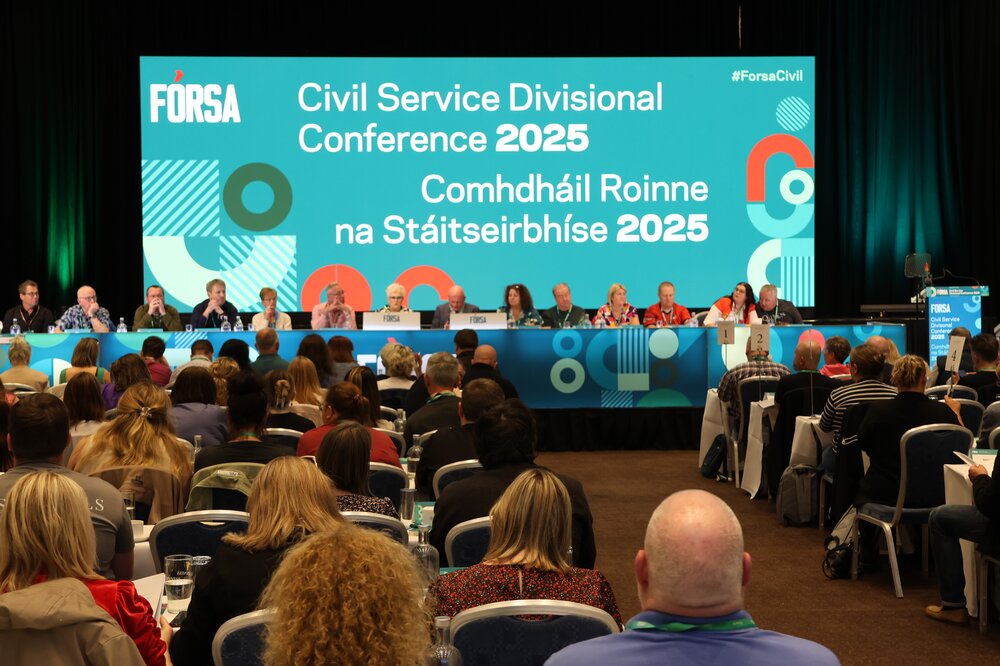
Delegates at Fórsa’s civil service divisional conference last week, in Galway, unanimously backed a motion calling for an analytics-based approach to any future review of blended working across the civil service.
The motion, brought by the division’s executive, calls on the union to insist that any forthcoming review—such as that anticipated in the Programme for Government—must be underpinned by “a rational, jointly agreed framework of analytics.”
Delegates stressed that any such review must assess a wide range of relevant factors, including public service delivery, workforce productivity, environmental impact, quality of life, and caregiving flexibility.
Addressing the motion, Fórsa deputy general secretary Éamonn Donnelly said:
“What we’re calling for is a mature, evidence-based discussion—one that recognises the benefits of blended working for the worker, the workplace, the employer, the environment, and the wider public. It’s not about preferences. It’s about what works.”
Éamonn commended members for their strong and united response to recent unilateral attempts by some departments to roll back agreed arrangements: “Our members stood firm in February. That solidarity made clear that arbitrary changes without consultation won’t be accepted.”
Fórsa member Gary Fagan told delegates that blended working is now an essential part of how many civil servants do their jobs: “It’s working for members. It’s working for services. And it’s working for the State. We need to ensure these arrangements are secured and strengthened, not undermined.”
Cathal Kelly, also speaking in support of the motion, referenced survey research from his branch showing that four-fifths of members with caring responsibilities would have to alter their arrangements if required to spend more time in the office. Most said such a shift would negatively impact their productivity.
His remarks were reinforced by findings from a recent UK study conducted by the Global Institute for Women’s Leadership at King’s College London and King’s Business School. The research showed that only 42% of workers would comply with a five-day return-to-office requirement—down from 54% in early 2022—highlighting the growing acceptance of hybrid models.
Éamonn said the study added to a growing body of evidence confirming that blended working is no longer a temporary post-crisis measure: “What employer seriously believes that time spent commuting is more valuable than time spent working productively?”
He also confirmed the issue had been on the agenda at the civil service general council earlier that same day, and that the Department of Public Expenditure, NDP Delivery and Reform is considering engagement in a process based on analytics.
Outgoing civil service Cathaoirleach Helen Linehan echoed this message in her opening address to delegates: “From the outset, Fórsa made it clear—blended working is not a pandemic-era favour to be withdrawn at a whim. It’s a negotiated, structured arrangement rooted in what works best for productivity, service delivery, and work-life balance.
“The real question is: why would any employer seek to reverse this progress except to reinforce outdated ideas about management and control?”
The conference motion passed unanimously.
Join a union that wins. Join Fórsa.





 Like
Like

