It’s time for a Better Deal
by James Redmond
We’re launching a new campaign built on a simple but powerful truth: change is not going to be delivered from above, it is only made possible when workers act together. Public servants will not be passive participants in the next pay negotiations. We're organising to get a better deal.
Across the public service, Fórsa members have been expressing the same frustrations. The cost of living continues to erode wages. Housing remains out of reach for far too many. Flexible and remote working - once seen as a hard-won positive legacy of the pandemic - is increasingly under threat. Public services are stretched, staff are exhausted, and the sense that “we deserve better” has rarely been stronger.
Fórsa’s recent Amárach survey confirmed just how widespread these concerns are, with large majorities saying their standard of living has worsened and that the next public service pay agreement must deliver real improvements. When asked whether they would be willing to take action with colleagues to strengthen their position ahead of the next agreement, an overwhelming 82% said they would take part in actions such as signing a pledge, attending a rally, or engaging in a form of action in support of a better deal and only 2% said they are not willing to take action alongside colleagues.
Changing our approach
That’s why we’re launching a new campaign built on a simple but powerful truth: change is not going to be delivered from above, it is only made possible when workers act together.
That willingness, and the challenges workers are facing, form the backbone of A Better Deal.
The first step of the campaign asks members to do something simple: sign a pledge stating that they will only support a pay agreement that delivers meaningful increases, resolves local bargaining claims, builds a fair work-life balance, and commits the government to investment in common good issues like healthcare and housing.
As Fórsa general secretary Kevin Callinan puts it: “It’s a straightforward statement of what we want to get out of the next round of public pay talks- but when tens of thousands of workers stand behind it, it will become a powerful message about what public servants will and will not accept.”
“The campaign begins in the workplace because that’s where power is built. It will send a message to government that public service workers will not be passive participants in the next pay negotiations. Our members expect more - and we are organising to ensure they get a better deal.”
Back to basics
The campaign is about more than a paper pledge. It is about a back to basics rebuilding of workplace-level organising that gives unions real power. The first phase centres entirely on conversation - not mass emails, not posters, not online petitions, but real discussions between colleagues. Workplace reps will be setting out to speak to members one by one, listening to their experiences, answering questions, and explaining how collective strength is built from the ground up.
Head of the education division Andy Pike said: “Members will begin to hear about the campaign in the weeks ahead.”
“In the education division, we will begin the campaign in Higher Education, the Education and Training Boards and Special Schools, as there is a real need to build collective strength in these areas, given the scale of challenges faced by members.”
“Reps will be reaching out, explaining how the pledge works and why it matters. They’ll be asking members about the pressures they are under and the demands that members themselves identified. They’ll be helping colleagues understand that the union’s strength in the coming talks depends on how many of us are willing to stand up and be counted now - before any offer is made, before negotiations begin in earnest,” said Andy.
Phased approach
This type of campaign takes time to build. In the first phase members will only be able to sign the pledge with a workplace rep present as it will only be possible to access the pledge platform through a unique link on workplace reps’ devices.
Kevin Callinan went on to explain how this approach reflects something deeper that has been going on in the union. He said: “A Better Deal is not an ordinary campaign: it is an opportunity for members to strengthen power in their own workplaces.”
“Many reps know the challenges of trying to support colleagues while feeling over-stretched and under-resourced. This campaign is designed to broaden that base - to identify new leaders, involve more members, and rebuild union presence in areas where it has thinned out. When members feel part of the union, rather than separate from it, everything becomes possible,” explained Kevin.
What’s next
What members can expect now is straightforward. You will hear from your rep. You will have the chance to ask questions, raise concerns, and talk about what matters to you. And you will be asked, simply and clearly, to sign the pledge. Signing is a public demonstration that workers want a deal that reflects the reality of their lives.
“Over the next six months we have a chance to rediscover our networks and build our capacity to carve out a deal that delivers the type of lives we deserve. Top level that means pay rises above inflation, working arrangements that deliver real work life balance, putting our tax money into building a public health system and real efforts to solve the housing crisis.
“We also need to be pushing back against empty rhetoric about rowing back on things like hybrid and remote work. The environmental and social gains growing out of these new patterns of work need to be robustly defended. Now is the time to stand up and be counted, and it starts with one small action: talking to your colleagues, listening to your rep, and adding your name to the pledge,” finished Andy.
Join a union that wins. Join Fórsa.
 |
|
Talks on pensions for school secretaries and caretakers pensions break down at WRC
by Niall Shanahan
Fórsa signals disappointment and warns further strike action “cannot be ruled out” as pensions issue referred to Labour Court.
Fórsa has confirmed that negotiations at the WRC (Workplace Relations Commission), on pension provision for school secretaries and caretakers, broke down on Thursday 20th November. The union said the breakdown follows the Department of Education and Youth’s failure to engage meaningfully with union proposals on a range of pension issues, including the recognition of prior service.
Fórsa said the breakdown in talks would require the matter be referred to the Labour Court, recourse to which was a central element of the September agreement that ended nationwide strike action in primary and secondary schools.
Talks resumed at the WRC yesterday to deal with the long-standing inequities affecting school secretaries and caretakers, who remain excluded from full pension parity with other school-based, public service staff.
Fórsa said no progress was made this week on the key issue of providing comparable pension benefits and recognising previous service.
The union’s head of education Andy Pike said any agreement must include appropriate credit for members’ earlier service. Without it, he said: “School secretaries and caretakers stand to lose significant pension value, many of whom have decades of employment behind them.
“The Department’s refusal to table a constructive proposal on this point has now brought the process to an impasse. School secretaries and caretakers have shown extraordinary patience. Their determination to secure a just and long-overdue resolution remains unwavering. But if progress continues to be blocked, we cannot - and will not - rule out further strike action.
“The next step now is to refer this matter to the Labour Court for a decision. Our members were clear in their intention when they took strike action in September. They fought for a fair agreement. We remain focused on establishing a satisfactory agreement through the State’s industrial relations mechanisms and will work with the Court to resolve this issue,” he said.
Build on EU’s wage directive for a better future for workers
by Kevin Callinan
The emerging voice of our younger workers points to a generation with an appetite for engagement, campaigns for justice and greater worker advocacy. We must nurture that.
In the immediate aftermath of the first wave of the global pandemic, Fórsa and SIPTU trade unions highlighted the unique opportunity for the Government to seize a watershed moment in history, likening the circumstances then to those that existed in Europe immediately after World War II.
With the right approach to leadership, we identified an opportunity for a new consensus on public services, workers' rights, and the social and political health of the nation, supported by adequate taxation, social dialogue, collective bargaining, and legal rights to equality and civil and political freedoms.
Five years on, the world has been beset by a combination of seismic change and increasing uncertainty. EU leaders, while grappling with demands for more defence spending, have managed to heed the warning flares fired by populist extremists, and this has been met with modest attempts to expand the focus from a market-centred economic orthodoxy to develop initiatives to improve social cohesion.
As inflation continues to take its toll, geopolitics remain fragile and immigration has become a focal point for the left, the right and the centre. Economic forecasts are explicit in their observation that inward migration will be an absolute necessity for the future of the Irish economy, while many of our main political parties continue to pivot on the topic in response to where they think the electorate wants them to turn.
If that growing tension is to be sustainably diffused, there is an oversized role to be played by access to fair wages, decent work and the process of empowering workers to engage in the collective bargaining process. Successful economies are characterised by greater levels of collective bargaining, not less. In a world of growing inequality, it is vital we have mechanisms in place to tip the scales of fairness back in the direction of a human workforce.
Last week, the European Court of Justice cleared the way for the implementation of the EU Adequate Minimum Wage Directive, designed to boost collective bargaining and to establish a National Living Wage.
It’s a significant development for workers throughout Europe, and a reminder that, at its best, the European Union can deliver real progress on living standards and workers’ rights. Its implementation truly has the potential to be a game changer for the Irish workforce, where there will be a significant challenge to boost collective bargaining coverage. It currently sits well below the minimum threshold of 80% envisaged by the Directive and lays down a challenge for trade unions to build union density in the workplace.
The Irish Government has followed through on its Programme for Government commitments to transpose the Directive into Irish law, which it did last year. And last week it published the Action Plan on Collective Bargaining, developed with the Irish Congress of Trade Unions and Ibec. It’s welcome and necessary progress ahead of Ireland’s presidency of the EU next year, and the planned pension auto-enrolment scheme. It is disappointing, however, not to be able to include the implementation of a National Living Wage, which has been pushed out to 2029.
Each of these elements have a role to play in improving social cohesion. Political leaders need only look at how the question remains largely unanswered in UK politics, and a growing sense of chaos as the electorate scrambles for a political saviour.
We’re not immune to the same cycle here, and recent events have shown discontent, and fear, can erupt into immediate and devastating violence. Remove any sense from people that they have a stake in society - and in their own futures - and this cycle is easy to replicate.
In this context, the Directive has a meaningful role to play in empowering workers. It has potential to be a properly gutsy reform of Irish industrial relations, and it throws down a challenge to trade unions to provide the leadership and expertise necessary to deliver a meaningful workers’ dividend.
In recent years Fórsa has made significant progress in recruiting new members, and the emerging voice of the newest generation of younger workers is becoming louder, and clearer. All the evidence points to a generation with an appetite for real engagement, campaigns for justice and greater worker advocacy.
In some ways this comes as no surprise. This is a generation that witnessed, as children, the devastation of the financial crash in 2009, and for whom CMAT’s recent hit Euro Country has become an important cultural and political marker. This is the generation who keenly felt the life restrictions of the pandemic, and who are now trying to navigate the world of work where full employment clashes headlong with a housing crisis, conspiring to force yet another generation of young Irish people to leave the country for better prospects.
They are a generation alive to the challenges we all face, motivated to find solutions and alert to the possibilities of collective strength and engagement. This Directive is one of the tools they need to carve out a better, more sustainable future for themselves and the generation of workers that follow them. Last week’s European Court of Justice (ECJ) ruling, the Government’s Action Plan and trade union leadership must conspire to place it in workers’ hands.
This piece was originally published in The Irish Examiner on Wednesday 19 November.
Join a union that wins. Join Fórsa.
Government opens consultation on the right to request remote working
by Niall Shanahan
With renewed noise in the media over hybrid work again last week, the Fórsa campaigns unit is urging members to take back control of the conversation from employers and pundits and ensure new policy is shaped by the people who actually do the work.
The Government has opened a public consultation on the right to request remote working, inviting submissions from workers and employers ahead of planned changes to the existing framework. The consultation, launched this week by the Department of Enterprise, Trade and Employment, will run until Monday 9th December.
Fórsa has urged members to take part, describing the consultation as a critical opportunity to shape policy following five years of unprecedented change in how work is organised. The union said the pandemic-triggered shift to remote and blended arrangements had permanently altered assumptions about productivity, service delivery, workplace location and work–life balance.
The union will host an online briefing for members to talk them through the consultation and the key points Fórsa will make in its submission. The briefing will take place on Tuesday 2nd December at 1pm.
Fórsa campaigns director Kevin Donoghue said the latest Central Statistics Office (CSO) figures underline the scale of this shift: “Despite slight decreases in the most recent figures, CSO statistics reveal that the proportion of people who work from home, at least sometimes, has risen from 20% in 2019 to nearly 36% in mid-2025.
“The number who sometimes worked from home increased by 14% between early 2024 and the same period this year,” he said.
Kevin added that public debate remains vulnerable to distortion, pointing to widely criticised remarks by businessman Denis O’Brien last week, who claimed remote work has made graduates ‘entitled’: “These comments illustrate the risk of sliding back into old assumptions rather than learning from our shared experience. Too often, the debate reduces to a crude argument between those who recognise the opportunities remote work presents and those who portray it as a threat to productivity.
“Over the past five years, workers across every sector demonstrated innovation, flexibility and resilience, delivering services in new ways without any loss to the high productivity that characterises the Irish workforce. That lived experience should inform policy, not be dismissed for convenience,” he said.
He said the union acknowledges that remote work does not suit every role, but that Fórsa’s experience shows that well-designed blended arrangements support both service delivery and staff wellbeing. Younger workers, for instance, benefit from in-person mentoring, while hybrid models can reduce long commutes and ease housing-related pressures.
Fórsa also highlighted wider societal benefits, including easing congestion, supporting climate targets and enabling more balanced regional development. Local businesses in commuter towns have seen stronger weekday footfall as more people work closer to home.
Kevin said the Government’s existing legislation continues to prioritise the employer’s ability to refuse a request: “This consultation is a chance to reset the conversation.”
“Remote and hybrid working has radically altered our view of where and how we work, and has revealed significant potential benefits to workers, families, our climate and regional economic development. The consultation process is a welcome one, providing an opportunity for workers to express their views and shape the future of work.”
You can access the consultation via the Department’s website here.
Register to attend Fórsa's online briefing on the consultation on Tuesday 2nd December here.
Join a union that wins. Join Fórsa.
Living Wage and collective bargaining plans to proceed following EU Court ruling
by Niall Shanahan
Europe’s top court confirmed the EU Adequate Minimum Wage Directive is built on rock-solid ground. The ruling gives Ireland and the EU a clear mandate to push ahead with reforms that workers have waited far too long to see delivered.
Fórsa and trade unions across Europe have welcomed a ruling by the European Court of Justice confirming that the EU Adequate Minimum Wage Directive stands on firm legal ground. The decision, issued last week, provides a solid basis for advancing fair wages and collective bargaining across Europe.
The European Trade Union Confederation (ETUC) said member states must now move ahead with national action plans to strengthen collective bargaining coverage and ensure that minimum wages meet adequacy benchmarks.
The Irish Government transposed the Directive into Irish law in November 2024 and launched its Action Plan on Collective Bargaining earlier this month. Ireland’s collective bargaining coverage remains below the 80% benchmark set by the Directive. The Action Plan was developed jointly with the Irish Congress of Trade Unions (ICTU) and the employer body, Ibec.
The Court upheld key provisions reaffirming the Directive’s “threshold of decency” (50% of the median wage and 60% of the average wage), as binding reference points for fair wage-setting across Europe. Ireland’s National Minimum Wage was set to be replaced by a National Living Wage next year, set at 60% of the median wage. However, the Government has pushed this back, with a phased introduction to 2029.
Fórsa general secretary Kevin Callinan said the ruling gives the Irish Government the opportunity to show real ambition in implementing the Directive and advancing collective bargaining coverage: “This ruling confirms that the Directive is robust, and that Ireland can move forward with confidence. The Government now has a clear mandate to implement its Action Plan on Collective Bargaining, including the reintroduction of tax relief on trade union subscriptions and the implementation of the National Living Wage.
“These are essential steps towards ensuring decent work, fair pay, and a sustainable model of social dialogue. In uncertain times, this Directive provides a solid foundation for negotiated progress. The kind of balanced, evidence-based approach that delivers stability and fairness for workers and employers alike,” he said.
ICTU general secretary Owen Reidy said: “Ireland needs to ensure that all workers who want a union at work can have one without the employer veto. This decision underlines the importance of a social Europe, which is critical if we are to stem the rise of the far right and ensure that workers and their families can not only survive but thrive in Ireland and across the EU.”
Fórsa national secretary and ICTU vice president Katie Morgan said: “This ruling is really welcome, particularly for workers who are seeking union recognition in their workplaces. Fórsa has been successful in achieving union recognition in many anti-union employments; however, some outliers continue to deny their staff the right to organise. Let this be a clear signal that the game is up; union recognition is unavoidable.”
Read general secretary Kevin Callinan's recent opinion column on this topic here.
Join a union that wins. Join Fórsa.
As pension auto- enrolment approaches ICTU call for vigilance
by Mehak Dugal and Hannah Deasy
The introduction of the pension auto-enrolment retirement savings scheme, called My Future Fund, will start from 1st January 2026. ICTU has warned union members to ensure that any new occupational pensions schemes meet the minimum conditions of auto-enrolment. Fórsa is holding an information session for members concerned on Tuesday 9th December.
From 1st January 2026 workers in Ireland without a pension will join the new auto-enrolment scheme, which was initially due to be rolled out in 2025, however successive delays have pushed the start date to next year.
Auto-enrolment is a new scheme designed to increase retirement savings among Irish workers. The goal is to ensure that all employees have access to a pension, particularly those who are not already enrolled in a workplace scheme. Under the scheme, the employee, employer, and Government all pay a certain amount into the employee’s pension fund.
The scheme aims to ensure that workers will not have to rely on the state pension alone. Supplementary pension coverage in Ireland is low, especially in the private sector where two thirds of workers are not paying into a pension scheme.
Fórsa national secretary and Irish Congress of Trade Unions (ICTU) vice-president, Katie Morgan, said: “The move to auto-enrolment represents one of the most significant shifts in how workers in Ireland will prepare for retirement. For workers who are not already in an occupational pension scheme, this will mean automatic enrolment into a new national retirement savings system. This is a safety-net measure for certain workers who cannot access their occupational pension scheme, or who are working for an employer who does not have a pension scheme in place."
This week, ICTU warned workers who have recently been enrolled in occupational pension schemes by their employer that they should ensure the contributions being made are not lesser than what they would benefit from as part of auto-enrolment.
In a statement released on Monday 17th November, ICTU general secretary Owen Reidy underlined that the integrity of pension auto-enrolment must be protected, and welcomed the news that the Minister for Social Protection intends to sign secondary legislation into law that will set minimum standards of employer contributions into existing occupational pensions. This will ensure that employees exempt from auto-enrolment are not short changed.
He said it was “urgent and necessary” to make sure that employers were stopped from making token contributions to occupational pension schemes before 1st January 2026 which would effectively block workers from the benefits of auto-enrolment.
He said: “New regulations will mean a token employer pension contribution will no longer satisfy the requirements of the Act, cutting off this avenue for those employers looking to violate the spirit of the law.”
To ensure our members are informed and prepared for these changes, Fórsa is hosting an exclusive member-focused event on the upcoming auto-enrolment pension system which will take place on Tuesday 9th December in Nerney’s Court and online.
Members can register their interest to attend here: Navigating Auto-enrolment with Fórsa.
Chaired by ICTU's head of social policy & employment affairs, Dr Laura Bambrick, this event will provide an essential briefing, expert insights, and a space to ask questions.
Quick Guide
Fórsa previously put together a short guide on the auto-enrolment pension system, developed by asking officials from the Department of Social Protection to explain what auto-enrolment pensions would mean for workers and answer questions on more specific circumstances. You can find our simple explainer here.
Join a union that wins. Join Fórsa.
|
|
The Cashew Connection: How Fórsa members are transforming lives in Burkina Faso
by James Redmond
Through a decade-long partnership with Self Help Africa, Fórsa members are helping Burkinabe cashew farmers reap the real rewards of their labour.
In recent years cashew nuts have surged in popularity due to their health benefits and protein-packed nature. Increasingly found on supermarket shelves and filling reusable lunchboxes, cashew nuts begin their journey thousands of miles away in the arid savannah landscapes of West African countries like Burkina Faso.
Cashew production is a lifeline for tens of thousands of rural families. Yet, despite its growing popularity the farmers who grow these nuts often earn very little from their labour.
That is slowly changing, thanks in part to the solidarity of Irish trade union members. Over the past decade, Fórsa has partnered with Self Help Africa to support women cashew producers in Burkina Faso.
Louise Rogan of Self Help Africa recalls how this partnership began: “A good few years ago we became aware that Fórsa had a fund that helps developing projects and since 2016 we have been in receipt of eight different grants from Fórsa, totalling just under 100k, which have supported many projects in different countries.”
For a sector where even a small investment can change many lives, that support has been transformative. Louise continued: “This has been hugely welcome and very generous support and we really do appreciate everything Fórsa has done for the organisation since 2016.”
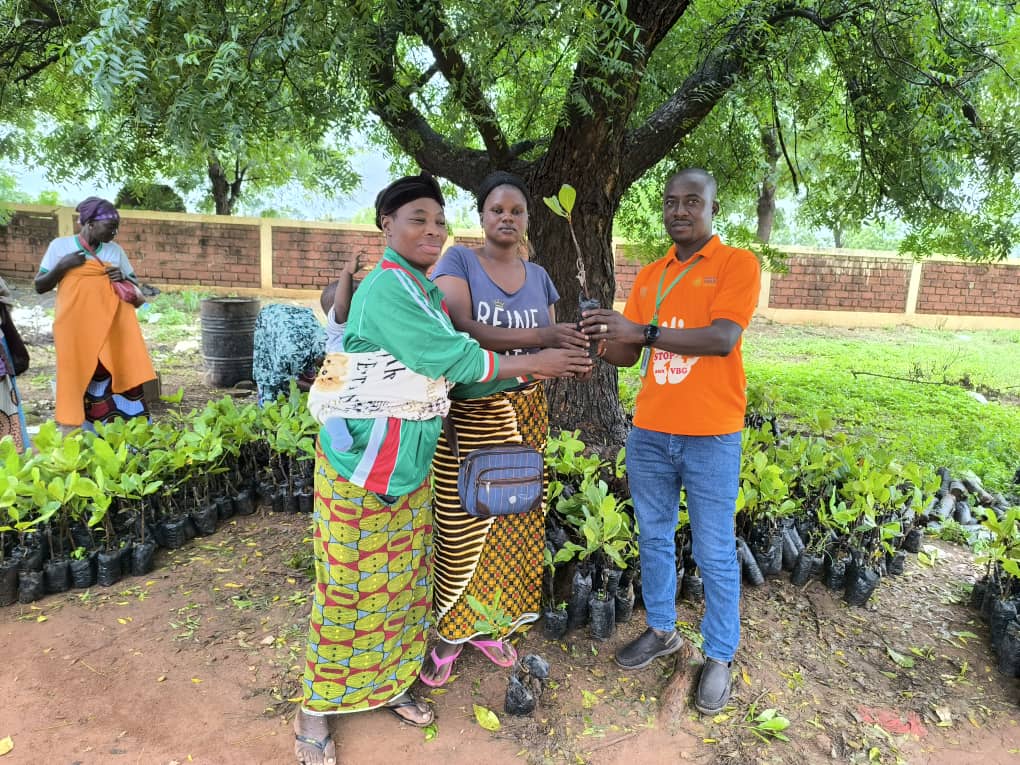
Seedlings being distributed through the project empower women farmers to expand their orchards and improve yields.
In Burkina Faso, cashew nuts are harvested once a year. For farmers working alone, this narrow window creates a dangerous bottleneck: everyone sells at the same time, flooding the market and driving down prices.
Ludovic Sawadogo, who oversees Self Help Africa’s programmes in Burkina Faso and Togo, lays out the problem plainly:
“Small-scale cashew producers who work alone can struggle to get their produce to market, and often must sell their crops locally, where they earn a lower price, thus flooding the market and driving prices down.”
This is where Fórsa’s backing has played a crucial role. The union helped fund the construction of a new storage warehouse - a simple building with enormous impact.
“The construction of a storage warehouse, with support from Fórsa, has provided women producers with a central depot where they can bring their crops for onward sale,” Sawadogo explains. It’s also a space where the nuts can be safely stored, sorted, and graded - essential steps for getting better prices.
“This opens up new markets for the farmer producers,” explains Sawadogo.

A production skills demonstration shows women farmers new techniques for managing their cashew orchards, improving nut quality and maintaining healthy trees.
Crucially, women farmers have also received hands-on training to improve their orchards and maximise their yields.
“Fórsa’s contribution also helped with the training of 1,000 women producers, and more than 12,000 grafted seedlings were purchased and distributed, improving cashew tree yields and nut quality.”
The real power of this partnership is best seen in the story of 63-year-old Fatoumata Siritie, a widow, grandmother, and member of the IYA YGO cooperative in Banfora. After fleeing political unrest in Côte d’Ivoire in 2011, she returned home with nothing.
“Returning home in 2011 after the socio-political crisis in Côte d’Ivoire, I walked back empty-handed, in total destitution; I could not even provide one meal a day for my children,” she remembers.
Today, she manages a 17-hectare orchard. Thanks to seedlings, equipment, training and beekeeping kits, she has transformed her land into a viable business. She now understands the cashew market, maintains her orchards effectively, and produces honey to supplement her income.
The turnaround is remarkable. The income she earns supports her children and grandchildren and gives her the confidence to plan for the future. She hopes to leave them a profitable enterprise - something she never imagined when she arrived home with empty hands.
If the cashew industry in Burkina Faso has a beating heart, it’s the cooperative model. Farmers there operate in groups governed by democratic rules, shared ownership and mutual support - principles that Irish trade unionists will be intimately familiar with, and which played a transformative role in agriculture in Ireland in the past.
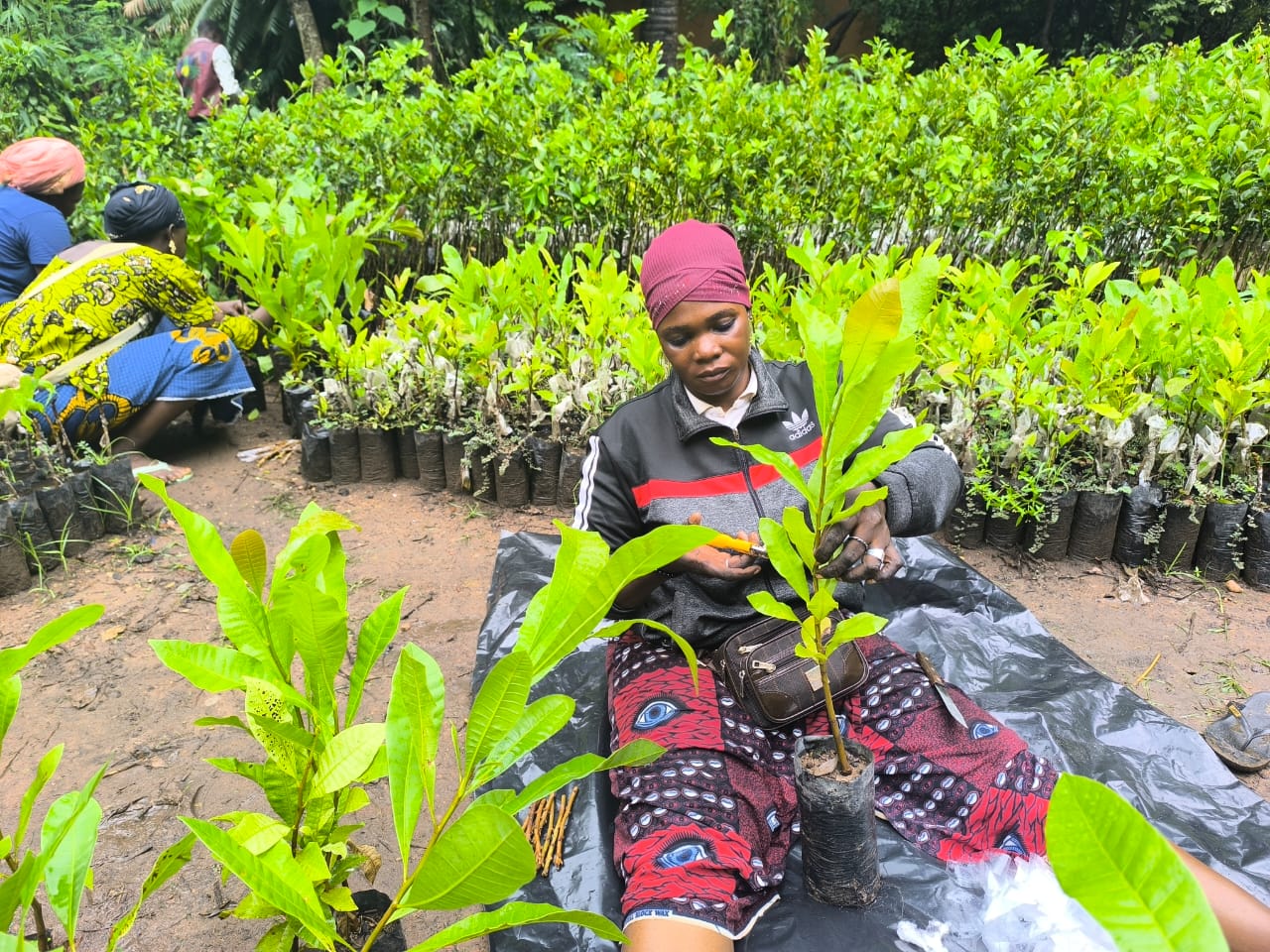
Training sessions on grafting cashew plants give women the technical knowledge needed to raise higher-yielding trees.
As Sawadogo says: “By definition, a cooperative is an autonomous association of persons who voluntarily come together through a jointly owned and democratically controlled enterprise.”
There are seven core cooperative principles, including voluntary membership, democratic control, education and training, and concern for the community - values that are at home in any union rulebook.
Self Help Africa builds on these structures by organising small farmers into producer groups, helping them scale up production and reach bigger markets. With more than 70% of Africa’s food grown on small farms, this kind of organisation is essential.
Despite their central role in cashew processing - where women make up more than 90% of the workforce - women face significant barriers. Land ownership is the biggest.
“Women’s access to land is a major challenge,” Sawadogo notes, with inheritance customs often excluding them. Even when they secure land, accessing tools, seedlings, fertiliser and market information remains difficult.
The Fórsa backed project tackles these barriers head-on through advocacy with local leaders, training, and improved equipment.
“The construction of a storage facility is also planned to improve storage capacity and nut quality,” explains Sawadogo.

Women participating in the programme are at the heart of Burkina Faso’s cashew sector.
Processing is another challenge. Women often work with basic, labour-intensive tools that can be unsafe or unhygienic.
“Through the project, Self Help Africa works mainly with these artisanal processors. They are supported with improved equipment such as full drying ovens, shellers and peeling tables.”
Burkina Faso is on the frontline of climate change. Rising temperatures, unpredictable rainfall and frequent droughts are making farming more difficult each year. Yet the innovations being introduced like rainfall-monitoring platforms, resilient seedlings, and techniques like the experimental use of biochar offer real hope.
“When properly applied, this technology helps retain moisture in the soil, ensuring crop survival,” explains Sawadogo, who also notes that cashew trees help pull carbon from the atmosphere and restore degraded land. Cashew is also grown in agroforestry systems to combat deforestation.”
For Sawadogo, the potential for trade-union collaboration is far from exhausted: “Unions like Fórsa can play a valuable role in transforming the lives of thousands of rural poor families,” he concludes.
For more information on these projects check out the Self Help Africa page on Burkina Faso.
Join a union that wins. Join Fórsa.
Stand in solidarity with Palestine
by Mehak Dugal
Preparation underway for rolling solidarity activities from workplace walkouts to seminars and large scale rallies.
Over the coming days, Fórsa members, activists and branches will be taking part in a range of powerful actions in solidarity with the people of Palestine.
Here is a quick reminder of all the activities taking place, starting from tomorrow in Nerney’s Court, Dublin.
Saturday 22nd November – Fórsa Palestine Solidarity Seminar
Fórsa is hosting a dedicated seminar tomorrow to explore how trade unionists can turn words into action using our collective strength to stand shoulder-to-shoulder with Palestinian workers and communities. Together, we’ll build our skills, deepen our knowledge and understanding, and plan practical steps for solidarity actions in our workplaces and branches.
Building on the commitments made at the 2024 Fórsa national conference, we’ll look at how economic measures can advance genuine solidarity.
Joining us at Fórsa, will be:
• Makan, an organisation providing transformative education to strengthen the movement for Palestinian liberation
• Workers in Palestine, representing over 30 Palestinian trade unions and professional associations, united in the call to end all complicity and stop arming Israel amid the unfolding genocide in Gaza, and
• Irish activists such as Eamon Mahon, MEP Lynn Boylan and Sarah Clancy who have stood fearlessly on the frontlines of international solidarity.
This is a day to connect, learn, and act, whether you’re a seasoned Fórsa activist or just taking your first steps in solidarity work.
If you are interested in attending the seminar, please register here.
Friday 28th November – Workplace Day of Action for Palestine
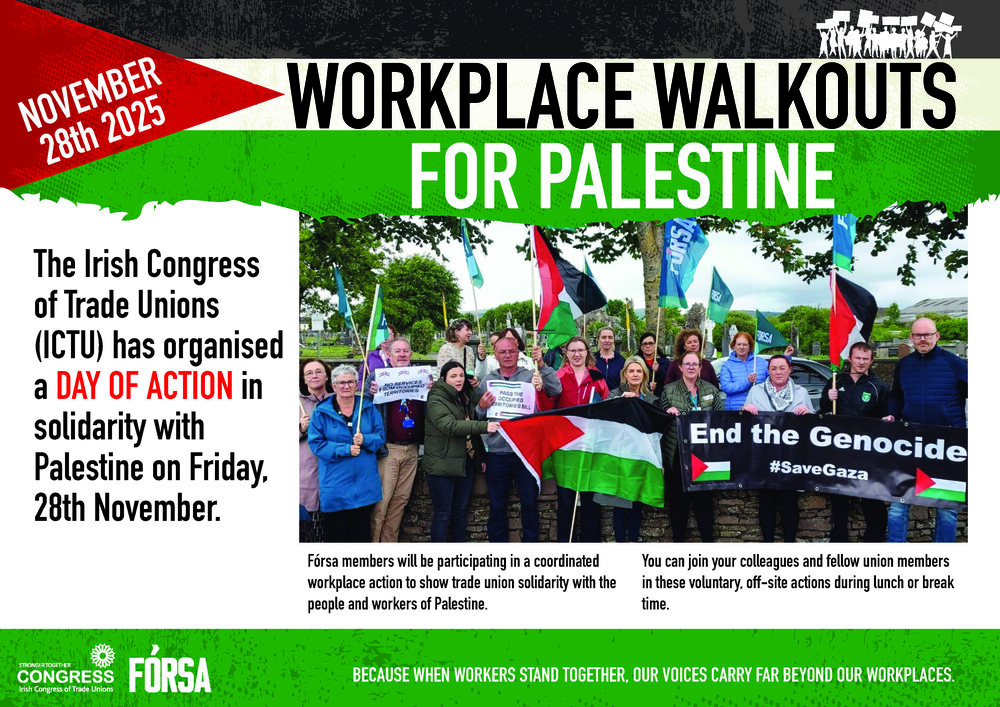
Fórsa activists and branches will take part in the ICTU-organised Day of Action for Palestine, with voluntary, off-site lunchtime or break-time activities.
This is an opportunity for members across the country to send a unified message of solidarity with Palestine, and to demand an end to all violations of international law.
Fórsa members will be staging workplace walkouts, lunchtime briefings, workplace photos, moments of solidarity, lunch and learn sessions and more!
The campaigns team has also put together a full suite of posters and digital materials for participating members and branches. These materials are suitable for professional and domestic printing, and carry messages relevant to the event, as well as messages of general solidarity with Palestine.
If you would like to receive these posters too, please contact campaigns@forsa.ie
The campaigns unit are also available to support branches in organising their events for 28th November. If you or your branch is participating in lunchtime walkouts or any other events on the day, please do let us know here so we can better support you.
Saturday 29th November – IPSC Rally
To mark the International Day of Solidarity with the Palestinian People, the IPSC will lead a National Demonstration in Dublin, and Fórsa members will once again march together as part of the trade union bloc.
The Fórsa delegation will gather at Nerney’s Court at 12.30pm before joining the broader union bloc outside Mandate’s offices on Cavendish Row. The main march begins at 1pm from the Garden of Remembrance and will proceed to the Dáil.
All members are encouraged to join us whether at Nerney’s Court, outside Mandate, or along the route as we raise our collective voice in solidarity with Palestine.
Over the next few days. we invite every member to get involved and help build the broad, principled solidarity movement that this moment demands.
If you’d like to stay connected to Fórsa’s ongoing Palestine work or get more actively involved, contact campaigns@forsa.ie anytime.
Join a union that wins. Join Fórsa.
Upcoming trainings
Registration for January courses now open.
It has been a busy first semester for the Skills Academy with hundreds of reps taking part in training online, and across the country. The semester will wrap up with the last Live: Lunch & Learn of the year, before the Christmas break. Initially scheduled for Friday 28th November, the session has been postponed until Friday 5th December to allow members to take part in the ICTU day of action in solidarity with the people of Palestine.
Registration for January courses has now opened. Be sure to register quickly to avoid disappointment as courses fill up fast and time is needed to secure release for participating members.
To register please contact your branch training officer, or branch secretary if the position is vacant. Participation requires sign-off from branch officers and relevant official. The Skills Academy cannot accept registrations directly from members.
Fórsa Induction for new members - Online - Wednesday 14th January
With morning and evening sessions available, this session is the perfect way to start off the new year if you have recently joined the union.
The induction is a short session to welcome new members and unravel some of the mysteries of Fórsa. Learn the basics of what exactly a trade union is, the structure of Fórsa, how we operate, and how members can become more engaged, have their voices heard locally, and raise issues at divisional and national levels.
Workplace Representatives Training Level 2 – Cork Wednesday 7th & Thursday 8th January
This course takes place over four full-day sessions which can be completed by reps in any order. Taking place in Cork for the convenience of Munster-based reps the organising module will be held on the Wednesday 7th January, and the Individual Representation module will be held the following day on Thursday 8th January.
The organising module consists of an in-depth look at organising, practical application of mapping techniques and identifying local leaders. The Individual Representation module is a fully interactive session taking reps through the journey of processing a case, from initially meeting the member to representing their issue to a management team.
The Cork sessions for the remaining two modules on Equality and Diversity, and Health, Safety and Welfare in the workplace, will take place in April for Munster based reps looking to complete the full set.
Annual Branch Returns – Dublin - Thursday 15th January
This will be the last session of Annual Branch Returns training before AGM season kicks off. A crucial training for treasurers, vice-chairs, or any committee member taking on their branch’s annual returns. Learn the responsibilities of branch treasurers, and the financial and accountancy obligations on branches.
Conflict Resolution – Dublin - Tuesday 20th January
Conflict can often, unfortunately, be inevitable, so learn to avoid escalation by investing in building high-quality working relationships with workplace representatives, members and management.
Communications Training – Galway - Tuesday 20th January
An opportunity not to be missed for Connaught and Ulster based members. This will be the only chance to catch this exciting training in Galway this year.
Ideal for workplace reps and branch officers who want to improve their lines of communication with their members. Learn to use effective tools to reach members, build a branch profile, and craft compelling messages to members.
RESCHEDULED Live: Lunch & Learn – Grants & Schemes to Buy, Retrofit & Renovate Your Home- Online - 1-2pm Friday 5th December
Due to the ICTU day of action in solidarity with the people of Palestine, this session has been postponed to the following week. As Fórsa will be participating in a co-ordinated lunchtime workplace walkout on that day, the session has been rescheduled to allow members to participate.
The session will focus on home improvement to save you money. Titled From Deposit to Dream Home: Grants & Schemes to Buy, Retrofit & Renovate Your Home, the session will feature guest speakers including Mark Solon, Managing Director of Symmetry Financial, and experts from the First Home Scheme, and SEAI. It will be a practical webinar that might just save you money or even be the key to getting that first foot on the property ladder.
Follow this link to register for Live: Lunch & Learn.
Join a union that wins. Join Fórsa.
|
|
|
|