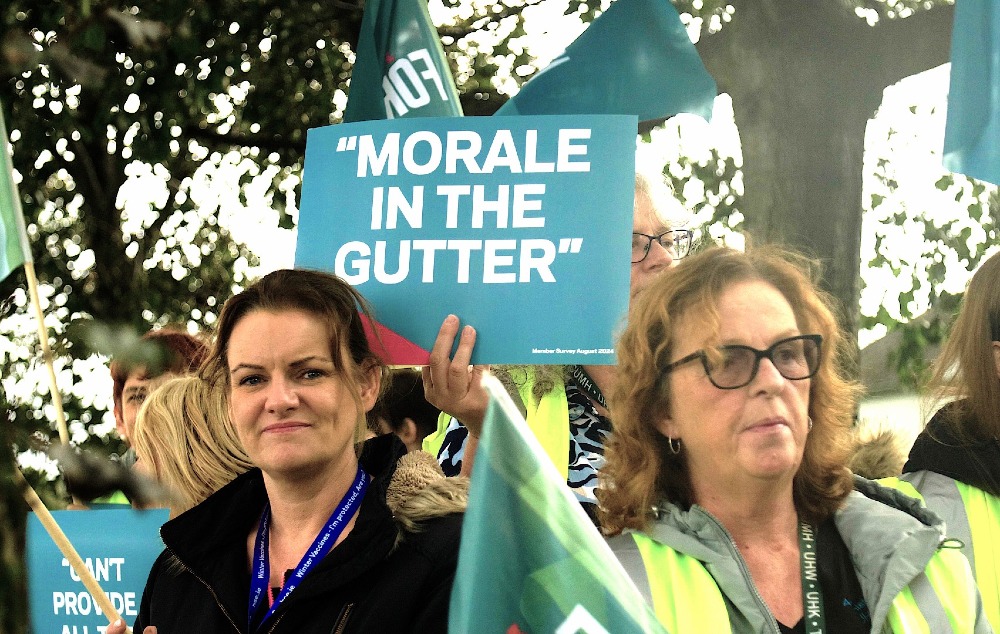
New research, developed with the participation of almost 3,800 health staff, has revealed that staff morale in Irish health services is at a critically low level.
Fórsa commissioned the research by independent think-tank TASC, in which 68% of respondents described staff morale as either ‘low’ (43%) or ‘terrible’ (25%). Almost half of respondents (48%) said the situation had worsened over the last two years, while just over half (53%) said low morale is negatively affecting the quality of care.
The research findings were presented last week to delegates at Fórsa’s Health and Welfare divisional conference in Donegal.
The research shows high levels of dissatisfaction with opportunities for career development (63%), and a significant number of staff continuing to work despite feeling unwell. Some 74% of respondents reported coming to work, despite feeling unwell, during the previous three months, while 68% of respondents reported feeling unwell, due to work-related stress, over the previous two years.
On the factors responsible for the continuing decline in morale, the research identifies understaffing, a sense of ‘disconnect’ between management and staff, a ‘lack of recognition and underappreciation’ of staff, alongside increasingly negative public perceptions of health and care systems.
Commenting on the research findings, Fórsa national secretary Linda Kelly said: “Unfortunately, the research confirms what our members have been talking about over the last couple years with increasing frequency.
“Staff shortages, in a wide range of acute health areas, has really increased the pressure on health and social care staff, and that has placed a heavy toll on staff morale,” she said.
Linda said that the most concerning aspect of the research is the extent to which staff are actively considering leaving their jobs to work elsewhere: “The staffing pressures are having a negative impact on staff retention.
“Diminishing morale among existing staff is leading to burnout, and we can see this especially among those with longer service and experience, while a very high proportion of respondents - 76% - said they often think about leaving their current role,” she said.
Linda added that staff shortages in some areas has led to cuts in services in some network areas, while the lack of referral options means that key services are sourced from private providers, at much higher cost: “Added to long wait times, which undermines preventative care, this is causing the public - our service users - to lose faith in our health system. This is a source of very serious concern for our members,” she said.
The TASC research combines an online survey of close to 3,800 participants, focus group research and a literature review, drawing responses from HSE, Tusla, and ‘Section 38’ and voluntary health organisations. Respondents include clerical and administrative staff and health and social care professionals (HSCPs).
Linda said Fórsa members identified the lack of recognition of issues faced by frontline staff, and the failure of management to address systemic issues, as factors that indicate “a lack of respect for workers.”
Proposing a motion to conference in response to the research, Donegal Fórsa member Angela McGinley said her department is at the loss of two people, both on stress sick leave: “These colleagues are not being replaced, and this has a knock-on effect of the rest of us, creating additional work, people eating lunch at their desk, while trying to maintain a service that responds to our patients,” she said.
Angela said while low morale jeopardises workforce retention, it also compromises service delivery.
See also: RTÉ’s coverage of Fórsa’s Health & Welfare divisional conference is available here.
Join a union that wins. Join Fórsa.





 Like
Like

