Members are invited to a coffee morning in Nerney's Court before the march on Saturday 17th May.
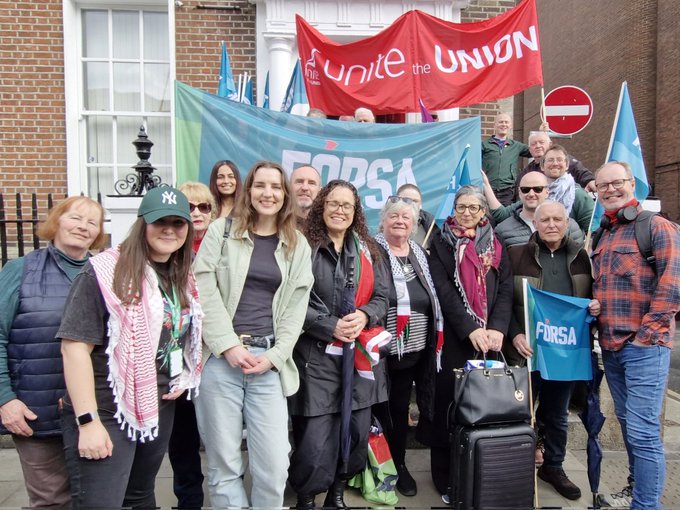
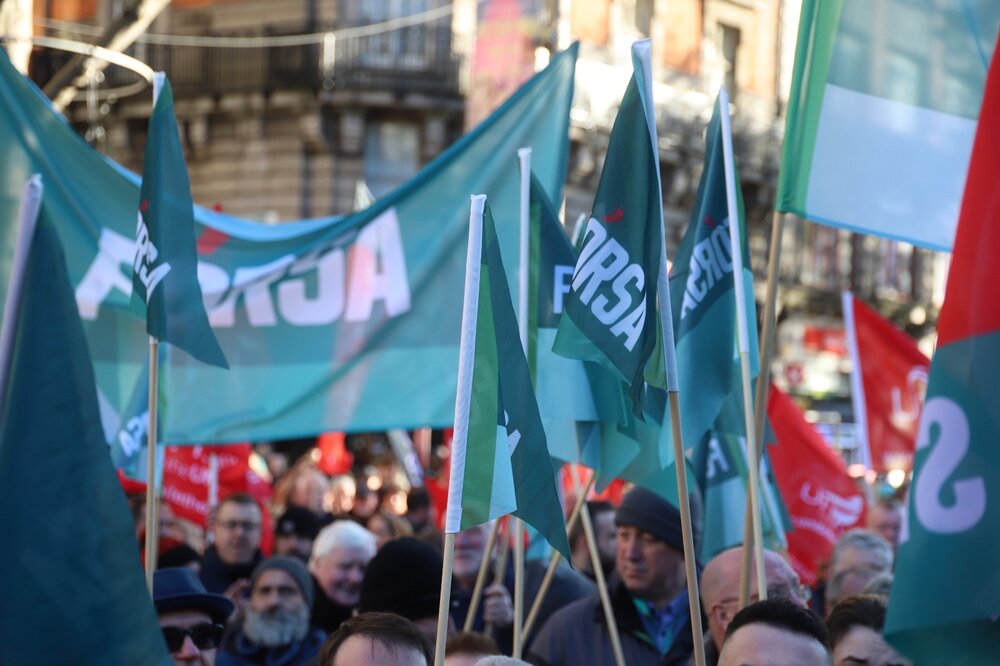
Fórsa is looking for a team of volunteers to help organise and take part in Fórsa's next presence at the national demonstration for Palestine on Saturday 17th May. We will be hosting a coffee morning in Nerney’s court from 12pm before the march, so come along and meet like-minded union members before the demo.
The march will begin at the Garden of Remembrance at 1pm and finish outside the Dáil on Molesworth Street/Kildare Street, to bring our demands to the Irish government’s doorstep.
As usual, the Fórsa delegation will be departing Nerney’s Court, Dublin, at 12.30pm to join the trade union bloc at the IPSC march. You are welcome to come to head office beforehand to collect a Fórsa flag and enjoy some coffee before joining the trade union bloc or meet us outside Mandate’s office at 1pm directly.
At the demo we will be calling for immediate sanctions and for the enactment of the Occupied Territories Bill.
This month’s march is of particular significance, as it also marks the 77th year of the ongoing Palestinian Nakba (‘catasrophe’ in Arabic), which began with the forcible depopulation of Palestine in 1948 and continues to this day with the ongoing genocide in Gaza.
In advance of the demo the IPSC criticised the Irish Government for not taking more action, stating “It won’t enact the Occupied Territories Bill, it won’t act to stop the Central Bank processing Israel’s genocide bonds, it won’t stop the use of Shannon Airport and Irish airspace for transiting weapons to Israel, it won’t stop dual-use exports to Israel. It won’t even ban the state investment fund — that invests our taxes — from investing in companies that profit from genocide.”
If you would like to become more involved with Fórsa’s Palestine demonstrations or would like to receive regular updates on the union’s activities in this area, contact campaigns@forsa.ie.
Fórsa delegates gathered in a rain swept Galway for the 2025 Fórsa Education Division Conference on the 23rd and 24th of April.
Delegates representing the division’s branches gathered to set the agenda for the next two years.
A packed agenda featured debates, awards, and fringe events tackling gender-based violence and systemic challenges in education.
Motions passed on approving a ballot on industrial action in respect of the pension parity in schools campaign, outsourcing in the ETB sector, increasing provision of autism classes, calling for the Department of Education Circular on assault leave to be amended, the inclusion of non-teaching staff on boards of management, the SNA workforce development plan, and increasing administrative staffing in the technological university sector, amongst many other topics
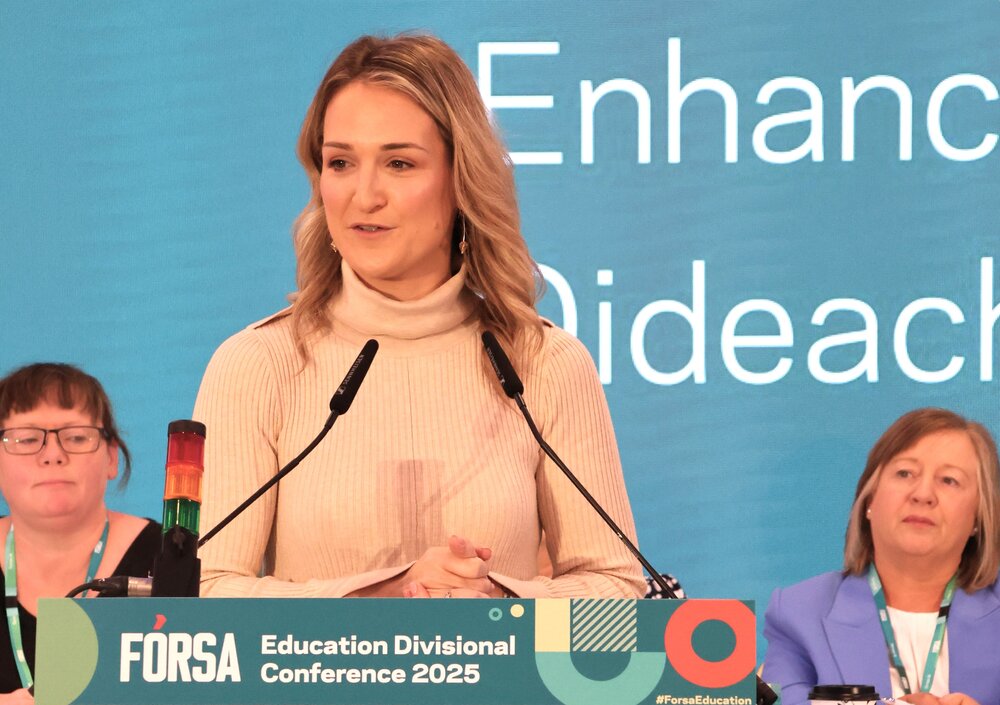
Minister Helen McEntee pledged support for school staff and announced a long-awaited SNA redeployment scheme. Watch the highlights, hear from members, and see how union members are coming together to fight for an education system that works for all.
Take a look at what the Skills Academy has on offer for members this May.
Due to great interest from members, an additional session of the Branch treasurers training has been scheduled. Learn all about the union’s mentoring programme at our next Lunch & Learn, and for those who missed it, last month’s mortgage essentials session is now available to watch back online.
Branch Treasurers training – Thursday 22nd May – Nerney’s Court
Thursday 22nd May will be the last opportunity for branch treasurers and vice-treasurers to avail of this important training this side of the summer. Healthy finances are essential to the proper functioning of a branch. This training will guide treasurers through the ins and outs of the position, how to avoid the pitfalls, and will give treasurers a firm understanding of the aspects beyond keeping a balanced ledger.
In addition to essentials such as information on funding, capitation and how to manage the branch’s financial returns, there will also be the opportunity to network with other treasurers to support each other in the carrying out of their role.
While newly elected branch treasurers and vice-treasurers will be given preference in the event of oversubscription, this course is open to all branch treasurers. If you are a treasurer who is looking to hit the ground running or feel you could improve as a treasurer this course is ideal.
Live: Lunch & Learn – The Fórsa mentoring programme - Friday 30th May - Online
The Fórsa mentoring programme was launched a year ago at Biennial Conference. It was an ambitious initiative that sought to bring together experienced union activists and promising newcomers in the hopes of passing on knowledge and wisdom earned through years of union work.
This upcoming Lunch & Learn will bring together programme participants and tutors to take a look back on the year. Find out what went right, how participants benefitted, and plans for taking the programme into its second year.
This will be an unmissable session for anyone interested in knowing more about the benefits of mentoring and how you and your branch can participate in this year’s programme.
Watch back - Lunch & Learn 25th April - Mortgage essentials: first time buyer’s guides to mortgages
The Friday 25th April Lunch & Learn Mortgage essentials: first time buyer’s guides to mortgages is now available to watch on YouTube.
For those who were unfortunate enough to have missed it, in this session Mark Solon, Managing Director of Symmetry Financial Management, shared some of his in-depth knowledge of the mortgage application process.
There is no better expert for Fórsa members thinking of applying for a mortgage. From day one Symmetry Financial Management has specialised in helping public sector workers find mortgages suitable to their circumstances.
In this hour-long session Mark presented a step-by-step guide on how the mortgage process works, as well as sharing his detailed insight into what lenders are currently offering and the criteria they use to assess applications.
The recording is available on the Skills Academy’s YouTube here.
The Fórsa summer series returns this year, taking place on Tuesday 10th and Wednesday 11th June in the Radisson Hotel, Athlone.
The Fórsa summer series returns this year. This annual event aims to boost the skillsets of Fórsa activists and those interested in further developing their campaigning skills.
The summer series delivers a comprehensive training programme for new and returning activists, and specifically provides Fórsa members an opportunity to expand their advocacy skills and networks.
There will be sessions on organising for power, lobbying, public speaking, digital skills, and more. You can look at the programme overview here.
This year’s summer series will be taking place on Tuesday 10th and Wednesday 11th June in the Radisson Hotel, Athlone. This is an in-person event only.
Our summer school is open to all Fórsa members, but branch campaigns officers are highly encouraged to apply as this programme will be of particular value to them and their work.
If your branch isn't part of our branch campaign officers network yet, you can send us the name and contact details of your branch campaigns officer by filling in this form here.
The deadline to register is Monday 12th May. It will not be possible to request release for attendance beyond this point.
While this event is open to all Fórsa members you should discuss your attendance with your branch before applying.
You can register for the Fórsa summer series here.
If you have any further questions at this time, please do not hesitate to contact us at summerseries@forsa.ie.
Members from across the Education Division and all over the country were to be found in the Galway Bay Hotel on the 23rd and 24th April for the Education Divisional Conference. Delegates gathered to set the agenda for the division’s activities for the next two years.
Members from across the Education Divisional and all over the country were to be found in the Galway Bay Hotel on the 23rd and 24th April for the Education Divisional Conference. Delegates representing the division’s branches gathered to set the agenda for the division’s activities for the next two years.
Watch our Confrence recap video "We Look After Each Other"
A new Education Divisional Executive Committee (EDEC) was elected, which will be chaired by Ursula Cox from the Higher Education branch. Catherine Quirke of the Munster SNA branch will take on the Vice Chair role.
Delegates were busy over the two days debating motions on a wide range of issues. Motions passed on outsourcing in the ETB sector, increasing provision of autism classes, calling for the Department of Education Circular on assault leave to be amended, the inclusion of non-teaching staff on boards of management, the SNA workforce development plan, and increasing administrative staffing in the technological university sector, amongst many other topics.
In a show of solidarity underscoring how connected the division is, branches put forward numerous motions supporting key campaigns being led by other branches in the division, from SNAs supporting pension parity in schools to school secretaries calling for better assault leave for SNAs.
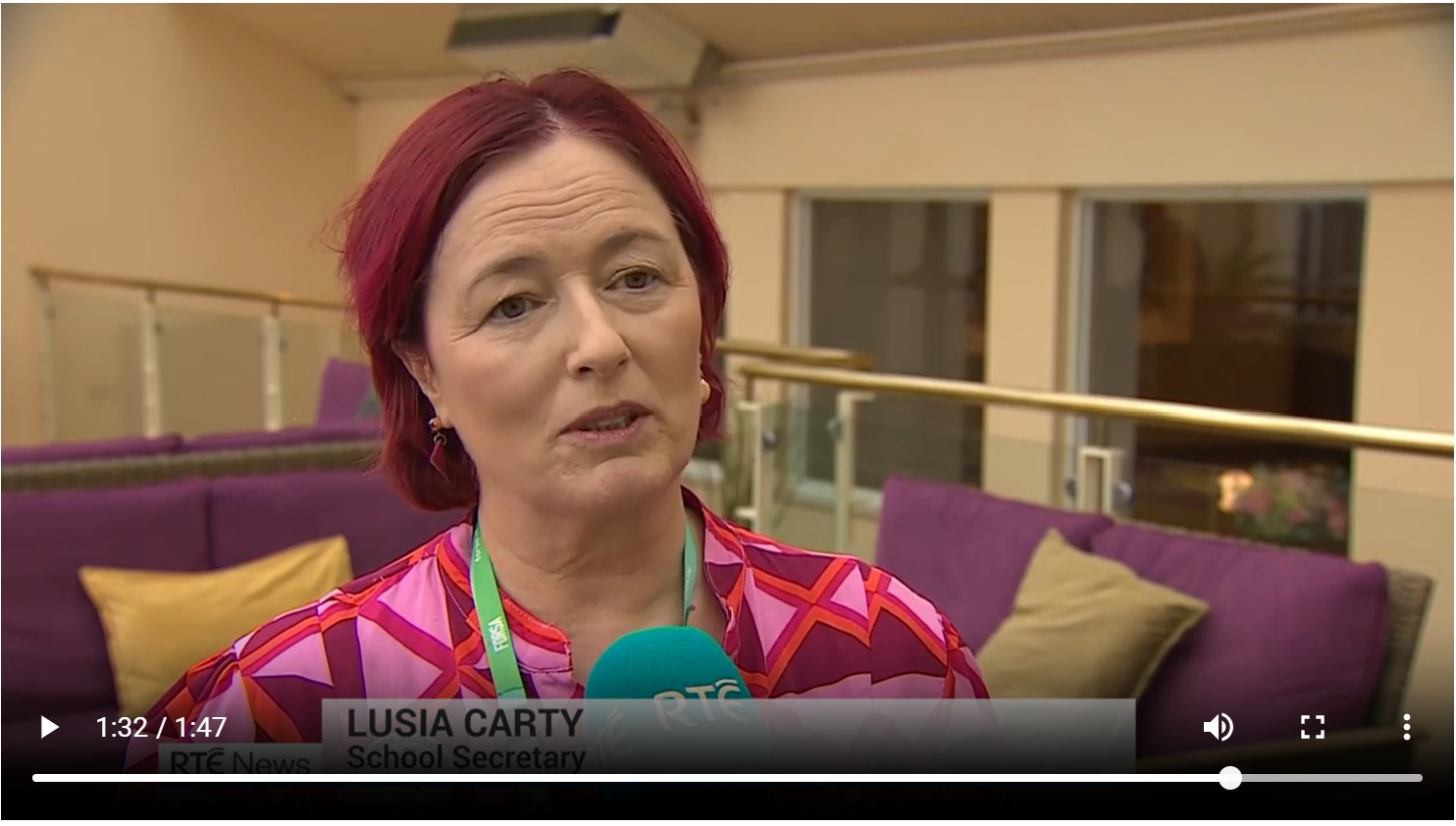
Delegates decided enough was enough for school secretaries and caretakers, voting in favour of a ballot of members on industrial action. Their vote created ripples with media coverage from RTE, The Irish Times, the Connacht Tribune, and on Galway Bay FM.
Minister commits to “doing everything she can” to advance progress for school staff
The new Minister for Education Helen McEntee received a warm welcome at conference. She paid tribute to the transformative work of Fórsa members in the Education division and made commitments to work towards pension parity in schools.
Fórsa’s head of education, Andy Pike responded to the Minister’s speech. He highlighted the injustice of school secretaries and caretakers being left without pensions, and without access to bereavement and critical illness leave. He acknowledged the work being done on the SNA workforce development plan and called the announcement that an SNA redeployment scheme will be in operation for the coming school year “seismic.”
Andy also highlighted the prevalence of children being locked out of education due to the lack of school places for children with additional needs. He called on the Minister to make both issues a priority.
He offered Fórsa’s support in solving the issues facing the Department of Education, recalling the beneficial collaborative working relationship between unions and the department that existed during the pandemic. He said: “where we can work with the Department, we will.”
Gender- Based Violence fringe
The need for a fundamental change in Irish society’s approach to the treatment of victims was highlighted at the Education Conference lunch-time fringe event: Addressing Gender-Based Violence.
Fórsa’s Linda O’Sullivan was joined by Diane Byrne of Women of Honour, and gender-based violence activist, Natasha O’Brien, for an unflinching look at the prevalence of gender-based violence in Irish society.
While the Irish Defence Forces came under direct criticism, panellists emphasised that the tendency towards seeing a victim seeking justice as the problem rather than the actions of the perpetrator, is an issue across Irish society.
Diane discussed how the legal team deployed against her by the Defence Forces was made up entirely of women. She called out the tendency of those in power to hide behind women when disempowering women and called on women to not uphold systems of abuse.
Natasha emphasised the role men have to play in creating meaningful societal change. She called on men to stand up when they see sexist and aggressive behaviour. She gave praise to the man who likely saved her life when she was assaulted, and held up her attacker’s friends who ran away as examples of how other men often do nothing.
Linda concluded proceedings by calling for greater solidarity between women, and between women and allies. She praised her fellow panellists for their tireless work addressing gender-based violence and lamented the slow pace of change in the country.
‘I was sick every time I was on leave’ – Members speak out about impact of burnout, stress, assault and injuries
After lunch, delegates attended an insightful panel discussion, chaired by Jen Cummins TD, on the impact of stress, burnout, assaults and injuries in the workplace.
The discussion was preceded by a presentation on the findings of the Education division’s recent survey on this topic, by officials Seamus Ryan and Diarmaid Mac a Bhaird. Read a summary of the findings here.
Fiona McGrath, SNA, and Esther Luttrell, school secretary, spoke about their own experiences, with Fiona outlining that, for her, burnout manifested itself through illness at every school holiday. They were joined by Orla Flynn, President of Atlantic Technological University and Patricia Murray, Organisational Psychologist. Patricia reminded the audience that stress will manifest itself physically if it goes ignored, saying “stress will bypass your intellect and impact your body.”
She also highlighted the connection between caring about the impact of your work and the likelihood of suffering from stress and burnout. This is backed up by the survey findings in which 73% of respondents said they feel their work is making a difference and 88% reported feeling stressed at work.
Focusing on solutions Patricia noted that being part of a team is shown to reduce stress, while good relationships and clear communication were also identified as important ways to reduce stress and burnout in the workplace.
In the Q&A session that followed members spoke from the floor about their own experiences of injury, where they had not wanted to report the incident and take assault leave, as well as incidents when training was refused. There was clear agreement that the Department of Education circular on assault leave has to change.
Concluding for the day, the chair underlined the importance of being treated with dignity at work, the need for critical incident training for all school staff, and that that staff can only support children effectively if they themselves are also supported.
Friday opened with motions on Local Pay Bargaining and SNA Appreciation Day. Michael Moynihan TD, Minister of State for Special Education and Inclusion, delivered a well-received address. Andy Pike again provided a response, outlining the outstanding issues for the minister and calling for a healthy collaborative relationship between union and department.
Although unable to attend, James Lawless TD, Minister for Further and Higher Education, Research, Innovation and Science, provided a pre-recorded address which was played to delegates.
Panel discussion on the experiences of refugee students in the education system
Great opportunities and great barriers were the themes of the panel discussion on the experiences of refugee students in the education system on Friday. While panellists spoke highly of the education opportunities available, they described a lack of any systemic approach to letting refugees know what opportunities are available to them.
Additionally, panellists were critical of the lack of stability afforded to people living in Direct Provision. They described having been given no more than a day or two notice before being required to move across country. Dima Atiyeh said, “They don’t give people enough time to move.”
Fellow panellist Luciano Hilario described the difficulty of moving school at short notice during term time. He called for greater stability for DP residents. He said, “if they put you in one place you stay there, make friends, and don’t have to break the bonds you make.”
After the panel discussion some of Fórsa’s most committed members were presented with Distinguished Service awards, celebrating decades of commitment to improving the lives of fellow workers. Watch this space for a profile of this year’s recipients in the next bulletin.
James Kavanagh wrapped up proceedings thanking delegates for their time, and staff for their hard work organising the conference. He highlighted the transformative power of education, the necessity of ensuring everyone has access to good quality education, and, where it is needed, the support to see it through to completion.
The campaign for pension parity in schools continues to grow in strength. Fórsa’s school secretaries and caretakers’ branches have been building public awareness of their campaign over the past two weeks by distributing thousands of badges and stickers to supporters in their communities.
The campaign for pension parity in schools continues to grow in strength. Fórsa’s school secretaries and caretakers’ branches have been building public awareness of their campaign over the past two weeks by distributing thousands of badges and stickers to supporters in their communities.
Chair of the school secretaries branch Luisa Carty said: “Parents, teachers, family and friends all play a powerful part in telling government that there is no reason to discriminate between school staff, everyone who works in a school plays a part in a child’s education.”
Signatures of the campaign pledge continue to build with over 23,000 pledges of support made.
At the Education Divisional conference in Galway on Thursday 24th April, Minister Helen McEntee committed to doing “everything she can” to support pension parity in schools, while delegates passed a motion calling for a ballot on industrial action.
Chair of the school caretakers branch David Hearne said: “In the workplace the government talk about equality. But there is no equality in schools.
Because one side of school staff get pensions and others don’t. It was huge to get our motion at conference passed calling for a ballot on industrial action. The whole room supported us.”
Thousands of pictures of supporters wearing the campaign badge have been shared, demonstrating just how much support is out there.
Head of the union’s Education division Andy Pike said: “It has been fantastic to see the school communities rallying together with our secretary and caretaker members in all the pictures, supporting them in their right to access fair pensions and equality in terms of sick, bereavement and critical illness leave. It really shows the level of comradery in schools and amongst colleagues who are members of Fórsa and the teachers’ unions. This is what the union movement is about and demonstrates unequivocally that an 'injury to one is an injury to all'".
Assistant general secretary Shane Lambert said: “It is important that we finish badge week on a high, with a flurry of pictures from all over the country, so please keep the momentum going. Please continue to get colleagues involved and continue to post and tag your pictures on social media.
Shane continued: “The effect it has had is evident in the fact that there has been great coverage and keen interest from political circles, so the message is being heard. We just need to keep repeating it in our actions. Keep posting and keep sharing, keep growing the support and gathering signatures for the pledge.”
“The next stage of the campaign will now begin. As we prepare for a ballot of members, we will hold another round of in-person information meetings. There will be 15 meetings in various locations nationally so be sure to keep an eye on email for further details. It is hugely important that there is significant attendance at these meetings. High participation shows our strength and demonstrates the commitment you and your colleagues have to this cause.”
On Wednesday 30th April Fórsa SNAs brought their campaign to amend the Circular on assault at work to Leinster House. They were there to witness the launch of a Bill, brought forward by Senator Laura Harmon.
On Wednesday 30th April Fórsa SNAs brought their campaign to amend the Circular on assault at work to Leinster House. They were there to witness the launch of a Bill, brought forward by Senator Laura Harmon.
The Education (Leave for Personal Injuries) Bill 2025 would establish standards for a scheme relating to leave for teachers and special needs assistants who are assaulted at work.
The Bill was drafted in consultation with Fórsa and the INTO.
Speaking at the launch Senator Harmon said: "This is about safety at work for staff and children. The reality is that our teachers and special needs assistants often work in challenging environments. When they experience an assault at work, the impact can be physical, emotional and long-lasting.
“Most of these injuries are not the fault of children and do not have any malicious intent behind them but we need to ensure that teachers and SNAs are supported and receive the financial support they need."
Fórsa NDNL SNA branch member Samantha O’Flanagan explained that SNAs know that most incidents arise because of a child’s unmet needs, communication difficulties, or a lack of appropriate supports, but she said the current Circular fails to reflect and support the complexity of the issues faced by SNAs and teachers in schools.
She said: “Staff must be properly supported when incidents occur. The Department has a duty of care to protect the health, safety, and wellbeing of school staff. This should never be compromised by budget constraints. SNAs and teachers must be paid for the full duration of any medically certified leave. We dedicate our lives to supporting children – we need the Department to show the same dedication to supporting staff.”
The launch of the Bill was supported by a range of politicians from across the political spectrum.
A number of motions on this issue were passed at the Education Divisional conference, which took place in Galway in April.
Speaking about the new Bill assistant general secretary Shane Lambert said: “This Bill is very welcome and brings to the fore many issues that Fórsa have raised on behalf of our members in recent years. At our divisional conference two weeks ago, we released the findings of a survey which highlight how relevant this issue is to members.”
“We want to see changes made to provisions in the Circular, that are unnecessarily restrictive and do not live up to the Circular’s intention to provide support to those who are injured.”
“We also need to move away from the term assault. We know that in many of the incidents, whilst they may involve contact between a child and the SNA, there was no intent to hurt or deliberately strike, therefore the incidents should not be classed as assault. Whilst assault may need to be encapsulated, as such incidents do arise on occasion, most incidents happen when a child becomes dysregulated and accidently strikes or knocks an SNA, without ever intending to do so.”
“Our members develop strong bonds with the children they care for and they should not be forced to label something as an assault, when it clearly wasn’t the case.”
Shane also explained that there are practical elements that must be addressed too, for example the tight timeframes on making an application can be an obstacle when injuries prevent the individual from submitting the application, and the need for flexibility around returning to work.
The union is also calling for a provision that would allow an individual to resume assault leave if they have returned to work thinking they are fit, only to suffer a reoccurrence or a flair up of the original injury. He said: “We don’t believe any member should be out of pocket, whether that’s down salary or for medical expenses related to an injury that has been sustained in the line of duty. It is as simple as that.”
Shane concluded by underlining that a more considered approach to health and safety in schools could lead to a reduction in classroom incidents, which should be the ultimate collective goal for all those engaged on this issue.
The Government launched its ‘Guidelines for the Responsible use of Artificial Intelligence in the Public Service’ yesterday (Thursday). Fórsa national secretary Catherine Keogh welcomed the emphasis on prioritising public trust and people’s rights.
The Government launched its ‘Guidelines for the Responsible use of Artificial Intelligence in the Public Service’ yesterday (Thursday).
Public Expenditure Minister Jack Chambers said the guidelines “compliment and inform strategies regarding the adoption of innovative technology and ways of working already underway in the public service” and seeks to set “a high standard for public service transformation and innovation, while prioritising public trust and people’s rights.”
The minister added that the guidelines have been developed “to actively empower public servants to use AI in the delivery of services, and that by firmly placing the human in the process “these guidelines aim to enhance public trust in how Government uses AI.”
Responding to the launch of the new guidelines, Fórsa national secretary Catherine Keogh agreed that AI offers potential to improve the provision of public services, and welcomed the emphasis on prioritising public trust and people’s rights: “Responsible AI management should absolutely prioritise public safety and trust.
"As the main public service union, Fórsa is also aware that there will be significant challenges to address when new, very powerful - and experimental - technology is integrated into our public services.
"We need to consider the experience of service users, for whom engagement with public services comes with a reasonable expectation of being able to talk to a real person.
"These challenges were raised in motions brought to our conference last year, reflecting members concerns. This includes AI’s difficulties with bias and discrimination, its potential use in worker surveillance and the continuing challenge of data privacy, and the importance of the ethical use of AI.
"Equally, it raises the question of who gets to share in the benefits of AI? As AI develops it will put various types of jobs at risk, including a variety of skilled jobs. As that happens, there needs to be a real worker dividend. For example, this opens up opportunities to talk about trialling a four-day week," she said.
Fórsa members outdid themselves this year for the second ever Trade Union Week, the annual highlight of the Better in a Trade Union campaign. Over 70 events were held the length and breadth of the country.
Fórsa members outdid themselves this year for the second ever Trade Union Week, the annual highlight of the Better in a Trade Union campaign. Over 70 events were held the length and breadth of the country.
Better in a Trade Union is an all-island cross union campaign, launched in 2024, led by the Irish Congress of Trade Unions (ICTU). It aims to build union membership across the country. Trade Union Week provides an opportunity to celebrate unions and their members, with events taking place from Monday 28th April to Friday 2nd May.
Last year during the first ever Trade Union Week Fórsa members held an array of fun and informative events, and this year was no different with members in every division holding events to create and recruit new members.
Events took place in hospitals, schools, offices, airports, libraries and further afield again. Workplaces from the State Labs, to the National Archives, the Oireachtas, the Courts Service and the Chief State Solicitor’s Office all took part, bringing members and prospective members together.
One branch event took place on the Saturday before the beginning of Trade Union Week. St Colmcille’s GAA club in Swords teamed up with Fórsa to produce new jerseys sponsored by the union.
Chris Crowley, a Fórsa member and union rep in Fórsa’s Dublin Garda Civilian branch, came up with the idea: “As Trade Union Week approached our branch decided to sponsor jerseys for the kids and ‘Mothers and Others’ groups at St Colmcille’s.
“I was active last year in the Better in a Trade Union campaign, and I was inspired by the success of the special jersey produced for Bohemians FC. We felt this was a lovely way to bring it into the community and to younger people,” he said.
Fórsa national secretary and ICTU vice president Katie Morgan said: “The current international uncertainty underlines the importance of union membership. We must protect collective bargaining and build union power; every new member increases our collective strength.”
Director of Campaigns in Fórsa Kevin Donoghue thanked members who organised events and recruitment stands, saying: “We know that people are most likely to join the union if they’re asked to by a colleague, so these visibility events are vital to our collective efforts to build our union.”
Gary Rutledge, from the Courts Service branch, co-hosted an event with the AHCPS. He said: "It was really good to chat with non-members in a more relaxed setting. A few said they liked the idea of joining a union but no one had spoken to them about it yet. In a big organisation like ours, we don’t always know when new people start, so this was a chance to connect with them.
It was a great opportunity to meet and work with our counterparts in the AHCPS who share the same union values as ourselves."
Ahead of the first online session of the ICTU Stronger Together Project: Ethnic Minority/Migrant Worker Leadership Training we spoke to Fórsa’s Khalid El-Busaidy, who shared his experience as part of the first class to take the training.
Next week, the ICTU Stronger Together Project will host the first online session of their Ethnic Minority/Migrant Worker Leadership Training.
Project organisers decided to host the online sessions to facilitate workers who expressed interest but were unable to attend previous sessions held in Dublin.
Ahead of the online session we spoke to Fórsa’s Khalid El-Busaidy, Senior Membership Recruitment Officer, who shared his experience in undertaking the Leadership Training.
When the Stronger Together project began recruiting for the inaugural class of May/June 2024, Khalid decided he would take part. He saw the course description and thought “it would be interesting, something different” and that it was something he could use to develop his skills.
The training was an immensely positive experience for Khalid. He said, “I was glad I did it. I met with colleagues from other unions. It opened me up to so much out there that I wasn’t aware of. I heard directly from the participants about their everyday lives and about their communities.”
For Khalid, the team facilitating the training was core to its success. He spoke fondly of Dr. David Carroll, Dr. Lucy Michael, and Gordon Ogutu, who created a comfortable environment and made him feel like he could excel. It also gave him the space to explore talents he had not realised he had.
One such talent was on full display at the ICTU’s Stronger Together: Anti-racist workplaces & trade unions conference, where Khalid spoke as part of the migrant worker’s panel. Using his talent as a storyteller and raconteur, Khalid took the themes being discussed and brought them to life with his own lived experience, enthralling all present in the process.
Khalid believes “all of us are equipped with some talent we didn’t know about” and for him the best way to uncover these talents is to “get out meet people and do something new.” For Khalid the Leadership Training was the beginning of doing just that, and it gave him the confidence to go further.
He said, “When I concluded that course, it gave me skills, confidence and a new sense of what I am capable of.”
Since completing the Leadership Training Khalid has found further enjoyment in education. He has taken on the Trade Union Congress: Organising Diploma course and reads for learning in his spare time. Khalid has excelled. He received word he has passed the course with flying colours just prior to publication and is already thinking about his next challenge.
Khalid said: “If you asked me years ago I would have said I don’t have the time for that. It was the Leadership Training that gave me the push to do the organising course. When I started, I wasn’t nervous because I already knew what to expect.”
“The ICTU Ethnic Minority and Migrant Worker Leadership Training, really was the key for me. It opened everything up.” he concluded.
Encouraging anyone thinking about doing the training he said: “Definitely go for it, take the step. It is a great opportunity to grow personally and professionally.”
Most of all Khalid wanted to stress the way the training made him feel in the hope others can experience it too, saying “you meet so many people, they’re so diverse, and everyone there is just like me. It makes you feel like you’re not alone.”
ICTU Stronger Together Project: Online Ethnic Minority/Migrant Worker Leadership Training will take place on Mondays 12th and 19th May, from 6.30pm - 8.00pm.
Sessions will be facilitated by ICTU and Dr Lucy Michael.
Attendance is free of charge and open to all migrant workers and those of a minority ethnic background.
Fórsa encourages all members who qualify for the training to take part if they can.
To register for the course, please send an email, with your name, trade union affiliation and contact details to antiracism@ictu.ie.
Only three days left to get your submission into the Department of Enterprise, Trade and Employment's public consultation on Ireland's action plan to promote collective bargaining.
Only three days left to get your submission into the Department of Enterprise, Trade and Employment's public consultation on Ireland's action plan to promote collective bargaining.
This consultation is an extremely important opportunity to shape the future of our workplaces, our rights, and our collective strength. It is open now, and will close on Monday 12th May.
Collective bargaining is the process by which working people come together and negotiate with employers, through their trade unions, to determine fair conditions of employment.
The right to collectively bargain is essential to ensuring that working people have the capacity to improve their living standards, provide for their families and build a strong foundation for our economy.
At present, Ireland’s collective bargaining coverage only amounts to around one-third of all employment.
Under Article 4 of the EU Adequate Minimum Wages Directive, member states with less than 80% collective bargaining coverage are mandated to provide a framework of enabling conditions for collective bargaining and establish an action plan to progressively increase the collective bargaining coverage rate. The action plan should be established after consulting the social partners or by agreement with them.
Fórsa has produced a sample document to help guide you in filling out the public consultation form, with a run through of each question in the consultation along with guidelines on possible responses. You can view it here.
Last week Fórsa also held an online webinar to provide information about the public consultation and inspire attendees to make their own contributions through the online consultation survey.
The lunchtime session featured contributions from Irish Congress of Trade Unions (ICTU) general secretary Owen Reidy and Fórsa general secretary Kevin Callinan. The webinar covered recommendations for the submission from both ICTU and Fórsa, and also outlined how you can and should use stories from your workplace to submit your own thoughts on this consultation.
Fórsa’s director of campaigns, Kevin Donoghue, encouraged every trade union member to contribute to this important consultation and draw on their experiences to inform Ireland's action plan.
He said: “It is important that we as trade unionists make a significant contribution to the number of submissions received in the consultation. The more members who speak up, the louder our collective voice. When we act together, we win together. This consultation is an opportunity to strengthen collective bargaining rights and encourage greater levels of trade union coverage. Raise your voice and encourage your colleagues and coworkers to raise theirs too.”
If you have questions about Fórsa's submission to the consultation or need help with your own, you can get in touch with us at campaigns@forsa.ie.
In-work poverty and an increase in the national minimum wage to bring it up to a living wage were the main calls highlighted in Fórsa’s recent submission to the Low Pay Commission.
In-work poverty and an increase in the national minimum wage to bring it up to a living wage were the main calls highlighted in Fórsa’s recent submission to the Low Pay Commission.
In the submission, Fórsa called for an increase in the existing national minimum wage that would effectively replace the minimum wage with a real living wage, set at 60% of the median hourly wage, by 1st January 2026. To achieve this, an increase of €1 is required.
This would be in line with the previous government’s commitments and recommendations made by the Low Pay Commission.
In the submission, Fórsa stressed that it was vital that the national minimum wage is seen and understood as a wage floor and absolute minimum rather than a ceiling. The union said it must not replace or restrict access to collective bargaining agreements or employment regulation orders which may secure higher wage rates in certain employments.
The Central Statistics Office Survey on Income and Living Conditions 2024 shows that poverty still exists for those in employment, with most recent in-work poverty figures at 5.4% This data re-emphasises the stark reality that minimum thresholds set below 60% of median wage place workers at high risk of in-work poverty.
In a wealthy country like Ireland, with a tight labour market, a minimum threshold of at least 60% should be considered reasonably practicable.
Fórsa national secretary and ICTU vice-president, Katie Morgan, said: “While employment should always provide people with the means for a decent quality of life, it does not automatically guarantee a quality standard of living or that a person will no longer experience poverty. The small increases in pay rates recommended for those who need them most, would deliver meaningful improvements in quality of life and living standards. This would also take an important step in advancing fairness and equality across our labour market.”
Fórsa also called for the abolition of sub-minimum rates of pay for workers under the age of twenty in the recent submission.
The National Minimum Wage Act explicitly discriminates against workers based on their age. It allows employers to pay those under 18 at 70% percent of the national minimum wage, those aged 18 at 80% and those aged 19 at 90% percent.
In 2023, the Council of Europe also concluded that Ireland was in breach of the revised European Social Charter due to its sub-minimum rate of pay for young workers and failing to ensure a decent standard of living for these workers.
While the majority of Fórsa’s membership is covered by collective bargaining agreements with their employers, it is essential that statutory minimum wage thresholds are set at a level that ensures that workers not covered by collective agreements can earn a fair and adequate wage that ensures a decent quality of living.
This would greatly benefit workers earning the minimum wage, largely concentrated in our retail, accommodation, food, or wholesale sectors, where lower wages are more predominant.
The submission to the Low Pay Commission was made in the context of the government’s decision to delay key measures already agreed that would make life better for working people. These include the delay of pension auto enrolment and a delay to the implementation of a national living wage for three years.
ICTU’s general secretary Owen Reidy said the delays were “shameful and unacceptable” and revealed that government policy seems to favour employers over low-paid workers, and called for supports for workers who may face short-time working breaks or layoffs due to anticipated economic challenges.
Fórsa’s policy officer, Aisling Cusack, said: “Inflation is slowing down, and the Government has indicated that it does not intend to continue cost-of-living supports, such as energy credits, or introduce new cost-of-living measures in the next budget for 2026 through the 2025 Finance Bill. The planned cessation of these supports places a greater urgency on the need to increase wages for those earning the minimum wage so that they can afford basic necessities and a decent standard of living without temporary cost-of-living supports.”
The national minimum wage is currently set at €13.50 per hour, effective from 1 January 2025. Fórsa is recommending an increase of €1 per hour which would bring the statutory minimum hourly rate of pay to a living wage of €14.50.
This change would allow our lowest paid workers to meet their basic needs and give them a better chance of avoiding in-work poverty.