The next CORU regional seminar for social care work members takes place in the Fairways Hotel in Dundalk, next Wednesday, 24th July from 10am to 1pm. It will be followed by the final session in this series on 11th September in Fórsa’s head office in Dublin.
Since February, Fórsa’s CORU registration roadshow has been travelling around the country speaking to our social care work members. The roadshow is a series of seminars to support and advise our members on the CORU regulation and registration processes.
On 30th November 2023, the transition period for the Social Care Workers Register with CORU opened. This opened a two year window for existing Social Care Workers to gain access to the register. This is in preparation for 30th November 2025, when the title ‘Social Care Worker’ will become a legally protected title in Ireland.
Fórsa assistant general secretary Chris Cully urged members to attend, saying “There's plenty of guidance available to help members understand upcoming regulatory changes. We will take members through the registration process so they can avoid any pitfalls and spend more time focussing on their work.”
These events are only open to Fórsa members. Anyone interested in attending an information event can join Fórsa by clicking here.
International solidarity is a cornerstone of the union, and in 2022 and 2023 Fórsa donated over €1.3 million to global solidarity projects through its long-established Developing World Fund.
Fórsa works to better workers’ rights, quality public services, human rights and equality both in Ireland and internationally. This vital work is achieved through the generosity of members. Funded by 3% of every member’s union subscription, the Fórsa Developing World Fund gives over €600,000 a year to projects around the world, allowing the union to make ongoing contributions to human rights and development, as well as responding to humanitarian emergencies.
Proceeds from the Developing World Fund are distributed through trade union federations like PSI, key Irish charities (like Concern, GOAL, Trócaire, Irish Red Cross etc.) and other smaller NGOs, delivering focused campaigns.
Since 2022, organisations including Self Help Africia, Concern Worldwide, Turkey/Syria ITUC Emergency Appeal, Vita Ireland, Justice for Columbia, PSI International Projects and Tír nan Óg Childrens Foundation have been supported through this fund.
The outstanding generosity of members has also helped support organisations such as UNICEF and The Irish Red Cross, who rapidly respond to humanitarian crises. Fórsa has made significant donations to help these organisations deliver aid to both Ukraine and Gaza. Last year a donation of 100,000 euro was made to UNICEF’s Gaza Crisis Appeal on behalf of the union, and last week a further donation of over 36,000 euro was also made to the charity.
Fórsa will be lining up again tomorrow, Saturday 20th July, to protest the ongoing atrocities and humanitarian crisis being subjected upon the people of Palestine.
The latest national demonstration is taking place in Dublin this Saturday. Fórsa members are encouraged to march together as part of the trade union bloc.
Fórsa members will gather outside Mandate’s offices on Cavendish Row (across from the Gate Theatre) from 12.30pm. Flags and banners will be available to collect at Nerney’s Court from 12pm.
The march is set to leave the Garden of Remembrance at 1pm and end at the Dáil.
Speaking ahead of the upcoming demonstration Grace Williams, head of campaigns at Fórsa, said: “For close to ten months now, Fórsa members have marched together calling for an immediate ceasefire."
She continued: "Union members across Ireland demand effective leadership from Government in creating international pressure to prevent further atrocities from occurring. This weekend’s march demonstrates the breadth and depth of support for this cause, and the need for an urgent Government response.”
There’s never been a better time to join a union, and it’s never been easier. Join Fórsa today.
In a wide-ranging speech, President Michael D. Higgins has spoken of the importance of the Irish trade union movement in rising to the economic, social, and ecological challenges facing the country and the world.
The comments came at an event held at Áras an Uachtaráin on Sunday 30th June. The gathering was to celebrate the success of the Better in a Trade Union campaign which saw thousands of people across Ireland joining a union for the first time earlier this year.
The President warmly welcomed the collected union members, including a sizeable Fórsa contingent. A lifelong trade unionist and founder of the teaching section of the Workers’ Union of Ireland, he introduced the theme of the party ‘Celebrating the Trade Union Movement’ as a subject very close to his heart, and that of this wife and fellow committed trade unionist, Sabina.
He called on unions to “to play a leadership-defining role in the coming years as we build the future of our economy and our society.” A future he envisaged as one where all workers, and people from all backgrounds, can flourish.
He laid the blame for the various crises the country faces at the feet of our current economic model, which he described as having failed, and having “left huge residues of inequality, environmental degradation.”
To build towards a better future, the President emphasised the importance of engaging with the public saying unions would need to increase their membership and foster “an expansion in economic literacy and rights-based thinking.” In a powerful plea for clear use of language he said: “There is not a concept beyond the understanding of our citizens if it is explained correctly.”
The President acknowledged the EU as a key battleground where many advances have been won for workers through international cooperation between unions. He lauded the recent EU Adequate Minimum Wages European Directive which requires Member States to put in place policies and legislation that increase collective bargaining coverage and to facilitate the right to exercise collective bargaining.
He praised the Irish trade union movement for its history of international solidarity, from cooperation through with unions from other countries and in international alliances, as well as supporting trade unions facing violence and suppression across the globe. After paying tribute to the Dunnes Workers boycott that heralded the beginning of the end of apartheid in South Africa, he said: “The trade union movement is strongest when it is a movement that knows no borders.”
Before thanking all the workers who had contributed to the successful event, the President rounded off his speech by calling all in attendance to “affirm our commitment to playing our part in the creation of a society that removes the obstacles standing between so many of our people and their full participation.” He concluded “The world will be a better place when we’re all in trade unions.”
Attendees were treated to lunch and refreshments, with entertainment being supplied by a variety of young Irish musicians.
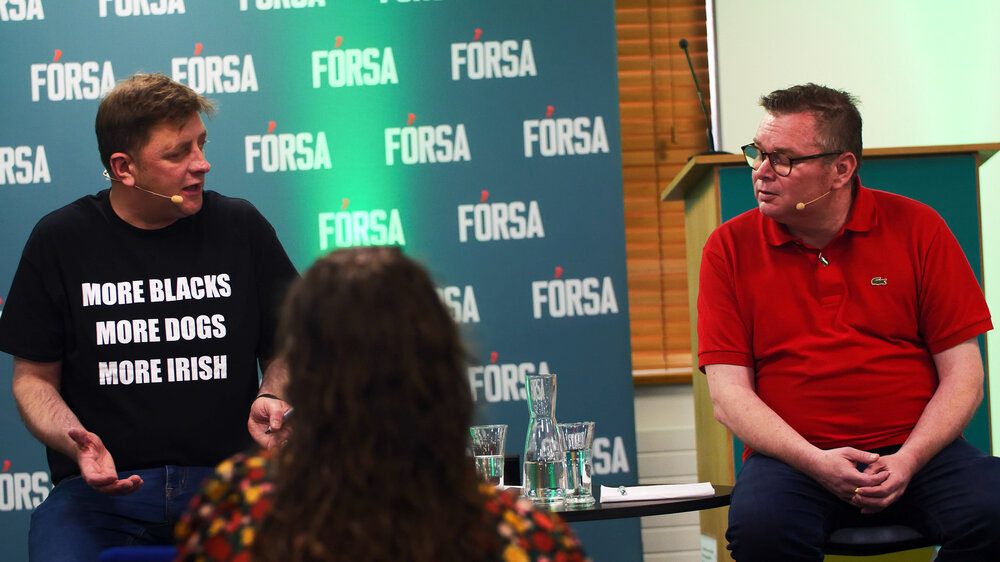
It’s a Wednesday evening in June and Fórsa’s headquarters are buzzing with the hum of a discussion on combating the far-right. Given the targeting of union members in workplaces like libraries, the event is being run as a tight ship, security checks are in place and a blanket ban on social media is in force.
The special guest is Hope not hate’s Matthew Collins, who has spent years subject to threats from far-right extremists after turning his back on hate in his early 20s.
Fórsa national secretary Richy Carrothers moderated a fascinating session with Matthew, covering his own story and considering what the union movement can do to combat hate.
Collins has one hell of a story to tell. By the age of 15, Collins, who had exhibited a school yard boisterousness antagonising people and unafraid of using racial slurs, had become captivated by the far-right and joined the National Front.
Matthew recalled how the environment within the National Front fostered destructive behaviour, particularly among its younger members. "Throughout the early part of my life, the teenage years, I was incredibly destructive, and that's what the National Front encouraged in me," he remembers.
He also speaks about the sense of belonging individuals can get from being part of the movement: “I became, in my mind, an important man and important person. I was elevated then. There was no one anywhere who told me I'd gone too far.”
As time went on, he became more involved in the bureaucracy of building fascism: “I'd get out of bed, I'd go to their little office. I'd lick envelopes, I'd send stickers. I'd post their bulletins out, go to the post office. And I absolutely loved it. I absolutely loved it.”
His epiphany occurred during a vicious assault on a meeting in a public library in London in 1989. A squad of forty British National Party (BNP) men, some laden with hammers, laid siege to a meeting of activists who were organising protests against the party setting up their HQ in the locality.
Collins was horrified by what he says as the “potentially murderous” mayhem that unfolded all around him. “These people who we were attacking would be the sort of people who would sign petitions to save a hospital or save a library or save a school from closing down.”
“And I thought I made no contribution to the community I lived in. I'd done nothing nice. I just thought, I need to just get out of this, this is horrendous.”
It was at that point that he turned and became a spy, sharing insider information with Searchlight, an anti-fascist research organisation, which put him on the path to becoming the activist he is today with Hope not hate.
“For three years I was like a spy who would tell anti-fascists what the campaign was, where the fascists were going to be, what they were going to do, who they were going to attack.”
Then, in 1993, Collins took part in a television exposé of the group which turned his life upside down, as he was subsequently relocated by the authorities to Australia due to active revenge threats from those who now considered him a traitor.
After a decade in Australia, Collins returned to the UK and began working with Hope not hate, an organisation which began as the campaigning arm of Searchlight, in response to the British National Party's (BNP) rise in 2001.
Collin’s role initially was to tell people what life was really like in the BNP. Today, he is the organisation’s head of intelligence, engaged in daily work to monitor the far right’s activities. This vital work has had a huge impact, including the prevention of a plot to kill Labour MP Rosie Cooper.
Anyone who follows Collins online knows he's keenly aware of what's happening on the ground in Ireland with a new wave of far-right agitators moving offline into our communities and workplaces. He recognizes an all too familiar pattern: "They go around intimidating women and entering libraries," he says. "Always libraries and always women."
When asked what advice he would give to ensure people here don’t get swept up in what he himself experienced in his youth he says he believes the secret lies with the trade union movement.
“Let's get those of our members who are unsure. Let's get them skilled up. Let's get them prepared. Let's get them educated. The greatest educator of the working class is the trade union movement. Know your rights. Know where you stand and know what your achievements are. Know where you're going. Know your enemy.”
“The trade union movement is always there, it's always organised, it's always prepared. It's always prepared to fight for you and your rights, and those rights should be for everyone. And when fascists come in and racists come in and they start dividing our class or dividing our people, that's where the trade unions can stand up and say, this isn't acceptable.”
Legislation that will see higher rates of Jobseeker’s Benefit for people with longer histories of PSRI contributions was signed into law by President Michael D. Higgins on Monday 15th July.
The new rates have been welcomed by unions as a much-needed modernisation of the social welfare system.
Welcoming the new model ICTU general secretary Owen Reidy said, “For us, this is only the beginning of a shift toward a more European-style social insurance system. Pay-related family leave must be included in the next Programme for Government.”
Owen also strongly criticised the model to date, saying, "Ireland was one of only four EU27 members states, along with Greece, Malta and Poland, to pay the same flat-rate payment to unemployed workers (€232 a week), despite workers paying pay-related social insurance (PRSI) contributions when in employment.”
The new rates will see workers who have five or more years of PRSI contributions prior to becoming unemployed receive 60% of their previous salary, up to a maximum payment of €450 for the first three months.
In the following three months the rate will be reduced to 55%, up to a maximum payment of €375. The three months after will see a reduction to 50%, up to a maximum payment of €300.
Workers with 2 – 5 years PRSI contributions will be able to access 50% of their previous salary, up to a maximum payment of €300 for 6 months, after which they will be put on the standard Jobseekers rate of €232.
There will be no change to the duration of Jobseeker’s Benefit, which will continue to expire after nine months at which point applying for Jobseeker’s Allowance will be necessary to maintain payment.
New rates will not take effect until later this year when the necessary IT systems will been put in place.
While the new rates represent a drastic improvement, the rates remain low when compared to some of our European counterparts. The current rate of €232 represents just 25% of the average weekly wage or 47% of the full-time minimum wage. Pay-related unemployment benefits in Belgium replace 91% of a worker’s wage, while in Denmark a worker can expect 79% of their wages replaced, and 69% in the Netherlands.
PRSI Changes
The legislation includes PRSI rate changes which take effect between 2024-2028. The rates will be increased across all classes in increments throughout the four-year period.
The first increment of 0.1% will go into effect from 1st October 2024, followed by another 0.1% from 1st October 2025. Rates will then gradually rise by another 0.2% up to October 2028.
The PRSI increases are intended to ensure the sustainability of the Social Insurance Fund while maintaining the State pension age at 66.
This plan did, however, draw criticism from Mr Reidy who said: “Unions recognise that social spending must be sustainable. However, the estimated €62 million yield from the 0.1% increase in PRSI contributions this year will be all but wiped out by the decision to simultaneously increase the cut-off point at which employers must pay a full PRSI contribution on behalf of their employees.“
There’s never been a better time to join a union, and it’s never been easier. Join Fórsa today.
Fórsa’s Skills Academy trainings are designed for you. So before your summer holidays begin in earnest read through our training calendar to see what might make your union work easier, but don’t take too long, as courses are filling up fast.
Our director of training, Fiona Dunne says: “Our aim in the Skills Academy is to fully support the development of skilled and knowledgeable representatives who are effective in the workplace, so it is crucial that the right reps get onto the right courses.”
“When you see a course that you think is the right fit for you, talk to one of your branch executive officers before applying, so that they can fully support you to put that training into practice. Applying your learning in the workplace is essential to retaining the knowledge obtained and developing key skills” Fiona continued.
Here’s an overview of how the application process works:
Step 1 Check the calendar to see what might be useful to attend. (Remember: applications open 10 weeks before courses start).
Step 2 Talk to your branch executive officer who receive ALL course application links and your IRO/AGS for support in your learning.
Step 3 Apply using the advertised link (see previous step).
Step 4 Complete the form FULLY, as this information is essential to processing your application.
Step 5 You will receive an acknowledgement and/or confirmation of your course place.
Further details on our courses are available in the Skills Academy hub here
July’s Lunch and Learn: Supporting LGBTQIA+ colleagues
The next Lunch and Learn on Friday 26th online is one not to be missed. Led by one of our very own representatives active in the equality field, Rob will talk through how we can support our LGBTQIA+ colleagues within branches and how Skills Academy can support our branches by building our capacity on this issue. The session will be hugely practical and essential for all members, but particularly those on Branch Executive Committees. This session is open to all members, the application form is available here.Please share this link with colleagues and encourage them to attend.
August sees another Fórsa 101 Induction take place online and is open to all new members. The application form is here so please forward tit to any new colleagues and remind them to attend.
DEADLINES ARE REAL
As applications open 10 weeks before course delivery, registration deadlines are looming. So, if you are interested in courses in September, they are already open and courses in October will open in August. Keep an eye out for those emails from your branch executive.
Soon to close ….
Our new communications and digital skills course
Our Director of Digital Kate O'Sullivan and Director of Member Communications Hannah Deasy will deliver this new course on Tuesday 10th and Tuesday 24th September in Fórsa’s head office in Dublin. Links to the application are available from your Branch Executive Committee.
Level 1 Workplace Representatives Training Galway
If you have already undertaken the Fórsa 101 induction course and are a new workplace representative, then this is the course for you. Delivered over 3 days we provide all the essential information and skills development to be confident in your new role. Links to the application are available from your Branch Executive Committee.
Mentoring programme
Do you have a lot of union experience with us in Fórsa? Would you like to share it? Are you new to union activism and could do with some help? Then mentoring might be for you. For the next 3 weeks (up until August 6th) we will accept applications as a mentor or mentee so please contact your branch directly or send us an email skillsacademy@forsa.ie for the link to apply.
Further details of all Skills Academy programmes are available on our training hub on the Fórsa website check it out here.
There’s never been a better time to join a union, and it’s never been easier. Join Fórsa today.
The ICTU group of healthcare unions representing staff in the HSE has said it remains concerned over the ability of the national health body to staff its services adequately, as the HSE’s latest staffing strategy shows that vacancies up to the end of 2023 have been effectively suppressed.
The ICTU group of healthcare unions representing staff in the HSE has said it remains concerned over the ability of the national health body to staff its services adequately, as the HSE’s latest staffing strategy shows that vacancies up to the end of 2023 have been effectively suppressed.
Unions have also raised questions with the HSE about how, in the absence of filling posts, funding for sanctioned posts was spent. Unions sought a meeting with the HSE following the announcement on Sunday (14th July) that it had lifted its recruitment freeze, which had been in place since October 2023.
That meeting took place on Tuesday. In a statement following the meeting, Fórsa official Ashley Connolly said: “We sought the meeting following HSE correspondence from last week stating that strict controls would be placed on recruitment for the remainder of 2024.
“What has become clear is that there are still a significant number of vacant posts that went unfilled up the end of 2023."
“We were advised this morning that these posts will have to be considered in the context of the head count for 2024. That is a complicated way of saying that these posts are effectively lost”, she said.
Ashley added: “The question is now, were the posts that went unfilled in 2023 fully funded? And, if they were, where was that money spent?
“We believe the failure to fill these posts will continue to place severe pressure on healthcare workers to provide a safe service. The provision of timely and safe care is now an afterthought,” she said.
Unions have said they will reflect on this week’s developments and revert back to management.
Ashley added: “The inconsistency in its approach to human resources management doesn't bode well for an employer, like the HSE, that’s hoping to persuade young workers to take up health service employment rather than leave the country.
“The HSE’s pay and numbers strategy (PNS) for 2024 has effectively guaranteed the loss of thousands of frontline positions. We know from our members that these will be vacancies in community health services, mental health, services to older people and it is likely to affect disability services also.
“We remain concerned too for the additional pressure this will have on our members as they continue to try and deliver services in circumstances where vacant posts have been long suspended but now appear to be permanently suppressed,” she said.
The ICTU Group of healthcare unions is made up of representatives from the Connect, Fórsa, Irish Medical Organisation (IMO), Irish Nurses and Midwives Organisation (INMO), Medical Laboratory Scientist Association (MLSA) SIPTU and Unite trade unions.
There’s never been a better time to join a union, and it’s never been easier. Join Fórsa today.
The union has written to Minister Health Stephen Donnelly T.D. seeking a meeting to address the exclusion of Health and Social Care Professions from the senior management structure of the six new HSE Health Regions .
The union has written to Minister Health Stephen Donnelly T.D. seeking a meeting to address the exclusion of Health and Social Care Professions from the senior management structure of the six new HSE Health Regions.
As part of the transition to Sláintecare Fórsa has been involved in ongoing engagement with the HSE on several significant issues. In recent weeks it has become clear that although medical staff, and nursing and midwifery staff will benefit from having a specialist regional director, health and social care professionals will not have a regional director.
In effect this would mean that the insights and concerns of health and social care professionals, who form the second largest clinical group in the HSE, would be absent from critical decision making.
Fórsa national secretary Linda Kelly said: “The exclusion of HSCPs from senior operational management structures will serve only to delay the achievement of Sláintecare objectives. It is in our view, an entirely retrograde step to allow this exclusion to happen.”
Linda continued: “The current restructuring of the HSE into health regions will likely shape the face of healthcare in Ireland for the next two decades. It must be done with the best interest of citizens in mind. All staff have an integral and important role to play in the delivery of Sláintecare and the new structures must reflect that at all levels."
The HSE’s own HSCP office produced a position paper in January 2024 making a compelling case for inclusion of HSCPs in the senior management team of health regions. In the paper they argue that collaborative clinical leadership enhances patient outcomes. You can read the paper here.
Linda concluded: “The position paper of the HSE HSCP Office is widely supported by our members, by the relevant professional bodies and by other colleagues in the Health Service. We are asking the Minister to intervene so that at a minimum, further discussions take place on this decision.”
There’s never been a better time to join a union, and it’s never been easier. Join Fórsa today.
Fórsa has written to the HSE, advising them that the current project plan on the proposed National Disability Authority's review of Children’s Disability Services is not fit for purpose and outlining its concerns.
Fórsa has written to the HSE, advising them that the current project plan on the proposed National Disability Authority's review of Children’s Disability Services is not fit for purpose and outlining its concerns.
The move comes following engagement and consultation with workplace representatives working in Children’s Disability Services on the HSE provided project outline.
Outlining the union’s position, she said Fórsa is of the view that an independent review of Children’s Disability Services is vital to restore public confidence in Children’s Disability Services, and the current project outline does not meet these requirements.
“It is entirely focused on avoiding the central issues that staff and parents are asking about, for example, whether this model is appropriate for the Irish context, what is the evidence base to support same, what resources, benchmarked internationally, are required to deliver the model, and what are the anticipated clinical outcomes of this model when properly resourced. Until such time as these core questions are addressed, our members cannot support the review,” she said.
Linda has long maintained that members voices should be at the crux of this project and encouraged members to get involved.
“It’s integral that the voices of our members working in Children’s Disability Services are at centre of this feedback to the proposed National Disability Authority Review of Children’s Disability Services. It’s vital that you and your colleagues are heard, I’m calling on members to get involved and become workplace reps at this time,” she said.
The next online workplace rep meeting for members working across Children’s Disability Services is scheduled for Tuesday 30th July from 12.30pm to 2pm.
Fórsa has called for an immediate review of the role of Hospital Pharmacy Technicians (HPTs) within the Health Service Executive (HSE) and HSE-funded services.
Fórsa has called for an immediate review of the role of Hospital Pharmacy Technicians (HPTs) within the Health Service Executive (HSE) and HSE-funded services.
The last formal review of the role took place 30 years ago, rendering the current job descriptions and career structures outdated and inadequate.
In a recent letter issued as follow up to a meeting with the HSE, Fórsa outlined several reasons for the necessity of this review. Linda Kelly, national secretary highlighted significant changes in hospital pharmacy needs and the evolving responsibilities of HPTs.
HPTs are responsible for a wide range of healthcare services, including purchasing and sourcing medications, invoice approval, price monitoring, staff management, and more. They also play a crucial role in medication safety audits, training new staff, and supporting anti-microbial and clinical pharmacists.
"The role of HPTs has evolved far beyond job descriptions that were written a long time ago," Kelly stated.
She added that despite while the role has expanded, there has been no corresponding recognition in terms of pay and grading structures.
The letter underscored that the recruitment and retention challenges within the Pharmacist grade have exacerbated the situation. Since pharmacists were added to the critical skills shortage list in 2022, hospitals have increasingly relied on HPTs to take on more responsibilities, often under minimal supervision.
"The pressure to meet service demands under pharmacist staffing strains has resulted in HPTs being asked to continue to expand their role under minimal supervision," Kelly explained.
Fórsa also pointed out that recent new service development within the health sector are led by basic grade HPTs, a practice the union deems inappropriate given the level of responsibility involved. Additionally, the union raised concerns about the increasing incidence of hospital pharmacists trained outside of Ireland being offered HPT roles despite not being eligible for registration with the Pharmaceutical Society of Ireland (PSI).
The union argues that a comprehensive review of the HPT role would unlock the vast potential within pharmacy services and improve workforce planning.
“There is a vast unlocked potential for Pharmacy Services within their current staff allocation in completing a review of HPTs. HPTs are skilled healthcare professionals responsible for a large remit of healthcare services,” noted Kelly.
Fórsa's call for a review is backed by the 2023 PSI Workforce Intelligence Report, which recommends such an evaluation. While not yet agreed, the union has put forward that Hospital Pharmacy Technicians will be a bargaining group in their own right.
Kelly expressed confidence that the review would benefit both the HSE and Fórsa in prioritising issues for the upcoming Local Bargaining Process under the Public Service Agreement . "It is our strongly held view that an internal review within the Public Health Sector would be a great asset to the broader long-term view committed to in the 2023 report," she noted.
In the months ahead it will be crucial for hospital pharmacy technicians to demonstrate they are no longer willing to let this situation continue to drag on.
Concluding, Linda Kelly urged members to talk to their work mates about the need to work together to get a review confirmed. She said: “Talk to your colleagues in your department who haven't joined the union yet. Together, we can build the momentum needed for this review and strengthen our position for upcoming local bargaining. We’ve seen how this worked for Hospital Pharmacists, now technicians must do the same," she implored.
There’s never been a better time to join a union, and it’s never been easier. Join Fórsa today.
Fórsa’s Louth Health and Welfare Branch recently launched a ‘One Person One Job’ poster campaign across the Louth Hospital Group to demonstrate the importance of proper staffing numbers across the hospital sites.
Fórsa’s Louth Health and Welfare Branch recently launched a ‘One Person One Job’ poster campaign across the Louth Hospital Group to demonstrate the importance of proper staffing numbers across the hospital sites.
The poster depicts a character pushing away the idea of juggling jobs and advises staff that if they are assigned new duties or those of a vacant position, they should direct their manager to contact Fórsa.
The issue of short staffing has been critical in the Louth Hospital Group for a long time. In March 2023 the union highlighted that staffing shortages amongst Fórsa grades place added burden and risk to members working across the hospital sites.
After over 18 months of engagement at local level and at the Workplace Relations Commission, an agreement was reached this month. This agreement further embeds the accepted principle of 'one person one job' encouraging fair work practices and improving the work environment within the hospital.
The poster has been shared widely with members at a recent event at Our Lady of Lourdes Hospital which saw an impressive turnout of nearly 40 members. Each attendee received a copy of the poster and made a commitment to display the poster in their respective work areas. The members were also asked to explain the content of both the poster and to encourage new members to join the union.
Fórsa assistant general secretary Lynn Coffey said: “There’s a renewed energy amongst the members. We’ve re-established a hospital committee for the first time in several years. It’s made up of Fórsa members working across a range of sections within the hospital, people taking the power into their own hands - the very people who know best how to address the workplace issues that affect them!”
The initial gathering of the committee took place following the launch event, and the first official meeting is scheduled for September.
There’s never been a better time to join a union, and it’s never been easier. Join Fórsa today.
Legendary American trade union organiser Jane McAlevey died last week after a long battle with cancer. Through her writing and training her legacy will live on.
Legendary American trade union organiser Jane McAlevey died last week after a long battle with cancer. Born in Manhattan, McAlevey was the youngest of nine children. Her father, John McAlevey, a WWII fighter pilot, lawyer, and progressive politician, was at one stage a mayor. Her political education began as an infant, as she attended civil rights and anti-Vietnam war marches with her parents.
While her activism began at school, it was in university that she first demonstrated her flair for leadership. In 1984, while at the State University of New York at Buffalo, McAlevey was elected student body president and later became president of the 200,000-member Student Association of the State University of New York (SASU). Recalling that time, McAlevey later told of the campaigns they won on tuition fees, rent increases and divestment from South Africa.
Her political education took her from the US to the Soviet Union in 1984 for the World Festival of Youth and Students organised by the Komsomol, to Nicaragua during the height of the revolution to support the Sandinistas.
Back in the US, Jane spent several years in the environmental movement before working at the Highlander Research and Education Centre, known for training civil rights leaders like Martin Luther King, Jr. and Rosa Parks. Jane later emphasised that Parks' role in the Montgomery bus boycott was the result of years of training and disciplined movement building, not a spontaneous act.
It was here she discovered old organiser training manuals and that the dots began to connect up in her head. McAlevey authored four influential books on member-led organising. Her works include "Raising Expectations and Raising Hell" (2012), "No Shortcuts: Organising for Power in the New Gilded Age" (2016), "A Collective Bargain: Unions, Organizing, and the Fight for Democracy" (2020), and "Rules to Win By: Power and Participation in Union Negotiations" (2023), co-authored with Abby Lawlor.
Her writings wove together memoir, manifesto, and manual. The key to Jane’s organising recipe was to ensure that there was a “continually expanding base of ordinary people, never previously involved” at the centre of things.
Through her writings and trainings, Jane hammered home the principled differences between what she called advocacy, mobilising and organising. Advocacy often ignores “the only concrete advantage ordinary people have over elites: large numbers. In workplace strikes, at the ballot box, or in nonviolent civil disobedience, strategically deployed masses have long been the unique weapon of ordinary people.”
Jane emphasised the need for approaches that would “expand the universe of people in our movement” and talked about “waking up in the morning with an explicit plan.”
Within the unions, Jane pushed for the adoption of methods like whole worker organising, power analysis and structure tests. Whole worker organising means recognising people aren’t hermetically sealed in little boxes between 9am - 5pm, but that we live in an ever-shifting society where conversations happen at large - and that power can be wielded just as much in the community as the workplace.
In exploring the applications of the McAlevey model, one thing is clear: it's one which advocates for a conversational approach to engaging workers in identifying their challenges, asserting their voices, and formulating their solutions. It isn't about imposing strategies on people; it's really about something "that enables ordinary people to understand their potential power and participate meaningfully in making strategy."
Ultimately for Jane: “When people understand the strategy because they helped make it, they will be invested for the long haul, sustained and propelled to achieve more meaningful wins."
In November of 2023, McAlevey promoted her fourth book Rules To Win By in the Fórsa’s Dublin head office.
Reflecting on the event, Fórsa general secretary Kevin Callinan said: “It was an inspirational evening for all present. Although not so well, her message was delivered in the usual clear and direct way. Organise, but organise to win. The methods that she had developed, and in which she had trained thousands of trade unionists around the globe, are designed to do just that.”
In a tribute to Jane posted online last week Kevin talked about how he met her for the first time in-person in May 2023 in Cork when she was visiting to deliver a workshop for Fórsa and says they struck up an instant connection that led to an all-staff training being organised earlier this year.
While Jane couldn't provide the training herself, Kevin was keen to ensure she knew the impact of her team's training on Fórsa staff: "Although very seriously ill and unable to travel, I messaged her to describe the electricity in the room and to let her know that we were creating a great legacy for her, that could in time change our country and our world. She replied, ‘that's such a beautiful and powerful note.’ It was always about power. That's how I'll remember her.”
In an era where algorithms designed in Silicon Valley sow seeds of division to disrupt and destroy conditions for workers around the world, Jane’s approach offers hope of a reset button.
She may not have had all the answers, but she knew the right questions. With the legacy she has left, and the thousands of people that have passed through her trainings: her organising is nowhere near done yet.
The executive of IALPA, the professional body for Irish airline pilots, and a branch of Fórsa trade union, has recommended acceptance of the Labour Court recommendation (23007), concerning the current dispute between IALPA and Aer Lingus.
The executive of IALPA, the professional body for Irish airline pilots, and a branch of Fórsa trade union, has recommended acceptance of the Labour Court recommendation (23007), concerning the current dispute between IALPA and Aer Lingus.
Pilots commenced their ballot on the recommendation yesterday (Thursday) and the ballot will conclude next Tuesday, 23rd July, at 9am.
IALPA members immediately suspended their work-to-rule action, in place since late June, pending the outcome of the ballot, while flight schedules were confirmed to have returned to normal this week.
The recommendation by IALPA followed communication from the Labour Court last week, confirming IALPA’s understanding of a number of provisions in the recommendation. Aer Lingus also provided clarification of its intention to lift restrictions on staff travel when the industrial action was confirmed suspended.
IALPA subsequently passed a motion to recommend acceptance of the Labour Court's recommendation. The union has also hosted a series of information engagements with members this week, ahead of the ballot opening yesterday.
The ballot result will be made known before lunchtime on Tuesday 23rd July.
There’s never been a better time to join a union, and it’s never been easier. Join Fórsa today.
Our membership survey is ongoing, but we need one final push to maximise the response rate. You have until Monday, July 22nd, at noon to submit your thoughts.
Our membership survey is ongoing, but we need one final push to maximise the response rate. You have until Monday, July 22nd, at noon to submit your thoughts.
Thousands of Fórsa members have already shared their views on critical topics such as artificial intelligence in the workplace, the devastating effects of climate change, and ensuring the best solutions for workers in the upcoming general election and future pay negotiations. Don’t wait until it's too late—take part and please remind others to participate!
In 2023, over 20,000 members took part in a survey we conducted. Your input ensured that your concerns were prioritised in the public service pay negotiations later that year. The resulting pay agreement was directly influenced by your participation. That’s why we’re doing it again: to ensure a strong collective response from our union.
We want to know which issues matter most to you. The concerns of our membership are always central to our negotiations and campaigns. Your input and participation will help direct our focus and secure a better future for you and your colleagues.
As before, we have partnered with Amárach Research to conduct the survey on behalf of Fórsa. Your participation is voluntary, and all responses will be anonymous and confidential.
The survey is open until noon on Monday, July 22, 2024. The survey link is here.
There’s never been a better time to join a union, and it’s never been easier. Join Fórsa today.