Greater than the sum of our parts: Our union stands strong
by Kevin Callinan
As we embark on a challenging year ahead, Kevin Callinan reflects on the successes of 2025, how they were built through collective action and solidarity. With the public sector pay deal due to expire, ongoing disputes, and a changing international political climate, we will need that solidarity to deliver for our ever-growing membership.
Dear members,
As this new year begins, I have been reflecting on how the bonds we share as union members shape our identities as individuals and our strength as a collective. When you join the union, you become part of a branch, a division, perhaps also a professional committee, and most importantly you join a community of 97,000 members who have your back. While we join as individual workers, through our membership we become stronger as a collective. By standing together, we amplify each other’s voices and create the conditions for all of us to be more than the sum of our parts.
Fórsa may be a young union but our roots reach way back throughout the history of the Irish trade union movement, and our collective achievements over the past twelve months have shown that our union will continue to be a vital force for workers into the future.
From a high-profile seven-day strike by school secretaries and caretakers, to union recognition agreements with employers that had previously refused to engage, to pay agreements for workers in Pobal, Barnardos, the IAA and for CE scheme supervisors to name but a few, and raising the alarm about the staffing crisis in the health sector, we have delivered real, meaningful results for members. You can read more about last year’s highlights here.
This year already, our members working in Information and Communication Technology (ICT) roles in local authorities, and clinical measurement physiologists in the Health Service Executive (HSE) have served notice of industrial action in long-running disputes.
While disputes may be our bread and butter, our focus on our future strength will not waver. A core part of our mission is to build power and grow in strength, density and size. I am proud that we are now within touching distance of hitting 100,000 members, with sustained growth over the past two years, as reported at the start of the year by The Irish Times.
This year we will undoubtedly face new challenges, many of which may be caused by decisions made far from our shores. A key priority for me this year will be ensuring that public servants are not caught in the headwinds of changing geopolitical circumstances or used as a political football domestically.
We know that the cost-of-living crisis continues to be felt harshly, and that the roll-back on remote work is a cause of serious concern for members. Indeed, in last year’s survey of members nearly three out of four members (73%) said their standard of living has worsened and a majority told us that protection of remote and flexible work is their most important issue after pay.
Demonstrating our strength and unity of purpose in the months ahead will be essential as the current Public Service Agreement 2024-2026 expires in June, after two final pay increases, due on 1st February (1% or €500, whichever is greater) and on 1st June (1%).
The survey results informed the development of our ‘A Better Deal’ campaign, which in turn lays out our ambitious agenda for the next pay talks. We’ll be fighting for real pay rises above inflation, resolution of local bargaining claims, a fair work-life balance, targeted investment in public healthcare and housing.
Using the local bargaining clause of the current agreement we have negotiated tangible results for members in the civil service, who voted to accept proposals which will shorten the journey through pay scales. We will now move to negotiating similar agreements in linked grades and groups in the public sector and press for discussions on all outstanding claims.
The beginning of the year coincides with AGM season. I encourage all members to look out for information about their upcoming branch AGM and attend. Whether you are a recent member or have been in the union for years, and even if you have never been to a branch meeting, please do go along to the AGM, and consider putting yourself forward to join your branch committee. It could be the first step towards a lifetime of union activism, or simply a way to make new friends. Either way it will shape your future identity as an individual, and as part of our collective endeavour.
There is much work ahead of us, but as the saying goes, many hands make light work. Together we have already achieved so much, and I know that much more lies ahead.
Beir Bua,
Kevin Callinan
General Secretary
Join a union that wins. Join Fórsa.
 |
|
ICT workers meet management inaction with a work to rule
by James Redmond
Industrial action is set to begin on Wednesday 28th January, as workers call for ICT roles to be properly resourced, and recognised as the backbone of local government digital services.
Information and communications technology (ICT) workers in local authorities will begin industrial action later this month following a nationwide ballot where Fórsa members voted in favour of taking action over pay, grading, and professional recognition.
From Wednesday 28th January 2026, Fórsa members working in ICT roles across local authorities will cease all out-of-hours work and withdraw from engagement with third parties, including contractors, vendors and the Local Government Management Agency (LGMA).
The action follows what the union has described as “years of management inaction” despite repeated engagement efforts and formal processes.
Fórsa national secretary Richy Carrothers said the decision to escalate came only after ICT staff exhausted every available avenue for resolution. “If management continue with the strategy of frustrate and delay tactics by dragging their heels and inaction, then we’ll meet that with industrial action.
“For more than five years, we’ve sought meaningful engagement with the LGMA on pay, grading and recognition for ICT roles,” he said. “Despite detailed proposals, reports, and engagement at the Workplace Relations Commission, there has been no tangible progress. Our members’ patience has understandably run out. We’re no longer willing to tolerate this behaviour.”
The ballot, which opened in late November, covered around 300 ICT staff nationally, and activists in Fórsa say that number has now grown significantly due to a surge in membership during the campaign.
ICT workers play a central role in the delivery of digital public services, supporting everything from internal council systems to public-facing platforms and cybersecurity. Workloads have expanded significantly in recent years as local authorities pursue digitalisation, while staffing levels, grading structures and pay have failed to keep pace.
Richy said the mismatch between responsibility and recognition is now affecting service delivery. “Local authorities are struggling to retain ICT workers. Morale is low and the Government’s digitalisation goals are at risk,” he said.
The union points to the introduction of mandatory third-level qualifications for ICT roles as evidence that the nature of the work has fundamentally changed. “The role has become more complex and more demanding, yet pay and grading remain stuck in the past,” Richy said.
Chair of Fórsa’s ICT Committee in local authorities, Paul Barker said members feel their goodwill has been taken for granted. “It’s demoralising to see our work undervalued while expectations continue to rise,” he said. “ICT workers are committed to keeping services running for the public, but that commitment has not been matched with fair treatment.”
The dispute centres on three key union claims: a sector-wide review of ICT grading and pay, benchmarking roles against equivalent professional grades elsewhere in the public sector; the establishment of a National ICT Continuing Professional Development (CPD) Committee to oversee career pathways and skills development; and a nationally agreed framework for out-of-hours work to ensure consistent and fair compensation.
Paul said the claims are aimed at creating sustainability and proper support for staff: “Our proposals are about ensuring ICT roles are properly resourced and recognised as the backbone of local government digital services,” he said.
Following the ballot result, Fórsa’s Local Government and Local Services divisional executive committee approved a recommendation from its disputes committee to proceed with industrial action. The union has confirmed that formal notice has been served on individual local authorities and the LGMA.
Under the initial phase of action, members will withdraw from unpaid or informal labour that has become routine in ICT services, particularly out-of-hours availability and liaison with external bodies. Fórsa has warned that there will be “inevitable impacts” if the dispute is not resolved.
“There will be an existential threat to local government services if this is not taken seriously,” Richy said.
“ICT professionals underpin local authorities across the country. If they step back from the additional duties they have been carrying, the effects will be felt internally, publicly and politically.”
“This is simply about a fair and sustainable future for the ICT workforce and local government’s digital plans,” Paul said. “Now we have the opportunity to fight for proper grading, a clear career path and recognition of the responsibilities they carry. Anyone participating in our industrial action is legally protected. So don’t be afraid of standing up for yourself. Make an effort to speak to any colleagues who haven’t yet joined. Now is the time to get people on board.”
Join a union that wins. Join Fórsa.
Workers’ lived experience must shape Ireland’s EU Presidency
by Mehak Dugal
Fórsa has told the Government that Ireland’s 2026 Presidency of the Council of the European Union, which begins in July, must put housing, healthcare and the cost of living at the centre of the EU agenda.
Fórsa has told the Government that Ireland’s 2026 Presidency of the Council of the European Union, which begins in July, must put housing, healthcare and the cost of living at the centre of the EU agenda.
In a recent submission to a consultation run by the Department of Foreign Affairs and Trade, the union argued that the three interconnected crises of housing, healthcare and cost of living are currently having a significant impact on workers’ living standards, the delivery of public services and social cohesion in Ireland, and right across Europe. You can find Fórsa’s full submission here.
Fórsa’s submission highlights the significant challenges facing Europe’s labour market and makes specific recommendations for Ireland’s Presidency on each of the three priority themes.
General secretary Kevin Callinan said: “The EU Presidency is a chance for Ireland to put workers’ lived experience at the centre of European decision-making. It is our view that anything less than an ambitious, proactive approach to tackling these interconnected issues would be a significant missed opportunity for the Presidency and for workers across Europe.
Kevin continued: “We have used this submission to highlight the top three priorities affecting Irish workers, and people across Europe, which we believe should be given particular attention during Ireland’s Presidency.”
“Ireland’s upcoming EU Presidency should place the lived experiences of workers, particularly younger workers, centre stage. We know these are our members’ core issues because they have told us in numerous surveys. Our research reflects not just personal experiences, but widespread concerns around over-stretched and under-resourced public services. Interventionist policies on housing, healthcare and the cost of living must now be prioritised if the EU is to address the realities of people’s everyday lives.”
The cost-of-living crisis, rising housing costs, and pressures on essential public services have left many struggling to make ends meet. With 84% of Fórsa members advocating for a real pay rise that goes beyond the rate of inflation as part of the next public sector agreement, their demands and concerns could not be clearer.
Beyond pay and working conditions, Fórsa members have also outlined targeted investment in healthcare as their top priority, followed by housing, with care for older people notably following close behind.
Fórsa’s submission outlined that housing is now the single most destabilising issue facing workers. While house prices across the EU have risen sharply since 2010, Ireland has seen far steeper increases, with rents more than doubling and home ownership slipping further out of reach for younger workers.
Figures from the Central Statistics Office (CSO) in January 2025 showed that 69% of people aged 25 were still living with their parents, and 85.8% were “very concerned” about the housing crisis.
According to Eurostat, house prices in Europe have increased by 57.9% since 2010. This compares to an 80% increase in the same period in Ireland. The cost of renting is also a significant problem. Rents in Europe have increased by 27.8% since 2010. This compares to an increase of 115% in Ireland.
To counter this, Fórsa said Ireland must use its Presidency to drive the delivery of affordable public homes across Europe, including the implementation of the European Affordable Housing Plan and expanded cost-rental models.
On healthcare, Fórsa stressed that without a major shift towards public investment and workforce planning, healthcare systems across the EU risk long-term decline or even collapse. Staff shortages, burnout and a growing reliance on private sector agency providers are challenges present across Europe. Fórsa also warned that current models disproportionately impact women, who make up the majority of care workers and continue to carry the burden of unpaid care.
The submission called for a strong EU-wide response, including better implementation of the EU Care Strategy, a European healthcare workforce plan, and targeted investment in public provision and long-term care.
The union also argued that the Presidency must confront the ongoing cost-of-living crisis, noting that most Fórsa members say their standard of living has declined in recent years. Despite inflation stabilising, Fórsa told Government that workers are still falling behind. Nearly three-quarters of members responding to Fórsa’s latest survey said their standard of living has worsened, with younger and lower-paid workers hit hardest.
Fórsa’s director of campaigns Kevin Donoghue said: “These interconnected crises demand coordinated EU action, not short-term fixes or further privatisation. Fórsa has consistently argued that joined-up thinking is needed.”
“The submission once again calls for a new social compact which would bring together government, employers, and unions to support Ireland and the EU to better address or resolve present and future challenges, such as healthcare, childcare, education, housing, and climate change. Such a system would also strengthen the EU’s resilience and ability to respond to any future crises.”
You can find Fórsa’s full submission here.
Join a union that wins. Join Fórsa.
Katie Morgan appointed DGS
by Hannah Deasy
Katie Morgan has been appointed Deputy General Secretary following an internal competition.
Katie Morgan has been appointed to the role of deputy general secretary (DGS), following an internal competition and ratification by the National Executive Committee (NEC) in November 2025. Katie had been head of the Services and Enterprises division of the union since 2022.
During her time at the helm of Services and Enterprises, the division grew its membership by 33%, achieved over ten new recognition agreements, and negotiated over fifty new collective labour agreements and pay deals.
Following Matt Staunton’s retirement, Katie began the role on 1st January 2026 and has hit the ground running.
Speaking about her new role, Katie said: “I’m honoured to follow in Matt’s footsteps and want to pay tribute to his immense contribution to our union.
“The past year has been really positive for Fórsa. Membership is growing; in 2025, almost 13,000 workers joined Fórsa, and at the start of this new year we are at 97,000 members, within reaching distance of hitting our ambitious goal of 100,000 members. That’s down to the hard work of reps, branches and staff. In this new role, I want to strengthen and expand operations to further support our organising efforts and campaigns.”
General secretary Kevin Callinan said: “Over the years she has worked in Fórsa, Katie has demonstrated that her tenacity, dedication, and hard work can make real inroads for members. As vice president of Irish Congress of Trade Unions (ICTU), she had a central role in developing the cross-union nationwide Better in a Trade Union campaign. As an activist, organiser and leader, she brings experience and enthusiasm to the DGS role which will be critical to building our union further.”
Katie has spent over 15 years working in the trade union movement in Ireland and abroad. She has been Vice President of ICTU since 2023 and was appointed to board of the Health and Safety Authority (HSA) in 2025.
Join a union that wins. Join Fórsa.
ICTU strongly condemns blocking of Irish-funded maternity care for Gazans
by Mehak Dugal
The Irish Congress of Trade Unions (ICTU) has condemned the continued blocking of Irish-funded maternity care from entering the Gaza strip and has urged the Irish Government to engage with its Israeli counterparts in ensuring the aid reaches those in need.
The Irish Congress of Trade Unions (ICTU) has condemned the continued blocking of Irish-funded maternity care from entering the Gaza strip and has urged the Irish Government to engage with its Israeli counterparts in ensuring the aid reaches those in need.
In a letter to Minister Helen McEntee this week, ICTU urged the Irish Government to make representations directly to the Israeli Government, as well as through the United Nations (UN) and European Union, to allow the entry of medical aid into Gaza.
The mobile maternity units, which were part funded by donations from across the island of Ireland, have been developed to provide women in Gaza with safe and secure maternity care. The units have been denied access due to restrictions imposed by the Israeli authorities on the entry of medical vehicles into Gaza.
As a result, the units are unable to cross despite being ready for deployment.
ICTU vice president and Fórsa deputy general secretary, Katie Morgan, said: “The deliberate blocking of Irish-funded maternity units from entering Gaza is a cruel and indefensible act that directly endangers the lives of women and babies. This is not a bureaucratic delay, it is a political decision by the Israeli state to inflict collective punishment on a civilian population.”
“Silence or half-measures from the international community are not acceptable, and the Irish Government must challenge Israel to end this obstruction and allow lifesaving care into Gaza immediately,” said Katie.
According to the United Nations, around 130 babies are born each day across Gaza. More than a quarter are delivered by caesarean section. One in five is born too early or underweight, often with complications that would normally require specialised care.
UNICEF said that in October alone, 8,300 pregnant and breastfeeding women were admitted for treatment for acute malnutrition, contrasting this with the stark reality that there was no ‘discernible malnutrition’ in Gaza before October 2023.
ICTU said the sole purpose of these maternity units is to provide the most fundamental care to women and infants in Gaza, and it was inexplicable that they would be denied entry at the border.
President of the Irish Congress of Trade Unions, and general secretary of the Irish Nurses and Midwives Organisation (INMO) Phil Ní Sheaghdha said: “After years of violence, brutality, and genocide, the people of Gaza urgently need access to medical care, and we were heartened by the response of the Irish public in funding specially fitted units for maternity care. The continued refusal to allow them to enter the Gaza strip is a blatant breach of the most fundamental of human rights.”
The coordination efforts are led by Medics World Wide, working closely with key humanitarian and coordinating bodies, most notably the Egyptian Red Crescent and the Egyptian Committee.
Join a union that wins. Join Fórsa.
|
|
Upcoming Skills Academy courses – early 2026
by James Redmond
Start the new year with one of our fantastic offerings.
As we roll into the new year, the Skills Academy has a full programme of training and information sessions ready for 2026. These tailored trainings offer Fórsa members, activists and representatives, opportunities to build skills, deepen their understanding of union work, and connect with colleagues all over the island.
From monthly online Live Lunch & Learn sessions to in-person training courses, all programmes are open for registration until capacity is reached. Courses do fill up, so don’t delay!
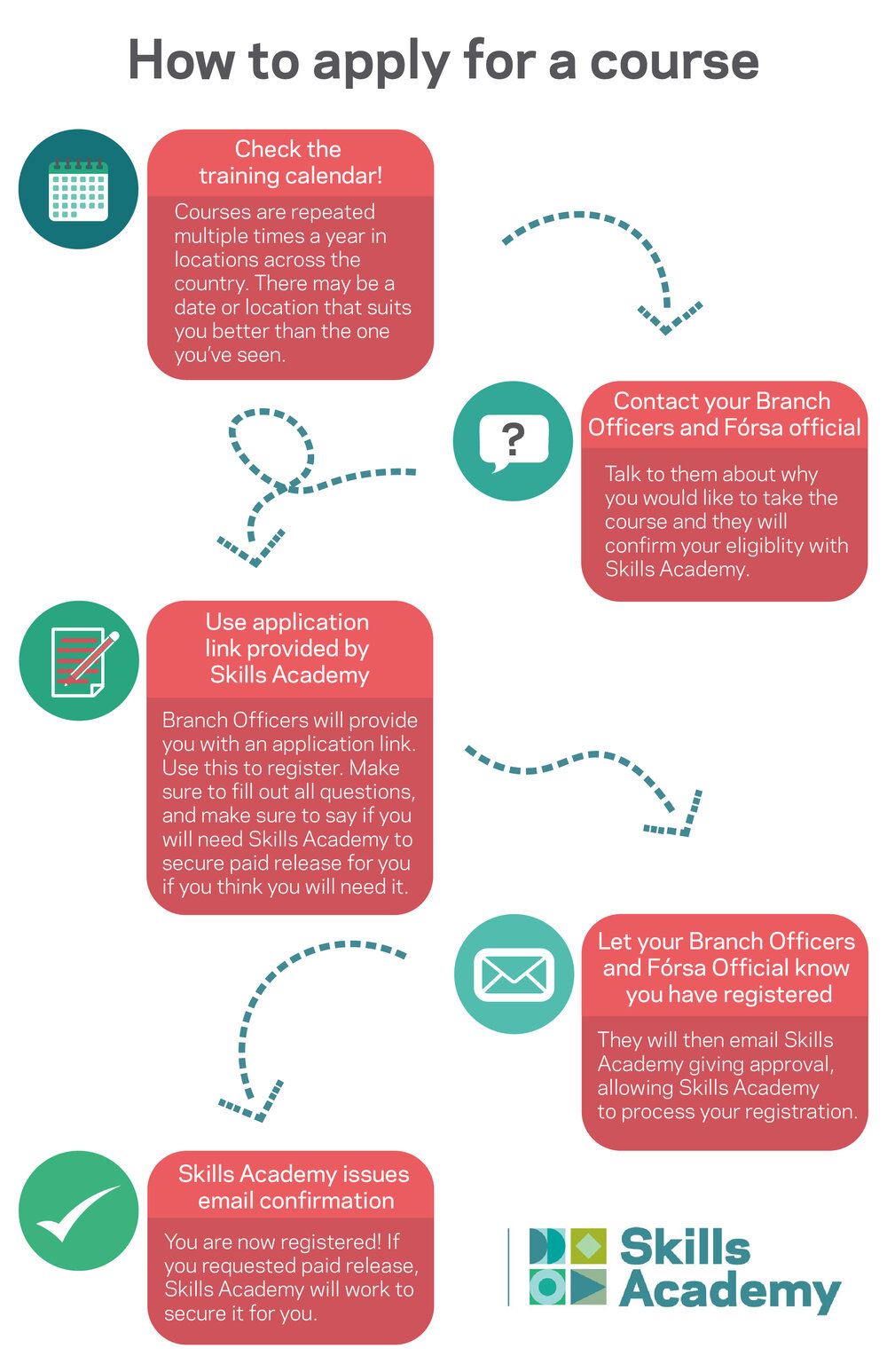
To help branch officers and workplace representatives navigate the application process, a new infographic guide has also been published with step-by-step instructions on how to apply for courses - make sure to lash this out to your branch and get them up to speed.
Friday 30 January 2026
Live Lunch & Learn: The Work of Fórsa’s International Committee (Online)
This session explores the role and impact of Fórsa’s International Committee and the importance of international solidarity in trade union work. Guest speakers include Richy Carrothers, head of the local government & local services division and head of the municipal employees division, and Michael Smyth, Fórsa’s treasurer, who’ll caution against insularism and make the case for solidarity beyond borders.
To register for Live, Lunch & Learn.
Tuesday 3 February 2026
Time Management – Nerney’s Court
Make the clock work for you. A one-day course for NEC, DEC and BEC members focusing on planning, prioritisation, delegation and goal setting to better balance union, work and personal responsibilities.
Tuesday 10 February 2026
Public Speaking – Nerney’s Court
This is ideal for workplace representatives, branch officers and conference delegates who want to put themselves out there and argue their corner. The course builds confidence and practical skills for speaking at meetings, Annual General Meetings (AGMs) and conferences.
Wednesday 11 February 2026
Fórsa Induction (Online)
An introductory session explaining how Fórsa operates and how members can engage to improve their workplaces, with morning and evening options available.
Tuesday 17 February and Tuesday 3 March 2026
Presentation Skills – Nerney’s Court
Learn how to make an effective pitch. A two-day intensive course for NEC, DEC and BEC members focused on effective communication and presentation delivery. Attendance on both days is required.
Thursday 19 February 2026
Industrial Conflict Resolution (Level 2) – Nerney’s Court
A follow-on course for experienced representatives who have completed earlier industrial relations training, focusing on managing and resolving workplace conflict.
Tuesday 24 – Thursday 26 February 2026
Level 1 Workplace Representative Training – Sligo Regional Office
A three-day compulsory programme for new workplace representatives or those with less than two years’ experience, covering core representative skills and organising.
Wednesday 18 March 2026
Branch Chairs and Secretaries Training – Nerney’s Court
Training for newly elected branch chairs and secretaries, outlining role responsibilities and building key leadership and organisational skills.
Tuesday 24 – Thursday 26 March 2026
Level 1 Workplace Representative Training – Wexford Union Office
A three-day foundational programme for new workplace representatives in the South-East, focusing on representation, recruitment and workplace organisation.
To register for any of the above courses contact your branch secretary or training officer.
Join a union that wins. Join Fórsa.
Fórsa Youth – get involved!
by Fórsa Youth
Youth members are invited to a meet-up in Galway, where ongoing planning for conference motions and events in 2026 will take place.
The next Fórsa Youth meet up will take place on Thursday 22nd January in Galway, followed by a meeting on Friday 23rd January in Fórsa’s office in Galway. The meeting will focus on Fórsa Youth motions for the biennial conference, plan the year’s schedule of events, and discuss further training for youth reps.
In December 2025, Fórsa Youth hosted a What the Fórsa?! information night for members, new, and old, and for those who are curious about joining. The night focused on answering questions on membership, campaigns, and how to get more involved. It was also an opportunity for attendees to meet and mingle over some wine and cheese!
The evening featured an insightful panel consisting of Fiona Dunne, director of membership training & development, Kevin Donoghue, director of campaigns and Bridget Moylan, Fórsa Youth’s own public relations officer. The panel discussed what a union is, how unions help workers, and the importance of attracting more members to strengthen the movement. There was also a focus on campaigns, with Kevin assuring members that they are very welcome to get involved with the union and with Fórsa campaigns. The event was chaired by Fórsa Youth chair Hugh McInerney, who guided the discussions and facilitated questions from the audience.
Fórsa Youth wants to thank Fórsa HQ for hosting the night, and to the panellists for their excellent contributions.
Fórsa Youth provides opportunities for members to become more active and engaged with the union’s mission. If you are interested in joining Fórsa Youth at a future event or getting involved in building youth membership in your workplace, please email youthsec@forsa-rep.ie.
Join a union that wins. Join Fórsa.
Win a €500 Gift Card with Arachas
by Brendan Kinsella
Be in with a chance of winning a €500 Gift Card for the Choice Hotel Group.
Be in with a chance of winning a €500 Gift Card for the Choice Hotel Group with Arachas and enjoy a stay in one of their beautiful hotels located in Galway, Ennis, and Dublin.
This Fórsa member exclusive competition will run until Tuesday 31st March 2026, with the winner being announced soon after.
To enter members will need to renew or take out a new motor or home insurance policy with Arachas before the deadline.
Arachas (formerly Glennon) is Ireland’s largest nationwide insurance broker, with a wealth of experience in supporting public sector employees. Their team of over 750 insurance specialists, based across 14 offices in towns and cities nationwide, provides advice on a full range of insurance products and services tailored to public sector employees’ evolving needs.
The €500 Gift Card is redeemable at The House Hotel, Galway,The Hardiman Hotel, Galway, Hotel Woodstock, Ennis, and the Shoreline Hotel, Dublin.
If you wish to get a quote and enter the competition, you can find more information on the Arachas page on our website.
Join a union that wins. Join Fórsa.
|
|
|
|