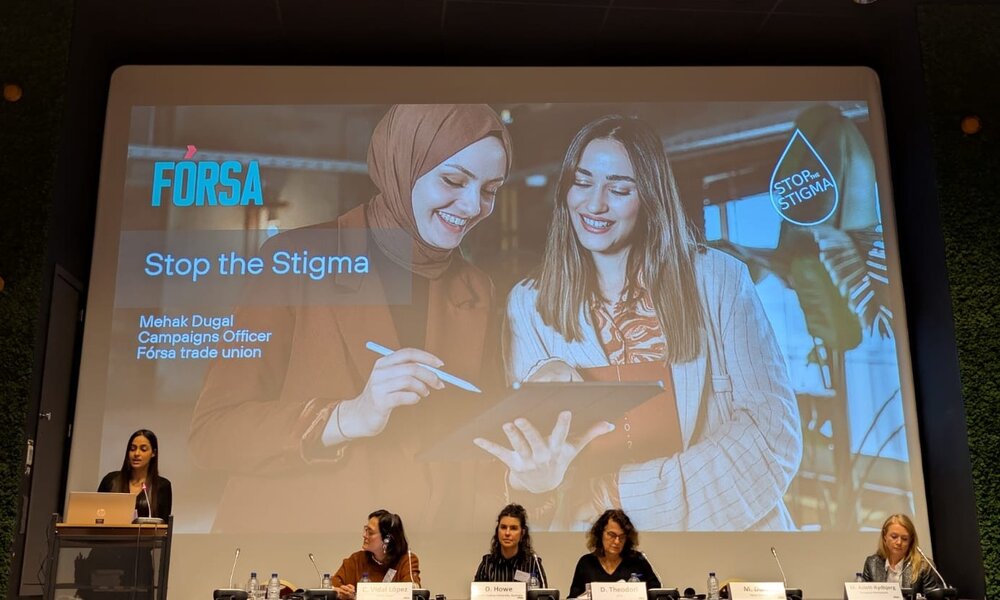
Fórsa presented the trade union Stop the Stigma campaign at a recent conference in Brussels, hosted by the European Trade Union Institute (ETUI). The conference aimed to begin a discussion about how to reshape the future of occupational health to make it more inclusive and effective for everyone.
The ETUI is the independent research and training centre of the European Trade Union Confederation (ETUC).
The two-day conference brought together trade unions, policymakers, researchers, and advocates to explore how to embed gender into occupational health and safety policy and practice, to discuss how gender influences workplace risks, and how a 'one-size-fits-all' approach can overlook critical gender-specific risks and needs.
Mehak Dugal, Fórsa communications and campaigns officer presented the Irish trade union coalition campaign Stop the Stigma, which calls on employers to provide a supportive, stigma-free environment for workers dealing with periods and menopause.
Speaking to the conference Mehak said: “Integrating gender into occupational health and safety is not just the right thing to do, but the smart thing to do for all workers, regardless of gender.”
“If we truly want a healthy workforce, we need to start addressing the barriers that are silently affecting so many workers—especially women. Menstruation and menopause are natural biological processes, but they’re often treated as a stigma or a taboo in the workplaces. And the result is that people who menstruate or go through menopause can be forced to choose between their health and their career, leading to sickness absence, presenteeism, and workplace inequality.”
The presentation was well received and several researchers and policy officers from trade unions across the EU indicated that they would seek to focus on these issues in the months ahead. In closing remarks to the conference, the ETUI’s Director of Research Bart Vanhercke noted that they are keen to further their research on menstrual and menopausal workplace policies.
Mehak told the conference that nine of Ireland’s biggest unions are now also advocating for these policies in the workplaces they represent, and that the campaign is also active lobbying for legislative change, seeking amendments to the Safety, Health, and Welfare at Work Act and the Employment Equality Act.
She said : “In Ireland the Safety, Health and Welfare at Work Act already places a duty of care on employers to ensure the health and safety of their employees. And we’re very clear that menstrual and menopausal health should fall under this duty. We need to see a change in how workplaces are designed to accommodate these biological processes to support the well-being of all workers. Menopause and menstruation impact a significant portion of the workforce. But in reality, these issues are often sidelined in traditional OHS frameworks.”
She said: “We have been and will continue to call on employers to integrate menstrual and menopause policies into their workplaces to ensure our workplaces are safe, supportive, and inclusive for all employees, regardless of their gender or biological processes.”
“The workplace of tomorrow needs to reflect the needs of today’s diverse workforce, and we at Fórsa are very vocal that by implementing these policies and also explicitly embedding these protections in the existing legislation, Ireland will take a crucial step forward in creating healthier, more inclusive workplaces. Our efforts are about creating workplaces where women can thrive, not just survive.”
The conference also discussed LGBTQIA+ working life conditions, Recognizing breast cancer as an occupational disease, gender-based violence and harassment at work. You can watch the conference here: Integrating gender into occupational health and safety | etui
Learn more about the Stop the Stigma campaign here.
Join a union that wins. Join Fórsa.





 Like
Like

