Implementation of community and voluntary sector pay deal underway
by Hannah Deasy
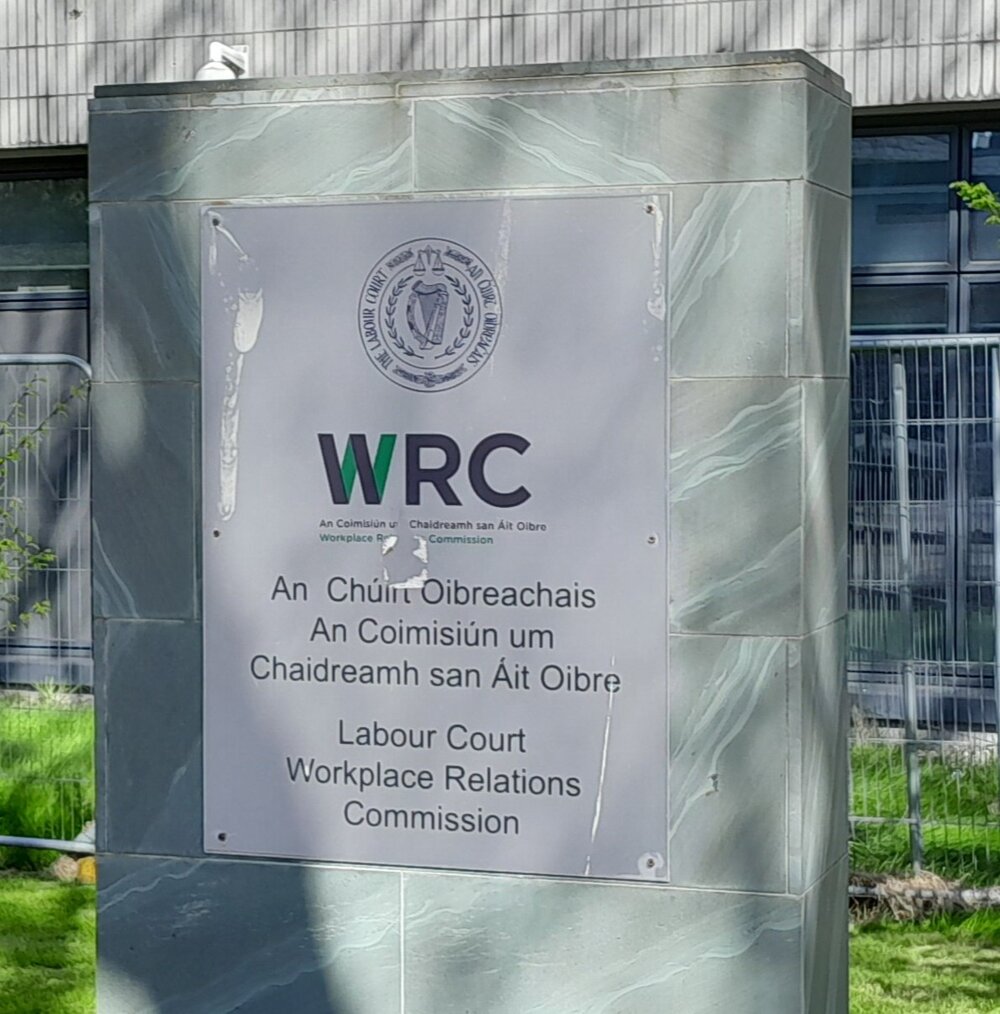
Following WRC engagement earlier this week, the funding agencies confirmed that funds should all be allocated by the end of September.
All parties to the pay agreement negotiated earlier this year for workers in the community and voluntary sector met at the Workplace Relations Commission (WRC) this week. Following the engagement the funding agencies confirmed that funding arrangements have begun, and that funds should all be allocated by the end of September.
For funding to be released employers must submit relevant information to the funding agencies, who will assess and validate the information.
Under the terms of the agreement Fórsa members working in Section 10, 39, 40 and 56 organisations should benefit from pay increases valued at 9.25% over two years, backdated to October 2024 and running to October 2026.
The agreement was secured by unions after more than ten years of campaigning for better pay and conditions for workers in the community and voluntary sector. However, delays in implementing the agreement have occurred in recent months.
Fórsa’s head of health and welfare Ashley Connolly said: “The engagement this week has been positive, with all parties committing that the relevant information will now be provided in a timely manner. The current situation of ongoing delays is very frustrating for our members who, quite naturally, are impatient to see the pay increases promised in the deal.”
“We asked the WRC to reconvene to address these delays and we are pleased with the outcome of this week’s meeting.”
“The employers’ groups present committed that payments will be processed as soon as possible after the funds are received. This is what will make the difference in members pay packets.”
Ashley continued: “An implementation and monitoring group was established as part of the agreement, and its first meeting will take place on 7th August. We are hopeful that this will enable the allocation of funds to take place swiftly.”
Join a union that wins. Join Fórsa.
 |
|
Solidarité sans Frontières
by Brendan Kinsella
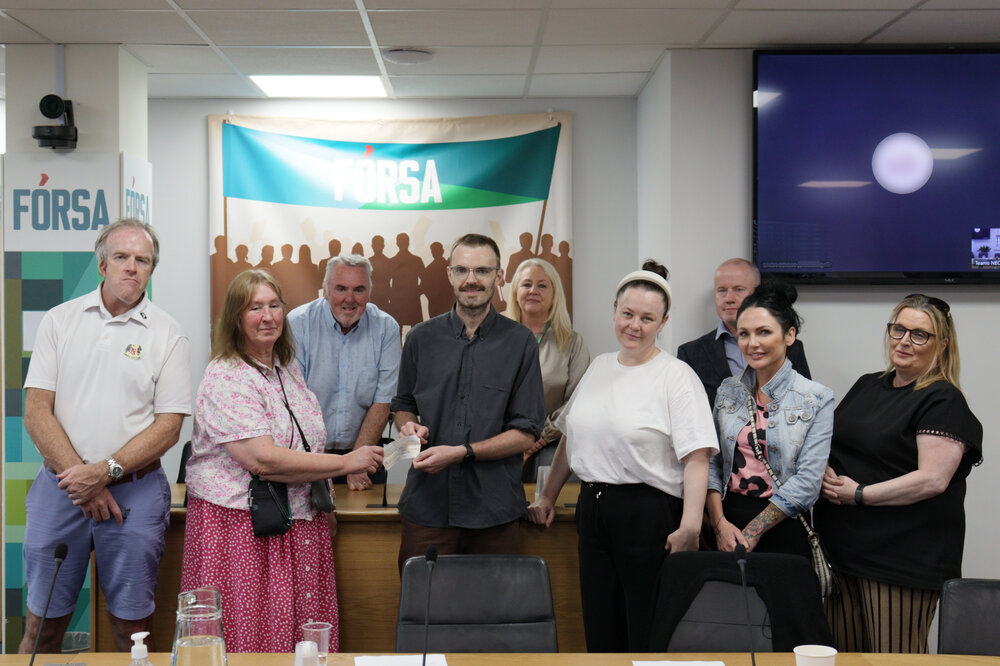
Dublin North Health and Welfare branch renewed their support for Médecins Sans Frontières.
The Dublin North Health and Welfare branch has repeated last year’s generous donation to Médecins Sans Frontières (MSF). For the second year running, the branch has donated 10,000 euro as a token of their solidarity and to support the charity’s work providing medical assistance to people affected by conflict, epidemics, disasters, or exclusion from healthcare in over seventy countries, including significant presences in Sudan and Gaza.
Branch chair, Michael Davis said, "This is our second year to support Médecins Sans Frontières, and the need to do so increases day by day.”
He continued, “What is unfolding before us in Gaza is beyond comprehension. Healthcare workers have suffered appalling casualties. These are people who are only trying to bring medical attention and comfort to others, and even they have not been spared from the outrages taking place. As trade unionists and healthcare workers, the very least that we can do for them is to extend a helping hand.
“There is no looking away on this, we will stay the distance with them!" he concluded.
Branch campaigns and equalities officer, Liz Butler proudly presented the cheque on behalf of the branch during the Thursday 19th June meeting of the branch executive committee. She said, “There should be no expiry date on our solidarity.”
Accepting the cheque on behalf of Médecins Sans Frontières Ireland, Liam Corcoran thanked the branch for their continued support and gave an update on MSF’s activities over the past year.
He said, “As MSF, we are very grateful to members of the Dublin North Health and Welfare branch for the generous donation to support our life-saving work around the world.”
“Amid the ongoing conflict in Sudan—the world’s largest humanitarian crisis—our teams are providing urgent medical care and basic services in 11 of 18 states. In Gaza, since the war began on October 7, our medical teams have handled hundreds of thousands of outpatient and emergency cases, despite rapidly shrinking space for healthcare and humanitarian work.”
“MSF remain committed to providing impartial medical humanitarian aid to people who need it. The branch’s donation helps us to continue to go where others can’t, and to provide care based on need alone. For that, we are very thankful.”
Liam underlined how important it is that MSF is funded through donations. Significant cuts to foreign aid budgets in the current geopolitical climate are causing many charities to scale back in their operations. According to Liam, MSF “are looking at how and where we may be able to scale up, expand or reprioritise some of our activities in response to critical medical gaps.”
The Dublin North Health and Welfare Branch credit the union’s donations to the Irish Red Cross’s Ukraine and UNICEF Gaza appeals as inspiring them to support MSF.
Michael said “It all stems from a number of years ago Fórsa made a couple big donations to the Irish Red Cross and UNICEF. At the time Kevin Callinan encouraged branches to keep it going. So we did. We followed that example, and we hope when others see what we’re doing they feel encouraged to do the same.”
He continued: “We chose MSF because there is a natural solidarity there, as a health and welfare branch it relates to the people we represent.”
“Whether it’s as branches or individuals, if we all chip in we can make a big difference.” He concluded.
You can donate to Médecins Sans Frontières on their website.
Join a union that wins. Join Fórsa.
Pride and fighting prejudice
by Brendan Kinsella
Members march in Dublin Pride, and show solidarity against anti-LGBTQIA+ crackdown in Hungary.
The afternoon of Saturday 28th June saw the streets of Dublin bloom in a riot of colour as revellers gathered for the annual Dublin Pride parade. A momentous occasion this year as the city celebrated ten years since Ireland became the first country in the world to legalise same-sex marriage by popular vote.
To add to the occasion, members marching under Fórsa’s banner did so for the first time under the auspices of the LGBTQIA+ Network, established in February of this year.
There were high spirits in Nerney’s Court that morning, as members met for a light breakfast before making their way to O’Connell Street.
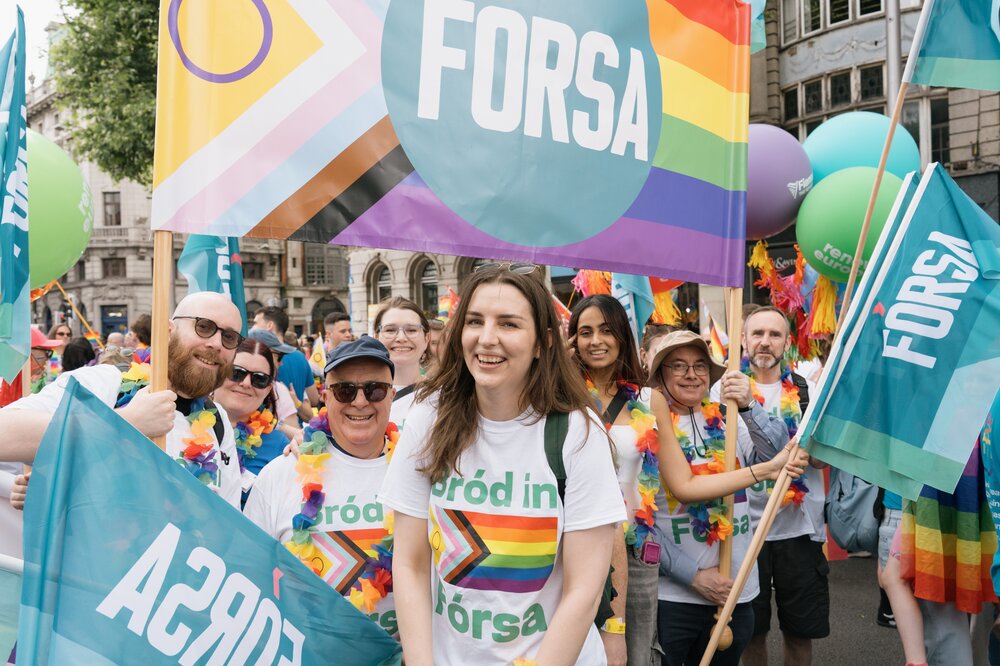
The Fórsa contingent joined over 12,000 people representing more than 280 organisations taking part in the parade, with thousands more packing the pavements from start to finish along the route from O’Connell Street to Merrion Square.
Also in attendance were leaders and representatives of parties from across the political spectrum.
Speaking at the festivities, An Taoiseach Micheál Martin rejected the rise of anti-LGBTQIA+ sentiments across the world. He said, “Our goal is to build a society in which LGBTQIA+ people can live safe, inclusive, healthy and fulfilling lives in an accepting and compassionate Ireland.”

Cathal Kelly, a member in the civil service division and a former editor of Gay Community News (GCN), marched with Fórsa this year. A veteran of Dublin Pride going back to his first march in 1993, Cathal sees union participation in Pride as more than just a celebration.
He said, “Members of my community across Europe have known about and often directly felt the danger from Hungarian Prime Minister Viktor Orbán for many years. But less attention has been paid to dangers closer to home. When the Fórsa conference last year decided to set up an LGBTQIA+ network, a handful of delegates shared some shocking and brave testimonies of harassment, aggression and intrusion that LGBTQIA+ members of Fórsa still face today, in our workplaces and in broader society.”
Fórsa will be taking part in Transgender and Intersex Pride in Dublin on Saturday 12th July, Cork Pride on Sunday 3rd August, and Galway Pride on Saturday 16th August. Members can register their interest in attending any or all events here.
All members welcome to show up on the day for Transgender and Intersex Pride on Saturday 12th July. Meeting at Dublin City Hall on Dame Street at 1.45pm.

Stand up, fight back: Budapest Pride
While members were making their way into Dublin, Fórsa official Aisling Cusack was already on the streets of Budapest in defiance of the Orbán regime’s Pride parade ban.
Aisling travelled to Budapest to represent Fórsa as part of the European Public Services Union (EPSU) delegation, hosted by the Hungarian union VDSZ, marching side-by-side with trade unionists from across Europe in support of Hungarian LGBTQIA+ people facing the repression of an authoritarian state.
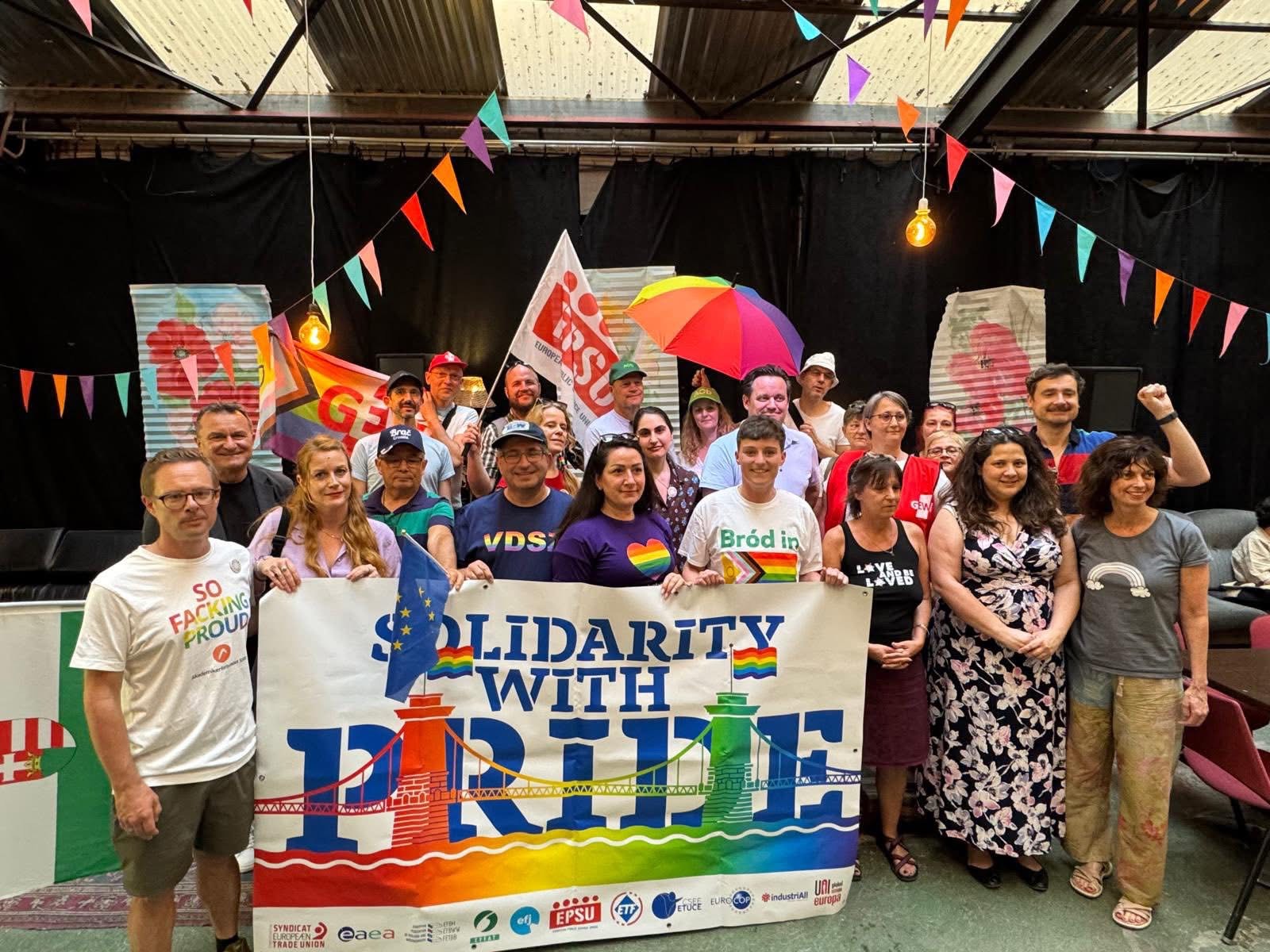
She said, “Trade unionists in Ireland have a proud history of fighting for LGBTQIA+ rights and equality both in the workplace and in society. It’s incredibly important that our solidarity does not stop at our island’s borders. Our solidarity must extend to all those facing the threat of persecution because of who they are.”
In March of this year, the Hungarian Parliament voted in favour of a bill that effectively banned Pride events in Hungary. The bill, proposed by Viktor Orbán’s Fidesz party, builds on their previous 2021 anti-LGBTQIA+ law. The law in question has been compared to the UK’s infamous “Section 28”, prohibiting the promotion or portrayal of homosexual or transgender people to minors, effectively eradicating queer lives from the public sphere.
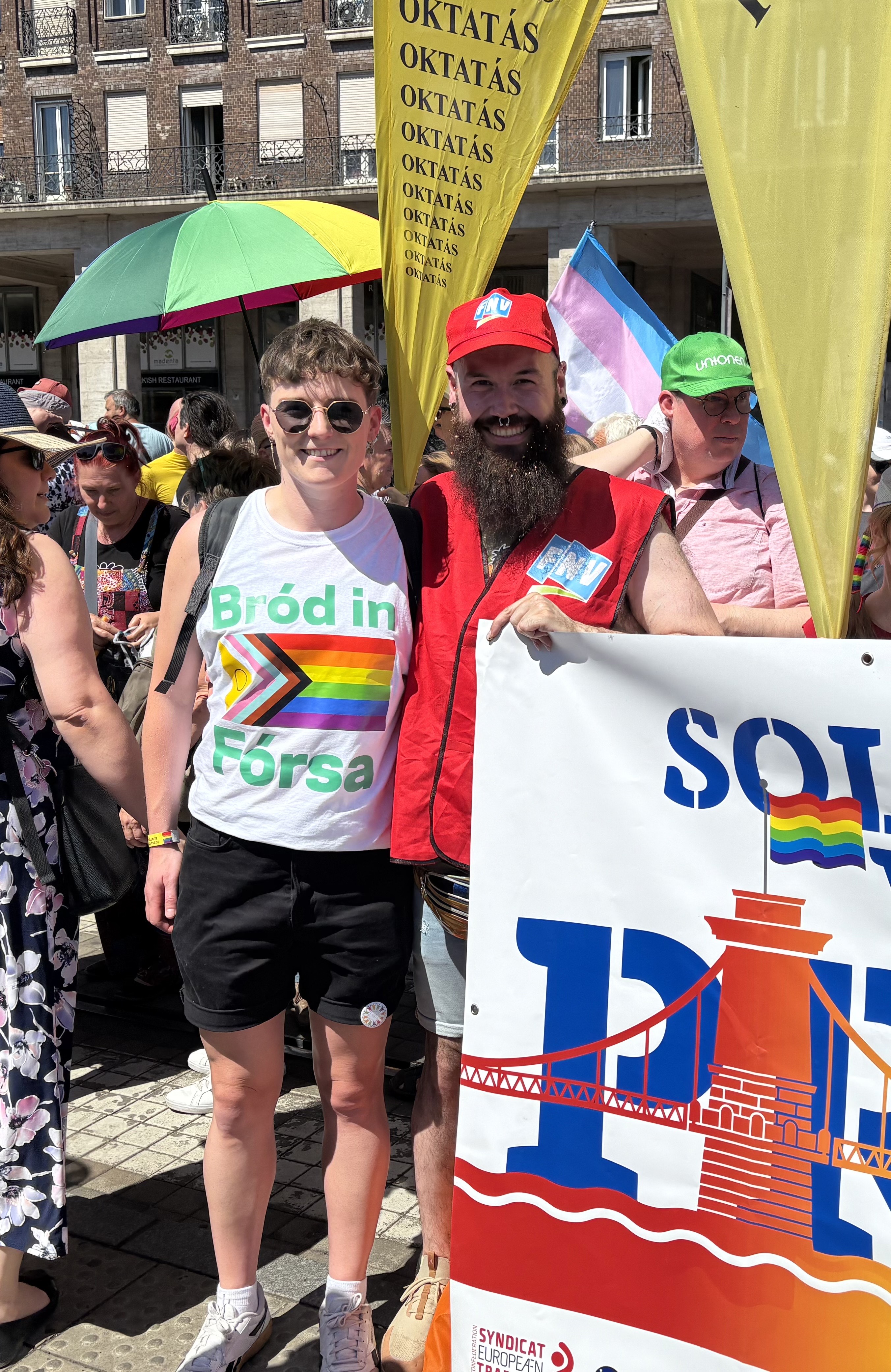
Reports estimate upwards of 200,000 people took part in Budapest Pride, in a stark rebuke of the Orbán government’s latest attack on LGBTQIA+ rights.
Aisling said, “We marched for freedom, for democracy, and for love. Orbán attempted to silence LGBTQIA+ identities and ban the pride protest, but the right to protest can never be taken away just because the government doesn’t like the message.”
There were significant concerns for the safety and wellbeing of participants prior to the parade, with fears that a large scale far-right counter protest would turn violent, or that mass arrests of parade participants would take place.
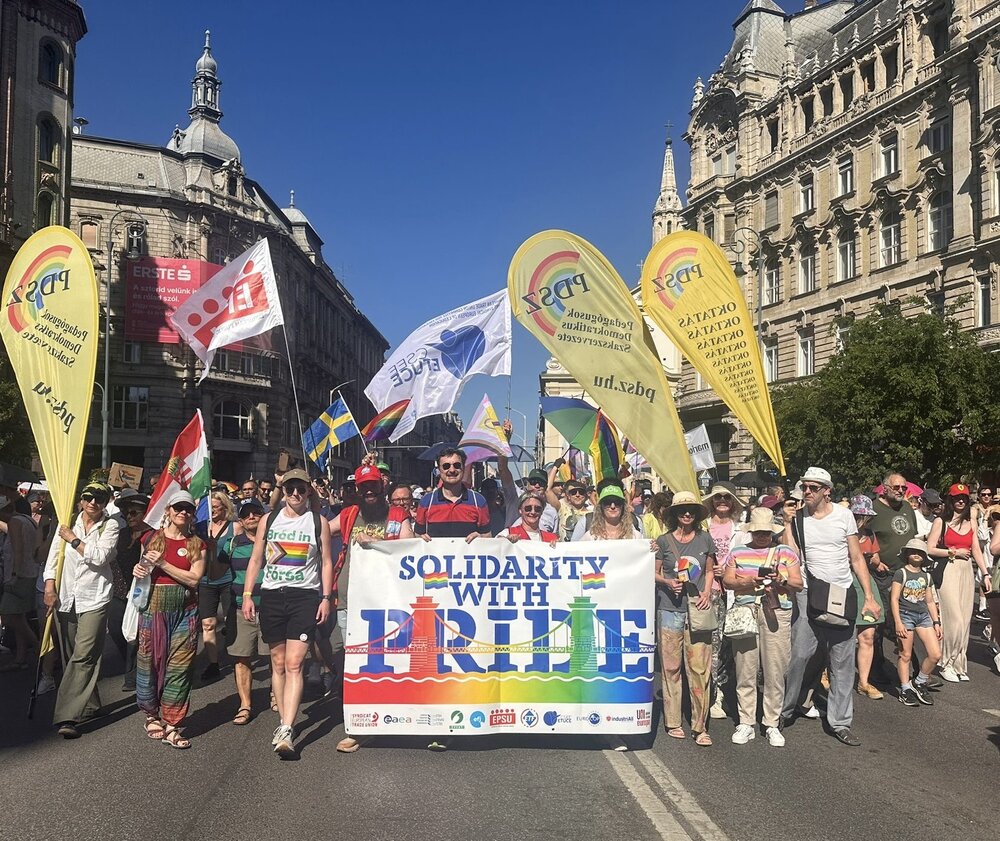
Describing the atmosphere on the day Aisling said, “That morning, I could feel a sense of tension in the air all across the city, but as the parade start time neared and thousands gathered at City Hall together, there was a huge feeling of determination and defiance among the crowds.”
She continued, “The Hungarians I spoke to were grateful for the international support. Many were also really surprised that so many Europeans showed up in solidarity. I think it was really important that we let them know, no matter what their government throws at them, ‘you are not alone.’”
Join a union that wins. Join Fórsa.
Identity Theft helpline launched
by Brendan Kinsella
Fórsa launches new members’ helpline.
Fórsa has launched a new helpline for members who have experienced identity theft. The helpline will help with situations such as having a credit card stolen or a bank account hacked.
When identity theft happens, acting quickly is crucial to limiting the amount of damage the thief can inflict upon your finances. The helpline offers immediate assistance so you can stop the thieves in the act and limit the damage.
After you have removed the thieves access to your accounts, you may need help restoring access to your accounts. The helpline can assist you with reissuing stolen or compromised cards and reinstating your credentials.
In the event of legal issues arising following your identity theft incident, the helpline can provide you with assistance on any related issues. This includes potential penalties or fines that may arise following the incident.
Fórsa deputy general secretary, Matt Staunton said “ID theft is on the rise. We’re now seeing more cunning and sophisticated scams online and on our phones, on top of the physical theft of cards.”
He continued, “We want to make sure that our members are well supported if the worst happens to them. It can be scary when a theft happens to you, and it can be hard to think straight. The helpline is there so you can make sure you don’t miss anything, cut the thieves off completely, and help you sort everything out afterwards.”
If you are experiencing identity theft or have experienced identity theft and need support, you can reach our helpline at 0818 252 922.
Our other helplines for members include legal advice, confidential counselling, and home incidents. Details of all helplines can be found here.
Don’t get scammed!
The best way to combat identity thieves is by making sure they don’t get their hands on your personal information in the first place. Their methods evolve and change so remain vigilant! So here is some evergreen advice for keeping yourself safe:
Text scams
- Don’t use links you receive in texts. If it’s from someone claiming to be your bank, call your bank’s customer service number if you think it may be legitimate. For An Post or other delivery services check for updates on their website using tracking information or contact the sender.
Phone Scams
- Stay calm, scammers will often try to panic you. When you’re panicking, you’re not thinking, and you are less likely to notice important things, like if they are asking you for information they should already have, if they are who they say they are.
- As a rule, if someone contacts you claiming to be from your bank, a service provider, the government, An Post, or another similar organisation, do not give them your details, name, age, address, account number, passwords, login details, PPSN, etc. Only ever give details to a number you have called and verified as legitimate from the company/organisation’s website.
Fake invoices
- An increasingly common scam, you may receive a fake invoice that looks like it is from a legitimate company. This is likely a phishing scam. If it is with a company or service you don’t use, you can ignore it. If you are worried, you can contact the company’s customer support using information found on their website. Do not reply to the email.
Be mysterious
- Never put important details out on social media. Your address, children’s names, place of birth, etc. these can be used by tech-savvy thieves to access your social media accounts, and in scams to access your bank accounts. This includes message board sites like RIP.ie, where it is best to just use your given name when extending your condolences.
- Similarly, there are commonly used security questions you should be aware of and be careful not to post the answers to. The name of your first pet, favourite food, mother’s maiden name, favourite colour, and street you grew up on are all commonly used security questions. So, chain memes like “your mother’s maiden name backwards and the last thing you ate is your Star Wars name” may seem fun but could leave you exposed to identity theft.
Be careful at ATMs
- This is less of an issue these days as plastic payments take over from paper, but you should still be careful when using an ATM and examine the machine’s casing for signs of tampering before using it. Thieves can place card skimmers inside ATMs and steal your card’s information. Where possible withdraw money from ATMs in bank lobbies which are less exposed to tampering.
No one can be vigilant every second of every day and even the most careful person can get scammed. The important thing is to remember to act fast when it does happen, and our identity theft helpline is there to ensure you can get back to normal as quickly as possible after.
Identity theft helpline -0818 252 922
Join a union that wins. Join Fórsa.
Skills Academy awards and summer courses
by Brendan Kinsella
Course participants and well-wishers gathered for the first Skills Academy award ceremony.
Tuesday 24th June was a big day for Fórsa’s Skills Academy. Course participants and well-wishers gathered in Nerney’s Court for the first Skills Academy award ceremony.
Awards were presented to participants from the 2024–2025 academic year who took part in chairs and secretaries training, leadership training, the mentorship programme, and levels one and two of workplace representatives training.
The event was a celebration of the course participants, with contributions from a number of them. The event was at times raucous, at times earnest, and on occasion touching.
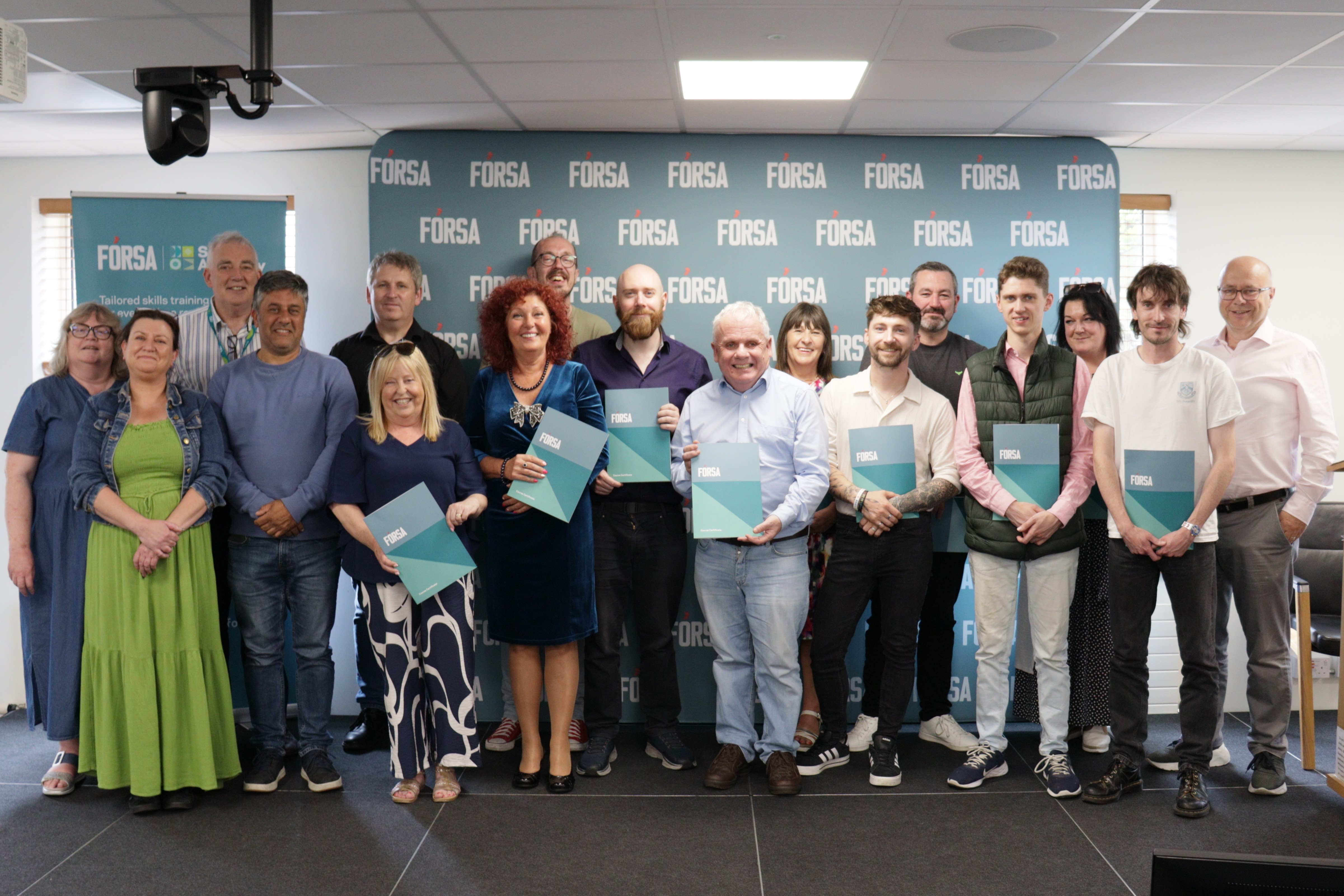
Workplace representative training level one: Majella Murphy, Clodagh Kavanagh, Michael Crowe, Ian Patel,John Buggy, Andrea Somerville, Daniela Abrudan, Declan Foley, Gary Rutledge, James Bradley, Bernie Kelly, Cameron Hourigan, Paul Dwan, Kevin Foley, Jennifer Drohan, Robert Black, Kevin Callinan.
Fórsa vice-president Michael Crowe, head of the training sub-committee, and general secretary Kevin Callinan were on hand to present course participants with their certificates of completion.
In his address, Michael Crowe emphasised the importance of labour representatives having confidence in their workplace, and the vital role that training plays in fostering that confidence. He said, “Thank you all for being visionaries in seeing what we hope will be the future of Fórsa in the workplace, you are leading the change.”
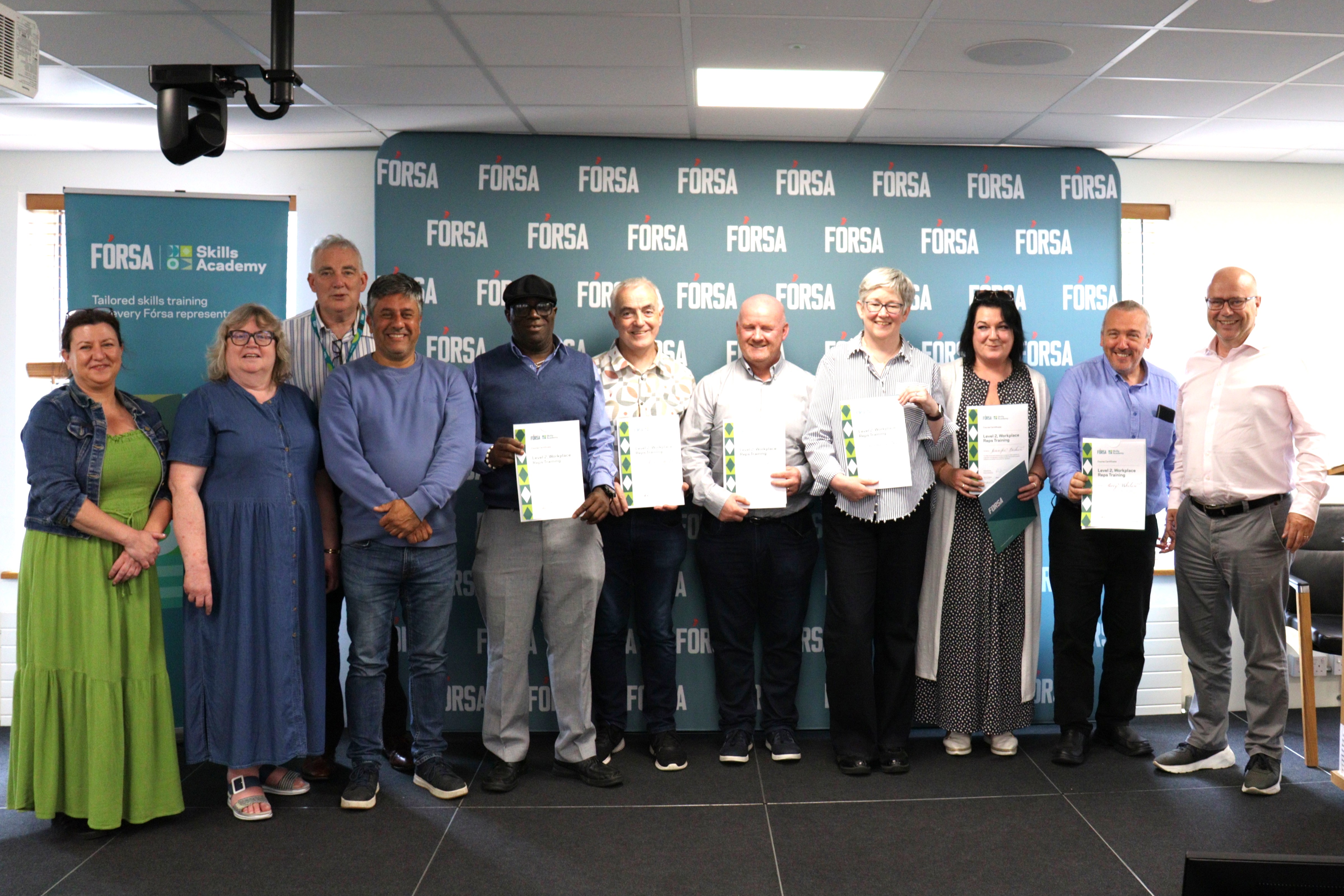
Workplace representative training level two: Clodagh Kavanagh, Majella Murphy, Michael Crowe, Ian Patel, Thomas Madden, Darren St. Leger, Catherine Black, Jennifer Drohan, Garry Whelan, Kevin Callinan.
Kevin Callinan praised the Skills Academy for its work. He said, “I don’t think there’s another union in the country doing the level and standard of training we are doing.” He praised the course participants for stepping forward.

Chairs and secretaries training: Clodagh Kavanagh, Majella Murphy, Michael Crowe, Ian Patel, Sorcha O’Connor, William Mooney, Geraldine Whelan, Gary Guilfoyle, Elain Quinn, Elaine Gallagher, Kevin Callinan.
Director of membership training and development, Fiona Dunne, praised course participants for their time, effort and hard work.
She said, “Workplace representatives and branch officers are the lifeblood of our union and with their knowledge, skills, and expertise locally, the union grows stronger. Training and development programmes provide the information, skills platform, and opportunities to learn and develop key skills to build confidence and capacity to be effective in their role. “
“At the Skills Academy we understand the commitment and dedication our representatives have and what it takes to complete their learning, whilst balancing their work and family life. We hope the presentation of certificates goes some way to showing that appreciation on behalf of the union and members.” continued.
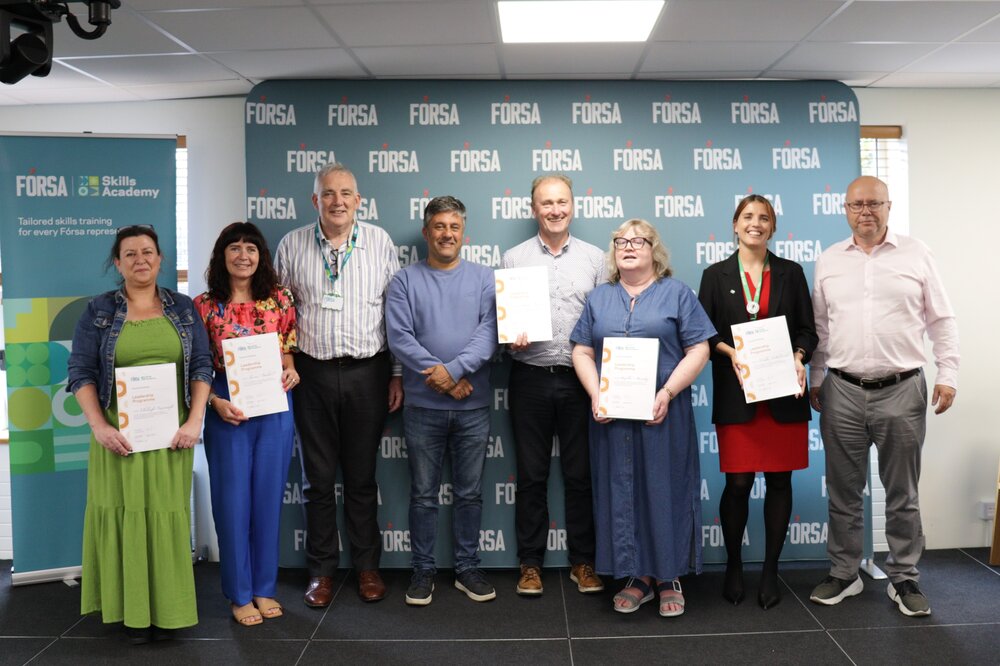
Leadership training:Clodagh Kavanagh, Fiona Baskett, Michael Crowe, Ian Patel, Caoimhín Ó Tuathail, Majella Murphy, Linda O’Sullivan, Kevin Callinan.
A second award ceremony for students of the 2024-25 academic will take place later this year. The winter awards ceremony is set to take place following the November consultative council. More information will be issued closer to the date.
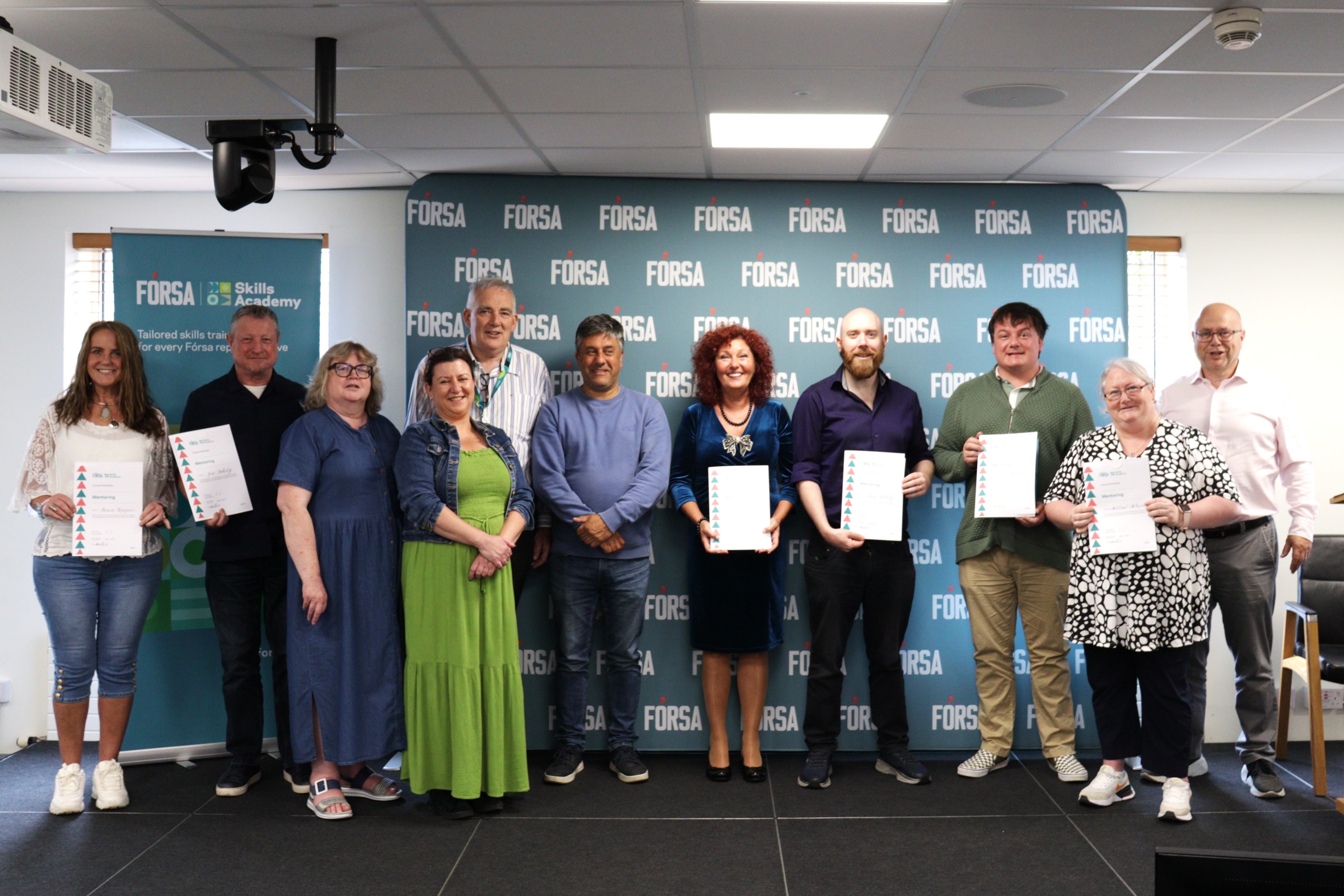
Mentorship program:Denise Knezovic, Jim Doherty, Majella Murphy, Clodagh Kavanagh, Michael Crowe, Ian Patel, Daniela Abrudan, Gary Rutledge, Liam Mullins, Martina McKenna, Kevin Callinan.
Upcoming: Lunch & Learn – Supporting our Pink and Blue campaigns – 1-2pm Friday 25th July – Online
Lunch & Learn will continue on the last Friday of every month through the summer break. The next session takes place on Friday 25th July. Skills Academy will be joined by Eimear Conroy, senior relationship manager with Cornmarket, and Juliette O’Connell, outreach officer with Breast Cancer Ireland, to discuss the Pink and Blue Power Programme, and raise awareness around breast and prostate cancers. Register here. https://forms.office.com/e/hGXm4J0Vvn
Fórsa Induction for new members – Online - Wednesday 13th August
Also continuing throughout the summer, the next Fórsa Induction will take place on Wednesday 13th August. It is a short, informative session designed to unravel some of the mysteries of the union and provide a warm welcome to new members. Register here. https://forms.office.com/e/WeJyZ7pqfg
Register for next semester
Solas training for Dublin and Leinster branches, taking place on Tuesday 2nd September in Nerney’s Court, is now open for registration. Details were emailed to all branches last week and will remain open until the end of July.
Level 2 Workplace Representative Training in Dublin is now open to those who have completed Level 1 or have 2+ years' experience as a workplace representative. It is imperative that those who register commit to all three parts over four dates, as only participants completing all sessions will receive a certificate of completion.
Other courses taking place in September will be opened throughout July for registration and will be sent to branches as per our procedure so branches should keep an eye on their email accounts during the summer.
Join a union that wins. Join Fórsa.
Palestine march and BDS portal
by Brendan Kinsella
Next demonstration on Saturday 19th July.
Fórsa members will be participating in the next national demonstration for Palestine on Saturday 19th July.
All members who wish to take part in the demonstration are encouraged to join the Fórsa delegation that will be marching as part of the trade union bloc.
There will be a coffee morning in Nerney’s Court from 12pm for members to meet and get to know like-minded union members.
The delegation will leave Nerney’s Court at 12.30pm to join the trade union bloc, gathering outside Mandate’s offices across the road from the Gate theatre on Cavendish Row. Members are welcome to join the delegation at Nerney’s Court or meet directly outside Mandate.
The march will begin at the Garden of Remembrance at 1pm and finish outside the Dáil on Molesworth Street/Kildare Street.
According to demonstration organisers, the Ireland-Palestine Solidarity Campaign, the demonstration will call for immediate sanctions, the enactment of the Occupied Territories Bill including a ban on services, and the end to the state’s complicity through the central bank’s facilitation of the sale of war bonds and the transport of arms through Irish airspace.
If you would like to become more involved with Fórsa’s Palestine demonstrations or would like to receive regular updates on the union’s activities in this area, contact campaigns@forsa.ie.
BDS training portal
For members looking to become more informed on the Boycott, Divestment, and Sanctions (BDS) movement, Trade Union Friends of Palestine (TUFP) has launched a BDS training portal.
Trade Union Friends of Palestine is a cross-border collective of trade unionists who seek a lasting and just peace guaranteeing the freedom and human rights of Palestinians.
Fórsa official and chair of Trade Union Friends of Palestine, Paul MacSweeney, said: “The portal is intended to ‘train the trainers.’ It is there to give people all the information they need to become a leader on BDS, both in their union and in their workplace.”
The portal contains help with writing BDS motions including examples of motions passed by other unions, and a wide variety of reports and other information to explain BDS to colleagues who may only have a vague idea of what it entails.
Paul said “We know everyone is deeply frustrated seeing men, women, and children being killed and starved. Boycott gives you the power as individuals to show you don’t accept this.”
He continued: “Having the right information is crucial to being effective in any action. It can be difficult to know what falls under BDS and how best to target certain services that do, the portal is there to help give anyone who wants to take action.”
The Trade Union Friends of Palestine portal can be found here.
A list of the companies which fall under BDS boycotts can be found here.
Join a union that wins. Join Fórsa.
|
|
Barnardos action suspended following employer agreement to pay increase
by Niall Shanahan
Planned industrial action by Fórsa members at Barnardos, due to commence last month (25th June), was suspended by the union’s disputes committee following the employer’s decision to implement a 4% pay increase.
Planned industrial action by Fórsa members at Barnardos, due to commence last month (25th June), was suspended by the union’s disputes committee following the employer’s decision to implement a 4% pay increase.
The payment, which will be backdated, represents the balance of an 8% pay rise due under the 2023 Workplace Relations Commission (WRC) agreement covering health-funded agencies in the community and voluntary sector.
Barnardos had previously paid just 4% of the increase, claiming the remaining funds had been diverted to offset an earlier 2022 pay uplift. Fórsa rejected this rationale and had served notice of a work-to-rule action after Barnardos refused to engage with the union or attend WRC conciliation.
The suspension of the action followed Barnardos’ confirmation that it would now proceed with the remaining 4% payment. The organisation indicated this would need to be “self-financing.” However, Fórsa’s position remains firm. The 2023 pay deal was fully funded by Government, and employers in receipt of that funding are required to use it in full for pay restoration and increases.
Fórsa official Louise O’Hara commented: “There is no provision in the agreement for employers to divert funding to recoup past pay costs. We welcome the decision to pay, but we do not accept any suggestion that staff must absorb cuts elsewhere to fund it. Members at Barnardos will robustly challenge any such approach.”
Join a union that wins. Join Fórsa.
Know your rights on HSE extended working arrangements
by Niall Shanahan
Fórsa has advised members working in HSE services to download and retain a copy of the newly agreed principles document on extended services, which outlines your rights and protections where changes to rosters or working hours are being proposed.
Fórsa has advised members working in HSE services to download and retain a copy of the newly agreed principles document on extended services, which outlines your rights and protections where changes to rosters or working hours are being proposed.
In a memo to members issued on 23rd June, Fórsa advised that no automatic changes can take place, and management must follow a clearly defined process before any service or rostering arrangements can be altered. The agreement was reached following several weeks of negotiation between health unions and the HSE and has since been issued to local managers.
For staff employed before 16th December 2008, and who have not been promoted since, there is no obligation to accept changes to your working arrangements. Any changes must be made on a strictly voluntary basis.
For those employed after that date, or who have been promoted since, you may be asked to consider new roster arrangements, but only after the full procedure in the agreed document has been followed.
Where local disagreements arise, the agreement provides for a formal disputes process. This includes referral to a Joint Review Group, and if necessary, to an independent adjudicator. Critically, any proposed service extensions must be based on safe staffing levels.
The HSE had initially proposed changes that would have undermined long-standing protections set out in the 2008 Framework Agreement. Fórsa and other health unions were clear that these would not be accepted. The final agreement ensures that staff protections remain in place and that any proposed changes must be negotiated through the agreed industrial relations process.
If you are approached by management about changes to your roster or hours, contact your Fórsa workplace representative immediately for advice and support.
You can view and download a copy of the agreement here.
Join a union that wins. Join Fórsa.
Physiotherapists urged to stand against hike in registration fee
by Hannah Deasy
Fórsa has written to members who are physiotherapists urging them not to pay an additional registration fee, which is being imposed on members who have recently completed training.
Fórsa has written to members who are physiotherapists urging them not to pay an increased registration fee, which is being imposed on members who have recently completed additional training. The issue emerged when members who had recently completed the UCD Professional Certificate in Physiotherapist Referral for Radiological Procedures were asked to pay an additional registration fee of €50.
At the moment, the professional registration fee for physiotherapists is €100, a reduced rate which was negotiated as part of the Public Service Agreement.
Given there is no agreement with Fórsa or the Public Services Committee (PSC) of the Irish Congress of Trade Unions (ICTU) for any such increase to be applied, last week Fórsa advised members not to pay this additional fee.
You can read the correspondence here.
National secretary Linda Kelly said: “Reducing registration fees has been a big achievement in recent years, and now we want to make sure to keep it in place. Increasing the fee for one cohort of members, who have already invested in their own professional development, is totally unfair.”
“We know it works when members come together to oppose increases to registration fees. So, while we understand that this can be a daunting instruction for some members, it will have an impact. This is how the fee was reduced from €295 in the first place.”
Any members who are impacted by this should directly contact Sheena Clarke by email sclarke@forsa.ie.
Join a union that wins. Join Fórsa.
Local bargaining surveys for psychologists and social work members close today!
by Brendan Kinsella
As the local bargaining process continues, Fórsa has been surveying psychologists and social work members. The surveys are open until 5pm today, Friday 11th July.
As the local bargaining process continues, Fórsa has been surveying psychologists and social work members. The surveys are open until 5pm today, Friday 11th July. Results will then be considered to finalise the claims.
Local bargaining is a process that addresses collective issues specific to a grade, group or category, and a key feature of the Public Service Agreement 2024-2026.
As the Department of Public Expenditure has indicated that engagement on local bargaining claims will begin soon, Fórsa is asking members what issues they most want to see addressed in their claim.
There are already several areas identified as priorities for both professions by the respective National Professional Committees. These have been identified from the previous member engagement on establishing a career pathway reviews for psychology and for social work.
National secretary Linda Kelly said: “It’s really important that members shape local bargaining claims related to their grades, so that the claims really reflect the issues being faced by members.”
Members will be required to provide their membership number to complete this survey.
Psychologists
Tell us what matters to you as a psychologist when it comes to pay and terms and conditions of employment by completing this short survey.
This survey is only open to members of Fórsa working as psychologists in the public health and social care service (HSE, TUSLA, Section 38 organisation). If you have a colleague who is not yet a member of Fórsa, why not tell them about the survey and encourage them to join?
Social work members
Tell us what matters to you as a social work member when it comes to pay and terms and conditions of employment by completing this short survey.
This survey is only open to members of Fórsa working in social work in the public health and social care service (HSE, TUSLA, Section 38 organisation). If you have a colleague who is not yet a member of Fórsa, why not tell them about the survey and encourage them to join?
Join a union that wins. Join Fórsa.
“Employers cannot be left to self-police,” ICTU Conference told
by Hannah Deasy
Members from Irish trade unions, north and south of the border, came together for the Irish Congress of Trade Unions’ (ICTU) biennial delegate conference last week in Belfast.
Members from Irish trade unions, north and south of the border, came together for the Irish Congress of Trade Unions’ (ICTU) biennial delegate conference last week in Belfast.
The conference theme was Winning Our Future in Uncertain Times, which ICTU general secretary Owen Reidy addressed in his speech on the first day. In the wide-ranging speech, he spoke about the “casino” housing market and its impact on workers, rising violence and misogyny in public life, recent rollbacks on workers’ rights, and the uncertain economic and political climate.
Underlining the need for legislation on collective bargaining rights, he said: “Workers’ rights aren’t some luxury goods, advancing workers’ rights is vital to advancing the economy. The way to put money in people’s pockets is collective bargaining in the workplace, not by narrowing the tax base, and we have to make sure that happens in the future.”
Over three days delegates debated motions on a range of topics including working time, terms and conditions, surveillance of journalists, AI, and pay. Motions on violence against women saw passionate interventions, with Sally Rees, president of the teacher’s union NASUWT, talking about her own experience of ‘upskirting’ while at work. The international session focused largely on Gaza and the Middle East with delegates denouncing the atrocities committed in recent months.
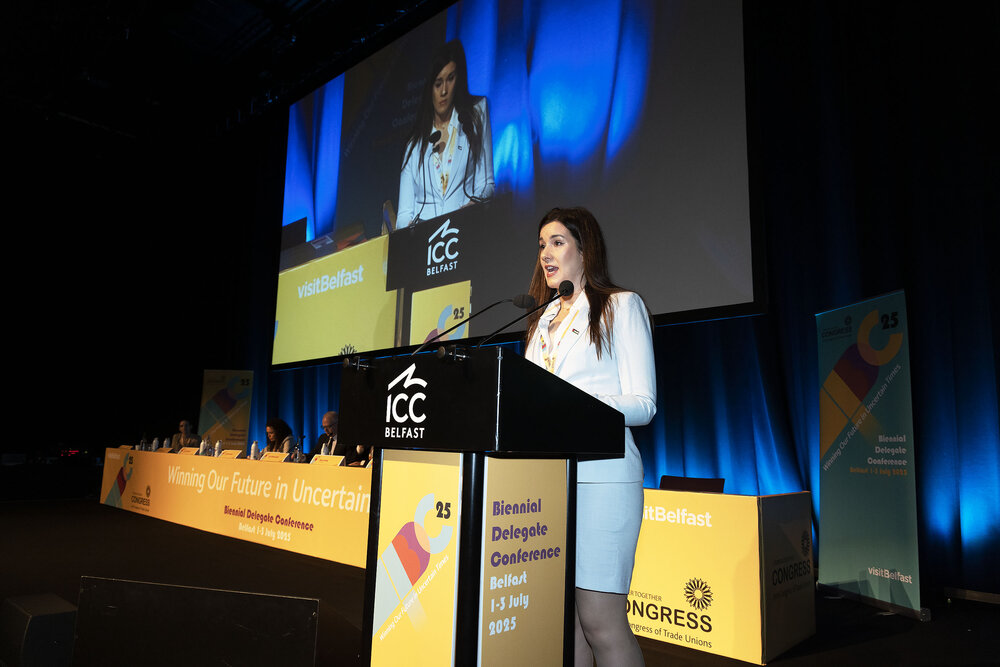
Fórsa AGS Hazel Nolan
Fórsa brought forward a motion on health and safety, calling for stronger legal protections, better training, and formal recognition of the role of health and safety representatives.
Proposing the motion, assistant general secretary Hazel Nolan warned that unsafe and psychologically damaging working environments are becoming more widespread, and that toxic workplace cultures are inflicting real harm on workers.
She cited figures provided by the Health and Safety Authority (HSA) showing that 59% of all work-related ill-health cases in Ireland are linked to stress, depression or anxiety, which comes at an annual cost of €926 million to the economy. She said: “Toxic workplaces, where bullying, misogyny, racism, disablism and cronyism persist, must be tackled by the trade union movement as a health and safety issue.
“Employers cannot be left to self-police the very risks they are often responsible for. Proper scrutiny and action can only come from empowered, independent health and safety representatives, supported by strong trade unions. That means empowering reps to act without fear and giving workers the tools they need to ensure we are safe at work and not suffering harm from work,” she said.
Speaking in a panel debate on organising in Ireland, Europe and the USA, ETUC general secretary Esther Lynch underlined that workers and unions in the EU and the US are putting forward the same agenda and organising to build the trade union movement. She said: “Don’t defend the status quo – it’s letting too many people down”.
Liz Schuler, AFL-CIO president, joined the panel by video link. She told the audience that 90% of Americans under 30 support trade unions and speaking about the current US administration, she said: “There’s nothing scarier to an authoritarian than an organised labour movement fighting back.”
Phil Ní Sheaghdha was elected as president of ICTU, replacing outgoing president Justin McCamphill, who has been in the role since 2022. She is currently the general secretary of the Irish Nurses and Midwives Organisation (INMO) and has served as a vice-president of Congress for the last three years.
Speaking after the announcement, Phil Ní Sheaghdha said:
“At a time of grave global uncertainty, Irish workers will need their trade unions now more than ever. As a trade union movement, we need to be clear that we will not accept the erosion and dilution of workers’ rights. This includes the denial of a living wage, paid sick leave, and flexible working arrangements, particularly as we face the looming threat of tariffs and other economic shocks.”
Fórsa national secretary Katie Morgan was re-elected as vice president of ICTU, and Jacquie White of the Ulster Teachers Union (UTU) was also elected vice president, marking the first time all three ICTU officers are women.
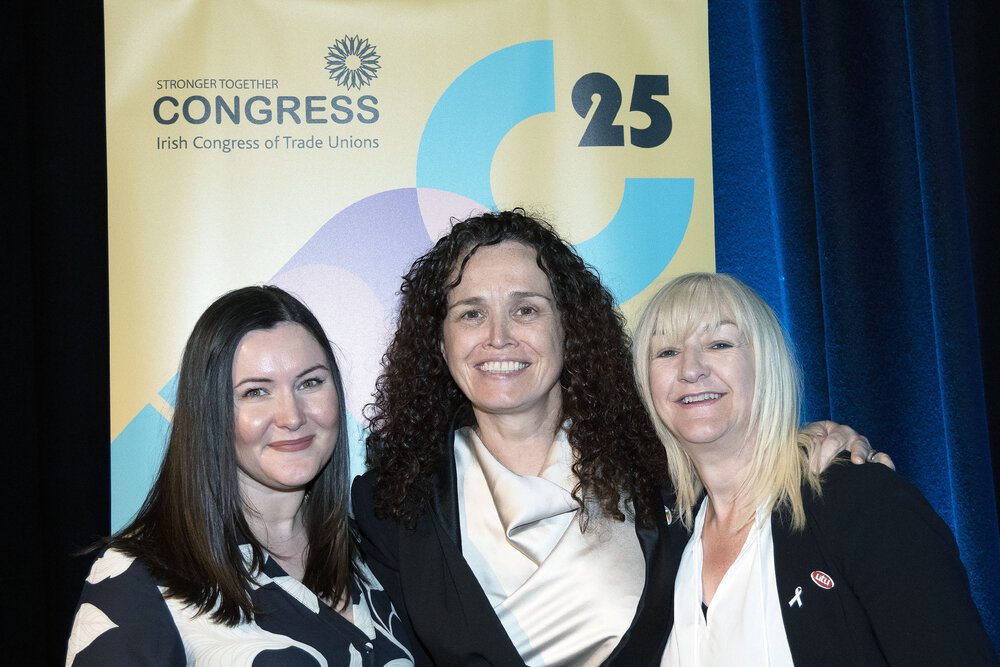
Katie Morgan (Fórsa), Phil Ní Sheaghdha (INMO), Jacquie White (UTU)
Speaking about the term ahead, Katie Morgan said: “As trade unionists we aim to give workers a voice and stand with them as they fight for fairness at work. Congress is a really important body and gives each affiliate union greater power when we stand and act together. Over the next two years we will have plenty of work to do to further build trade union power in Ireland, in order to support all of our members.”
Join a union that wins. Join Fórsa.
Call for solidarity as pension parity strike planning underway
by Hannah Deasy
Fórsa’s school secretaries and caretakers will begin indefinite strike action for pension parity on Thursday 28th August 2025, at the start of the new school term.
Fórsa’s school secretaries and caretakers will begin indefinite strike action for pension parity on Thursday 28th August 2025, at the start of the new school term. Letters of notice have issued to affected school employers and school management bodies.
Members voted overwhelmingly in favour of indefinite strike action in their ongoing campaign for pension parity. The ballot saw 98% of voting members support the move, with a turnout of over 81%.
Fórsa represents more than 2,300 school secretaries and 500 school caretakers working in primary and secondary schools across the country. The ballot follows years of campaigning to secure access to the Single Public Service Pension Scheme, from which school secretaries remain excluded, despite being placed on the Department of Education’s centralised payroll since 2023. School caretakers are fighting for access to the same terms and conditions as previously won by secretaries, and for pensions.
Chair of the school secretaries branch, Luisa Carty, thanked members from across the union for the solidarity and support they have shown so far. She said: “Every community has a school at its heart and school secretaries and caretakers are the heart of those schools. We give so much to our communities and we’re so grateful for the support being shown to our campaign.”
David Hearne, chair of the school caretakers branch, urged members from other divisions to sign the petition and to come along to rallies when the strike action begins. He said: “The more people who stand with us the stronger the message the government will get. So, when you see the secretary and caretaker from your school on strike, please support them.”
Andy Pike, Fórsa’s head of education, said the result sends a powerful message: “Our members have voted overwhelmingly for strike action because they believe in pension equality. These are dedicated professionals who are essential to the smooth running of our schools. They deserve the same pension rights as their public service colleagues.”
Andy said the ballot reflected growing frustration at the State’s continued refusal to extend pension parity, despite the significant progress made in standardising pay, contracts, and payroll arrangements for school secretaries. Similar pay arrangements for caretakers are expected to be finalised this year.
He added: “The 2023 agreement was a landmark in recognising the value of school secretaries’ work. But without pension provision, it remains incomplete. Fórsa has always maintained that pension justice is a vital element of achieving full equality.”
The 2023 agreement followed a prolonged campaign by Fórsa, which included strike action by school secretaries in January 2020, with strong support from teachers, Special Needs Assistants (SNAs) and parents in school communities.
Fórsa has advised the department that it remains available for engagement should the department wish to discuss the terms under which Fórsa members can be admitted to the Single Public Service Pension Scheme.
Andy added: “We urge both the Department of Education and the Department of Public Expenditure, NDP Delivery and Reform to re-engage with Fórsa to secure a fair and equitable resolution.”
Read more about the campaign here.
Sign the petition here.
Watch the campaign launch here.
Join a union that wins. Join Fórsa.
Preventing sexual harassment at work: training available from GRCC
by Mehak Dugal
The Galway Rape Crisis Centre offers training to build staff awareness and improve workplace reactions when incidents occur.
Fórsa branches and members can now organise training sessions provided by the Galway Rape Crisis Centre (GRCC) on sexual harassment in the workplace.
The sexual harassment training aims to create a workplace culture where individuals feel supported to report incidents and to equip management and their teams with the skills to identify and respond appropriately to sexual harassment.
The training also outlines support pathways, both internal and external, on options available to staff who might be dealing with sexual harassment in the workplace.
Susan Costello, head of development at the GRCC and Fórsa member, encouraged people to think about how the training could benefit their workplace and to get in touch for more information.
She said: “Practical training can make a real difference to building a supportive culture where workers feel safe.”
This training is delivered by experienced, trauma-informed facilitators from GRCC and can be adapted to an organisation’s size, sector, and policies. It includes real-life case examples, discussion and Q&As and is available in-person and online.
The purpose of the training is to help organisations meet their legal obligations, strengthen staff awareness by providing clear guidance on identifying and responding to sexual harassment in the workplace.
According to the Code of Practice on Sexual Harassment and Harassment at Work 2022, an employer is legally responsible for harassment suffered by employees in the course of their employment unless they take reasonable, practicable steps to prevent it, to reverse the effects of it, and to prevent its recurrence.
This training contributes to creating a healthier, more respectful workplace culture while promoting a safer working environment for all.
Investing in sexual harassment training is a crucial step towards fostering a respectful and inclusive work environment. It supports an organisation's compliance with the Employment Equality Acts 1998–2015 and builds staff confidence and workplace trust.
When individuals feel safe and supported, they are more likely to perform at their best, collaborate effectively, and contribute to the overall success of an organisation.
If you would like to arrange a training session for your branch or organisation or if you have any other query, please contact education@grcc.ie or visit https://galwayrcc.ie/education-training/
Join a union that wins. Join Fórsa.
Share your Covid-19 experiences and help shape future action
by James Redmond
Through this public consultation, you have an opportunity to share your personal story, helping to draw lessons that will guide future national responses.
COVID-19 reshaped lives worldwide, and everyone in Ireland felt its impact, though each experience was unique. The independent COVID-19 evaluation has been tasked with getting to grips with the diverse effects of the pandemic era. Through its public consultation, you have an opportunity to share your personal story, helping to draw lessons that will guide future national responses.
Chaired by Professor Anne Scott, the evaluation panel has been tasked with compiling a comprehensive, independent report. Its goals include providing a factual account of how Ireland planned for and managed the pandemic, identifying lessons learned, and recommending principles and processes to strengthen future decision-making for crises of this scale.
The evaluation panel will submit its final report to the Taoiseach within 12–18 months, possibly issuing interim reports if immediate improvements are identified. Its recommendations will draw on all findings and best practices to shape guiding principles, ensuring Ireland is better prepared for future emergencies.
Fórsa will submit a response on behalf of members, highlighting how members went above and beyond to serve the public during the pandemic. We are also encouraging anyone who wishes to contribute themselves to do so.
The evaluation is eager to reach as many people as possible, and it has asked trade unions to help raise awareness and encourage participation in the public survey. Please consider passing this on to members, colleagues, or anyone interested in contributing.
Details on how to share your experience are available here.
Join a union that wins. Join Fórsa.
|
|
|
|