Despite a growing economy, this year’s belt-tightening Budget feels more like a cold slap in the face with tax bands frozen and key cost-of-living supports withdrawn. Workers are once again being asked to carry the can.
That’s why it’s vital that every member working in the public sector takes part in Fórsa’s 2025 survey. The results will shape the union’s priorities in the upcoming public service pay negotiations, which begin next year when the current agreement expires.
“At a time when the economy continues to perform well, you could be forgiven for thinking we were back in the austerity years. That’s how workers will see it, as the cost-of-living crisis is far from over for many of them,” said Fórsa general secretary Kevin Callinan, responding to the Government’s belt-tightening Budget.
He warned that Budget 2026 will have major implications for wage bargaining across the economy and urged all members to take part before the survey closes at 5pm today.
“Tax bands and allowances aren’t being indexed, and cost-of-living supports like energy credits are being discontinued. So, the only way living standards can be maintained is through higher wage increases,” said Kevin.
He continued: “Most trade unions in the private and public sectors will be reviewing their bargaining strategies in the light of the apparent decision to let workers bear the brunt of the belt-tightening.”
Your views will help decide what goes into the next round of pay claims, setting out the conditions and protections that matter most to you and your colleagues. It only takes four minutes to complete and is conducted confidentiality by Amárach Research on behalf of Fórsa.
The more members who take part, the clearer and stronger our collective voice will be.
Fórsa's Local Government and Local Services division is inviting members currently working at Grade VIII level across local authorities to attend an online meeting on Friday 17th October at 1.15pm.
Fórsa's local government and local services division is inviting members currently working at Grade VIII level across local authorities to attend an online meeting on Friday 17th October at 1.15pm.
The purpose of the meeting is to discuss the local bargaining claim submitted for members working in local authorities at Grade VIII level. This will include senior executive officers, county and city librarians, heads of information systems, financial accountants, management accountants, financial and management accountants, among others.
Local bargaining is a form of collective bargaining that was included in the Public Sector Agreement 2024-2026.
It allows grades, groups, or categories to negotiate claims up to 3% of overall payroll costs. The first phase of this was due to be paid from 1st September 2025, with a second phase payable after the expiry of the current agreement in June 2026.
Fórsa has lodged several cross sectoral ‘core’ claims and numerous sector specific claims on behalf of members across all divisions of the union, including local government. Active negotiations with the Department of Public Expenditure, Infrastructure, Public Sector Reform, and Digitalisation (DPER) are ongoing.
A link will be issued on the morning of the meeting to those registered to attend.
Head of division Richy Carrothers urged members to attend, saying: “The local bargaining claims submitted by Fórsa will be based on what members tell us they want. Now we need to update you on the progress that has been made. Be heard, get involved and shape your pay.”
This guest column, written by the Co-Director of the Nevin Economic Research Institute (NERI), analyses Budget 2026, calling out the ‘bizarre’ decision to favour tax breaks for hospitality over investment in better public services for all.
In this guest column, Tom McDonnell, Co-Director of the Nevin Economic Research Institute (NERI), analyses Budget 2026.
A lot has been said about Budget 2026 but it’s worth emphasising some key points.
Firstly, the budget is clearly expansionary and inflationary. The net spending increases (i.e. gross spending net of tax changes) of €9.4 billion are well above the sustainable growth rate of the economy.
The budget is also taking place in the context of an economy that is now years into an economic boom, with close to record employment rates, a projected half a million extra people in work between the end of lockdown and the end of 2026, and evident labour and infrastructure shortages across the economy.
If we put the facts together it is abundantly clearly that the budget is firmly pro-cyclical, and that the fiscal stance is too loose. We are channelling the 2000s with boom-time budgeting for a boom-time economy.
It is true that we have a projected surplus in the public finances next year of close to €5 billion. Unfortunately, the recent headline surpluses seem to be causing a troubling sense of complacency to the longer-term fiscal squeeze that an ageing society and other pressures will bring.
The truth is that the only thing differentiating Ireland from the deficits and austerity facing France, the United Kingdom and other Western economies is the windfall corporation tax receipts emanating from a tiny group of US multinationals.
These companies are exploiting Ireland’s tax regime to reduce their corporation tax payments with Ireland benefiting as a side effect. They can easily change their tax arrangements, and the corporation tax yield is extremely vulnerable to policy shifts in the United States, downturns in the fortunes of individual companies, or boardroom decisions to move intellectual property assets out of Ireland.
If these receipts were to vanish, we would be left with a yawning deficit in the public finances. While this may seem a low probability event to some it is still a high-risk strategy to rely on these taxes. The windfall taxes should all be saved, not just a portion of them.
Notwithstanding this concern, many of the policy directions announced in the budget are broadly positive. Moving from universal once-off payments to targeted income supports was a necessary shift. Higher spending on infrastructure is welcome given our severe capacity constraints in energy, water, transport, and of course housing.
The housing and infrastructure crises are profound and need to be addressed with decisiveness. Unfortunately, it is not clear whether the increased budget allocation will even be spent. We simply don’t have the domestic construction workers to quickly ramp up supply. Is there a plan to divert workers from elsewhere or to improve productivity through regulatory or other reforms? The reality is we will need to import the relevant workers.
While far from an austerity budget it was clearly not a populist budget. Effective tax rates will increase, albeit very marginally, for most workers. But context is important. Ireland’s ratio of government revenue to economic output is well below the average for the European Union once we exclude the potentially footloose corporation tax receipts.
This doesn’t imply that income tax paid by workers shouldn’t be indexed for inflation or wage growth, but it does mean that some taxes will need to increase over the medium-term. The decision to cut taxes for the hospitality sector at a time of full employment – the lowest paying and least productive sector in the economy – is a particularly bizarre one. Wasting €700 million on a policy that will generate little to no new jobs is a breathtakingly feckless waste of resources.
We could have hired over 11,000 nurses, made public transport free, or taken 50,000 children out of poverty with that money. Unfortunately, the evidence free tax breaks for the business lobby follow a well-worn pattern of responding to complex policy issues with a blunt, ineffective and regressive tool.
Instead, the needed direction of tax reform is to move in precisely the opposite direction through a medium-term project of generating billions in additional revenue by gradually winding down these types of tax breaks. There is also significant scope to increase the yield from capital taxes as noted by the Commission on Taxation and Welfare.
Lots of mistakes were made and opportunities not taken. We needed a counter cyclical budget that built our resilience to future shocks. We got the opposite. There is no obvious strategy to deal with our high rates of deprivation and child poverty. Minimum wage workers will be forced to wait at least three more years before we achieve a living wage.
We continue to under-invest in key ingredients of long-run growth such as public research and development (R&D) and education and we continue to distort the economy with tax breaks.
We need a new economic model that prioritises productivity, good jobs, economic security and resilience. We’ll be waiting another year it seems.
Tom McDonnell is Co-Director of NERI.
The Nevin Economic Research Institute (NERI) aims, through the provision of world-class research and analysis, to contribute towards the construction of alternative perspectives and possibilities that will lead to the creation of a sustainable and inclusive economy that works for everyone in society. It is supported by the unions affiliated to the Irish Congress of Trade Unions.
After a year bursting with activity, Fórsa Youth are capping things off with their Annual General Meeting (AGM) on Friday 17 October, at Fórsa HQ, Nerney’s Court, Dublin.
After a year bursting with activity, Fórsa Youth are capping things off with their Annual General Meeting (AGM) on Friday, 17 October, at Fórsa HQ, Nerney’s Court, Dublin. The event will see members gather to review the year’s achievements, debate motions, and elect the next executive committee.
At the heart of everything Fórsa Youth does lies the Fórsa Youth Charter - a document that defines its purpose and passion. The Charter commits young trade unionists to fight for fairness, equality, and social justice in their workplaces and communities.
It champions pay equality, living wages, housing rights, mental health, and inclusion, while urging members to challenge discrimination and stand shoulder-to-shoulder with workers everywhere.
Reflecting on the group’s success, Fórsa Youth chair, Hugh McInerney, said: “I couldn’t be happier with how the year went and that’s all down to the wonderful exec committee and our youth reps, along with the consistent support from HQ.”
In March, Fórsa Youth hosted a quiz night in aid of Stop the Wall, a Palestinian trade union recommended campaign supporting communities affected by the West Bank Apartheid Wall and the misery imposed on workers forced to cross the barrier daily under a restrictive visa system.
Fórsa Youth was also front and centre at the 2025 education conference, where secretary Rachel took the podium to speak on vital motions around youth engagement and union density. She also called on the Department of Education to offer vaccines to Special Needs Assistants (SNA), ensuring health and safety remains a union priority.
In May, members hit the streets to celebrate Mayday, the International Day of the Worker, meeting at Big Romance in Dublin before joining the march and rally from the Garden of Remembrance. It was a lively show of solidarity and a reminder that young trade unionists remain at the heart of Ireland’s workers’ movement.
Then came the headline event of the year - the inaugural Fórsa Youth Conference in Trinity College Dublin last September. The conference featured panels and discussions on housing, the cost of living, and workers’ rights, sparking new energy among attendees and setting the tone for the future.
Participants in the conference included trade unionists, academics, journalists, activists, and politicians, including presidential hopeful Catherine Connolly T.D., as well as the Palestinian Ambassador to Ireland, H.E. Dr. Jilan Wahba Abdalmajid.
"We are very grateful to all those who joined us and participated across the day. Not only was the conference fascinating and informative, but it was also a great opportunity for Fórsa Youth reps to mingle with each other and build relationships with members of other trade unions and organisations" said Fórsa Youth communications officer Bridget Moylan.
"Going forward, we hope to increase union density among young workers, and we are looking to ensure that every branch has a Fórsa Youth rep."
With the AGM around the corner, members will reflect on that success, debate motions, and elect the next executive.
Speaking ahead of the AGM, Hugh said: "In a year that ranged from walking tours to quizzes and mortgage info sessions to research discussions, we were delighted to see our presence and active membership grow substantially. Building on the success of the first ever Fórsa Youth conference at the beginning of September, we hope as many of our younger members as possible get involved to make their voice heard!”
The day begins with tea and coffee at 10am, with the meeting starting at 10:30am. Lunch will be provided for those registered, and for anyone who can’t attend in person, the meeting will also be streamed online. Register to attend here.
For details on submitting motions or nominations, members should check their emails or contact youthcommittee@forsa.ie
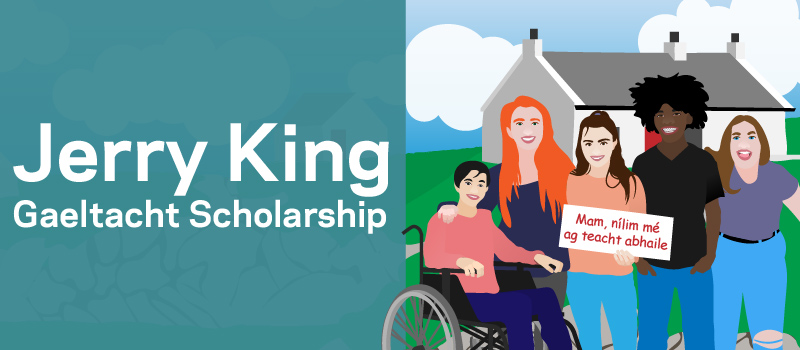
Fórsa is proud to announce the expansion of the Jerry King Gaeltacht Scholarship Scheme for children of Fórsa members in 2026.
The scheme is now open to children of Fórsa members, who are aged between 11 years and 18 years of age on 1st July 2026.
For the first time, the union will be offering 300 grants of €150 each to assist children of Fórsa members in attending Irish language courses next summer.
The Jerry King Fórsa Gaeltacht Scholarship Scheme is designed to assist the children of Fórsa members to attend approved residential Irish Language courses in designated Gaeltacht areas and also covers daytime only courses outside Gaeltacht areas during the summer months.
The scheme is named after former President of IMPACT Jerry King, who died in April 2022. A proud library worker and deeply committed trade unionist, the Fórsa Gaeltacht scholarship scheme was named in recognition of his long service to the union and his desire to see everyone fulfil their potential through education.
Fórsa senior vice president Julie Flood said: “We're so proud to expand our scholarship scheme this year, giving even more children the chance to experience the richness of the Irish language in the heart of the Gaeltacht. This initiative is about improving access to these language courses, to ensure more children can immerse themselves in our native language and culture.”
If you wish to apply, click to download the application form here. Application forms are also available via the union's website and have been issued to Fórsa branch committees via email.
The completed form must be received by Friday 5th December 2025. The draw will take place on the 16th December and winners will be informed soon after.
Forms can be submitted by email to gaeltacht@forsa.ie, or by post to Fórsa Head Office to the following address:
Fórsa members turn out in their droves for IPSC rally.
Fórsa members turn out in their droves for IPSC rally.
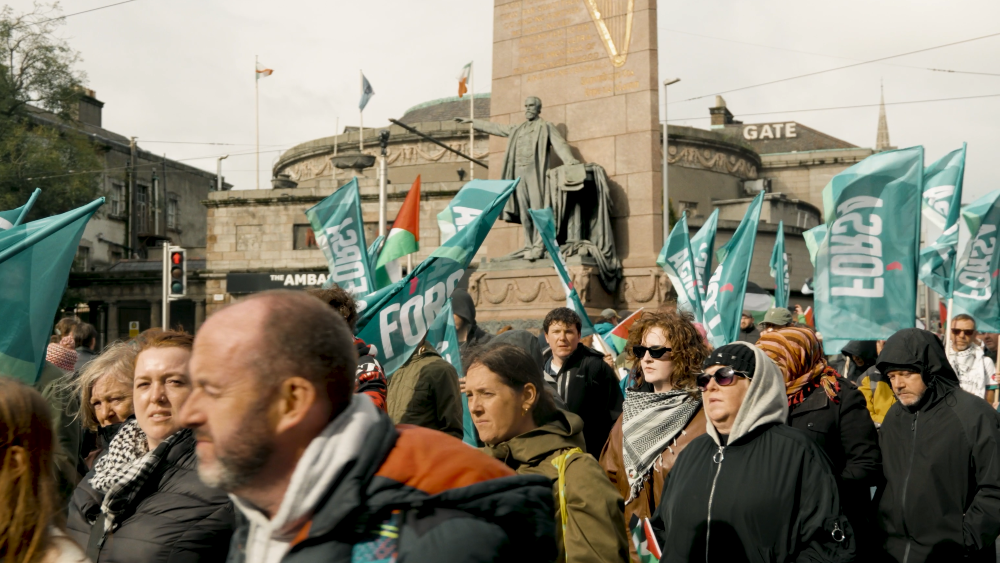
Though Storm Amy swept across the country last weekend, nothing could stop the steadfast outpouring of solidarity that surged through Dublin last week as Fórsa members mobilised to join the monthly Ireland Palestine Solidarity Campaign (IPSC) demonstration. James Redmond has this report.
As wind rattled the city, Nerney’s Court opened its doors - offering warmth, conversation, and connection before people joined the main march for Gaza.
Things felt especially close to home, as two people with strong links to Fórsa were among those recently detained by Israeli forces while taking part in the Sumud Flotilla.
Fórsa campaigns officer Mehak Dugal said: “Today we've hosted a community event for Fórsa members who want to come and show their solidarity with the people of Gaza. Today also marks two years of the genocide. The weather is a bit rough, but we've got a great turnout in the building. There's so many young Fórsa members who've come out to show their solidarity with the people of Gaza. We really want an end to the horrific violence that we continue to see daily.”
Chair of the Meath health branch, Grace Doyle, had travelled in with her family from Meath. She said: “It's important that we don't just sit at home. It's important that we show support, to bring about an end to the genocide and atrocity that is happening in Palestine at this moment.”
For Fórsa official Paul MacSweeney, Chair of the Trade Union Friends of Palestine, his thoughts were with those taking real risks in solidarity by taking part in the Sumud Flotilla. Two activists with close connections to Fórsa were among those detained in international waters by Israeli forces, after the vessel attempted to break the blockade of Gaza.
“We are also remembering the Irish people and all the people who bravely were part of the Sumud Flotilla and who were detained illegally in international waters by the Israelis, that includes Fórsa member, Donna Schwarz. We also have somebody who works with us here who has a relative, Diarmuid MacDubhghlais, who was on the flotilla.”
Most of the Irish citizens detained by Israel after intercepting the Global Sumud Flotilla have now returned home, where friends, family and supporters gathered at Dublin Airport to welcome them back. Among the first to be released was Fórsa member Donna Schwarz, who, along with Sarah Clancy and Thomas McCune, said they were subjected in Ktzi’ot Prison to “petty and extreme cruelties.”
Descriptions from other returnees detail lack of water, denial of medical support, aggressive behaviour by Israeli Defense Forces (IDF) personnel, and being restrained under harsh conditions. Despite the trauma, the activists expressed relief to be home and hope their ordeal will raise awareness of the humanitarian crisis in Gaza and spur further solidarity action.
“They're the best of us. They represent us. They're doing something in the absence of international pressure. They're trying to break the blockade, an illegal blockade put there by Israel which is actually starving men, women and children,” said a supportive Paul MacSweeney.
Subscribe to Fórsa’s YouTube channel and get the latest stories straight from other workers and members themselves. Hear what matters most in workplaces and communities across the island. Click here to subscribe, stay connected, and don’t forget - share widely and let’s strengthen our collective voice!
From workplace reps’ trainings in Limerick and Galway to public speaking training and effective local Industrial Relations practices, there’s plenty on the Skills Academy agenda for the month ahead.
Workplace Representative Training (Level 1) – Limerick – Tuesday 28th – Thursday 30th October
There are few spaces left on the Level 1 WRT which runs from 11am - 4pm, at the Fórsa Limerick Office, Roxborough Road, Limerick, V94 YY31 on Tuesday 28th, Wednesday 29th, and Thursday 30th October.
It is open to reps in North Kerry, Tipperary, and Clare along with Limerick.
This training programme is a three consecutive day course for newly elected workplace representatives, or those with less than 2 years representative experience who have attended Fórsa Induction (formerly Fórsa 101).
It covers all the basic skills and information that workplace representatives require to build their capacity and grow their confidence to recruit and organise new members, represent members locally, and gain a brief understanding of the importance of health and safety whilst upholding principles of equality and diversity.
Level 2 Workplace Representative Training (Level 2) – Galway
This programme, comprising three one day sessions, all of which must be completed, is delivered over four days on the following dates:
PART 1 focuses on recruiting and organising members in your workplace and provides practical opportunities to develop your individual representative skills. It is available on Wednesday 5th and Thursday 6th November 2025.
PART 2 covers equality legislation and diversity in the workplace and takes place on Wednesday 21st January 2026.
PART 3 covers health and safety practices, risk assessment, and an overview of legislation which takes place on Thursday 19th March 2026.
Public Speaking Training – Dublin- Tuesday 11th November
Are you a workplace rep, a member of your branch executive committee or perhaps you might be a delegate at conference next year? Then this is the course for you.
On this one-day in person session you will learn how to plan and prepare to speak in public for whatever occasion or event you might be attending in the future.
Public speaking is an essential skill for everyone to learn but is particularly important for active trade unionists who will encounter a variety of situations which will require them to open a meeting, make a speech or propose a motion.
This course will help with all that by equipping you with the tools to craft a speech to garner the interest, empathy or influence of your particular audience and ensure that your message is received effectively.
This workshop will take place on Tuesday 11th November, from 11am- 4pm, in Nerney's Court.
Building Effective Local IR Practices -Dublin– Thursday 18th November
This course is specifically for branch reps who participate in local industrial relations, along with their branch and union official, meeting local management and representing members within the branch.
This session is open to reps from all divisions, except civil service, as they have already participated in a dedicated session reflecting their own distinct dispute resolution procedures.
This workshop will take place on Tuesday 18th November 2025, from 11am – 4pm in Nerney’s Court. It will be delivered by Brendan Cunningham, former Regional Manager at the Workplace Relations Commission (WRC).