A Fórsa first – marching together at Dublin Pride
by Brendan Kinsella
 |
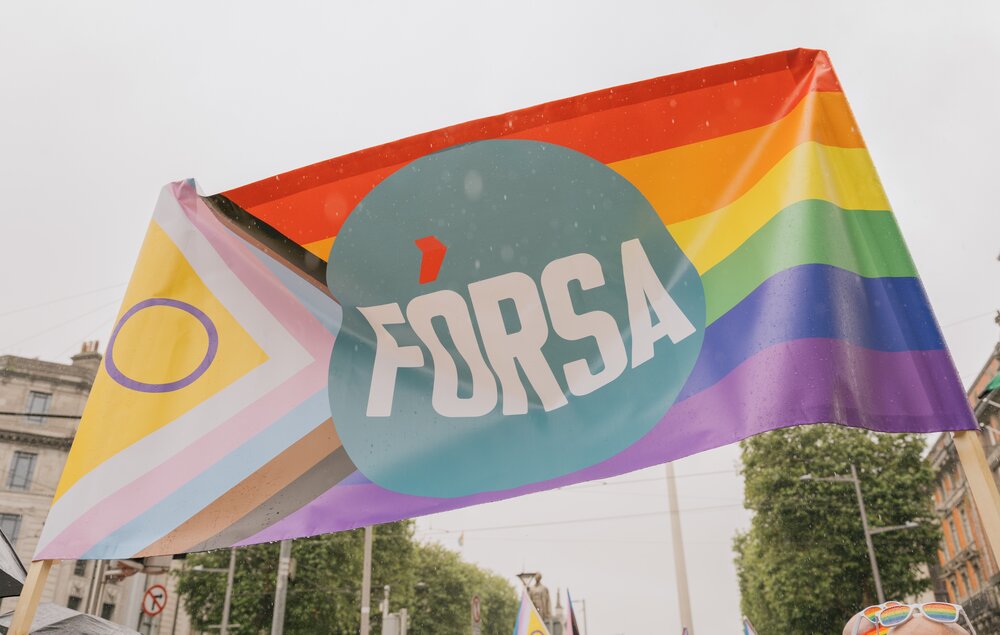
Although Fórsa members are not a rare sight at Pride, Saturday 29th June 2024 marked the first time we marched together under the union's banner.
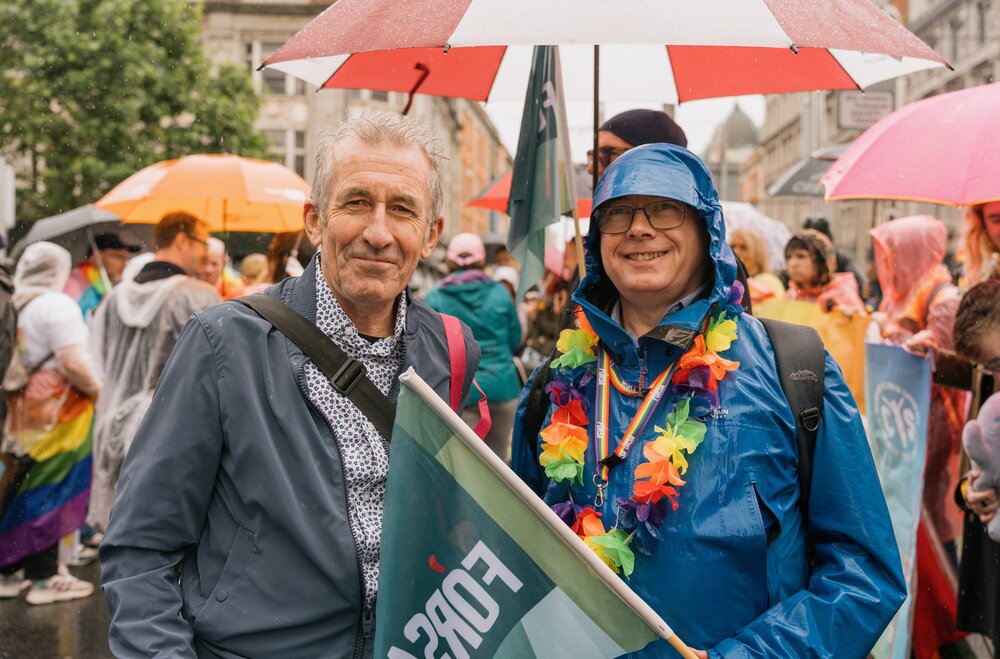
A festive atmosphere reigned when members assembled on O’Connell Street, in defiance of the torrential rain, with rainbow colours only slightly muted by the clear plastic of ponchos. The union group was joined by Fórsa president Martin Walsh, and general secretary Kevin Callinan.
Also marching with Fórsa was Kieran Rose, lifelong union member and LGBTQIA+ activist.
Putting the day into historical perspective, he said “The trade union movement was hugely important in progress for LGBT people in Ireland from the early 1980s when we had few supporters but many powerful enemies.”
Kieran recently produced a new publication on the trade union movement’s important role in the struggle for LGBTQIA+ rights in Ireland. A struggle that has its beginning with a motion put forward by Kieran, when he was in the Cork Branch of the LGPSU, one of the predecessor unions to Fórsa, calling for lesbians and gay men to be protected by the unfair dismissals act.
The most popular part of the Fórsa contingent on the day was the Queer Library Alliance, their banner receiving raucous cheers and applause from fellow marchers and those gathered along the parade route.
The Queer Library Alliance are a group set up last year by LGBTQIA+ library staff and allies in reaction to increasing incidents involving the far-right in libraries across the country. They campaign against the intimidation and censorship of queer staff, patrons and literature.
In a statement released on Monday, the Queer Library Alliance said “We were proud to march with Fórsa at Dublin Pride in solidarity with all library workers affected by far-right and anti-LGBTQIA+ aggression and library censorship.”
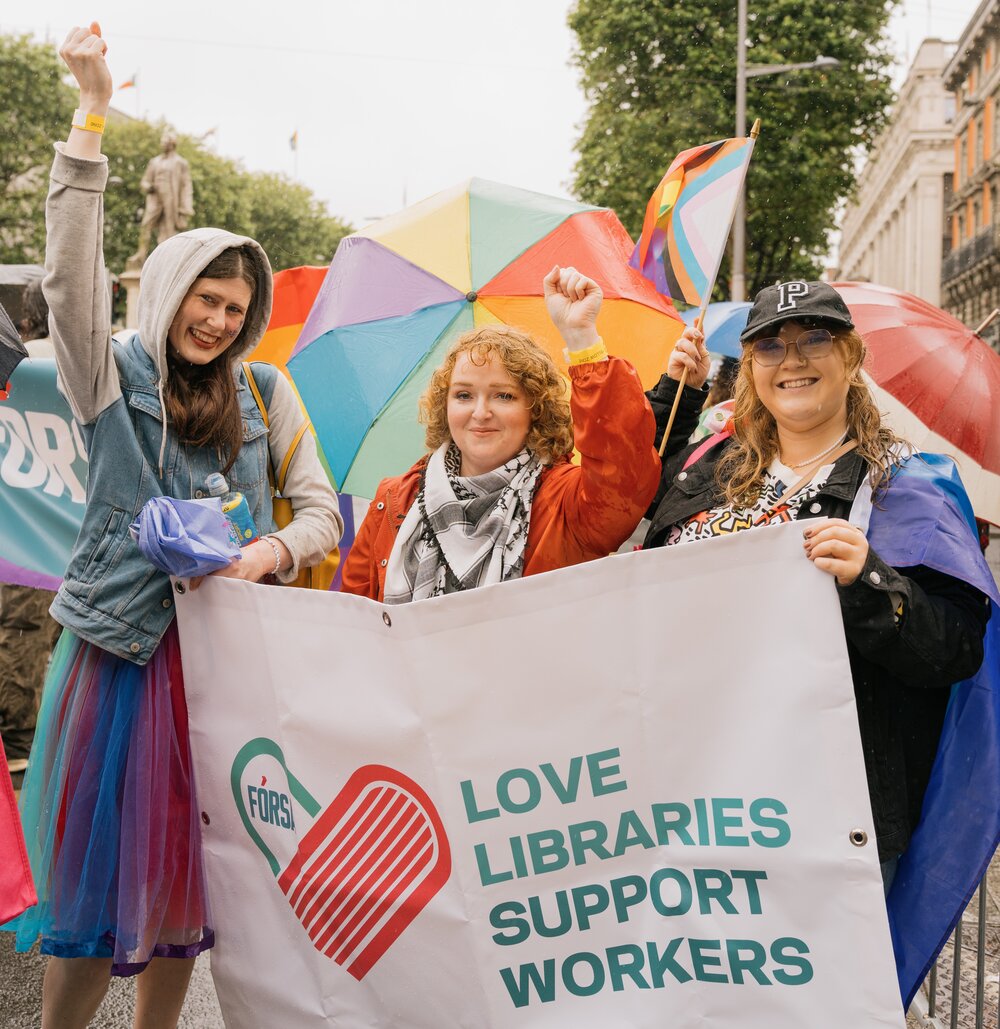
Fórsa national secretary and equality officer Ashley Connolly said: “Unions played an important role in the furthering of LGBTQIA+ rights. Now as the far-right threaten those rights, it’s important we show solidarity not only with our LGBTQIA+ friends and family, but with our librarian colleagues who have found themselves on the front lines of a culture war no one asked for.”

Rob Partridge, of the Galway Health and Welfare Branch, made his way to Dublin for the day. Some may recognise Rob from national conference where he received a standing ovation for his presentation of a motion to establish a Fórsa LGBTQIA+ Network.
Arm-in-arm with his husband, soaked and beaming joy, Rob spoke of why marching with fellow members was important to him.
Rob said “Every year, for as long as I can remember, there has been someone from this union attending the Pride march in Galway. They haven’t gone to say, ‘Look, here we are, we’re going out again.’ They’ve come to say, ‘We’re supporting the community’.”
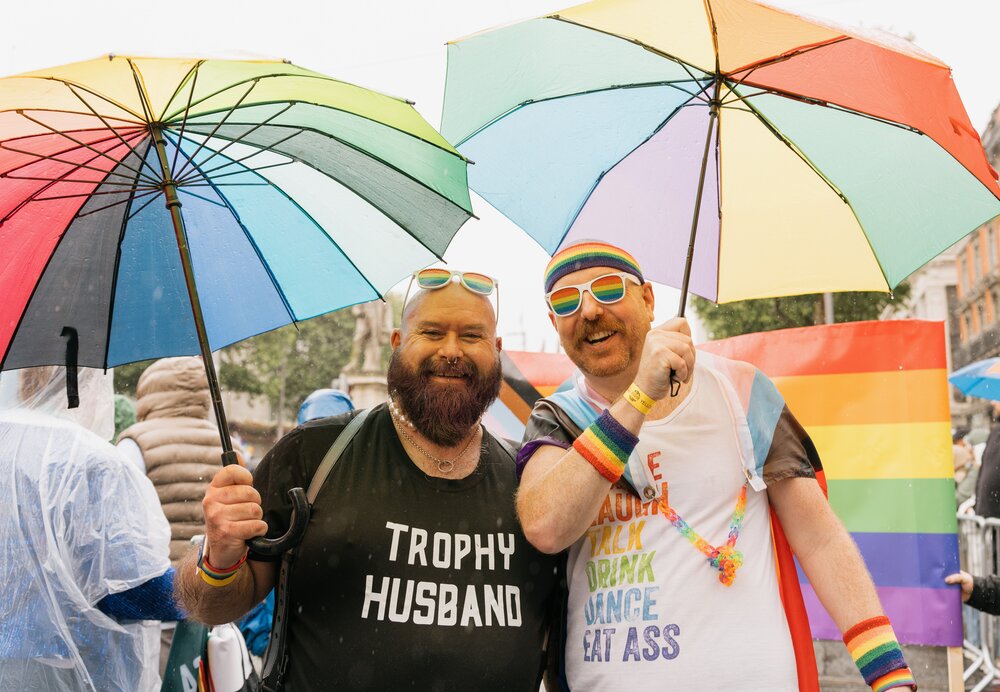
Having proven a success this year, the Fórsa block at Dublin Pride has undoubtedly laid the foundations of a yearly tradition.
There’s never been a better time to join a union, and it’s never been easier. Join Fórsa today.
Skills Academy: What’s on offer over the summer?
by Hannah Deasy
|
As summer holidays begin in earnest the Skills Academy still has plenty on offer for members.
July's Lunch and Learn session takes place on Friday 26th July on the topic of LGBTQIA+ activism in the union. This talk will primarily focus on how branches can be supported to establish the role of LGBTQIA+ officer and what other supports might be required to build capacity in this area.
Our union induction course for new members, Fórsa 101, runs right through summer. Applications for the August sessions on Wednesday 14th will open in the coming weeks, new members will be notified by email. When it opens the application form will be accessible here .
Don’t miss registration deadlines for September trainings
In September, we will have level 1 and 2 workplace rep training on offer and a new communications and digital skills course for members. Details on course content for all of these can be found on our website hub .
All our courses open for applications 10 weeks before scheduled for delivery to facilitate workplace releases so planning ahead is essential.
Finally, we are still accepting applications to our mentoring programme until August 6th. Contact your branch or send an email to skillsacademy@forsa.ie for the link to apply.
Further details of all Skills Academy programmes are available on our training hub on the Fórsa website check it out here.
There’s never been a better time to join a union, and it’s never been easier. Join Fórsa today.
EPSU Congress champions public control of essential services
by James Redmond
|
The European Public Services Union (EPSU) held its 11th Congress at the Palace of the Parliament in Bucharest, gathering 500 trade unionists from 45 countries from 18th - 20th June. The event marked 45 years of the organisation’s existence and saw huge enthusiasm around the continuation of its mission to champion public services and the rights of public service workers across Europe.
The European Federation of Public Service Unions, established in 1978, represents eight million public service workers across 260+ trade union organisations. It is affiliated with the European Trade Union Confederation and recognized as the regional body of Public Services International.
Fórsa was entitled to two delegates: Richy Carrothers, representing Local and Regional Government, and Linda Kelly, representing Health and Social Services. Additionally, Michael Kerrigan attended as a member of the EPSU Youth Committee, and Eoin Ronayne participated in his capacity as a member of the outgoing EPSU Executive.
Among the notable actions taken at the Congress, Eoin Ronayne moved a successful resolution on solidarity with Palestine. Richy Carrothers presented an emergency motion on the rise of the far-right following the European elections, which was also adopted.
Francoise Geng, representing the French union CGT’s Health and Social Action Federation, emerged as the new President of EPSU. Meanwhile, Jan Willem Goudriaan secured his third consecutive term as EPSU's General Secretary, a position he has held since 2014. Additionally, Richy Carrothers was elected to represent Ireland on the EPSU Executive Committee for the 2024-2029 term, marking a pivotal moment in the organization's leadership landscape.
Fórsa, alongside the Dutch union FNV and the French union CFDT, hosted a fringe meeting on remunicipalisation. This event featured Professor Andrew Cumbers from the University of Glasgow/University of Bonn as the keynote speaker and focused on launching the EPSU PSI toolkit for campaigning for re-municipalisation.
Re-municipalisation is the process of bringing privatised services back into public control. Fórsa national secretary, Richy Carrothers was a member of the Steering Committee that developed the toolkit.
Richy said: “This movement toward reclaiming public services—water, health, education, and more—from profit-driven models underscores a broader societal shift. Fuelled by crises like Covid-19 and climate change, it champions democratic, inclusive definitions of 'public,' promoting socially just and sustainable solutions.”
“We’ve been walled in by the dictates of neo-liberalism, it has not worked - so this is about forging a new common sense and prioritising community involvement over market interests.”
The conference also discussed themes such as securing peace, democracy, equality, rights, and freedoms, alongside reclaiming, and strengthening public services, and advocating for a green, digital, and socially just transition. Delegates consistently pushed the importance of quality jobs in delivering high-quality services and focused on strengthening public service trade unions.
Linda Kelly, national secretary and Fórsa delegate at the Congress said it was a pivotal event, reinforcing the union's commitment to public services and the rights of workers across Europe.
“The trade union movement has always been internationalist and Fórsa’s participation in the EPSU Congress is an expression of that. There is so much we can learn from our colleagues in unions across Europe. I would like to pay tribute to Eoin Ronayne’s long service on the EPSU Executive Committee, a role to which he dedicated his time and energy, and which has ensured the interest of Irish public sector workers are supported by our European colleagues.”
There’s never been a better time to join a union, and it’s never been easier. Join Fórsa today.
Pension reform law passes
by Hannah Deasy
|
The Dáil passed the Automatic Enrolment Retirement Savings System Bill on Wednesday 3rd July. The legislation had previously been passed by the Seanad and will now go to the President to be considered and signed into law.
This comes after a lengthy campaign and legislative process.
Welcoming this landmark social policy Irish Congress of Trade Union general secretary Owen Reidy said:
“This is a defining moment in bringing an end to our failed voluntary approach to pensions saving. Future generations of workers can now be spared from seeing their income and living standards plummet in retirement.
“After decades of delay, it is vital to maintain momentum. The Minister must name the date for the first auto-enrolment pension contributions. This legislation cannot be left to sit on a shelf gathering dust” he said.
“Congress and affiliated unions accept the intention is for auto-enrolment to do no harm to existing good occupational pensions. We will nonetheless be vigilant for displacement or dilution and won’t hesitate in taking action should employers respond to the cheaper pension auto-enrolment option by closing their workplace pension to new hires or levelling down their pension contributions to the AE rate.”
Mr Reidy added: “I want to acknowledge the work and collaborative approach of the Minister for Social Protection Heather Humphreys and her officials in delivering what I believe will be the most significant social intervention to protect older people’s living standards since the Old Age Pensions Act of 1908 introduced the state pension.”
There’s never been a better time to join a union, and it’s never been easier. Join Fórsa today.
|
|
The Future Of Work! Summer 2024 CSQ now online
by Brendan Kinsella
The new edition of CSQ, Fórsa’s magazine for our members in the Civil Service division, is now available.
The new edition of CSQ,Fórsa’s magazine for our members in the Civil Service division, is now online.
This edition contains highlights of our recent national union conference, an interview with Éamonn Donnelly on the future of the C&A scheme, and an insightful overview of a recently released WRC report on the future of the Irish workplace.
Recent elections across the European Union will no doubt have an impact in Ireland, and we are delighted to feature a guest column from Esther Lynch, General Secretary of the European Trade Union Confederation, and Fórsa member, in this issue. There’s also a look back at the Irish trade union movement’s proud history of fighting for LGBTQI+ rights.
Read CSQ here.
Local bargaining preparations underway
by Niall Shanahan
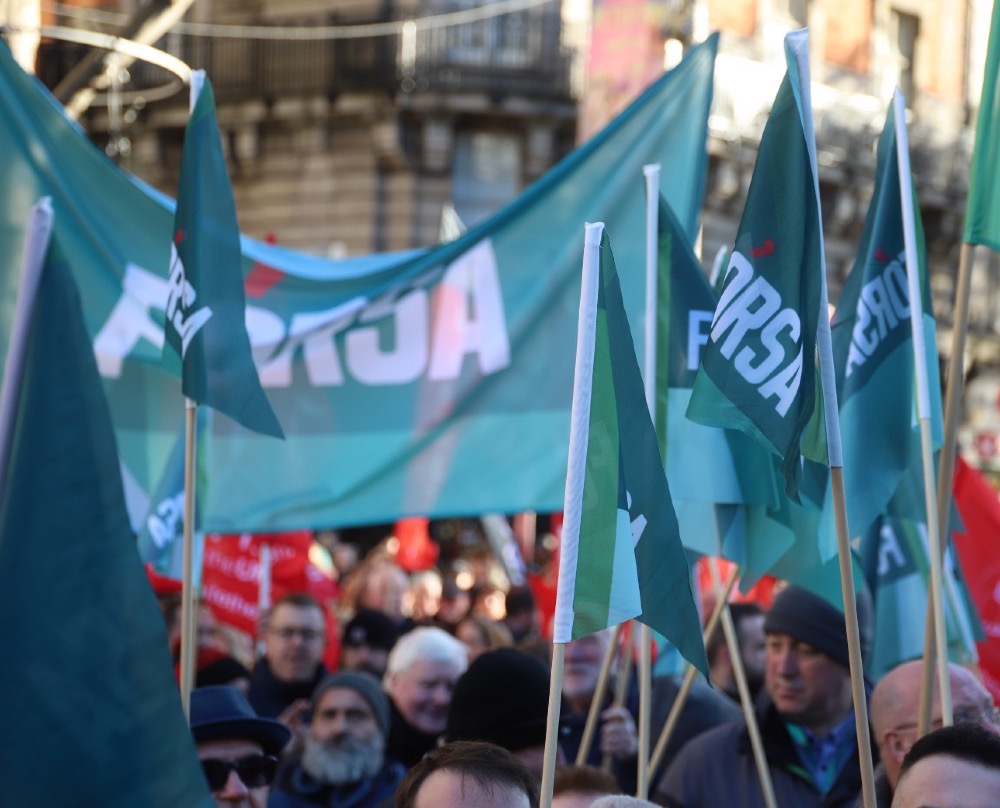
Fórsa has prepared its position paper, in advance of local bargaining negotiations, under the terms of the Public Service Agreement 2024 - 2026 (PSA).
The local bargaining provisions of the PSA allows trade unions to negotiate up to an additional 3% of pay costs, inclusive of allowances, for particular grades, groups or categories of employee.
In a letter to branches on Tuesday (2nd July), Fórsa general secretary Kevin Callinan outlined the union’s progress in identifying the bargaining units - ahead of the 30th June deadline - under the terms of the current deal.
Kevin explained that the position paper is not a final, definitive document: “It was prepared so that Fórsa was able to meet the deadline of 30th June for finalising the bargaining units set out in the agreement.
“Fórsa is the only union - so far - to have outlined a detailed approach to the operation of local bargaining for grades, groups and categories,” he said.
Under the terms of the deal local negotiations are to take place between July 2024 and June 2025, while agreements on local bargaining measures are to be secured, to the greatest extent possible, through direct negotiations. While termed ‘local’ bargaining these claims and negotiations will be addressed on a national basis.
Fórsa shared the document last week (25th June) at a meeting between officials from the Department of Public Expenditure, NDP Delivery and Reform (DPENDPDR) and the officers of the ICTU Public Services Committee (PSC), which is chaired by Kevin.
A further meeting, to review progress, will take place on 25th July. Kevin said the management side believes if comprehensive lists of bargaining units can be finalised by September, there will be sufficient time to process claims during the nine months from October 2024 to June 2025.
He added: “This is the timeline in the PSA to allow partial implementation of outcomes, equivalent to 1% of the cost involved, on the agreed date of 1st September 2025.”
The balance of 2% of the cost will fall to be negotiated in the context of talks on a future public service pay deal.
Kevin described this timeline - for negotiation and implementation - as ‘ambitious’, particularly if there is disagreement within the process: “It is also ambitious because the identification of bargaining units, although complex for a union like Fórsa with such an array of grades, is relatively simple compared to the formulation of claims.
“It will require a big effort on the part of branches, national professional or vocational groups and union staff over the coming weeks to ensure that we can fully maximise this bargaining opportunity,” he said.
You can read the Fórsa position paper here.
There’s never been a better time to join a union, and it’s never been easier. Join Fórsa today.
Labour Court recommendation due on IALPA/Aer Lingus dispute
by Niall Shanahan
The Labour Court is expected to issue a recommendation following this week’s special hearing on the pay dispute between the pilot body IALPA, a branch of Fórsa, and Aer Lingus.
The Labour Court is expected to issue a recommendation following this week’s special hearing on the pay dispute between the pilot body IALPA, a branch of Fórsa, and Aer Lingus.
Work-to-rule action by IALPA members at Aer Lingus continues, while over 500 pilots took part in the rally and picket at Dublin Airport last Saturday (29th June) during an eight-hour work stoppage by pilots.
Both parties attended lengthy talks on Monday (1st July), following which the Court said it would exercise its power under section 26(5) of the 1990 Industrial Relations Act to formally intervene in the dispute. That hearing took place on Wednesday (3rd July).
The airline has cancelled approximately 400 flights since work-to-rule action commenced on 26th June.
IALPA has highlighted the generous bonus terms recently awarded to Aer Lingus senior management, including almost €300k in shares to its CEO Lynne Embleton, and has criticised what it describes as “corporate greed” at the airline.
Pilots are pursuing a pay claim based on the cumulative effect of inflation since 2019, since when there has been no increase in pilot pay terms. Pilots and other airline employees also endured hefty reductions in pay during the period affected by Covid-related travel restrictions.
IALPA will ballot its members on the terms of the anticipated Labour Court recommendation, which is expected in the coming days.
There’s never been a better time to join a union, and it’s never been easier. Join Fórsa today.
Time to extend domestic violence leave to ten days paid
by Róisín McKane
Fórsa has called on the government to increase paid domestic violence leave to 10 days.
Fórsa continues to work towards ensuring better support for those experiencing domestic violence and has called on the government to increase paid domestic violence leave to 10 days.
A key issue for the union, Fórsa has long-fought for protections for workers experiencing domestic abuse. Following a lengthy campaign during which the union tirelessly lobbied for statutory paid leave for those experiencing abuse, and fought to secure domestic violence policies in workplaces across all of the union’s divisions, five days statutory paid domestic violence leave per year came into effect last November under the Work Life Balance and Miscellaneous Provisions Act 2023.
While broadly welcomed as a milestone in this hard-fought campaign, Fórsa had expressed disappointment at the five-day limit and committed to continue to collectively bargain for increased supports. Delegates at Fórsa’s national conference in May voted overwhelmingly in support of a motion mandating the union to further engage with Government to increase domestic violence leave and bring it in line with recommendations from Women’s Aid and advisory working groups.
“No one experiencing domestic violence should have to risk poverty or unemployment to seek support. Financial independence from abusers is the key to escaping and building a better life. This leave helps workers find a pathway out of violence - it’s disappointing that the leave is for only five days, but we continue to work to collectively bargain to provide for ten days paid leave,” said Fórsa National Secretary and Equality Officer Ashley Connolly.
Last month, Women's Aid launched its annual impact report which recorded its highest ever number of domestic abuse disclosures for last year. The report found that 40,048 disclosures of abuse against women and children were made last year during 28,638 contacts with frontline services, an 18% increase compared to 2022. READ the report here.
.
The effects of domestic abuse often spill over into the workplace and Fórsa has long maintained that domestic violence is a workplace issue.
Fórsa’s Róisín McKane said workers should feel supported and should not face losing their jobs or income because they are experiencing abuse at home.
“Those experiencing abuse may not have financial independence or full control of their own finances. If a person’s income is monitored or appropriated by their abuser or both, a change in their normal salary may alert the abuser, putting the victim at risk. We believe the workplace should be a safe space. It’s time to extend domestic violence leave to ten days paid,” she said.
More than 40% of respondents to the union’s 2022 survey said the work environment offered them some safety and respite from the abuse. Ashley said that domestic violence supports make a huge difference to victims and called on Government improve workplace supports for survivors.
“Domestic abuse is in our communities and in our workplaces. One in four people have experienced abuse, and one of the critical ways in which people can be supported is by helping them maintain their financial independence from their abuser. Their work, as a source of income and personal autonomy outside of an abusive or controlling domestic environment, helps them to do that.”
“We’re urging the government to extend the statutory entitlements to ten days paid leave for those experiencing abuse, as set out by Women’s Aid and experts in this field. We know the difference these policies make, our members are a testament to this, and we will continue our efforts to support workers navigating a pathway out of abuse,” she said.
There’s never been a better time to join a union, and it’s never been easier. Join Fórsa today.
New WRC report outlines future workplace challenges
by Brendan Kinsella
A recently released report from the University of Limerick’s Kemmy Business School explores the current and possible future impacts of several key developments affecting the Irish labour market.
A recently released report from the University of Limerick’s Kemmy Business School explores the current and possible future impacts of several key developments affecting the Irish labour market. The research, carried out on behalf of the Workplace Relations Commission (WRC), looks at the effects of inflation, recruitment and retention challenges, technology, and climate change on work in Ireland in the coming years.
The research consisted of two parts. The first was academic research drawing upon a wide variety of international sources from across a number of disciplines, and the second part consisted of interviews with representatives of organisations and state bodies, ranging from the Department of Enterprise, Trade & Employment, to the National Women’s Council and Fórsa. The responses from interviewees paint a clear picture of workers’ concerns.
Inflation
Of the four key factors, inflation was seen as having the greatest priority for employers and workers. This was in part due to “its immediate impacts on business costs, incomes, and related wage negotiations.”
Inflation was found to be “inextricably linked” to recruitment and retention challenges. There was little hope of a quick resolution to the problems this presents, with interviewees expecting inflation to be an ongoing issue for the medium term.
Currently the labour market, while strong, is tight, that is expected to continue and will contribute to wage growth. This is expected to be nominal with “growth of 5.0 per cent in 2023 and 5.5 per cent in 2024.”
Although to date there has been little evidence of inflation causing significant workplace conflict, it is leading to tensions. If inflation continues workplace conflict will become a more real possibility as workers’ wage demands increase to meet continued rising cost-of-living.
Recruitment and retention
The effects of a tight labour market are not being felt evenly across all sectors. The vacancy rate in the Information and Communication sector has halved since 2016, while the rate in Public Administration and Defence has doubled in the same period.
There is evidence of skills gaps across all sectors. This issue is exacerbated by difficulties in recruiting and retaining workers from other parts of the country and abroad.
The cost-of-living crisis is an ever-present deterrent to attracting new workers. The availability and costs of housing and childcare likewise make moving for work an unattractive prospect.
As employers compete against each other over a smaller pool of potential workers, there is a worry that this may cause friction as new hires get offered better pay and conditions than pre-existing staff.
Interviewees were in agreement that greater social dialogue is needed to properly address the issues facing recruitment and employment.
Technology
Digitalisation and automation were seen as both a threat and a possible benefit for workers. There is a clear potential for technology and automation to make workers’ lives easier, make workplaces safer, and allow workers more leisure time.
Upskilling/reskilling was cited as one way to offset the potential threat to jobs. This comes with the danger of ‘skills churn’ increasing in pace. Skills churn is “the necessity for workers to constantly update skills to maintain employability.” This puts pressure on workers over who funds their learning, and whether they are expected to undertake upskilling in their own time.
AI was frequently cited as likely having the greatest consequences for work. Of particular concern was AI being used in managerial or HR contexts which are “high-risk in these contexts because they can potentially lead to discriminatory outcomes impacting workers’ careers, livelihoods, and rights.”
Climate change
Interviewees thought that with proper planning mitigation and adaptation, measures could be introduced without creating significant conflict.
There was an impression that implications of climate change for workplace relations “had not been given significant attention by actors with limited national level dialogue.” Interviewees saw the immediate ‘here and now’ issues such as inflation being prioritised over long-term planning.
Lack of proper planning was expected to be exacerbated by the wider impacts of climate change which have yet to emerge and won’t be seen for 10-20 years. There were worries that an insufficient amount of strategic planning and action had taken place, despite the size of the crisis and its potential to impact the labour market.
Overall, the report provides fascinating insights into the concerns workers in Ireland have, and the solutions they believe could address workplace relations challenges.
There’s never been a better time to join a union, and it’s never been easier. Join Fórsa today.
|
|
Shape your future: Take part in our membership survey
by Kevin Callinan
We've launched a new membership survey, take part and tell us what you care about most.
In 2023, over 20,000 of you took part in survey we conducted of Fórsa members. Your input ensured that your concerns were at the fore of the public service pay negotiations later that year. The subsequent pay agreement was directly influenced by your participation in that survey. Now, we’re launching a new survey.
Addressing the impact of artificial intelligence in our workplaces, the disastrous effects of climate change, and ensuring the best solutions for workers in the upcoming general election and future pay negotiations, will require a strong collective response from our union. That is why we are asking you to help shape our response to these challenges.
We want to know what issues matter most to you. The concerns of our membership are always at the centre of our negotiations and campaigning, and your input and participation will help to direct the focus of that work and secure a better future for you and your colleagues.
As before, we have partnered with Amárach research to conduct the survey on behalf of Fórsa. Your participation is voluntary, and all responses will be anonymous and confidential. The survey is open until 12 noon on 22nd July 2024.
You can access the survey here.
Only Fórsa members can respond to the survey and all new members will receive an invitation to respond shortly after joining the union. So, please use this opportunity to encourage your co-workers to join Fórsa today using our online platform at www.forsa.ie/join.
I look forward to your participation and cooperation in this important initiative.
Kevin Callinan
General Secretary
There’s never been a better time to join a union, and it’s never been easier. Join Fórsa today.
|
|
|
|