Mentoring and more
by Brendan Kinsella
An exciting month of training opportunities lies ahead!
This month, plenty of training opportunities awaits our members. With a range of offerings from the Skills Academy, we're excited as we approach the much-anticipated pilot of the branch mentoring programme. Other upcoming courses include treasure training, Fórsa induction, and an engaging Lunch & Learn at the end of this month.
Live: Lunch & Learn: Make learning easier, assistive technologies for students, 28th March – Online
Deirdre Madden is the Assistive Technology Outreach Co-ordinator at Access UCC, at this month’s Lunch and Learn she will share her experience working in disability support and take attendees through some of Access UCC’s incredible work with the Make Learning Easier resource.
The Make Learning Easier resource is a free course for anyone who wishes to learn more about built-in tech to make reading, writing, planning and studying easier. It will take you through the various types of assistive technologies and how they can be useful to both abled and disabled people.
This will be of special interest to members working in education, training, or disabilities.
Register here.
Branch mentoring programme begins in April
There is a lot of excitement in the Skills Academy this month as the launch of the pilot for the branch mentoring programme is only weeks away.
The programme aims to ensure the long-term success of Fórsa through the development of our activists.
Speaking about the programme, Director of membership training and development, Fiona Dunne said: “We plan to bring the leaders of the present and future together, in an intentional way. So, when today’s leaders head off to a well-earned retirement, they know that a new generation of motivated and capable members who will build upon all their hard work.”
Mentors and mentees will take part in a half-day workshop. The workshops aim to promote a learning culture, increased participation, and succession planning in all our branches.
Workshops are available on the following dates:
- Dublin - Thursday 10th April 2025
- Cork - Tuesday 15th April 2025
- Galway - Tuesday 6th May 2025
To be eligible for this training, branches are required to nominate at least one branch officer (as mentor) along with at least one workplace representative (mentee).
Interested branches should complete the registration form (one per person) linked here. Spaces are limited so don’t miss your chance and register now!
Fórsa Induction for new members – Wednesday 9th April
New to Fórsa? Not entirely sure of the difference between a rep and a committee member? Or how you even fit into Fórsa, never mind how to become more engaged as a member? Fórsa Induction is a great way to answer these questions.
It is a short information and awareness raising session to welcome new members into the union and highlight how members can become more engaged in the union locally. Learn the basics what exactly a trade union is, the structure of Fórsa and how we do our business, and how members can become more engaged and have their voice heard locally and their issues raised at divisional and national levels.
Register here.
Change of location: Branch treasurers training – Thursday 1st May – now in Woodford
Due to a high level of interest, the branch treasurers training in May will be moved to our Woodford office.
If you are a treasurer or vice-treasurer who has not availed of this training before, this course is an unmissable opportunity to be guided through your role and responsibilities.
With places going fast, don’t miss your chance to attend! Register here.
Join a union that wins. Join Fórsa.
United for Palestine: Demo tomorrow
by Mehak Dugal
Join us tomorrow, Saturday 22nd March, in a National Demonstration to stand in solidarity with Palestine and demand an end to genocide.
Join us tomorrow (Saturday 22nd March) as we march in the National Demonstration to show solidarity with the Palestinian people and call for an end to the ongoing genocide. Join us in calling for immediate sanctions and for the enactment of the Occupied Territories Bill.
Show your support by taking a principled stance in defence of international law and by standing on the side of justice and humanity.
Fórsa members are invited to join the trade union bloc from 12.30pm outside the Mandate Trade Union offices on Cavendish Row (across the road from the Gate Theatre) Flags and banners will be available for collection from the Nerney’s Court office at 12.15pm.
The march will begin at the Garden of Remembrance at 1pm and finish outside the Dáil on Molesworth Street/Kildare Street to bring our demands to the Irish Government’s doorstep.
The Ireland-Palestine Solidarity Campaign (IPSC), supported by over 150 Irish civil society organisations, said: “In the ruins of Gaza, they are still counting the dead, with around 62,000 now feared dead, and children still dying from cold, malnutrition, and lack of medicine.”
If you are interested in being more involved with Fórsa’s Palestine demonstrations or would like to receive regular updates on the union’s activities in this area, contact campaigns@forsa.ie.
Join a union that wins. Join Fórsa.
 |
|
Step in the right direction for job evaluation
by Hannah Deasy
Positive engagement on job evaluation took place this week at the WRC, with momentum for a fair scheme gathering pace.
Further positive engagement on a job evaluation scheme for local authority workers took place at the Workplace Relations Commission (WRC) earlier this week, when Fórsa and the Local Government Management Agency (LGMA) met.
Head of the union’s local government and local services division Richy Carrothers said: “We are pleased with the recent progress that has been made. There appears to be a willingness to resolve this issue, which has momentum now. There’s a lot more to do but we are on the right path. It is incumbent on the parties to honour the Public Service Agreement in scoping out a job evaluation scheme for the local government sector”
The process has now adjourned so that information gathering can continue, and to enable the parties to continue their work on a scoping process to find the most appropriate form of job evaluation scheme for the sector.
Richy added: “Fórsa will continue to pursue a job evaluation scheme that is fair, open, transparent and fit for purpose. Conciliation talks will resume in early May. We want to get this done now, because our members have been waiting far too long for a fair job evaluation scheme. People deserve to be paid for the work they actually do.”
Close to 10,000 jobs were lost from the sector following the financial crisis in 2008, and services were only maintained because local authority workers countrywide took on additional responsibilities above their pay grades.
Following successful industrial action and intensive engagement in the WRC, Fórsa and the LGMA had agreed to pause negotiations to establish a job evaluation scheme for the sector last September, pending the national pay talks. The Public Service Agreement 2024-2026, which came into effect earlier this year, made provisions for re-engagement to progress this matter further, and in May, Fórsa wrote to the WRC triggering this clause. Engagement took place in late 2024 and has continued during the early months of 2025.
Join a union that wins. Join Fórsa.
|
|
SDCC non-cooperation action begins on Monday
by Hannah Deasy
Fórsa members will withdraw from all engagement with Councillors, as one of a series of measures being taken to show members’ determination to stop outsourcing.
At 9am on Monday 24th March, members working in South Dublin County Council (SDCC) will begin industrial action, which takes the form of a non-cooperation agreement.
Members have been instructed by the union to withdraw from all engagements with Councillors. This includes engagement by phone and email, and attendance at council, committee and municipal district meetings, if Councillors will be attending them.
Members have also been advised not to engage in any way with change programmes concerned with outsourcing, with external private consultants or companies, nor provide any information to these companies. In addition, members should not do the work of a vacant post and should strictly adhere to the terms of their substantive post. The full union instruction and FAQ is available here.
Responding to a statement issued on Wednesday by SDCC, Fórsa official Maura Cahalan pushed back against inaccuracies in the statement.
She said: “The kernel of the matter in dispute is the lack of proper and meaningful engagement by SDCC in negotiations over a protracted period of time. The definition and threshold for engagement to be meaningful are clearly understood by all parties and is well established as best practice within the industrial relations framework.”
“Meaningful engagement is not met by simply turning up at discussions locally and/or before meetings at the Workplace Relations Commission (WRC) and repeating the opening position as set out whilst refusing to respond substantively to the points raised by Fórsa or the third party.”
“Employers cannot simply resile from their obligations under the Public Service Agreement and then seek to rely on the protections of that same agreement.”
“The reference by management to pay adjustments set out under the PSA is particularly nefarious, without grounds under the PSA and Fórsa will resist any furtherance of such threats with all means at our disposal.”
She continued: “Our preferred option is and always has been to secure agreement by way of negotiation and we of course remain available.
Branch chair Noel McCarthy said: “Our members are proud to work in SDCC, serving the public and providing vital local services.”
Over 92% of Fórsa members backed industrial action - up to and including strike action - over the issue of outsourcing work from South Dublin County Council’s legal department, specifically, the engagement of external solicitors for debt recovery of rates arrears.
Lunchtime protests will also take place, members will be informed of details shortly.
Join a union that wins. Join Fórsa.
Members protest at proposed move of Galway City Council
by Hannah Deasy and Niall Shanahan
More than a hundred Fórsa members protested outside Galway City Council on Monday 10th March, calling on the Council to change course on the proposed move to Crown Square.
Over one hundred Fórsa members protested outside Galway City Council on Monday 10th March, calling on the Council to change course on its proposed move to Crown Square.
They were joined by local politicians from across the political spectrum, many of whom raised the issue at a Council meeting that took place later that afternoon.
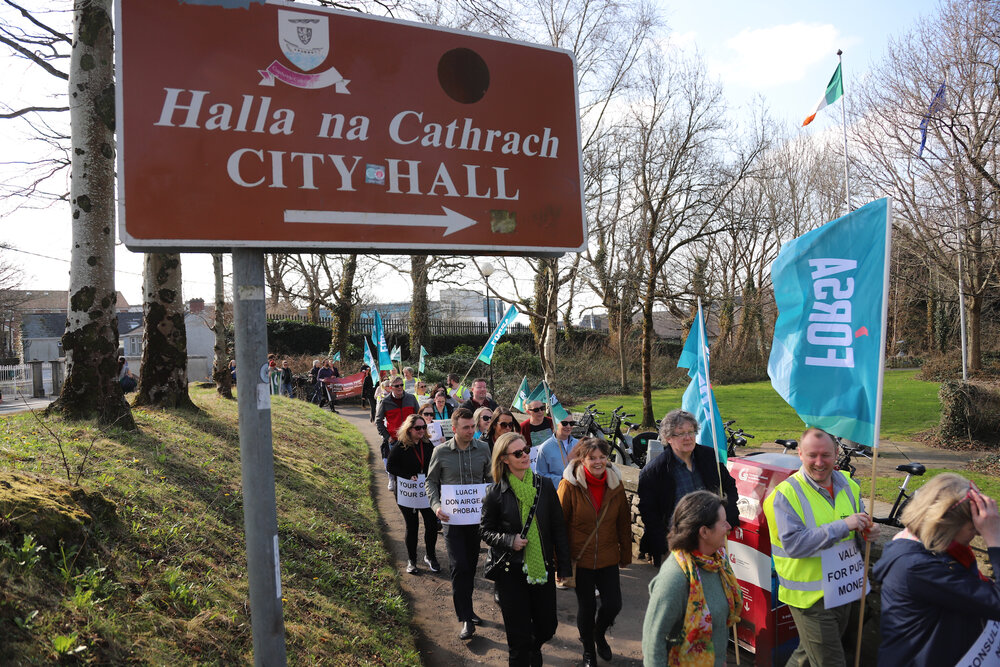
Members are concerned that they will not be able to serve the public properly and that services will be more difficult to access for many citizens if the Council proceeds with its decision to move out of Galway city to the proposed Crown Square site. Such a move will also add to traffic problems in the city and reduce footfall to local businesses in the city.
In a recent survey members voiced their concerns and criticised the lack of consultation with staff and other stakeholders about the move. Three quarters of the staff surveyed confirmed the move would make them consider applying for posts outside of the council.
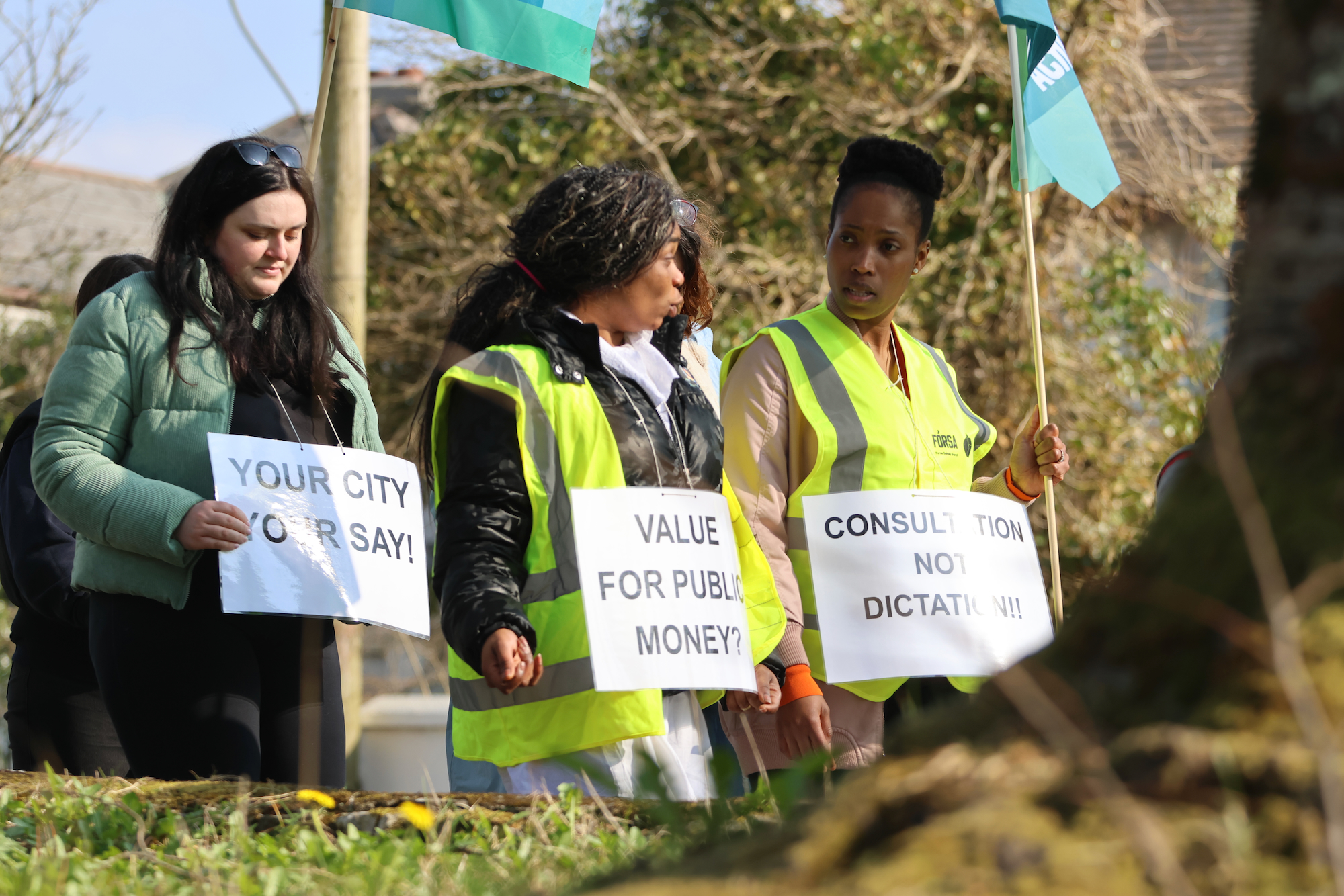
Speaking at the protest Fórsa official Padraig Mulligan commended the crowd for standing up for citizens. He said, “As public servants you get nothing out of this, you are standing with the people of Galway, with rate payers, and with businesses, saying no to the hollowing out of Galway city.”
Outlining the reasons why members care about this issue, branch secretary Adam Stoneman said: "As local authority workers we are proud to serve the people of Galway every day. The Council plays an important civic role in citizens’ lives, and its location has an impact on how people engage and relate to it. We want to stay close to the people and city we serve.”
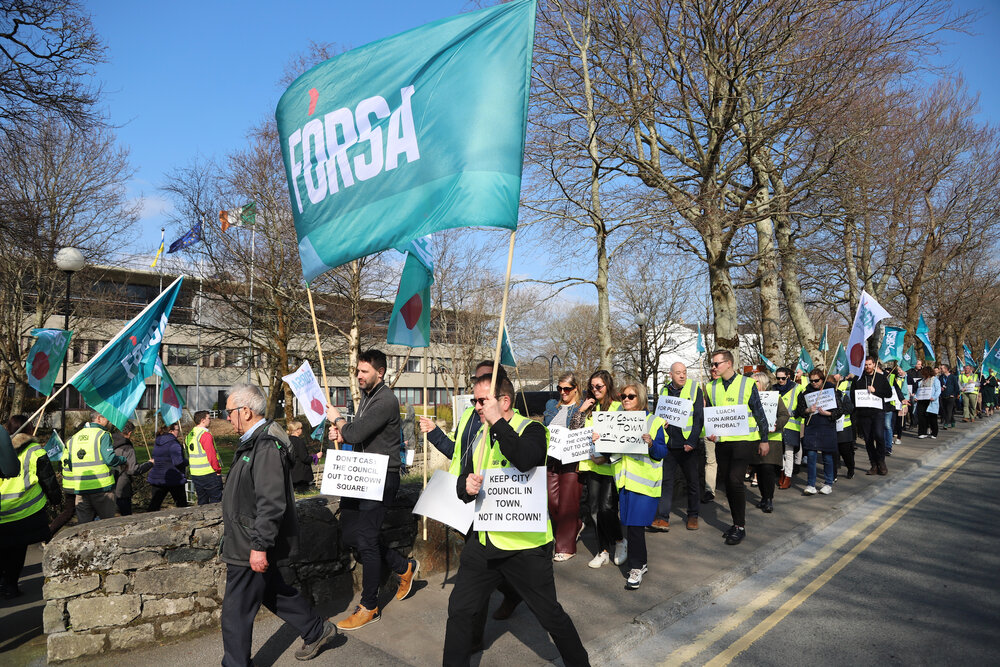
Padraig concluded “We’re really pleased with the support the public, local and national politicians and Galway media outlets have shown. We’ll keep fighting for our members and the public on this vital issue.”
Join a union that wins. Join Fórsa.
Caretakers! Join the push for pension parity in schools
by James Redmond
Fórsa will host a series of nationwide meetings - at 15 venues over the next month - with school caretakers and secretaries, as part of Fórsa's continuing campaign for pension parity.
We’re calling on school caretakers and secretaries across the country to join the fight for pension parity. To build momentum, Fórsa is launching a series of nationwide meetings which will take place over the next month, starting next week.
Seamus Ryan, an Industrial Officer in the education division, highlighted the growing strength of the movement:
“We’ve already held two hugely successful online meetings with school caretakers and secretaries. Now, we’re taking that momentum on the road with a whistle-stop tour, visiting fifteen venues across the country. These meetings are open to everyone—not just members—so we encourage you to invite every caretaker and secretary you know to get involved as success in this campaign will see life-long benefits, not just for peoples working lives, but for every day of their retirement.”
Andy Pike, head of Fórsa’s education division, summed up what was at stake:
“There is a deep historic wrong at play here. This campaign is about more than pensions and public sector status. We’re fighting for proper, fair, set rates of pay, a single contract of employment for all caretakers and secretaries, and access to decent sick leave, bereavement leave, and the same terms and conditions as teachers and SNAs.”
Seamus emphasized the importance of members stepping up and spreading the word in their workplaces:
“Start the conversation. Just go out there and talk to your colleagues—even those who aren’t union members. Don’t be afraid to bring it up. Non-members can also register for these meetings, and we’ll sign them up right there. This is how we grow our movement—by bringing new people in, sharing our fight, and uniting around our common goals. These meetings will lay the groundwork for that and look at how we can win together.”
The first meeting kicks off on Monday 24th March and runs until Thursday 17th April. A full list of dates and venues is available below.
The registration link is here.
|
|
|
|
|
|
|
|
|
|
|
|
|
|
|
|
|
|
|
|
|
|
|
|
|
|
|
|
|
|
|
|
|
|
|
|
|
|
|
|
|
|
|
|
|
|
|
Fórsa office Roxborough Road
|
|
|
|
|
|
|
The Bounty, Dunbarry Park
|
|
|
|
|
|
|
|
|
|
|
|
|
|
|
|
|
|
|
|
|
|
|
|
|
|
|
|
|
|
|
|
|
|
|
|
|
|
|
|
|
|
|
|
|
|
|
|
|
|
|
|
|
|
|
|
|
|
Join a union that wins. Join Fórsa.
Municipal members keep city shining during St.Patrick’s Festival
by Brendan Kinsella
Waste management members in Fórsa’s municipal employees’ division received well-earned recognition this week for their dedication during the St Patrick’s Festival. Working tirelessly from 6am on Friday to 6am on Tuesday, they kept the city clean and vibrant throughout the celebrations.
Dublin City Council (DCC) waste management workers were widely praised for their hard work over the St. Patrick’s weekend. They were the focus of articles on the Journal.ie and in the Irish Independent. Both papers described the enormous undertaking needed to keep the streets clean during the weekend’s festivities.
Over half a million additional visitors enjoyed atmosphere and activities in Dublin city centre over the course of this year’s St. Patrick’s Festival. An estimated 100k tourists visited the city for the festivities. DCC have come to view the St. Patrick’s Festival as an important advertisement for tourism, describing it as “an opportunity for Dublin to present itself as a destination of choice for tourists.”
Fórsa official Jay Power said “It might be the parade and all the events that bring people to the city, but it’s not going to be a great advertisement for Dublin city if the city is not kept to the highest standards. That’s where our members come in. It is great to see the members get the credit they deserve for maintaining the city to such a high standard when the eyes of the world are on Dublin city.”
Keeping Dublin clean over the weekend was a monumental undertaking. It required 442 workers working in rotating shifts from 6am on Friday to 6am on the following Tuesday.
Street cleaning was adjusted to a 24-hour service over this period. Footpaths were swept and road channels kept clean, 684 bins were continuously emptied, litter wardens patrolled the city, and a comprehensive wash programme took effect.
DCC estimates between 30 and 40 tonnes of litter was collected and removed from the heart of the city.
On parade day, streets had to be cleaned to Grade A standard before reopening to traffic. To ensure efficiency, the city centre was divided into four zones, with dedicated teams working swiftly to clear each section.
Mick Kieran, member of the municipal employee’s divisional executive committee said: “It’s a tough job but one we’re proud to do. Once the parade clears a zone the guards need to open it immediately. Our members treat it like any other day, get stuck in and make it happen.”
Join a union that wins. Join Fórsa.
Industrial action in the HSE begins next week
by Niall Shanahan and Hannah Deasy
Fórsa and the Irish Nurses and Midwives Organisation (INMO) served notice of industrial action to the HSE last week, marking an escalation in the dispute over the effect of the HSE’s ‘Pay and Numbers Strategy.’
Fórsa and the Irish Nurses and Midwives Organisation (INMO) served notice of industrial action to the HSE last week, marking an escalation in the dispute over the effect of the HSE’s ‘Pay and Numbers Strategy’ which imposed a fixed employment ceiling across all health services, in addition to suppressing all posts that were vacant on the 31st December 2023. The new ‘strategy’ also devolves responsibility for staffing decisions to each new Regional Executive Officer, with no oversight, or transparency in relation to staffing decisions. At no stage, were unions consulted in relation to these changes.
The two health unions served three weeks’ notice of the action and union members in both the HSE, and Section 38 voluntary hospitals have been instructed to engage in the action, commencing with a work-to-rule and other non-cooperation actions, from Monday 31st March. Other unions, including Connect and the MLSA, have also served notice of industrial action. Up to 70,000 health workers will be engaged in the action.
Fórsa’s head of health & welfare, Ashley Connolly, said: “The HSE has consistently refused to engage with us on the Pay and Numbers strategy.
“The people working in the health service aren’t just numbers. Without you there is no health service. You are advocating for the resources that are desperately needed to provide the services people desperately need. It’s time to show HSE management what happens when our members stop covering up the cracks in the HSE’s staffing strategy,” she remarked.
She added: “Ireland’s population is growing, and it is also an ageing population. These factors demand a more robust approach to health planning. An approach that doesn’t involve spending millions on management consultants, whose main advice appears to be the suppression of health posts that need to be filled.”
Fórsa national secretary Linda Kelly added: “Our members provide a vital public service – the healthcare that people need, when they need it. The crude imposition of employment restrictions does a lot of harm, adds to patient waiting times and delays treatment. This runs in total opposition to the values our members stand for on the delivery of care,” she said.
Read the union instruction here.
Join a union that wins. Join Fórsa.
Unions win pay deal for community and voluntary sector
by Niall Shanahan
A pay deal for workers in the community and voluntary sector was finalised last week at the Workplace Relations Commission. The proposed deal is intended to address the pay gap between workers in community and voluntary organisations and equivalent grades in public sector organisations.
Fórsa is to ballot its members in health service employments in the community and voluntary sector (Section 39, 56, and 10 organisations), on the terms of a pay deal finalised last week at the Workplace Relations Commission (WRC).
In a communication to members, Fórsa’s head of Health and Welfare, Ashley Connolly, said the new proposed pay agreement was achieved following months of ‘challenging’ negotiations, and that the terms build on the terms of the October 2023 agreement. The agreement comes after more than ten years of campaigning for better pay and conditions for workers in the community and voluntary sector.
The agreement acknowledges that the pay of some workers in the community and voluntary organisations has fallen behind equivalent grades in public sector organisations.
She added: “This agreement allows for future pay increases, and funding will be adjusted to allow for application of equivalent general round pay adjustments, as provided for in any successor agreements to the Public Service Agreement.
The issue of pay in the community and voluntary sector took on increased prominence during last year’s general election campaign however it has been a long running union campaign.
Ashley thanked members for their commitment to a long process, underlining that that the work of achieving the provisions in the pay agreement had been ongoing for close to ten years. She said: “Without your persistence we would not be where we are. This agreement will significantly increase pay in the sector now, and in the future.
“The community and voluntary sector is essential to the provision of vital public services, without which the most vulnerable people in our society would suffer hugely. Our members who work providing these services deserve fair pay,” she emphasised.
The union’s health & welfare divisional executive - comprised of senior elected workplace representatives - met last week and made the decision to issue a ballot with a recommendation to members for a vote in favour the terms of the new deal. Preparations for a ballot will get underway in the coming days.
Join a union that wins. Join Fórsa.
Fighting for a stronger EU Traineeship Directive
by Brendan Kinsella
An Irish Congress of Trade Union (ICTU) Youth Committee delegation met with the European Trade Union Confederation (ETUC) and a number of Irish MEPs to advocate for stronger protections for vulnerable young workers.
A delegation from the Irish Congress of Trade Union (ICTU) Youth Committee headed to Brussels earlier this month.
The ICTU Youth delegation consisted of Fórsa’s James Joy and Michael Kerrigan, along with the Electrical Services Union’s John Lawler, accompanied by Gerry McCormack, ICTU’s European Officer.
The delegation was joined by EPSU Youth Coordinator, Chloe Kenny. They met with the European Trade Union Confederation (ETUC) and a number of Irish MEPs to advocate for a strong Traineeship Directive.
The Traineeship Directive was proposed by the European Commission in March last year. It intends to improve and enforce decent working conditions for trainees while tackling disguised employment relationships that often occur when young people are working as trainees or interns.
On 3rd March the delegation met with ETUC General Secretary, Esther Lynch, and Tea Jarc, ETUC Confederal Secretary responsible for youth and employment policy, among other key areas.
The ETUC representatives highlighted what they see as the key challenges in the proposed Traineeship Directive and discussed strategies for young trade unionists to push for the strongest possible protections.
Speaking about the meeting, Fórsa’s Michael Kerrigan said, “We had a valuable conversation with the ETUC. They were very clear on their criticisms of the directive as it is now, and much of that matches with the realities faced by the young Irish workers we were there to represent.”
The ETUC has warned that the proposed Traineeship Directive will need to be strengthened to be effective. The directive as it stands could potentially leave many trainees without adequate protections, particularly if they are in unclear employment situations.
The ETUC is advocating for the directive to be improved by including clear standards on fair pay linked to minimum wage requirements, stronger action against abusive or fake traineeships, greater resources for labour inspectors to enforce rules effectively, and guarantees that the directive will not weaken existing national protections or create a new worker category that undermines trainees’ rights.
The following day the delegation met with Irish MEPs at the European Parliament to discuss the necessity of getting the Traineeship Directive right.
Aodhán Ó Ríordáin (Socialists and Democrats), Barry Cowen (Renew Europe), Cynthia Ní Mhurchú (Renew Europe), and Seán Kelly (European People’s Party) met the delegation in person. Three further MEPs were represented by members of their office staff, namely, Kathleen Funchion (The Left), Michael McNamara (Renew Europe), and Nina Carberry (EPP).
Michael Kerrigan said, “We were glad that the MEPs took time to meet with us. Their expressions of support for an ambitious Traineeship Directive are very much appreciated.”
He continued, “Now it’s about making it happen. Both the ICTU Youth Committee and the EPSU are looking forward to working with the ETUC and MEPs to ensure the traineeship directive will protect vulnerable workers.”
Join a union that wins. Join Fórsa.
Building power for ourselves: health workers in India win maternity benefits and better pay
by Mehak Dugal
A historic 45-day strike in Mumbai and sustained organising across India secured maternity rights and new benefits for Community Health Workers (CHWs), following a Public Services International (PSI) led programme in the region.
Recent feminist labour organising efforts in India have created ripple effects throughout the country’s broader community health workers’ workforce, demonstrating how strategic organising can amplify impact beyond direct participants.
A historic 45-day strike in Mumbai and sustained organising across India has secured maternity rights and new benefits for Community Health Workers (CHWs), following a Public Services International (PSI) led program in the region.
Increased organising among five unions since the pandemic has resulted in higher pay for members, regular payment of wages which were previously often delayed by months, and 6 months maternity leave for many more workers.
It has also led to a formalised work status and career path for workers that were often misclassified as ‘volunteers’ and significant growth in union membership.
Sumedha, a young Community Health Worker from the Mumbai union Mahanagar Karmachari Mahasangh (MMKM), said: "Earlier I thought unions were just for making demands. Now I understand we are building power for ourselves."
With an estimated 1 million Accredited Social Health Activists (ASHA workers) in India alone, and hundreds of thousands more CHWs across South Asia, these workers deliver healthcare to over 500 million people in disadvantaged communities.
Community Health Workers across South Asia have been campaigning for recognition as public health workers, entitled to fair and dignified working conditions. You can find out more about their campaign and support their efforts for recognition, rights, respect, care and for a well-funded public health system here.
CHWs hold a pivotal role in enhancing public health throughout South Asia, a region grappling with myriad health challenges, from infectious diseases to limited healthcare access. They bridge these gaps by delivering vital healthcare services to communities, imparting education, raising awareness, and advocating preventive health measures. Their significance is amplified in remote areas with scant formal healthcare infrastructure.
They are known as Accredited Social Health Activists (ASHAs) in India, Lady Health Workers in Pakistan, and Female Community Health Volunteers in Nepal. They serve as the initial point of contact during health emergencies.
Regrettably, this workforce, primarily composed of women from rural, socio-economically disadvantaged backgrounds, suffers due to gendered assumptions about their work. Their contributions are often undervalued, and they are poorly compensated. They perform their indispensable tasks without proper recognition as public health workers. In India, CHWs are denied the basic right to a minimum wage and lack essential social security benefits like pensions, medical coverage, and maternity leave.
The unions representing CHWs and PSI launched the campaign “Community Health Work is Work” in 2020 during the peak of COVID-19 pandemic. Even though CHWs were at the highest risk of contracting COVID-19 owing to their work, they were still denied health and life insurance and pensions.
The most powerful demonstration of the results of the campaign and the resulting organising capacity came in 2024, when CHWs from MMKM led a meticulously planned 45-day strike in Mumbai. It successfully transformed working conditions for thousands of health workers. Drawing on their organising training, CHWs developed and implemented a sophisticated two-phase approach. In the first phase, the workers ran a complete work stoppage across the whole city putting immediate pressure on the Brihanmumbai Municipal Corporation (BMC).
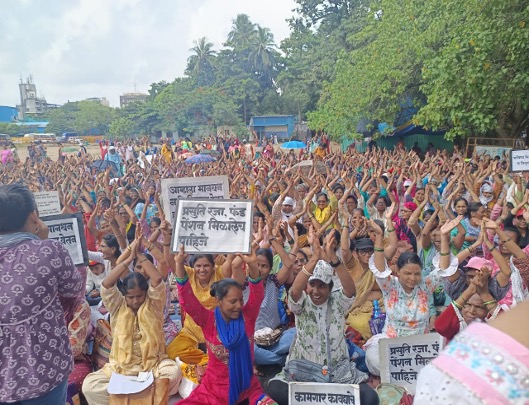
"Kaam Bandh" Movement (Work Stoppage): From 11-17 June 2024. Image from Public Services International
That was followed by a rotating protest system, from 18 June - 28 July 2024, to maintain essential services while keeping pressure on authorities. Each day, CHWs from different areas would participate in protests while their colleagues in other areas continued to provide critical healthcare services. This approach prevented authorities from dismissing the action as irresponsible or endangering public health, while ensuring that protest momentum could be sustained over the remarkable 45-day period.
What made this campaign particularly effective was its multi-pronged approach. The women CHWs leaders maintained detailed records of participation, with careful tracking of attendance from 24 different wards, held strategic meetings with various state ministers, municipal representatives and government officials, distributed demand letters to officials at multiple levels of government and engaged media to publicise their cause and the impact of the work stoppage.
After 45 days of sustained action, the CHWs secured significant victories and demonstrated the power of women-led organising, with planning, execution, and documentation led by the CHWs themselves.
Mumbai's success is part of a broader pattern of organising happening across India, with similar approaches being implemented by other unions across the country.
In each case, small groups of committed CHWs have built powerful movements and secured significant improvements through consistent organising, leadership development, and strategic action. As a result, women now also actively participate in union planning and leadership as well as hold visible positions in union leadership.
Public Services International stated that the most transformative aspect of this effort has been the shift to a "training the trainers" model, where CHWs themselves become educators and organisers. One health worker leader from Tamil Nadu said: "We are not just fighting for better wages. We are fighting for recognition that what we do is real work, skilled work, essential work. When we win, our communities win too."
Read more about this inspiring campaign here.
Join a union that wins. Join Fórsa.
|
|
|
|