A Better Deal campaign is ready to go to the next level
by James Redmond
With thousands of workplace conversations taking place across the country and a growing network of activists across the union, the campaign for ‘A Better Deal’ is now moving from base-building to mass participation - making it clear that public servants will not be passive spectators in the next round of pay bargaining.
Fórsa’s ‘A Better Deal’ campaign is preparing to move into its next phase, following months of intensive organising activity across workplaces in the civil and public service. Since late November 2025, union activists, workplace representatives and branch leaders have been laying the groundwork for the campaign with planning meetings and pilot programmes in select employments across the civil and public service.
The campaign has its roots in frustrations identified by members in the Amárach survey of last year, explained general secretary Kevin Callinan.
“The messages are coming in loud and clear from Fórsa members: the rising cost of living, an ongoing housing crisis, pressure on public services and growing threats to flexible and remote working have left workers stretched and frustrated. This campaign was established as a back-to-basics effort to continue to build workplace power and harness collective strength as we approach pay bargaining. The campaign begins with a simple but powerful pledge: members will only support a pay agreement that addresses the big issues in their lives.”
Over 7,000 organising conversations
According to deputy general secretary Katie Morgan, early results from the first phase of the campaign show significant engagement right across the union’s structures.
“So far, activists have held more than 7,000 one-to-one conversations about the campaign for ‘A Better Deal’ across almost 500 pilot workplaces, leading to over 7,000 civil and public service workers pledging support for a better deal.”
“These conversations have taken place across 95 Fórsa branches, involving 631 workplace representatives and campaign champions, and covering 120 employers. This grassroots organising has launched the campaign through member-led enthusiasm and energy, which will continue to build as we now move to the next stage, by expanding the campaign to all members covered by the public service agreement.”
There are now almost 2,000 workplace representatives in civil and public service employments who have stepped up to help lead the campaign locally.
The preparation for the campaign has also strengthened the union’s organising infrastructure. Katie says that significant work has been done behind the scenes to improve the union’s data and communication systems.
“That involved mapping and tagging our workplace representatives on our membership system. In total, the union has close to 2,500 workplace reps, with almost 2,000 working in the civil and public service - reps are the absolute backbone of the union. These are the people on the ground who work hard for the collective interests of the members and link the workplace to the broader union structures. They are key to the campaign for ‘A Better Deal’,” explained Katie.
Next phase
The campaign will now move into phase two, where the pledge for ‘A Better Deal’ will be open to all members and potential members covered by the public service pay agreement. From next week, these members will be asked to sign the pledge – and will receive the link directly.
Activists and workplace leaders will also begin a coordinated rollout of campaign materials and briefings. Online briefings for any member who is interested in finding out more about the campaign will start in late March, in addition to local workplace briefings and events.
A new campaign toolkit will be made available to workplace activists. The toolkit will include a leaflet with a QR code linking directly to the pledge, workplace posters, FAQs and other digital resources.
Well on the way to 100,000
The campaign is taking place against a backdrop of strong membership growth for the union. Fórsa recorded 96,924 members at the end of 2025, a net increase of more than 17,000 members since 2017.
The union has also dramatically improved the quality of its membership data.
Director of membership Seán McElhinney said: “We have now dramatically improved our overall accurate email coverage for members to over 96% in 2025. Furthermore, because of widespread mapping, we have also improved our workplace data and strengthened the foundations for organising in Fórsa workplaces and sectors.”
No more passivity
Seán said this momentum reflects the energy of activists and members across the organisation.
“We have been building towards an impressive ambition of 100,000 members. We’re building an organised collective that can fight for the common good and shape the world for the better on behalf of workers and communities everywhere. Isn’t that a mission worth signing up to?”
With thousands of workers pledging support for ‘A Better Deal’ and a growing network of activists across the union, Fórsa is now well positioned to move from base-building to mass participation, making it clear that public servants will play an active role in the next round of bargaining.
Join a union that wins. Join Fórsa.
 |
|
Staff safety warnings force pause on Oberstown capacity increase
by Hannah Deasy
The Minister has confirmed that the number of young people referred to Oberstown Children’s Detention Campus will not increase for now, following ongoing safety concerns raised by staff.
In a letter to Fórsa, Minister Norma Foley TD, Minister for Children, Disability and Equality, has confirmed that there will be no increase in the maximum number of referrals that can be made to Oberstown Children’s Detention Campus at this time, and that a review of capacity will take place later this year. Fórsa has requested full involvement in the review.
Staff have consistently raised concerns about serious security challenges at the facility due to short staffing. Last summer, the issues came to a head when a series of violent incidents took place. Nine staff were injured with some requiring hospitalisation, and one staff member sustaining ‘life-altering injuries’. At the time, Fórsa called on the Minister to address the short staffing and capacity challenges as quickly as possible.
Fórsa official Deirdre O’Connell Hopkins said: “It is very welcome that the Minister has finally acknowledged there are challenges at Oberstown. That’s thanks to the commitment of Fórsa members who have persistently sounded the alarm about the very serious risks to staff and young people in Oberstown.”
“Our members are willing to do what is required to make the campus as safe as practically possible, even if that means taking industrial action.”
Join a union that wins. Join Fórsa.
Remote working protections take centre stage
by Niall Shanahan and James Redmond
Deputy general secretary Éamonn Donnelly put the focus on remote work at yesterday's IRN conference in Croke Park, highlighting the necessity to collectively bargain toward a better way of establishing remote and hybrid working arrangements.
Fórsa deputy general secretary Éamonn Donnelly highlighted the importance of protecting flexible working arrangements during IRN's (Industrial Relations News) annual conference event, which took place in Croke Park yesterday (Thursday 12th March).
Speaking on a panel alongside legal and employment experts, Éamonn stressed that safeguarding hybrid and remote arrangements remains a key priority for the union in collective negotiations.
He criticised the right-to-request aspect of the Work & Life Balance Act, and rejected any proposal that the problem with the legislation is a lack of awareness among workers: "The legislation, as it is composed, is a lame duck. Those who've been through the process of appealing a decision can see that there's no teeth, everything is too reliant on procedure."
Holistic
Éamonn said a distinction was needed between relying on the legislative framework and collective bargaining coverage: "Because we're better off getting into the space where we collectively bargain to get the best working model, in a holistic sense. The contract between the employer and employee means you have to get the job done, so what are you looking for in a blended working model?
"What is the benefit, or otherwise, of blended working to the employer in terms of productivity? To the worker? To the environment? To mental health and wellbeing? What is the benefit or otherwise in terms of childcare and care of the elderly?"
He went on to highlight that infrastructural deficits in childcare and healthcare are factors that drive demand for remote and hybrid working opportunities.
He also outlined the value of utilising remote working arrangements to ease the growing problem of traffic congestion in towns and cities, and maximising the benefits for workers and employers alike: "It has got to the point where people are losing hours of their the day. Take the two hours somebody spends in a traffic jam on the M50. Zero productivity, and then you need to ask if you can you be the best version of yourself at work, if you have navigated that on the way in."
“What we need to do is break down the barriers of suspicion on remote work, connect the socio-economic factors and accept it's a systemic part of people's lives now," he said.
Also speaking at the IRN conference, Alison Hodgson of the Chartered Institute of Personnel and Development (CIPD), said the housing crisis is continuing to shape the labour market, affecting hiring and driving demand for hybrid and remote work.
A recent employer survey revealed a total of 61% of employers in the private and commercial semi-state sectors reported that the housing crisis is affecting recruitment, while 73% said it is fuelling demand for remote working.
Talks
Earlier this week Fórsa general secretary Kevin Callinan reinforced that stronger protections for remote and hybrid working will also be central to the next round of public service pay talks. With the current pay deal expiring at the end of June, Fórsa is pushing for clear commitments on flexible arrangements.
Speaking to the Irish Independent, Kevin said: “There is a clear need for certainty around hybrid and remote working. Legislative measures alone are not sufficient. Remote working must be addressed directly within a collective agreement to protect public service staff.”
He also highlighted the wider benefits of remote working, from supporting family and caring responsibilities to positive impacts on communities and the environment.
Almost one million people in Ireland now work remotely at least part of the week, making protections a key issue for the union.
Kevin added that Fórsa will continue to press for pay increases that address cost-of-living pressures, losses against inflation, and outstanding local bargaining agreements, stressing that any new deal must offer fair pay and conditions to ensure the public service remains a “beacon” for standards across the economy.
Survey
Fórsa launched a nationwide survey of members on remote and hybrid working in February, as debates over the future of workplace flexibility continue to make headlines and become prominent across the public sector.
The union says that understanding the full range of working experiences—including barriers to flexibility—is essential if it is to negotiate effectively. That's why the survey has been designed to build a detailed, evidence-based picture of how members are currently working, how those arrangements affect their lives, and what protections they want secured in future negotiations.
The survey is open to all members, including those who do not currently have access to remote or hybrid arrangements, it closes at midnight this Sunday 15th March, and can be completed here.
Join a union that wins. Join Fórsa.
Last chance to take part in our survey on working arrangements
by Hannah Deasy
Whether you have access to remote work or not – take part in this survey and inform our campaign to retain the benefits of remote and hybrid work.
Our nationwide survey of members on working arrangements closes in two days – at midnight on Sunday 15th March. Take part here.
The survey is designed to build a detailed, evidence-based picture of how members are currently working, how those arrangements affect their lives, and what protections they want secured in future negotiations.
The survey is open to all members, including those who do not currently have access to remote or hybrid arrangements. Director of campaigns Kevin Donoghue explained: “Understanding the full range of working experiences, including working preferences, is essential if we are to negotiate effectively.
Union research conducted last year found that more than half of respondents considered remote working to be as important as pay. All of this has strengthened the union’s determination to treat flexibility as a core workplace issue rather than a peripheral or accidental benefit.
Employers across the public service have been reviewing attendance policies over the past year, with some departments tightening in-office requirements. This has led to growing concern among members about the long-term security of hybrid arrangements.
The survey, which is being conducted independently by Amárach Research on behalf of Fórsa, will gather data on current working patterns, commuting times, productivity, wellbeing, and members’ preferences for future organisation of work.
Participation is voluntary, and the union has stressed that all responses will be anonymous and confidential, with findings reported only in aggregate form.
With negotiations on the next public service agreement looming, the outcome of the survey is likely to shape how forcefully remote and hybrid working feature in the union’s demands.
The survey closes on Sunday 15th March, and members are being encouraged to complete it as soon as possible.
Join a union that wins. Join Fórsa.
Proposals for final FEMPI unwinding brought to Cabinet
by Niall Shanahan
The Government is set to remove the final elements of the Financial Emergency Measures in the Public Interest (FEMPI) legislation, completing the long-running process of unwinding crisis-era pay restrictions on public.
The Government sought Cabinet approval this week for legislation that will finally repeal the remaining provisions of the Financial Emergency Measures in the Public Interest (FEMPI) Acts, the controversial laws that cut public service pay and pensions during the financial crisis.
It was reported this week that Public Expenditure Minister Jack Chambers proposed to Cabinet to remove the last elements of the emergency legislation, which were introduced between 2009 and 2015 as the State grappled with recession and fiscal pressures.
The move fulfils a commitment contained in the current public service pay agreement, which runs until June. FEMPI measures have been unwound in stages since 2015, with the final repeal expected to transition public service pay arrangements onto a normal statutory footing.
In an interview this week with the Irish Independent, Fórsa general secretary Kevin Callinan said former minister Paschal Donohoe had publicly agreed to a final unwinding of the legislation before talks on the current pay agreement began, but added there had been a “total absence of seriousness” to finish the job.
Fórsa and other public service unions had sought the final unwinding of all FEMPI because the legislation was seen as an inhibitor to fully resolving issues already subject to localised agreement, placing additional pressure on the state’s industrial relations processes.
Getting rid of what remains of FEMPI will allow industrial relations to return to pre-recession norms and should enable public bodies to exercise more autonomy on pay and local bargaining issues.
The Government says the legislation will avoid fragmentation in pay structures and strengthen financial oversight, while marking the symbolic end of the emergency framework that governed public service pay for almost 17 years.
Responding to the development, Fórsa deputy general secretary Éamonn Donnelly said the repeal was overdue: “Ending the remaining FEMPI provisions is the right thing to do and a necessary step, which is why we pursued this final unwinding as we negotiated the current public sector pay agreement.”
“Public servants have waited far too long for the final removal of this emergency legislation that was introduced during the depths of the financial crisis. While we welcome the Government’s move now, it should not have taken this long to complete the process,” he said.
Join a union that wins. Join Fórsa.
Let them play! Help us fill a container for GAA Palestine
by Mehak Dugal
We have just three weeks to pack a 20 foot container with GAA equipment for kids in the West Bank. Nerney’s Court is taking drop offs.
Fórsa is extremely proud to support the ‘Let Them Play’ campaign, a nationwide drive to get vital GAA equipment to children and volunteer coaches in five clubs in the West Bank.
For the next three weeks, our Dublin office (Nerney’s Court, D01 R2C5) will serve as an official drop-off point for donations for the GAA Palestine nationwide drive.
A 20ft container has been secured by GAA Palestine in Athy, Co. Kildare. We now need your help to fill it to the brim before it sets off for Palestine.
Fórsa national secretary Richy Carrothers said: “We’re so proud to stand with the volunteers of GAA Palestine who are working to make sure children in the West Bank have the chance to play.”
“Earlier efforts to send equipment were turned back, which was a huge setback, but that has only strengthened the determination of everyone involved to get this over the line this time. By donating equipment, our members and communities can help send a message of solidarity and hope. These efforts are about showing young people that even in the most difficult circumstances, they are not forgotten.”
We’re asking members, branches and activists to donate new GAA equipment, including:
- Hurls
- Helmets
- Sliotars
- Gumshields
- Training gear
- Kids’ kits and club gear
If you’re unsure what to donate, or would prefer to make a financial contribution instead, you can contact GAA Palestine here.
Please spread the word in your branch, your club and your community and help us make sure that children in Palestine get the chance to play.
Starting from today, members can drop donations to the Fórsa Dublin office right up until Tuesday, 31st March. Please note, our office reception is open from 8.30am-8pm Monday to Friday, and 9am-5pm Saturday, to collect the donations.
Lig dóibh imirt.
Join a union that wins. Join Fórsa.
Congress calls on Government to stand up for pay transparency
by Hannah Deasy
Ahead of International Women's Day last week, the Irish Congress of Trade Unions (ICTU) called on government to stand firm against employer efforts to stall EU pay transparency rules becoming law.
Last week the Irish Congress of Trade Unions issued an appeal to Government ahead of International Women’s Day, to stand firm against employer lobbying to delay the June deadline for new EU pay transparency rules becoming law.
Adopted in 2023, the EU Pay Transparency Directive is intended to reduce the gender pay gap. Fifty years after equal pay became a legal right, women working in the Irish labour market today earn around 90 cents for every euro men earn for each hour worked on average.
Under the new laws, employers must start providing pay details to job applicants, and interviewers must stop asking about pay history. Employers will no longer be able to stop their staff talking to each other about their pay and employees can request information on how their pay compares to the average paid to colleagues doing the same work or work of equal value.
In its statement, ICTU called out recent reports of concerted lobbying efforts by employer representatives to push out the June deadline for pay transparency.
ICTU president Phil Ní Sheadghda and general secretary Owen Reidy have written to Minister for Equality, Norma Foley, warning the Government must stand firm.
Phil Ní Sheadghda said: “Eleventh hour lobbying from employer representatives should not be allowed to frustrate this important piece of employment equality legislation. Businesses have had years to prepare for this. Government needs to get on with legislating for pay transparency, or risk fines from Europe and the ire of 1.27 million female employees”.
Fórsa deputy general secretary and ICTU vice president Katie Morgan said: “This legislation is badly needed. While public servants can benefit from pay scales, many workers cannot. Lack of pay transparency entrenches gender inequality and leads to women earning less over their lifetimes than men. It’s time to stop prevaricating and implement this vital legislation.”
Listen back to ICTU Policy Officer Laura Bambrick and Ibec’s Maeve McElwee on RTE Radio One’s Drivetime Should pay transparency rules be delayed? - Drivetime
Join a union that wins. Join Fórsa.
Intergenerational solidarity booming at packed Retired Members Association AGM
AGM marks the latest highpoint for the Retired Members Association as a strong turnout reflects growing membership and participation.
Fórsa’s Retired Members’ Association (RMA) held its Annual General Meeting (AGM) on Thursday 5th March in a packed Nerney’s Court, with more than 80 retired members participating both in person and online. The strong turnout reflected the growing momentum behind the RMA and set the tone for a lively and optimistic gathering.
From the outset, the atmosphere was warm, energetic and forward-looking. Members heard a wide-ranging series of reports from staff, activists and national officers, all of which highlighted the remarkable growth and renewal taking place within the RMA. Both Fórsa president Martin Walsh and treasurer Michael Smyth spoke about the positive transformation of the RMA in recent years and the renewed sense of purpose among retired members.
A new officer team was elected at the meeting, with Martin Bridgman returned as chairperson, Betty Tyrrell Collard elected as secretary and Gerry Monaghan taking on the role of treasurer. The officers will be supported by a newly established group of RMA ambassadors, who will play a key role in developing social events and initiatives throughout the year, strengthening connections between members and encouraging participation across the country.
In his address, Martin Walsh emphasised the importance of staying connected with retired members and ensuring that the RMA is an active, inclusive and welcoming space. He noted the exceptional growth of the RMA, with membership more than doubling in recent years, growing from approximately 500 members to over 1,300 today. This growth, he said, demonstrates the continued value of union membership well beyond working life.
Members were also informed that work will begin on developing a formal constitution and set of rules for the RMA. This work will be undertaken by the RMA officers in advance of the next AGM and will help to underpin the association’s future development.
Looking ahead, the RMA confirmed plans for a major conference in October, which will be held in Dublin. Further details will be shared in the coming months.
The year ahead also promises a rich programme of activities, including the launch of Fórsa’s first-ever formal Irish language class later this month, participation in Dublin’s May Day rally, a summer walk through Lough Boora Discovery Park, and a series of coffee mornings and mini-socials designed to keep members engaged and connected.
Addressing the group, membership development officer, Claudia Jennings, spoke about the unique role of the RMA within the union, describing it as a vibrant and welcoming space where retired union members can continue to enjoy the benefits of union membership and remain an active voice for retired workers.
Fórsa’s director of membership Seán McElhinney also praised the commitment of RMA activists, highlighting the importance that intergenerational solidarity has in the trade union movement and welcoming the new committee.
He said: “Our activists are the beating heart of our union, and seeing members stay engaged after they retire underlines how much being part of their union means to people. It’s a lifelong commitment based on shared values. By staying involved after retirement, members’ experience and skills can continue to build our union’s strength. That benefits us all.”
For more information on the activities outlined in this article or any questions you might have, please contact retiredmembers@forsa.ie.
Join a union that wins. Join Fórsa.
|
|
A fond farewell to Frank O’Donnell
by Brendan Kinsella
Remembering our cherished colleague, and dear friend.
With heavy hearts, we announce the passing of Frank O’Donnell, cherished colleague and dear friend of many who have worked in, and passed through the doors of, Nerney’s Court.
Frank passed away peacefully, surrounded by his loving family, this Monday 9th March, in the care of the staff of Beaumont Lodge Nursing Home.
He is remembered by his IMPACT and Fórsa family of staff and members as a gentleman, a colleague, and a friend to each and every one who worked in Nerney’s Court, and to the many more who regularly visited.
In recent days he has been described as “a gentle soul”, “one of a kind”, and “a great rebel”. General secretary Kevin Callinan remembers Frank as “the heart of our union building for many years” and “a good friend and a loyal colleague.”
Frank was known for his kindness, his easy social graces, and how he took genuine care for the well-being of others.
Senior PA Margaret Jackson, worked closely with Frank for many years. She remembers him as a dear friend and a “one in a million” who was “loved and treasured by all of us in his IMPACT family.” For Margaret, it was a great privilege to work with Frank, and “an honour to have had him as a true friend for many years.”
Frank was a hard worker who earned a reputation for being totally reliable, with nothing ever being too much trouble for him. Deputy general secretary Éamonn Donnelly fondly remembers Frank’s “warm, soft human nature” and recalled that he was not without his own “understated brand of acerbic wit.”
Frank loved working for IMPACT. Former IMPACT general secretary Peter McLoone said: “Frank was highly respected, and his contribution was much appreciated by members, and especially those who worked with him - the word 'cannot' never arose whenever you asked Frank if he could do something, it was done quietly and efficiently, without fuss.”
Frank was proof that the work of a union isn’t all pay deals and placards. Sometimes it’s the quiet graft done away from the spotlight that doesn’t make it into annual reports and newspaper headlines.
He was loved by his colleagues and loved them in return. Éamonn Donnelly remembers that Frank continued to participate in almost every staff social club event long after his retirement.
For Éamonn, Frank showed how much he loved being around his colleagues through his regular participation in these events and remembers how “his presence illuminated all of us” at each event.
His absence will be felt keenly by friends and colleagues at social club events this year.
Frank’s funeral was well attended by friends and colleagues. The sun shone brightly as he was laid to rest in Glasnevin Cemetery on the afternoon of Wednesday 11th March.
On behalf of all those who work and have worked in Nerney’s Court, we send our deepest sympathies to Simon who has lost a beloved brother, Aoife who has lost an incredible uncle, Bríd who has lost an irreplaceable friend, and to all friends, colleagues, and neighbours who feel Frank’s loss.
To Frank, we echo Kevin Callinan’s words: “Farewell Frank and thanks for everything. Suaimhneas síoraí ort”.
If you knew Frank and wish to leave his family a message of condolence, the online condolence book can be found here on rip.ie.
Join a union that wins. Join Fórsa.
Ideas of March
by Brendan Kinsella
Training opportunities in March and April.
There is a lot on offer this March-April from the Skills Academy. Applications are now open for a wide variety of courses from Communications Training to Industrial Conflict Resolution, to Public Speaking, and more. There is a course available for every need!
If you see anything that interests you, you can email your branch training officer or the Skills Academy for more information.
Level 1, WRT – Tuesday 24th – Thursday 26th March – Wexford Union Office
There are only a few places left on the Workplace Representatives Training taking place in Wexford this March. An opportunity not to be missed for workplace reps in the south-east of the country to learn everything you need to know on how to not only fulfil your role as rep but prosper.
Designed for reps with no previous experience or training, the course will take place over three days. The only prerequisite for taking this course is that you are a workplace rep and have previously taken the Fórsa Induction module.
Over the three days you will learn all the basic skills that you will need as a representative in your first year, including:
- the role and function of the workplace rep
- improving interpersonal skills and building good working relationships
- organising your union work
- recruiting members and handling problems
- an introduction to equality and diversity
- health and safety.
Live: Lunch & Learn – Staying Safe Online - Online - 1-2pm Friday 27th March
The dangers of the online world are ever evolving but being aware and up to date can go a long way to keeping you safe online. Guest speakers Kate O'Sullivan, Fórsa’s Director of Digital and Martina O'Leary, Fórsa Data Protection Officer, will take you through what is out there, and what you can do to stay safe in your personal life and as a worker.
Learn your legal obligations as a worker and how to fulfil them, as well as how to stay safe in your personal internet use. If you have any questions about online safety this is an unmissable opportunity to have them answered.
To register for Live: Lunch & Learn click here.
Communications Training – Tuesday 31st March – Woodford Office, Santry, Dublin
Time is running out to take part in the last session of communications training for branch officers this academic year. Don’t miss your chance to learn the most effective tools for keeping your members informed, engaged, and active.
Time Management – Tuesday14th April - Nerney’s Court, Dublin
For members who are juggling and struggling, trying, but unable, to fit everything into the day. This session will teach you all the ways to take control of your day and avoid the stress of looming deadlines.
Public Speaking – Tuesday14th April - Nerney’s Court, Dublin
Speaking at the Biennial Conference is a daunting task even for the most seasoned of speakers. With this in mind, the Skills Academy has prepared a special season of Public Speaking training geared towards delegates who will be delivering motions this May.
Learn how to handle those pre-stage jitters, speak clearly and confidently, and make the best of your time in the bright lights of the INEC in Killarney, with a little help from Skills Academy.
Industrial Conflict Resolution (Level 2) – Wednesday 15th April – Nerney’s Court, Dublin
The next step in our IR training for members who have previously attended the Building Effective Local IR Practices (Level 1) course with Brendan Cunningham. As there is a bespoke version of this course for members in the Civil Service division, this course is not open to members of that division.
Learn how to maintain positive working relationships without shying away from conflict and how to use conflict as an opportunity for positive change.
Branch Training Officers Seminar - Wednesday 15th April – Nerney’s Court, Dublin
Learn more about the role and meet with other training officers to discuss tips and tricks on how best to use training to benefit your branch. A fantastic opportunity open to branch training officers, and BEC members covering training officer duties.
Resilience Building Workshop – Tuesday 21st April – Nerney’s Court, Dublin
Learn how to weather whatever life throws at you. Build your resilience by enhancing emotional intelligence and awareness of others; and learning how to manage stress.
To register for a course:
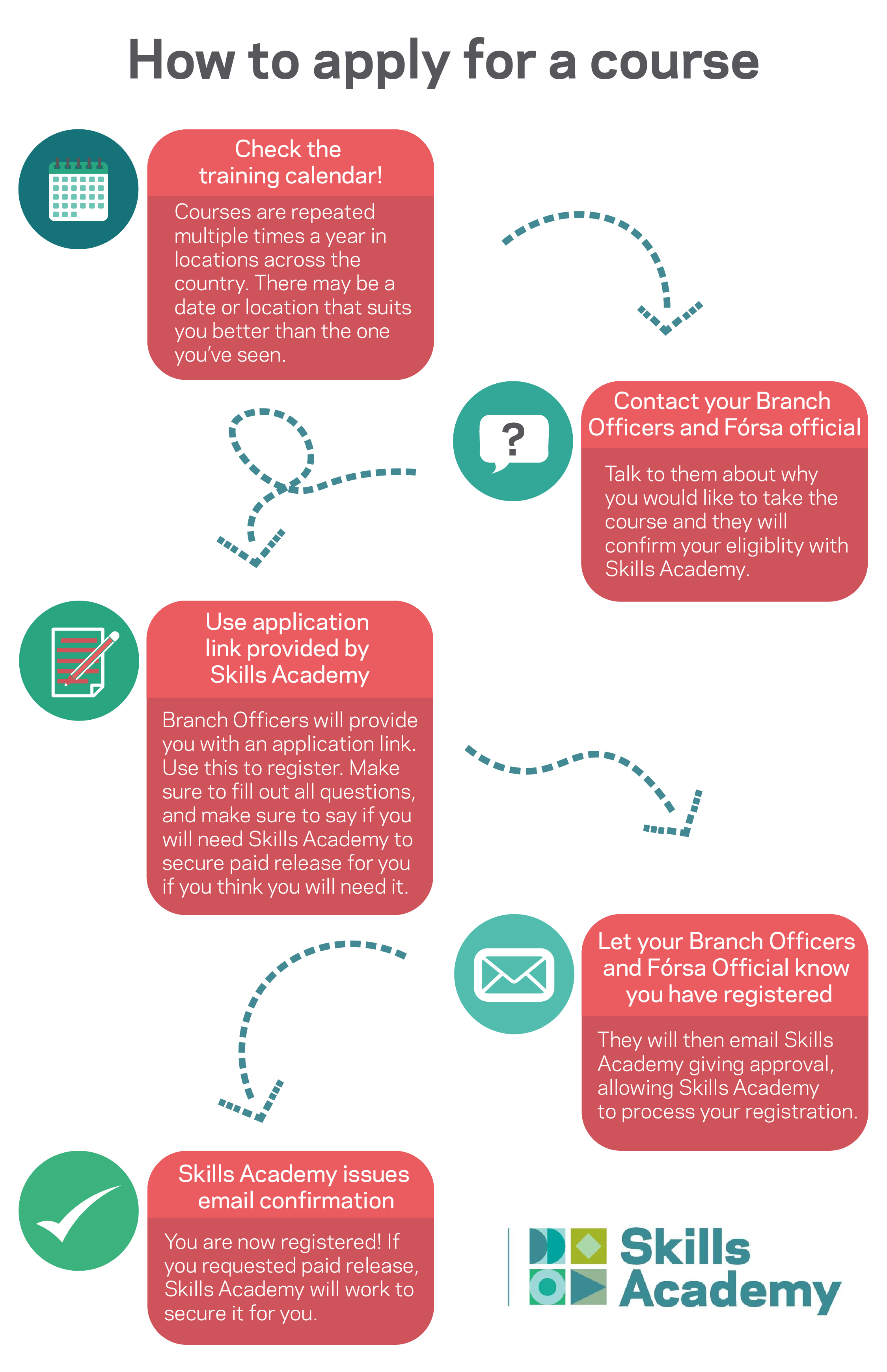
Aside from Live: Lunch & Learn and Fórsa inductions, participation on all courses requires sign-off from your branch and official. To apply, get in contact with your branch training officer or if your branch does not yet have one, contact your branch secretary.
Join a union that wins. Join Fórsa.
RMA launch Irish language refresher course
Online course available to members of the Retired Members Association.
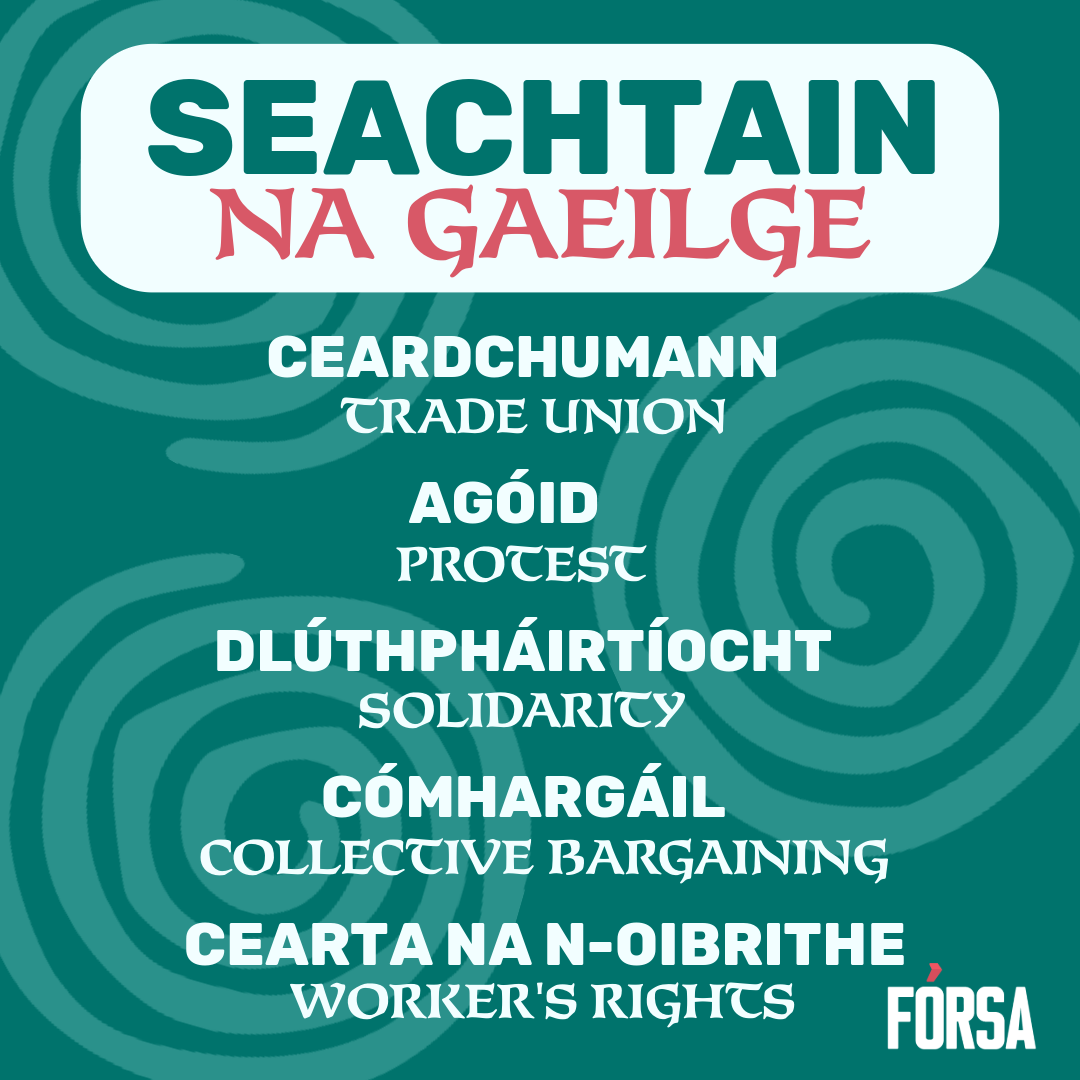
Sa Seachtain na Gaeilge seo, beidh Fórsa RMA ag obair le Conradh na Gaeilge chun ranganna Gaeilge a chur ar fáil don chéad uair dá bhaill.
Tosóidh siad le ranganna ar an leibhéal ‘Bonnrang’ atá dírithe ar dhaoine a bhfuil beagán Gaeilge acu, de ghnáth ón scoil, agus atá ag iarraidh cúrsa athnuachana bunúsach a dhéanamh chun an Ghaeilge a athfhoghlaim agus a athneartú.
Mairfidh an cúrsa seo sé seachtaine, le rang uair a chloig gach seachtain (14ú Aibreán – 19ú Bealtaine).
Leanann Conradh na Gaeilge curaclam TEG ina ranganna. Is ea TEG an chéad chóras teastasaithe do fhoghlaimeoirí fásta Gaeilge, agus díríonn na ranganna ar leibhéil éagsúla TEG.
Is féidir le baill ar spéis leo ranganna Gaeilge, ach nach bhfuill cinnte faoina leibhéal Gaeilge, triail a bhaint as an quiz ar líne seo ó TEG chun léargas ginearálta a fháil faoina gcuid scileanna Gaeilge.
Is féidir leis na baill ar scor a bhfuil an féinmheasúnú TEG críochnaithe acu agus a mhothaíonn go bhfuil an leibhéal athnuachana ceart dóibh, a gcuid sonraí a chur isteach ag baint úsáide as an bhfoirm seo: RMA Irish Language Refresher Course (Online) - April, May 2026 - Expression of Interest – Fill out form
Le haghaidh aon cheist faoi na ranganna, déan teagmháil le do thóil le retiredmembers@forsa.ie.
This Seachtain na Gaeilge, the Fórsa Retired Members’ Association will be working with Conradh na Gaeilge to offer Irish language classes to RMA members for the first time.
These will begin with 'refresher' classes aimed at those who have some Irish, mainly learned in school, who are looking for a basic course to relearn and reinforce their skills. The first course will consist of 6 weeks of one-hour classes (running from Tuesday 14 April to Tuesday 19 May).
Conradh na Gaeilge follow the TEG curriculum in their classes. TEG is the first and only system of certification for adult learners of Irish, and their classes are structured to focus on specific TEG levels.
Members who are interested in Irish language classes, but aren't sure of their level of Irish, can try the online TEG self-assessment quiz to get an idea of their current Irish-language skills.
Retired members who have completed the TEG self-assessment, and feel the refresher level is right for them, can submit their details using this form: RMA Irish Language Refresher Course (Online) - April, May 2026 - Expression of Interest – Fill out form
For any questions about the classes, please contact retiredmembers@forsa.ie.
Join a union that wins. Join Fórsa.
|
|
|
|