This week the Migrant Rights Centre Ireland (MRCI) launched a landmark survey of over 1,000 employment permit holders, exposing systemic and widespread exploitation of migrant workers across Ireland.
The findings paint a deeply troubling picture where workers are routinely underpaid, overworked, harassed and denied basic rights, with many feeling powerless to speak out due to their dependency on a single employer for both their income and immigration status.
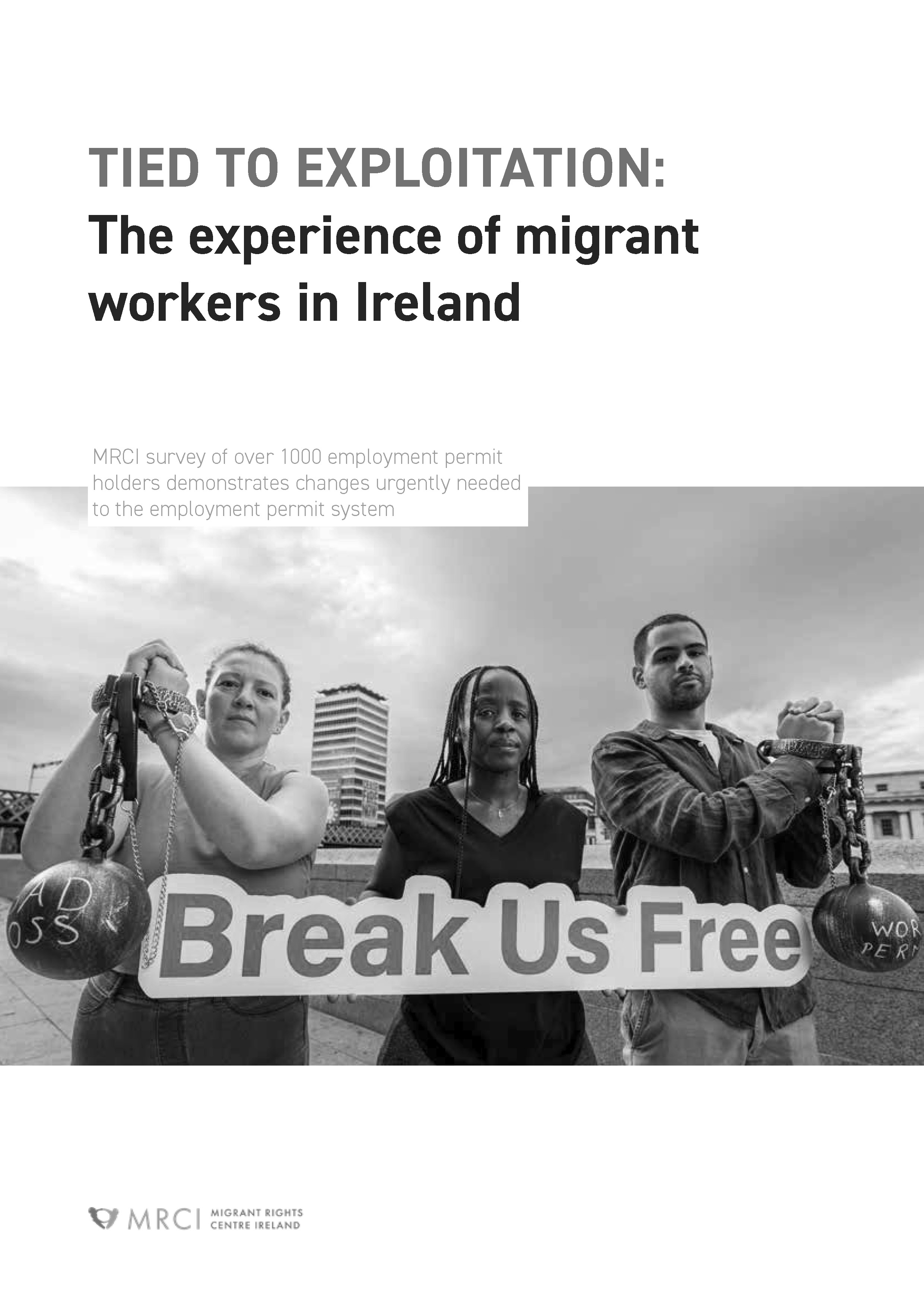
The report, Tied to Exploitation: The Experience of Migrant Workers in Ireland sets out the stark reality facing workers on general employment permits.
These survey results were also highlighted in this week’s RTÉ news article that outlined the case of severe exploitation of a worker, Sam, who came to Ireland six years ago on a general employment permit as a horticultural worker.
What he had hoped would be a turning point for his life soon turned sour. Sam said that in the two and a half years he worked for the company he only got two weeks holidays. "I was afraid to challenge the employer because I was tied to him through my work permit and there was nowhere else I could go," Sam said.
The survey covered 58 nationalities across all major employment sectors, including healthcare, hospitality, agriculture, transport and construction.
Exploitation was found across all job sectors and most nationalities surveyed. Healthcare assistants, the largest group, representing 45% of respondents, had a 78% exploitation rate. Female workers experienced higher rates of exploitation than male workers (76% vs 66%).
71% of general employment permit holders experienced exploitation in employment. 61% experienced severe exploitation – meaning repeated or multiple serious employment rights breaches.
Just over half of those who were exploited did not report it, primarily out of fear of losing their job or permit. The Migrant Rights Centre Ireland is calling on the Government to grant all employment permit holders the freedom to work in any job after two years, rather than the current five-year tie to a single employer, and to introduce a new criminal offence for severe exploitation.
In response to growing evidence of discrimination at work, the Irish Congress of Trade Unions Stronger Together: Anti-Racism Workplaces and Trade Unions project is working to combat racism and to illustrate the invaluable contributions made to Ireland’s workforce by migrant workers across the island.
The project investigates the prevalence and nature of workplace racism and the responses of trade unions across Ireland, and seeks to develop anti-racist trainings and strategies, to support workers from all backgrounds.
The project found that union members from minority ethnic and migrant backgrounds in Ireland and Northern Ireland frequently experience both direct and indirect racial discrimination, ranging from overt racism and racial slurs to subtle microaggressions and exclusionary practices.
In response, ICTU has designed a toolkit to familiarise trade union members at all levels of organising with the nature and impact of racial discrimination in the labour market and workplace, and support the development of strategies for anti-discrimination actions which can be accessed here.
Join a union that wins. Join Fórsa.





 Like
Like


