Fórsa's NEC recommends vote in favour of draft public service pay deal
by Niall Shanahan and Hannah Deasy
Draft agreement seeks to bolster members’ pay and living conditions, protect remote work, and future proof public service workforce in uncertain times.
Fórsa’s National Executive Committee (NEC) is recommending a vote in favour of the draft Public Service Agreement 2026-2029. Fórsa’s ballot opens next Monday 16th November, and closes at noon on Friday 4th December. The NEC agreed its recommendation at a special meeting on Wednesday (11th November), and suspended all planned industrial action, including the second national strike day and the ongoing work to rule.
Fórsa’s NEC is composed of union members, many of whom are working civil and public servants, elected to the executive to represent the members of Fórsa.
The proposed agreement, finalised at the Workplace Relations Commission (WRC) in the early hours of Wednesday morning, runs from 1st July 2026 to 31st March 2029, for a period of 33 months.
In addition to pay terms it contains provisions to protect workers amid technological change and resolve local bargaining claims.
In a message to members issued on Wednesdsay, general secretary Kevin Callinan underscored the key role of industrial action by members in reaching this point. He described the talks as difficult and underlined that the significant increases above Government’s initial offer would not have been achieved without the collective power demonstrated by members.
The agreement provides general pay increases of 9.75%, plus 1% through local bargaining, with minimum cash increases benefiting lower-paid workers, and a revised lower-paid threshold to determine those higher payments.
If members accept the agreement in the upcoming ballot, the following pay increases would apply to public service workers over its term:
- 1st September 2026: 2% or €1,200 (backdated), whichever is greater
- 1st April 2027: 1%
- 1st August 2027: 1% or €600, whichever is greater
- 1st November 2027: 1.5% or €900, whichever is greater
- 1st March 2028: 1%
- 1st June 2028: 1% or €600, whichever is greater
- 1st October 2028: 1%
- 1st March 2029: 1% local bargaining phase
- 2nd March 2029: 1.25% or €750, whichever is greater.
All industrial action related to the dispute was suspended on Wednesday, including Thursday’s planned strike and the work-to-rule action that had been ongoing for six weeks.
The proposed agreement also prioritises higher increases for lower paid workers, most of whom are younger workers. There are five instances in the lifetime of the agreement that will give lower paid workers higher increases. In addition, there has been an agreed increase in the threshold for the lower-pay provisions, from €50,000 to €60,000, which extends the reach of those protections, meaning many more workers will benefit.
Subject to acceptance, members would likely receive the backdated payments early in the new year.
Speaking to Matt Cooper on Today FM’s The Last Word on Wednesday evening, Fórsa general secretary Kevin Callinan said the minimum increases made the package significantly better for younger workers, those entering the public service and people on lower pay scales.
Kevin said members on picket lines had described rent and mortgage pressures, thoughts of emigration, and workloads intensified by rising demand and resourcing gaps. He said the union was conscious of public service workers who had said they had “nothing left to give”. Against that backdrop, he cautioned that acceptance would not necessarily be a landslide.
He called on the Government to use the agreement to address those pressures through meaningful dialogue and to “repair the relationship” with workers. He also highlighted its explicit commitment to no compulsory redundancies as the Government pursues its ambitions for more digitalisation of public services, particularly the use of artificial intelligence (AI).
He said the cost-of-living crisis had formed the backdrop to the negotiations. Inflation projections, including those from the unions’ advisers at the Nevin Economic Research Institute (NERI), pointed to cumulative inflation of between 7.5% and 8% over the agreement’s lifetime.
However, Kevin stressed that institutions, particularly the Central Bank, had cautioned about the possibility of an inflation spike. He said unions would keep inflation under review and could invoke the review clause if inflation moved significantly away from projections. For the first time ever the review clause is time limited, meaning that if either party triggers the clause, engagement must take place within six weeks.
All civil and public service Fórsa members will now have an opportunity to vote on the proposal. The ballot, which will take place online, will open on Monday 16th November, and run until Friday 4th December.
Members will receive a secure link and Unique Voter Code from Mi-Voice, an independent third party platform, which will allow them to vote.
The full agreement can be found here. An FAQ for members will be available in the coming days.
|
At a glance, what else is in the agreement?
by Hannah Deasy
While the majority of media focus on the agreement is on the pay terms, it also contains many other elements that will benefit workers and shape the public service in the years ahead.
Public service agreements typically contain provisions and commitments surrounding working conditions in the public service. The draft agreement reached this week is no different.
However, in advance of these negotiations, and indeed before the last deal expired in June, Fórsa made it clear that if there was to be a new agreement, its focus should be expanded beyond pay. Members emphasised that the need to maintain access to remote work, to protect jobs, and the need to safeguard public services all mattered. These issues continued to be raised throughout the six weeks of industrial action.
Speaking about the non-pay elements of the agreement, lead negotiator Kevin Callinan said: “There is a great deal in this agreement that paves the way forward on the key issues highlighted by members, but it won’t come as a surprise that the Government side fundamentally did not agree with us, and didn't want major issues relating to housing and investment in healthcare covered in an agreement.”
“Nonetheless we fought hard, and having the mandate from members who were on industrial action was hugely important. We were able to demonstrate just how important these issues are and how seriously impacted by the cost-of-living crisis people are. Now, this draft agreement changes the dial on the inclusion of non-pay matters in a very significant way.”
“Simply put, without the industrial action this would be a very different document. If we look back at the first two offers from the Government side, they were way off and totally failed to acknowledge the pressures people are under. Now, the pay terms being proposed go a lot further, and the non-pay terms are also significant.”
“The Introduction of the agreement explicitly acknowledges the concerns members highlighted during the industrial action, when they spoke out movingly on picket lines. That’s very different from previous agreements and really underlines the impact workers being vocal about their experiences had on this agreement.”
Remote work is here to stay
A key concern for workers was protection of flexible, hybrid and remote work.
The draft agreement explicitly recognises that the way in which we work has changed, and that remote and hybrid work is here to stay. It also acknowledges that remote work can support recruitment and retention, and that the State has a duty to lead the way on this issue. The agreement contains commitments to protect blended work and that established work practices cannot be changed without consultation.
Security in uncertain times
There is a review clause to protects workers from a spike in inflation, which is time limited, for the first time. The agreement also contains additional elements intended to improve industrial relations. There is a definition of ‘consultation’, and a chapter focused on ‘confidence building’ which outlines measures designed to restore trust in industrial relations.
No job losses due to AI
The introduction of AI across the workforce is already happening. This agreement contains, for the first time ever, a firm commitment that there will be no compulsory redundancies in the public service resulting from artificial intelligence.
A 150-million-euro training fund to upskill workers is referenced, which unions will be able to shape the use of, to make sure workers can adapt to the changing nature of work.
Trade union access and collective bargaining
This draft agreement also includes an explicit commitment to respect collective bargaining and facilitate workplace access for unions to organise workers. This opens to door for unions to further build density and organise across public sector workplaces.
Ethical and socially responsible procurement
The agreement includes a commitment to introduce ‘further safeguards’ to strengthen social and ethical considerations in procurement. It explicitly references human rights, the UN Guiding Principles on Business and Human Rights and OECD Guidelines for Multinational Enterprises. This provision will open a route for workers and unions to ensure that public contracts and funding are only awarded to businesses that respect workers and comply with human rights.
Given trade union activists’ deep involvement in BDS campaigning over the past number of years, this is a major milestone.
Sectoral agreements
There are number of sectoral specific provisions in the agreement. Those that relate directly to Fórsa members include commitments to begin talks to reduce the 72 hours rule for Special Needs Assistants, to implement the Labour Court recommendation on a job evaluation scheme in Tusla, agreement to continue to implement the McLoughlin Report relating to pharmacists in non-hospital settings, commitment to progress WRC agreements related to staff working in Oberstown Children’s Detention Campus, a prompt review of civil service mileage rates and agreement to engage with officials from DPER and the NSSO on technical pension matters.
Members can consult the full agreement here.
Kevin concluded saying: “I urge members to read the document in full before they decide on how they will vote in the ballot. While it may not be perfect, it progresses numerous key issues and shifts the scope of what can be included in a public service agreement. Without members’ organising and remaining committed to industrial action for six weeks, we would never have gotten to this point.”
How to have your say: Ballot arrangements
by Brendan Kinsella
Over 110,000 members working across the civil and public service will receive their electronic ballot on Monday 16th November.
Over 110,000 members working across the civil and public service will receive their electronic ballot on Monday 16th November.
In this secret ballot members will be asked whether or not to accept the draft Public Service Agreement 2026-2029. For more information on the agreement click here.
The ballot will run for three weeks, from Monday 16th November to Friday 4th December.
Members will receive an email from Mi-Voice, a secure, third-party ballot provider, on Monday 16th November containing a Unique Voting Code (UVC). This UVC will allow members to have their say in whether or not they accept the terms of the proposed agreement.
Information resources are currently being prepared and will be made available to members in the coming days. Members will be able to find these resources on our website where a ballot hub will be linked from the homepage.
The ballot hub will host an FAQ which will be continually updated as questions come in over the balloting period. The hub will host additional resources and information, including a Plain English guide and list of planned information meetings.
Fórsa’s NEC has recommended a vote in favour of accepting the draft agreement.
To help us develop materials that are as relevant as possible for members we're asking you to contribute questions for our Frequently Asked Questions document. If you or your colleagues have a question about the draft agreement you can submit a question using this form.
The power behind the dispute
For all the drama inside the WRC, the real muscle behind the negotiations had been built elsewhere, in workplaces across the country.
It was approaching four in the morning when Fórsa general secretary Kevin Callinan, and PSC officers Phil Ní Sheaghdha, John Boyle and Adrian Kane, emerged from the Workplace Relations Commission to speak to the waiting media.
Behind them were weeks of difficult negotiations, long days, late nights and meetings stretching through weekends and a bank holiday. At several points, an agreement had appeared remote.
From engagement earlier in the year, to the establishment of a government-appointed group following the strike in October, to interventions from the Taoiseach, and a final intensive round of negotiations stretching through the past weekend and into the early hours of Tuesday morning, the development of this deal was anything but straightforward.
For all the drama inside the WRC, the real muscle behind the negotiations had been built elsewhere, in workplaces across the country.
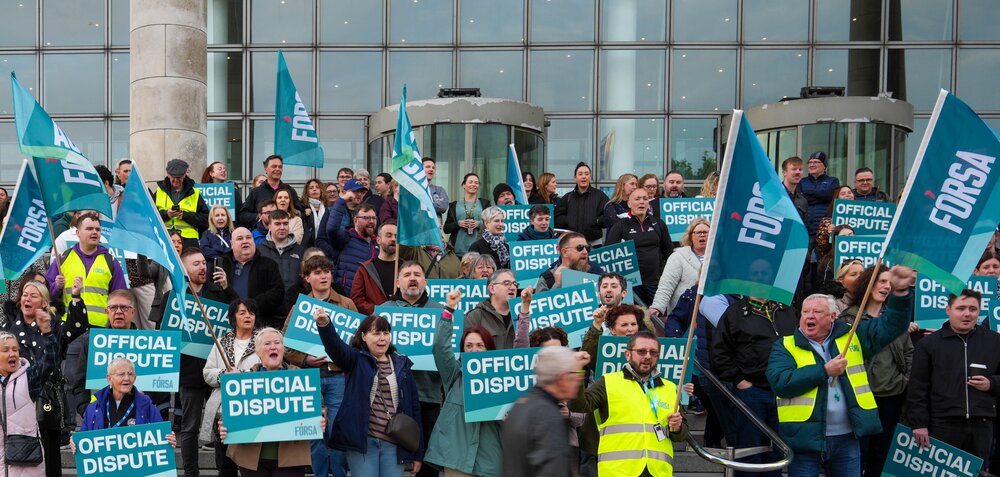
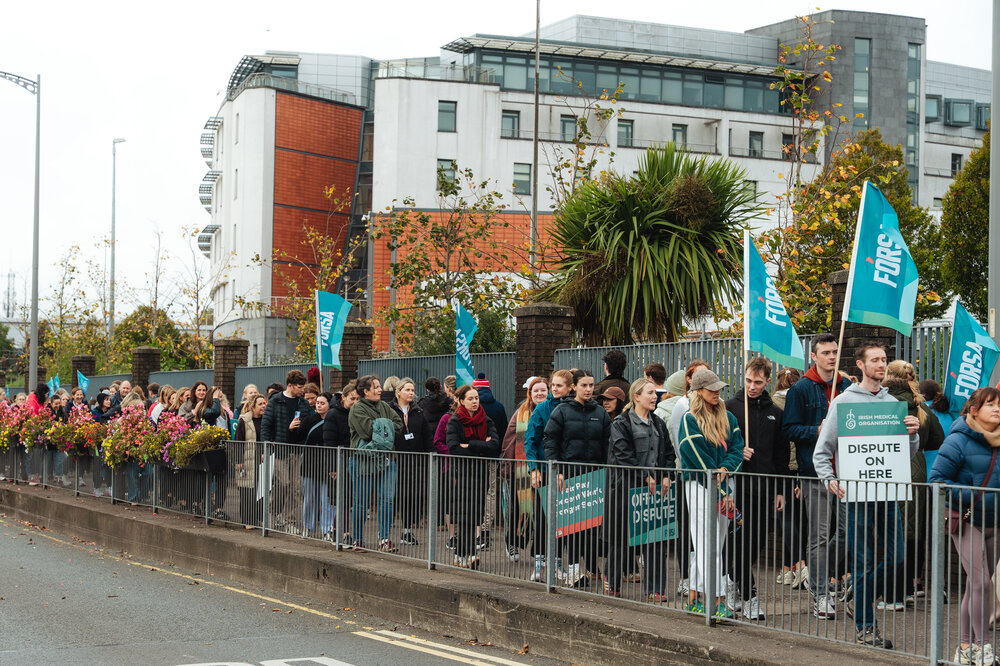
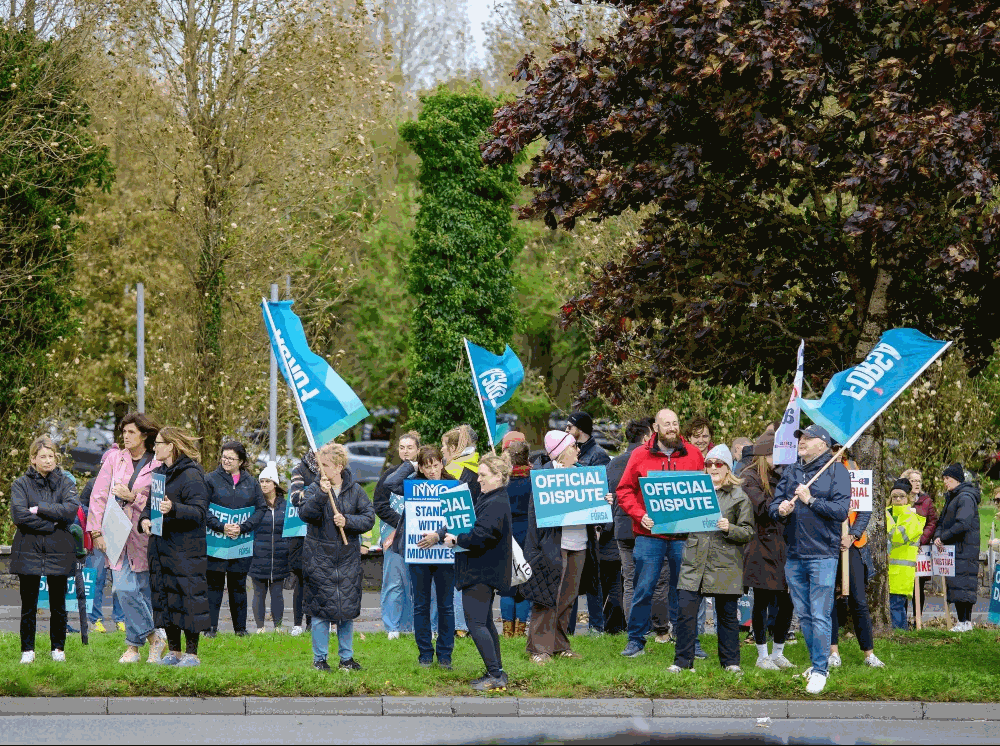
The work to rule industrial action which began on Wednesday 30th September and the national strike on Wednesday 14th October were the culmination of an organising effort that was gathering momentum for more than a year. For some members, it was their first experience of industrial action. Others stepped forward as workplace representatives, picket leaders or organisers.
Speaking about the impact this had on the negotiations Kevin said: "Leading from the front is one thing. Having the members organised and prepared to follow through is another."
"Throughout the long days and nights of negotiations we knew we had strong and united members behind us."
Preparing and maintaining the industrial action took an enormous amount of largely unseen work, and commitment from members. Organising pickets, rallies, transport and communications demanded sustained effort from activists, representatives, and staff.
Kevin continued: “On Wednesday 14th October there were over 10,000 picket lines across the country, and over 300,000 workers withdrew their labour, that fundamentally shifted the course, and outcome of, negotiations. It showed Government what was at stake, and how seriously they had to take us.”
Preparations were well advanced for further demonstrations on a second national strike day, when the proposed agreement was reached.
“Talk of eight regional rallies on the second national strike day wasn't a bluff or an exercise in brinkmanship. The plans were real, buses were booked and tens of thousands of members had filled out forms telling the union where they were going. Again and again, we were able to tell the other side that our members were committed and ready for the next stage of industrial action.”
“Simply put, without the industrial action this would be a very different document. If we look back at the first two offers from the Government side, they were way off and totally failed to acknowledge the pressures people are under. Now, the pay terms being proposed go a lot further, and the non-pay terms are also significant.”
“The Introduction of the agreement explicitly acknowledges the concerns members highlighted during the industrial action, when they spoke out movingly on picket lines. That’s very different from previous agreements and really underlines the impact workers being vocal about their experiences had on this agreement.”
Time for members to have their say
The immediate task now is the ballot, which will run for three weeks.
"Members will have their say in the ballot and we'll respect that. Our membership has grown substantially in recent months, and everyone in membership, who is covered by the draft agreement, is entitled to vote.
Members will make their own minds up about the deal. But whatever the outcome, the organising work of the past year has given us something incredible to build on."
|
Coming up: ICTU Stronger Together anti-racism conference
by Brendan Kinsella
The third annual ICTU Stronger Together Anti-Racism conference will take place on Thursday 3rd December. Trade unionists are invited to join and be part of the discussion on how to best support friends and colleagues from ethnic minority and migrant backgrounds.
Coming up next month, the Communications Workers Union will play host to this year’s ICTU Stronger Together Anti-Racism conference.
The CWU has kindly made William Norton House, North Circular Road, Dublin, available for the conference which will take place from 10AM to 4.30PM, on Thursday 3rd December.
The event is open to all union members. It will be of especial interest to ethnic minority and migrant members as well as those who wish to support them.
It is shaping up to be an action-packed agenda for the day, including the annual update on the activities of the Anti-Racist Workplaces and Trade Unions Project, as well as speakers, panels, and discussions on combatting racism as trade unionists.
There will be a lot to talk about for the Anti-Racist Workplaces and Trade Unions Project with the continuing success of their ethnic minority/migrant leadership trainings and the newly formed ICTU ethnic minority/migrant worker peer group (EMMWA) taking their first steps this year.
On top of this, there is an exciting line up of speakers. Special Rapporteur on Racism, Dr. Ebun Joseph and Dr. Lucy Michael are set to speak alongside representatives from Migrants Rights Centre Ireland, Black & Irish, AkiDwA, Friedrich-Ebert-Stiftung, and EMMWA.
Topics will range from supporting ethnic minority/migrant colleagues, dealing with the threat of racism in the workplace and society, and the importance of lifting up ethnic minority/migrant workers so they can advocate for the issues affecting them in their own voices.
Fórsa deputy general secretary and ICTU vice president, Katie Morgan said: “In the trade union movement we are proud to always lead with solidarity, so it’s of vital importance that we support our ethnic minority and migrant colleagues to have their place at the table and be able to advocate for the issues affecting them that may not affect other workers.”
The conference will take place at the Communications Workers Union headquarters, William Norton House, North Circular Road, Dublin, from 10AM to 4.30PM, Thursday 3rd December.
To register to attend you can email: antiracism@ictu.ie
Skills Academy this November
by Brendan Kinsella
Plenty on offer from the Skills Academy this November.
There is plenty on offer from the Skills Academy this November. With great courses like Conflict Resolution, Treasurers Training, and Assertiveness Training and Confidence Building later this month there is something for everyone.
Skills Academy Winter Awards Ceremony
Despite the intense preparations for the second national strike day which was due to take place this week, the Skills Academy Winter Awards Ceremony that took place Tuesday 3rd November in the NEC room at Nerney’s Court, was no less joyful for the members receiving their certificates.
It was all smiles and laughter as the graduates of the communications skills, conflict resolution skills, negotiation skills, presentation skills, public speaking, resilience building skills, and treasurers’ trainings were recognised for their efforts.
Senior vice-president and chair of the training subcommittee, Michael Crowe opened proceedings by congratulating the day’s graduates for their hard work and called on members to use the skills they have picked up “to help grow the union.”
President Martin Walsh reflected on how far Fórsa’s training has come since he was a fresh-faced rep, new to the union.
He said: “We’ve come a long way, and I believe we have more to give and more to grow.”
Director of membership training, Fiona Dunne, spoke about how important it is for unions to have workplace reps that members can rely upon.
She said, “It’s really important that our role focuses on building reps’ skills and capacity so they can take on leadership roles in the future. I can see a good few members here today who first came to us as reps and are now becoming branch officers. I think that shows that we are succeeding.”
Effective IR Practises (Level 1) General - Tuesday 17th November - Nerney’s Court, Dublin 1
Requirements: Currently serving as Workplace Rep, Branch Officer, or Executive Committee member, not a member of Civil Service Division
Local industrial relations is the bedrock on which a union’s success is built. In these smaller day-to-day interactions members learn the true value of having a union supporting them. Whether it’s resolving a workplace issue for groups or an individual, good outcomes at a local level can turn coworkers into lifelong trade unionists.
Join the Skills Academy and learn how to stay calm under pressure, how to go into every meeting prepared and how to get the best outcome for your members.
Note: there is a separate session available to Civil Service members which covers dispute resolution in the Civil Service.
Conflict Resolution - Tuesday 17th November - Nerney’s Court, Dublin 1
Requirements: Currently serving as Branch Officer, or Executive Committee member
Conflict arises even in the best working relationships. What is important is knowing how to use conflict for positive growth and not to let it damage your relationships. Join the Skills Academy to learn how to manage conflict when it happens and build better relationships with workplace representatives, members and management.
Treasurer Training - Thursday 19th November - Nerney’s Court, Dublin 1
Requirements: Currently serving as Branch Treasurer or Vice-Treasurer
The Branch Treasurer is one of the most demanding positions a member can take on. The role comes with a set of duties and responsibilities that are integral to the successful functioning of your branch.
Join the Skills Academy and learn what you need to do and all the important dates and deadlines you don’t want to miss. Being a treasurer can be very difficult to pick up on the job so save yourself the stress and hit the ground running by attending the Treasurers Training.
Assertiveness Training and Confidence Building - Tuesday 24th November - Nerney’s Court, Dublin 1
Requirements: Currently serving as Workplace Rep, completed Workplace Representatives Training Level 1
The ability to put yourself forward is invaluable to a rep, but it doesn’t come naturally to everyone.
Join Skills Academy and learn the secrets of being assertive. Build your confidence intentionally and watch yourself become the rep you know you can be.
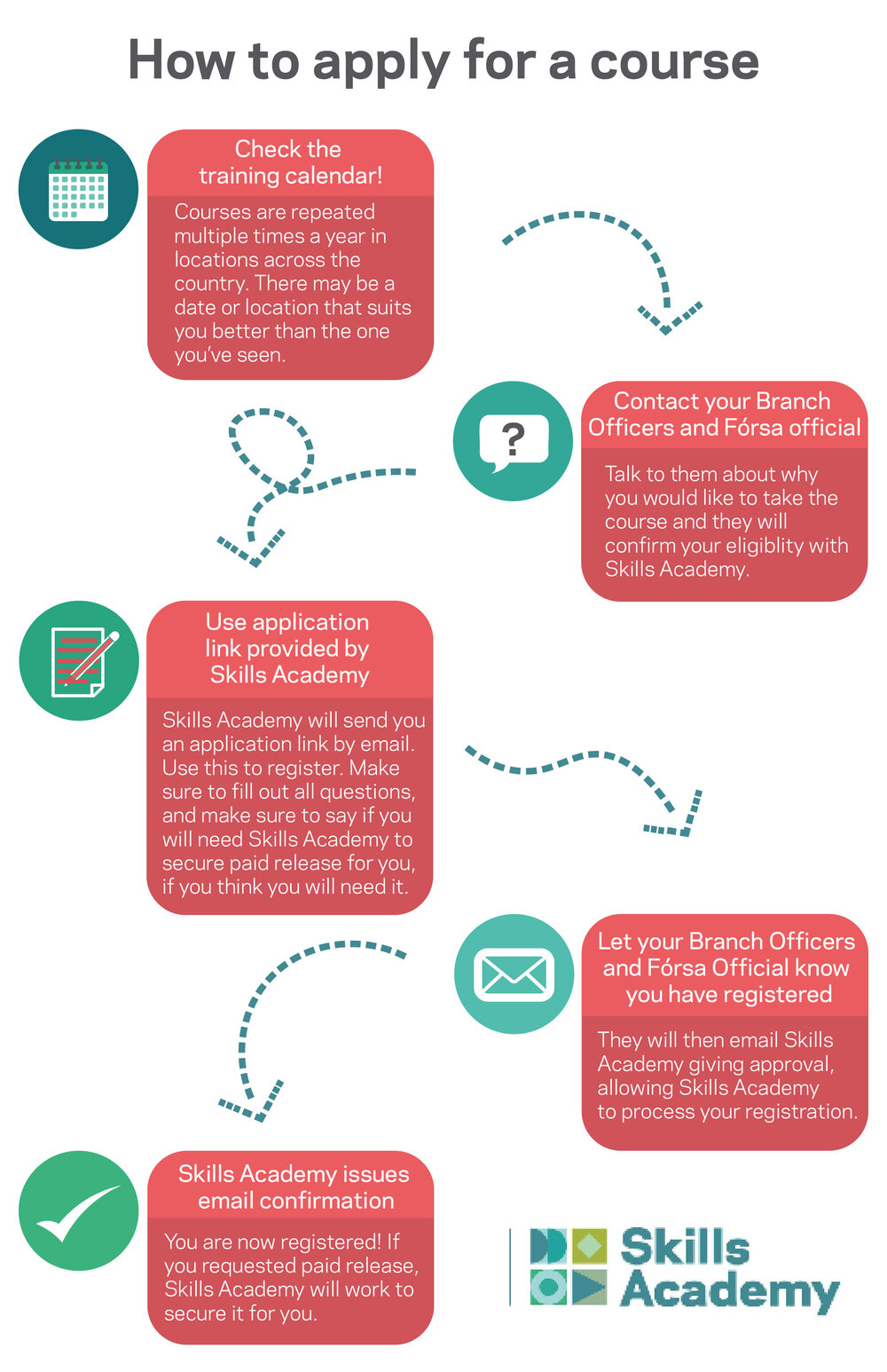
How to register
If you see a course you would like to take, simply contact your branch’s training officer or secretary and let them know you are interested. They will confirm your eligibility and contact the Skills Academy.
You will receive a registration link via email. Fill out the form in full and make sure you let the Skills Academy know if you would like them to secure paid release for you.
Join the Fórsa bloc at the National Climate Demonstration
by Brendan Kinsella
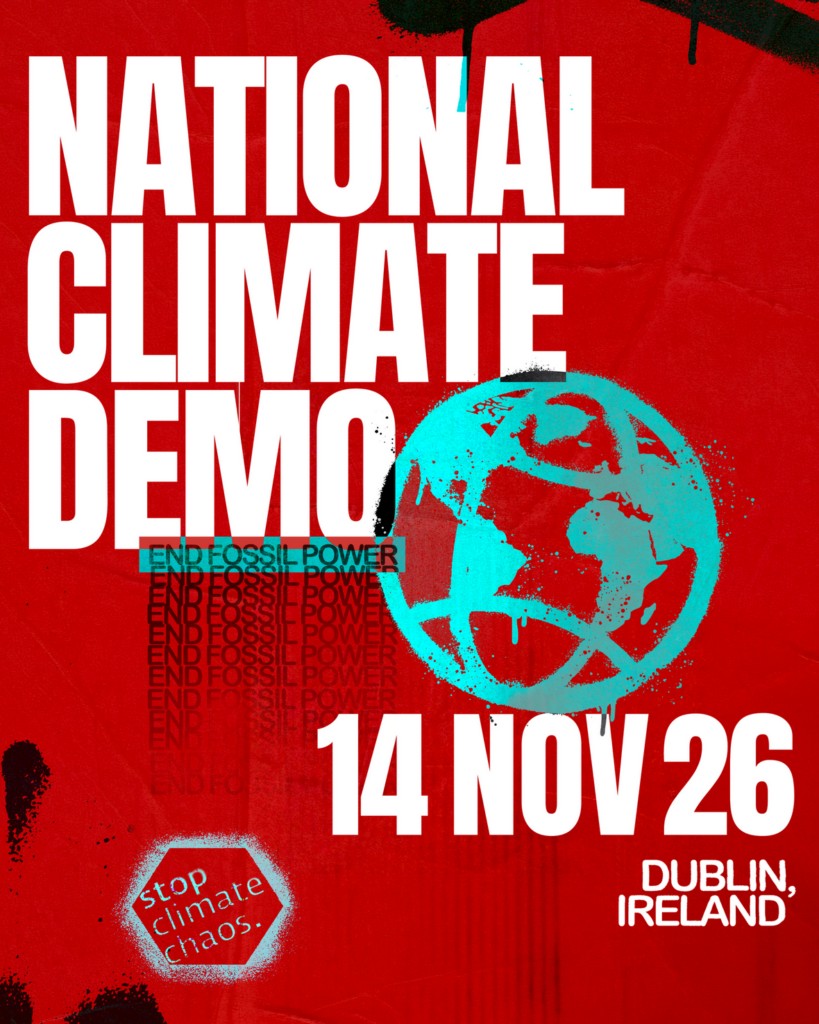
Join your fellow Fórsa members for the upcoming National Climate Demonstration Saturday 14th November.
Join your fellow Fórsa members for the upcoming National Climate Demonstration Saturday 14th November.
Fórsa members will meet in Nerney’s Court from 12.45pm, where we will collect flags before walking to the Garden of Remembrance to join the demonstration as a bloc.
If you can’t make it to Nerney’s Court, you can join the bloc directly at the Garden of Remembrance from 1pm.
The demonstration will take place alongside marches and demonstrations across the world during the COP31 global climate talks to demand positive action on climate change.
The demonstration will ask for five specific actions:
A fossil free future – phase-out fossil fuels and abandon proposals that are incompatible with this commitment. This includes a ban on Liquefied Natural Gas (LNG) and any new fossil fuel infrastructure.
A moratorium on new data centres – the enormous energy use of data centres raises the cost of energy bills for the average person, and the increased demand prevents us from moving away from fossil fuels.
A fair and just transition for everyone – rebuild our energy, transport, housing and food systems sustainably, in a way that benefits all, ensuring women and disadvantaged communities receive their fair share.
Affordable public transport for all – recognise the value of public transport in combatting climate change by reversing the increase in public transport fares and providing funding for public transport and active travel projects.
Climate leadership not climate hypocrisy – our government must protect our climate laws and demonstrate leadership as it negotiates on behalf of the EU during its presidency at COP31 in Turkey, as well as in its role as co-host of the Conference to Transition Away from Fossil Fuels process.
Fórsa director of campaigns, Kevin Donoghue said, “While members’ pay and working conditions have been our core focus in recent months, and we understand this has been busy week for the many members who have been taking industrial action, we are nonetheless hoping for a large turn out on Saturday."
“Climate change impacts us all and the impacts of climate change are already being felt by our members and communities. We hope members who can will join us on Saturday to call for a fairer more sustainable future for all.”
If you wish to attend, we would appreciate if you expressed your interest by filling out this form.
|
|
|