Photo by William Murphy [CC BY-SA 2.0], via flickr
Kevin Callinan urged members to vote today, saying: “The ballot box is one of the few places where all citizens’ voices are equal. No matter who you vote for, the right to vote is a powerful thing.”
The last leaflets have been delivered, the debates have passed, the campaign is over. Now it’s up to voters to speak their mind as they cast their votes in the general election today. Polls opened at 7am and will remain open until 10pm.
General secretary Kevin Callinan urged members to vote today, saying: “The ballot box is one of the few places where all citizens’ voices are equal. No matter who you vote for, the right to vote is a powerful thing.”
Kevin continued “Though Fórsa does not support or endorse any political party, we do encourage all members to have their say in shaping the make-up of the next Dáil Éireann.”
“In this campaign we produced a manifesto outlining our key policies and a poster for members to use when canvassers visited them and reviewed the political parties’ manifestos. You can consult those materials here.”
“When the next Government is formed, we will be the ones knocking on their door with our list of priorities, as outlined in the manifesto, to make sure they won’t be able to say they don’t know what our members want and need.”
Over 20,000 Fórsa members took part in our Amárach survey this summer and overwhelmingly stated that they would support candidates who committed to better pay and conditions for workers, the protection of flexible and remote work, and high-quality public services. The union’s manifesto reflects those priorities.
More than 680 candidates are running to be elected, across 43 constituencies. There are more women candidates in this election, with 246 running, the highest number ever. Over 3 million people are eligible to vote.
The Electoral Commission has produced several useful resources for voters, including clear explainers of PR-STV, the Irish electoral system. You can view them here.
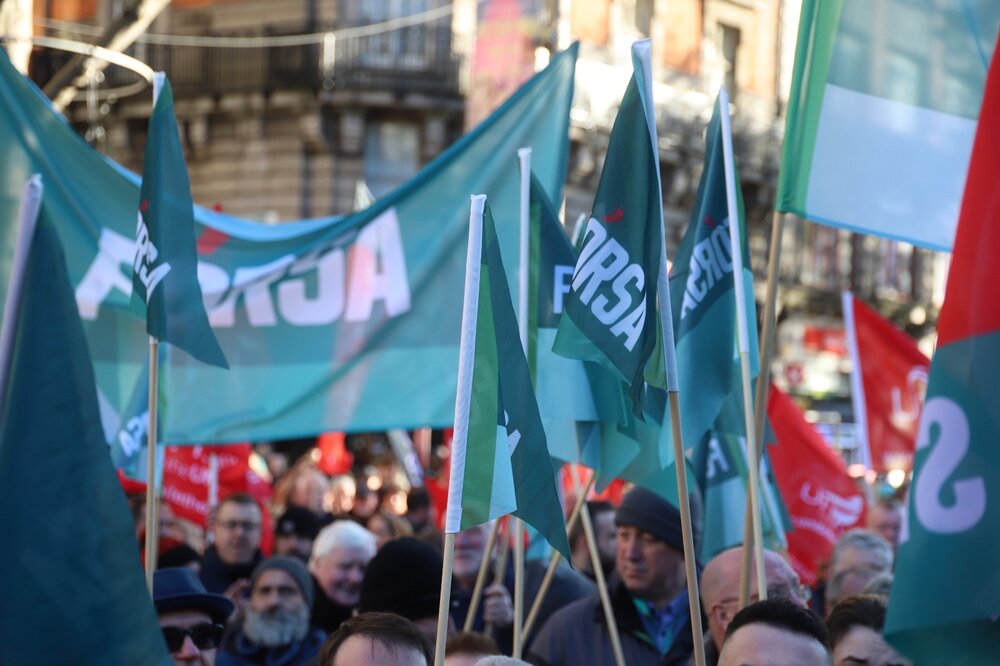
A national demonstration for Palestine will take place on Saturday 7th December at 1pm. The march will gather at the Garden of Remembrance and finish outside the Dáil on Molesworth Street.
A national demonstration for Palestine will take place on Saturday 7th December at 1pm. The march will gather at the Garden of Remembrance and finish outside the Dáil on Molesworth Street.
Fórsa will once again be present as part of the union bloc and calls on members to take part. Flags will be available to collect from the Nerney’s Court office at 12.15pm and members will gather at 12.30pm outside the Mandate Trade Union offices on Cavendish Row (across the road from the Gate Theatre).
Great importance is being placed on this protest by organisers as it is likely to take place against the backdrop of parties negotiating formation of a new government.
In the run up to the election all major parties made promises to pass the Occupied Territories Bill in the next session of the Oireachtas. Although outgoing government parties have suggested the bill may have to be altered before they will let it pass.
This protest is being seen by many as an opportunity to put Palestine and a sustainable ceasefire on the agenda for the incoming government. It is also an opportunity to push again for the passing of the Occupied Territories Bill, as well as to advocate on the issues of weapons passing through Irish airspace and the sale of ‘mixed use’ goods, which are goods that may be used for military purposes.
Fórsa Head of Campaigns, Grace Williams said “Fórsa members have consistently stood in solidarity with Palestine and the ongoing suffering of its people. Our presence at the IPSC march reiterates our demands for action to be taken by the Irish State, including the imposition of sanctions, to bring about a ceasefire in the region.”
It’s that time again! We’re now collecting for the Toy Appeal for the Temple Street Children’s Hospital.
It’s that time again! We’re now collecting for the Toy Appeal for the Temple Street Children’s Hospital. Our members’ generosity over the years has been amazing and has made such a difference to the children and teenagers in hospital at this time of year.
The appeal also includes the Crumlin, Tallaght and Connolly hospitals.
You can donate by posting a suitable unwrapped new toy to the following address: Fórsa Toy Appeal, Fórsa Trade Union, Nerney’s Court, Dublin 1. The deadline for the delivery of the gifts or vouchers is close of business on Monday 16th December.
Alternatively, if you happen to be in our Nerney’s Court office between now and then, you can drop off your donations at our collection point.
Vouchers would be very welcome, either for Smyths toys or One for All vouchers. You can also see a list of suitable toys here. We’ve also been asked by the organisers to make a special request not to forget about teenage children. Please also note that the hospital does not accept food items, homemade toys, small toys which could be a choking hazard, or used toys due to strict infection control guidelines. Please do not wrap the toys as all toys need to be checked by the hospital before being given to the patients.
Your support, as always, is hugely appreciated. If you have any questions, please feel free to contact kosullivan@forsa.ie or ghearne@forsa.ie. As always, your support is very much appreciated.
This year the International Day for People with Disabilities falls on 3rd December.
This year the International Day for People with Disabilities falls on 3rd December. To mark the occasion the Irish Congress of Trade Unions’ Disability Committee will launch a guide to supporting Neurodiverse members at work and within trade unions.
The event will take place at 12pm at the Communications Workers’ Union on the North Circular Road, Dublin.
Katie Morgan, Head of the Services and Enterprises Division and ICTU Vice President said “It is important that we as trade unions take on this kind of work. This year at biennial conference we saw the power of people with disabilities advocating for themselves. There is no one better to explain an issue than someone affected by it.”
Members who presented motions addressing disabilities saw their motions pass with great support from attending colleagues.
Fittingly, Brian Dooley, a Fórsa Youth member who identifies as an Autistic ADHDer, presented a motion calling on Fórsa’s NEC to “pursue the adoption of human resource policies in the public sector that recognise the unique nature of communication-based disabilities, i.e., specific communication policies regarding Autism, ADHD and other forms of neurodivergence.”
Upon the passing of his motion Brian reflected: “In many cases neurodivergent employees have unique skills and perspectives that are underutilised and underappreciated in professional environments."
With the release of this guide ICTU’s Disability Committee hopes to “recognise the important role that people with disabilities, including neurodiverse people, play in creating a more inclusive and sustainable world for everyone.”
The launch event is open to all interested members.
AirNav members vote overwhelmingly in favour of accepting a new pay deal which will deliver pay rises of 17.1% (compounded) over a five-year period.
Members in AirNav have voted in favour of a new pay agreement. Balloting closed on Friday 15th November. The ballot saw an impressive turn out with 87.5% voting. 78.4% voted in favour.
AHCPS members also voted to accept the pay agreement so unions can now move towards implementation of the new conditions.
The agreement will deliver pay rises of 17.1% (compounded) over a five-year period, running from 1st January 2025 to 31st December 2029.
Fórsa official David Field said “we are very happy that so many members took part in the ballot. This is a highly organised workplace and it is great to see such a large proportion of workers having their say on the deal.”
He continued “This is a good deal. It improves pay progression, protects members from inflation, and protect their incomes over the next five years.”
Under the agreement members accepted, AirNav workers will see increases of 17.1% compounded over a four year period:
1st January 2025: 2% or €800 whichever is greater
1st July 2025: 2% or €800 whichever is greater
1st January 2026: 3% or €1,200 whichever is greater
1st January 2027: 3% or €1,200 whichever is greater
1st January 2028: 3% or €1,200 whichever is greater
1st January 2029: 3% or €1,200 whichever is greater
Under the sectoral bargaining terms, the outcome will be applied to the grade/branch from the first full pay period in 2025, while a number of allowances, such as standby/call-in allowances, will attract general round pay increases to a maximum of 3% per annum over the lifetime of the agreement.
The consumer price index is forecasted to see 11% inflation over the same period. If inflation is in excess of the forecasted 11% there is a review mechanism built into the agreement to help assure the value of the pay increases is not lost to workers.
The agreement will also see workers reach their maximum incremental point quicker with two incremental points removed from most pay scales. The following number of incremental points were removed: four for engineers, six for aviation officers, and one for ATM specialists, watch managers and station managers.
The maximum increment will also be worth more with a once off payment of €900 to be applied to all pay scales in September 2025.
Fórsa met with the Department of Transport to set out key positions on the RSA’s future, including assurances that RSA staff, and future staff, retain their public servant status.
Fórsa met with the Department of Transport this week following the government’s recent announcement that it will split up the Road Safety Authority (RSA).
Understandably, many members have been in contact with the union expressing concern about what the reform of the organisation could mean for them.
During the meeting, Fórsa set out our key positions on the RSA’s future, including assurances that RSA staff, and future staff, retain their public servant status.
As a key stakeholder in the future of the RSA, Fórsa also formally requested that the union is included as part of the Departmental Group that will be established to oversee the future changes.
The Department representatives stated that no decisions had been made about any of the matters raised by Fórsa, and that the Departmental Group would be the forum that would consider such matters.
As Fórsa prepares to lodge its first local bargaining claim members are being asked to answer a survey and guide the union to making the most effective claims for members.
A survey has been issued to members asking for their views on what will be the union’s first local bargaining claim. View the survey here.
Local bargaining is a key feature of the Public Service Agreement 2024-2026. While it is called ‘local’ it is a new process of national bargaining for collective issues specific to a grade, group or category. Claims amounting to 3% can be made, however there will be no automatic payment without a claim being submitted.
In October the union’s National Executive Committee (NEC) decided that the first claim to be formulated and served by Fórsa under this clause of the national pay agreement would concern members who are clerical officers/ grade III and equivalent grades.
Fórsa general secretary Kevin Callinan said: “We want to submit a local bargaining claim on behalf of clerical officers and equivalent grades before the end of this year. This is a real opportunity for members to be fully involved in the claim. We want you to tell us what your priorities are when it comes to pay and related matters by filling in this survey.”
The survey asks members if they would prefer pay to improve at the maximum point of their relevant pay scale, or if they would prefer to see faster progression through the scale by the removal of points at various intervals on the scale. A combination of both these approaches is available as an option for members to select.
The survey was developed with input from the Equivalent Grades Committee. Members who are clerical officers, grade III or equivalent grades, across all divisions, should have received the survey on Tuesday 26th November.
In the Services & Enterprises Division members concerned work as Admin Assistants, Clerical Officers, in Grade II roles, in Grade III roles, as Library Assistants, Science & Arts Attendants & Visitor Security Officers.
Head of the Services & Enterprises Division Katie Morgan said: “We urge members to take part in this survey so that we know what matters most to you. Local bargaining could have a big impact on pay and conditions and by taking part in this survey you can really shape the claim we will submit.”
If you think this claim is relevant to you and you have further questions you can email localbargaining@forsa.ie
The survey closes at 12 noon on Monday 9th December 2024.
Fórsa members joined hundreds of trade unionists and their allies at the Rally for Unity and Hope in Dublin on Saturday, 23rd November. The event, organized by the Irish Congress of Trade Unions (ICTU), took place at the Larkin Statue on O’Connell Street.
Fórsa members joined hundreds of trade unionists and their allies at the Rally for Unity and Hope in Dublin on Saturday, 23rd November.
The event, organized by the Irish Congress of Trade Unions (ICTU), took place at the Larkin Statue on O’Connell Street.
Its goal was to counter division and hate in Irish society ahead of the general election. Katie Morgan, national secretary, delivered a speech, marking the one-year anniversary of the riots that left Dublin scarred by flames and littered with broken glass.
She highlighted the invaluable work of the city’s workers, who are members of Fórsa’s Municipal Employees’ Division, in cleaning up after the chaos and celebrated the contributions of migrants to Dublin.
Edel Scally, a Fórsa member working in libraries, gave a powerful and defiant speech. She spoke with pride about the essential role libraries play as sanctuaries for people from all walks of life.
Fórsa members working libraries have faced harassment, threats, and even forced closures due to protests, including incidents of book burnings and personal attacks on staff, over the past 18 months.
Speaking from her own experience, and that of her colleagues, Edel said: “As a librarian, I know the words of abuse and intimidation that have been hurled at library staff across the country. But it will not work, it will not stop us from doing our jobs. As librarians our message is ’Hands Off Our Libraries’!
Edel ended with a message of solidarity to the assembled crowd, saying: “Today, as we gather, we declare that unity is our strength. We declare that we will never tolerate hate — whether it’s against the LGBTQ+ community, against workers, or against anyone who is fighting for their rights. We will not stand idly by while hate divides us."
LGBTQIA+ members and allies gathered In Fórsa's Dublin office to reflect upon the union movement's history of supporting the LGBTQIA+ community's rights and embark upon a new chapter with the establishment of Fórsa's LGBTQIA+ Network.
Fórsa’s newly established LGBTQIA+ network was formally launched this week at the union’s equality seminar which took place on Wednesday.
The network, which was born from a motion brought to the union’s biennial conference in May by Fórsa activist Rob Partridge, will work to support all members and staff who identify as a member of the LGBTQIA+ community.
Kieran Rose presenting his book Trade Unions and progress for LGBT people.
The event, “Organising for equality: Then, now and in the future” also marked the release of a new memoir, “Trade unions and Progress, a personal history” by Kieran Rose, a stalwart of the movement. This book provides a rich and deep history of the role of the trade union movement in achieving progress for the LGBTQIA+ community and serves as a reminder of what can be achieved through the power of the collective.
The trade union movement has long been a shining light of support for LGBTQI+ people and has been instrumental in battling discrimination and fighting for equality for the LGBTQI+ community.
Fórsa Official Amy Moran and Rob Partidge
Speaking at the seminar Rob paid tribute the work of Kieran and said he was “standing on the shoulders of giants”. Over 40 years ago, Kieran put forward a motion seeking the decriminalisation of homosexual acts on the basis of equality, calling for equality legislation. This was the first motion if its kind, thus sparking hard fought trade union campaigns, spanning decades, which further improved the rights of LGBTQIA+ people.
Over 40 years later, Rob would receive an outpouring of support for his motion instructing the incoming National Executive Committee to establish a LGBTQI+ network to support all members and staff who identify as a member of the LGBTQIA+ community.
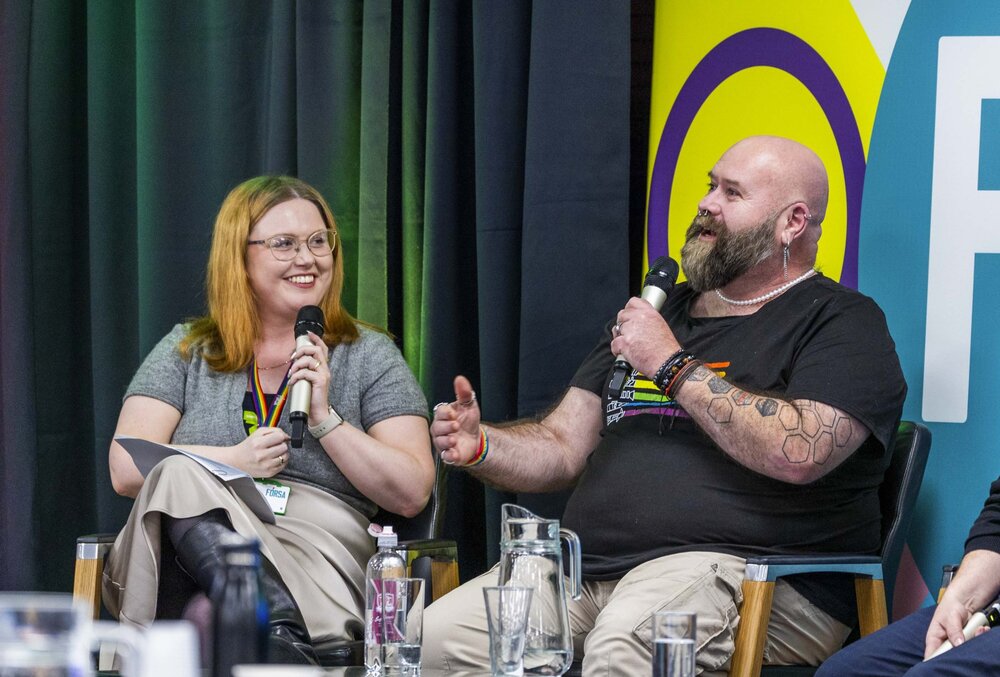
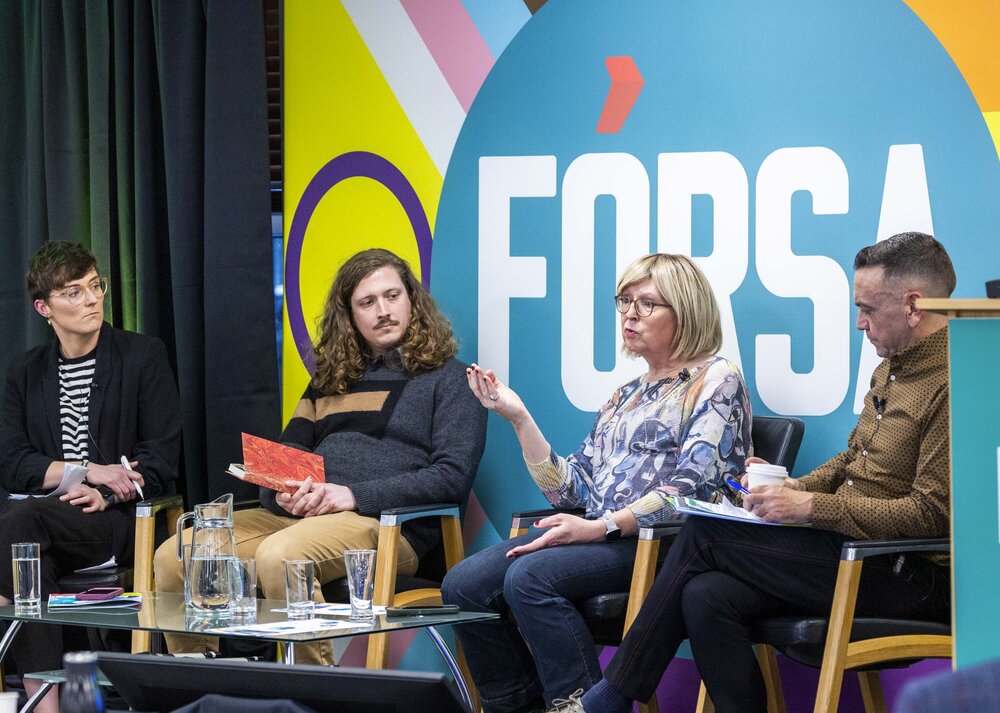
Panel discussion: Fórsa Official Aisling Cusack, David Rinehart, Philippa Ryder, David Carroll
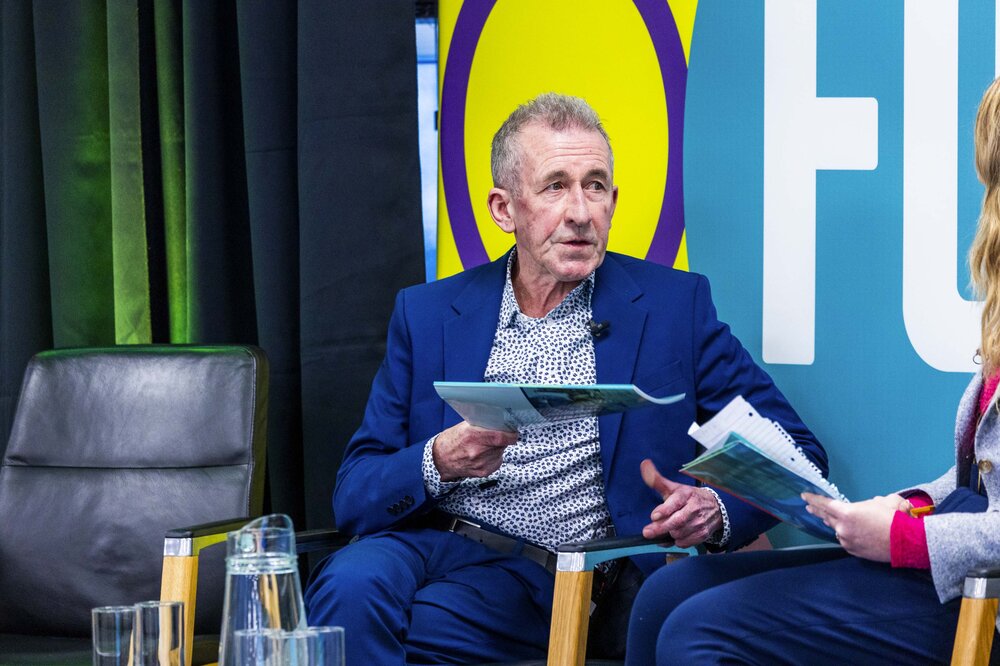
Delegates to the seminar also heard from activist and chair of Dublin Pride Philippa Ryder, ICTU’s David Carroll, and David Carlos Casanova Rinehart of the newly established Queer Library Alliance discuss their experiences of the evolving landscape of LGBTQIA+ lives, and in particular, the importance of combatting hate speech.
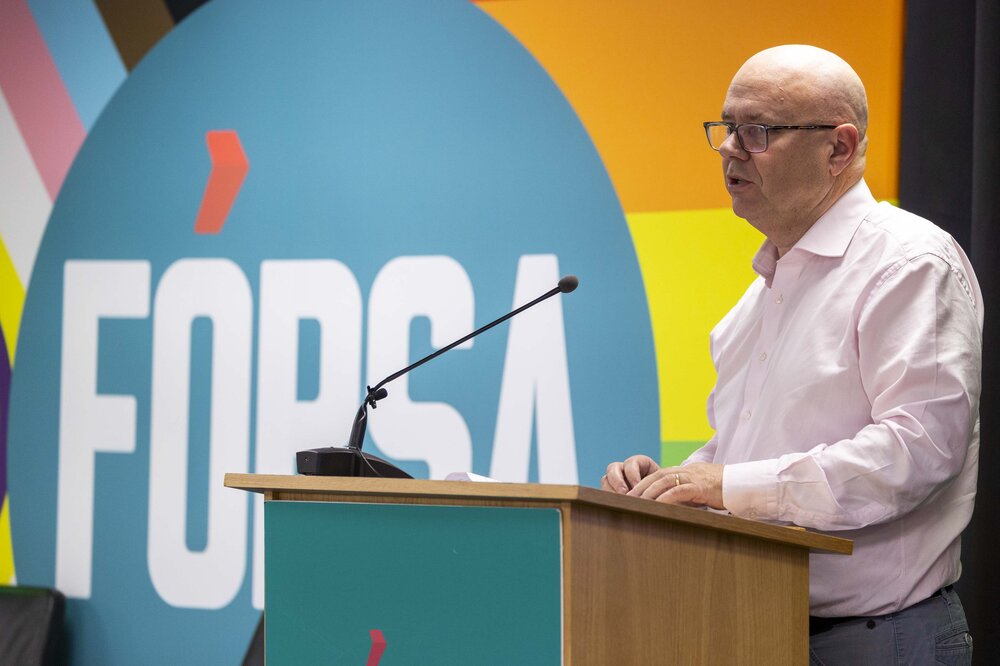
Speaking at the launch Fórsa general secretary Kevin Callinan said the work of the network was “only getting started”.
“We know that when people feel they belong, they thrive. As a union, we thrive when you thrive. You belong here, and this network is a crucial part of building that sense of belonging. And ensuring that we are a union where diversity is our strength, not just in principle but in practice,
“The evidence collected from our recent member survey will set our agenda. We will use our collective power as workers to fight for better supports and changes in the workplace and beyond,” he said.
General Secretary Kevin Callinan addresses event attendees.
For more information on Fórsa’s LGBTQIA+ network, or to get involved, contact rmckane@forsa.ie
The 12th Annual NERI Dónal Nevin Lecture fast approaches. This year the guest speaker is Professor Mary Murphy, Department of Sociology, Maynooth University, speaking on 'A new all island social settlement: An eco-social future of care and equality'.
The 12th Annual NERI Dónal Nevin Lecture will take place on Thursday 5 December 2024.
This year the guest speaker is Professor Mary Murphy, Department of Sociology, Maynooth University. The topic of the lecture will be 'A new all island social settlement; An eco-social future of care and equality'. Dr. Larry O’Connell, Director of the National Economic and Social Council (NESC) will be the respondent.
This in-person lecture will take place in the Royal Irish Academy, 19 Dawson Street, Dublin 2, D02 HH58. Registration begins at 17:30, with the lecture commencing at 18.00. This will be followed by a drink’s reception.
The NERI Dónal Nevin Lecture will be followed by the launch of a special issue of the Studies quarterly magazine. Mr. Dermot Roantree, editor of Studies will introduce this issue of the Studies magazine. He will then introduce Dr. Larry O'Connell, NESC and Dr. O'Connell will launch the special issue of the Studies magazine. The launch will take place at the drink’s reception from 20:00 - 20:15.
Find full details here - You can contact our colleague Louisa O’Brien on 01-889 7722 or by email at louisa.obrien@nerinstitute.net if you wish to register to attend the Lecture and/or the Studies quarterly magazine launch.
James Redmond talks to Fórsa Skills Academy head Fiona Dunne about the key role trade union education plays in transforming people’s lives and in reflecting the grassroots values of organised labour.
In this interview James Redmond talks to Fórsa Skills Academy head Fiona Dunne about the key role trade union education plays in transforming people’s lives and in reflecting the grassroots values of organised labour.
For Fiona Dunne, who heads up the Fórsa Skills Academy, education is about building a pathway to empowerment for members of the union.
With a career deeply rooted in the trade union movement and experience at the Irish Congress of Trade Unions (ICTU), Fiona joined Fórsa’s Skills Academy in September 2022. One of her initial challenges was addressing some reluctance among seasoned union members to identify their need for further training.
She explained: “It was interesting when I started here two years ago; there were a lot of people who told me that they were fully trained and didn’t require any further training.
“It was a bit of a challenge. But creating a developmental and supportive pathway ensures we meet the needs of all our workplace representatives where they are at.”
To overcome this, Fiona introduced confidence-building as a central component at every training level, starting with the Level One course.
“A lot of the time, when I open the Level One training, I say to activists and reps, you know a lot of this stuff, it’s a lot of common sense. It’s just putting it in a package.”
Fiona envisions a structured pathway that guides members from initial involvement to senior roles within the union. Beginning with a Fórsa induction, this pathway continues through Level One and Level Two Workplace Representatives’ Training that cover skills in communication, organising, engaging, and empowering members.
“I’m developing a strong pathway for activists and reps to support them on their development journey,” Fiona said.
Looking ahead, she’s also developing a Level Three course for next year, which will explore employment law and industrial relations, among other potential topics. The Skills Academy further supports branch officers with specialised training in time management, communication skills, public speaking, and negotiation skills essential to leadership roles.
The training structure emphasises workplace representatives at the Academy’s core, with additional courses available for branch officers and those advancing into more senior activist positions.
The approach underscores grassroots engagement and union democracy, both critical to effective union representation. “There is a lot more conversation about the benefit of the union,” she noted, observing a shift away from reliance on headquarters and a return to locally based trade unionism. Workplace democracy means that taking action and finding solutions should be as close to work as possible,” she added, explaining that solving issues locally strengthens both responsiveness and union cohesion.
In Level One training, reps learn fundamental union principles, from working with integrity and in solidarity to grievance processes and disciplinary procedures, reinforcing practical knowledge and the union’s collective values.
Fiona recalls that her experience during the pandemic is what inspired the union’s popular live ‘Lunch and Learn’ sessions, which take place on the last Friday of each month and labour tackle topics from digital activism to mental health.
These online sessions keep union members connected and for many can be their first engagement with union activities outside formal meetings. One of the most popular sessions, on CV writing by Fórsa’s HR manager Rebecca Woolf, was huge. “We had 480 registrations for that, which we've never surpassed,” she said.
Although Fiona is the most visible face of the Skills Academy, she is quick to credit her teammates. “I’m ably supported by Judith in Cork, who is the administrator. She’s ‘front of house’ is the way I describe it”.
Judith’s engagement with applicants and logistics allows Fiona to focus on programme development and strategy. Roisin Nolan, another essential team member, works “as our technical back-up,” handling technical tasks such as data management and record-keeping. “She keeps records of attendance, and she does all the techie work for online courses,” Fiona added.
When asked if the Skills Academy continues the long tradition of self-education in the workers’ movement, Fiona highlighted that union-based education has historically offered working people valuable opportunities. Unlike more formal education models, union training doesn’t place too much emphasis on accreditation but rests on a philosophical foundation rooted in collective learning and practical application.
“The principles include things like, you know, it's group oriented. So, it's about working together. It’s about the collective and sharing knowledge,” she explained, underscoring how the lived experiences of workers and reps are valuable assets in union roles.
Through conversations with Fiona and positive feedback from participants, it’s clear that the Skills Academy’s work is more than just training up a roster of robotic union representatives. Instead, the Academy’s education fosters personal and professional growth, as well as community and political engagement. Check out the Skills Academy upcoming courses here.
The Schools and Health Foundation (SHF) has built schools in Sierra Leone and Malawi thanks to donations it received through Fórsa’s Developing World Fund.
The Schools and Health Foundation, an Irish foundation committed to improving education and health in Africa, has benefitted greatly from the support of Fórsa, with all funds raised going directly to projects in remote communities. A small charity making a big difference, the organisation commits 100% of its donations to projects.
In 2021 a grant of €25,000 from Fórsa contributed to the building of a school, teacher housing, and the provision of clean water, in Rothana, a rural community in Sierra Leone.
Separately, SHF had funded a school block in the Rogballan Madina community, also in Sierra Leone, back in 2020, but as school enrolment doubled over the last four years, an extra block was needed. As an emergency measure a temporary block was built from bamboo, which was totally unsuitable for tropical rain.. Thanks to the generosity of members, the union’s Developing World Fund contributed €20,000 to a new school block and in May of 2021 the new block was completed.
Last year, a new school block was opened in Tukuyu, a small poor community in northern Malawi at a total cost was €32,000, and €20,000 of this was granted by Fórsa.
At the opening ceremony the head teacher thanked Fórsa and SHF, and said “this gift will go a long way, generation after generation.”
One of her pupils said: “Receiving this classroom block means much more to me than just a simple object. It represents new possibilities, growth, and endless opportunities for learning. It symbolizes a place where imagination can soar, where friendship can be built and where knowledge can be gained.”
More recently, the Kalama community in Malawi benefited from a Fórsa grant, where a contribution of €25,000 enabled SHF build a school block.
International solidarity is a cornerstone of the union, and in 2022 and 2023 Fórsa donated over €1.3 million to global solidarity projects through its long-established Developing World Fund. Funded by 3% of every member’s union subscription, the fund gives over €600,000 a year to projects around the world, allowing the union to make ongoing contributions to human rights and development, as well as responding to humanitarian emergencies.
Fórsa’s youth network are holding their first event since their new committee was elected, on Wednesday 4th December, and they’re encouraging young workers to get involved.
Fórsa’s youth network are holding their first event since their new committee was elected, on Wednesday 4th December, and they’re encouraging young workers to get involved.
This online event will take place from 6.30pm to 8.30pm and will see committee members briefly introduce themselves and outline the programme of work for the year ahead.
Chair of the network Hugh McInerney said they want to hear from young workers so that the committee can hit the ground running in 2025.
“We want to hear from branches as to what events you would like to see us hold, as well as where they should be. We will also be looking for suggestions on which campaigns we should prioritise for the year and how best to support Fórsa and our other partners through campaigns, leafleting and other direct action,” he said.
The event open to all, and Fórsa members and non-members are equally welcome. Those who are interested in attending should register their interest here.
“We would love to hear from as many people as possible on what you would like your union’s youth wing to focus on for the year ahead. If you have any questions, please don’t hesitate to get in touch and we’ll talk to you next Wednesday,” said Hugh.




![Photo by William Murphy [CC BY-SA 2.0], via flickr](/v3files/shard1/63805/7c/8babc1af9477e5ac4359f8.jpg "Photo by William Murphy [CC BY-SA 2.0], via flickr")